

.svg)
- AI receptionists are quickly becoming essential for healthcare and dental practices looking to improve patient access, reduce staff burden, and recover missed revenue.
- This blog breaks down the 10 most important KPIs organizations should track to measure the real-world impact of an AI receptionist.
- Learn how metrics like call capture rate, booking success, first-contact resolution, and after-hours performance reveal operational efficiency and patient engagement improvements.
- The article also explores how AI reduces administrative workload, lowers costs per call, and frees front-desk teams to focus on higher-value patient interactions.
- Most importantly, it shows how tracking the right performance metrics helps healthcare leaders prove ROI, improve patient satisfaction, and build more sustainable front-office operations.
AI receptionists are no longer experimental in healthcare. They have moved from being a promising idea to becoming an essential part of daily operations for hospitals, Federally Qualified Health Centers, specialty practices, and Dental Support Organizations. These systems are already proving their value by answering every patient call, easing the burden on front desk teams, and helping practices recover revenue that would otherwise be lost to missed appointments or unanswered calls.
However, simply having an AI receptionist in place is not enough. To know whether it is truly working for your organization, you need to track performance with clear, measurable outcomes. The right Key Performance Indicators, or KPIs, reveal whether your AI is delivering on its promise of better patient access, stronger staff support, and meaningful return on investment.
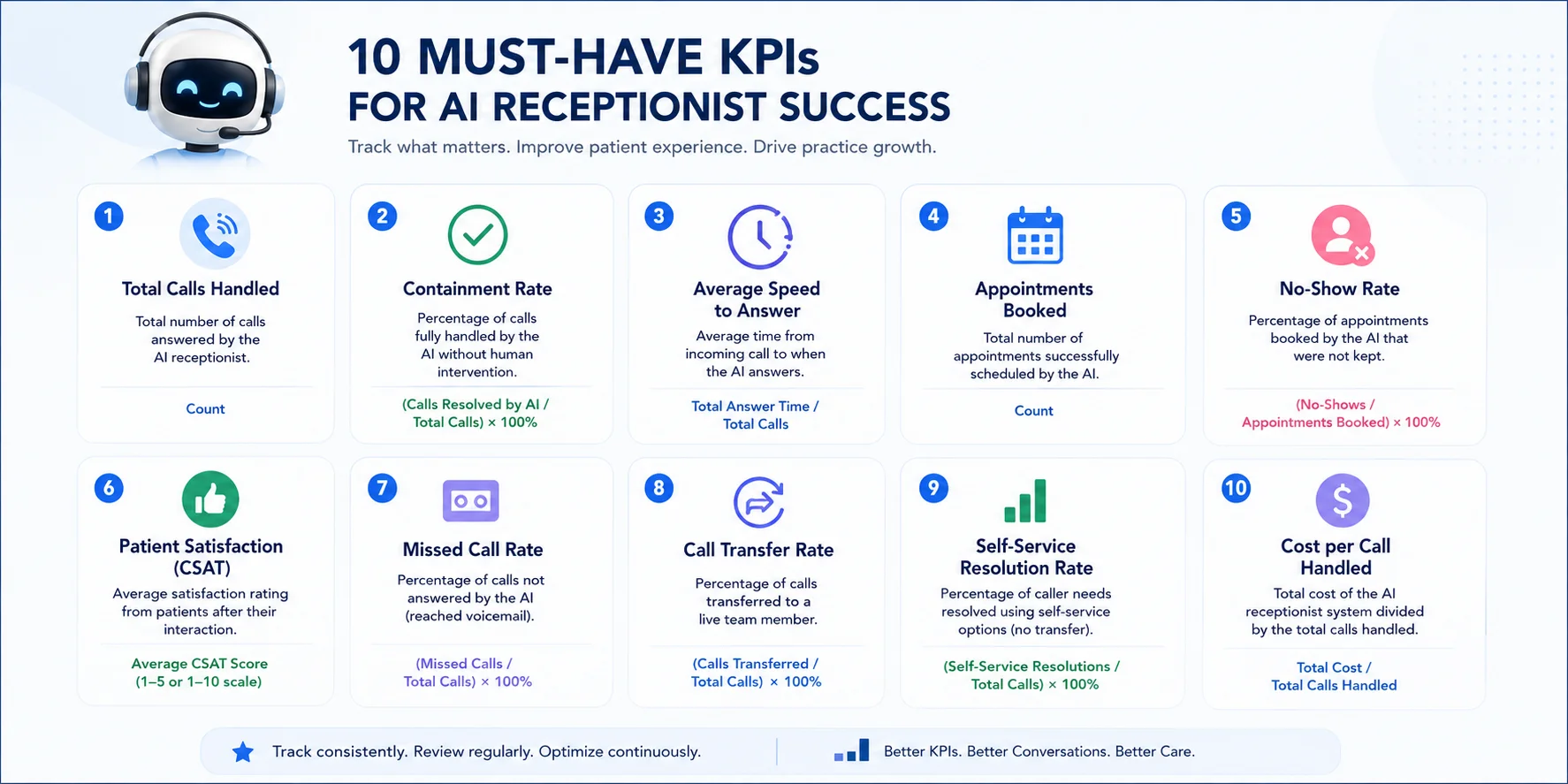
Here are the 10 most important KPIs every healthcare and dental practice should monitor to measure the success of an AI receptionist.
1. Call Capture Rate
What it Measures:
The percentage of patient calls answered and managed by the AI without staff intervention.
Why it Matters:
In healthcare and dental settings, missed calls directly translate into missed appointments, delayed care, and lost revenue. Patients rarely leave voicemails or call back, so even a small percentage of unanswered calls can have a major impact on access and continuity of care.
Example:
Healthcare groups using Confido Health report zero unattended voicemails after implementation, ensuring that every call is captured and either resolved or routed correctly.
Key Indicators:
- Inbound calls answered by AI
- Number of calls routed correctly to staff when needed
- Unattended or dropped calls
A high call capture rate confirms that the AI is delivering its core value: no patient is left waiting.
2. Speed to Answer
What it Measures:
The time taken for the AI receptionist to greet and engage with the caller.
Benchmark:
Best-in-class performance is under one second.
Why it Matters:
Patients expect quick responses when they call a clinic or dental office. Long hold times and phone menus create frustration and increase the chance of dropped calls. An AI receptionist can respond instantly, ensuring no caller is left waiting.
Impact:
Fast response times directly improve patient satisfaction and trust. They also reduce abandonment rates, meaning more patients book appointments or receive timely answers to their questions.
Key Indicators:
- Average response time per call
- Abandonment or hang-up rates
- Transfer speed for urgent calls
Instant response is one of the clearest advantages AI offers over traditional front desk workflows.
3. First-Contact Resolution (FCR)
What it Measures:
The percentage of patient inquiries that are fully resolved during the first interaction without requiring a follow-up or transfer to staff.
Healthcare Examples:
- Scheduling or rescheduling appointments
- Prescription refill requests
- Insurance eligibility verification
- Answering preparation or follow-up instructions
Why it Matters:
When patients get what they need in a single call, it reduces repeat contacts, shortens wait times, and ensures continuity of care. For staff, it removes repetitive back-and-forth tasks that often cause bottlenecks.
Impact:
High FCR rates mean patients leave the call satisfied and informed, while the practice reduces administrative load and improves overall efficiency.
Key Indicators:
- First-contact resolution rate (%)
- Call transfer rate to staff
- Repeat call volume for the same issue
Strong FCR performance shows that the AI receptionist is not just answering calls but actually completing meaningful tasks that drive care and revenue forward.
4. Booking Success Rate
What it Measures:
The percentage of patient scheduling or rescheduling requests that are completed successfully by the AI.
Why it Matters:
In healthcare and dental practices, appointments are the core of revenue. Every missed or incomplete booking is a lost opportunity for patient care and production revenue. AI ensures that patients can book at any time, even after hours, and that confirmations and reminders are managed automatically.
Impact:
AI-driven booking not only captures more appointments but also reduces cancellations and no-shows by up to 50 percent, improving both access to care and financial outcomes.
Key Indicators:
- Successful appointment scheduling rate
- Cancellation and no-show reduction
- After-hours bookings captured
High booking success rates confirm that the AI receptionist is directly contributing to practice growth and patient continuity.
5. Patient Satisfaction (CSAT)
What it Measures:
The level of patient satisfaction with their interaction, often gathered through short post-call surveys or feedback scores.
Why it Matters:
Even if calls are answered quickly and tasks are completed, the experience must still feel natural, empathetic, and patient-friendly. In healthcare, trust is as important as efficiency.
Impact:
Confido Health customers consistently report patient satisfaction scores above 97 percent, with many patients noting they did not realize they were speaking with AI. This shows that when designed well, AI receptionists can match or exceed the quality of human interactions while delivering faster and more reliable service.
Key Indicators:
- CSAT scores after calls
- Patient comments and feedback trends
- Comparison of AI vs staff-handled interactions
High CSAT demonstrates that the AI receptionist is not only performing tasks but also supporting a positive patient experience.
6. Escalation Rate to Human Staff
What it Measures:
The percentage of calls the AI receptionist transfers to a staff member for completion.
Why it Matters:
A well-trained AI should handle the majority of routine tasks on its own. Too many escalations defeat the purpose by keeping staff tied up with repetitive work. At the same time, some handoffs are necessary for complex or sensitive cases.
Impact:
Best-in-class systems resolve about 95 percent of calls without staff intervention. This frees front desk teams to focus on patient care and in-person interactions while ensuring edge cases are smoothly routed to the right person.
Key Indicators:
- Escalation rate (%)
- Types of calls most often escalated
- Average staff time spent on escalated calls
Low escalation rates confirm that the AI is reliable, efficient, and reducing staff workload in a meaningful way.
7. Cost per Call
What it Measures:
The average cost of handling each patient call through the AI, compared to staff-managed calls.
Why it Matters:
Front desk staff in healthcare and dental practices cost an average of $52,000 per year, including benefits. Each call they handle adds to that overhead. AI receptionists deliver the same or better service at a fraction of the cost, while scaling effortlessly with volume.
Impact:
Practices using AI have reported savings of up to 80 percent compared to human-staffed calls. Lower costs per call mean more efficient operations and higher margins without compromising patient care.
Key Indicators:
- Average cost per call handled
- Total savings compared to human reception
- Return on investment over time
Tracking this KPI makes the financial value of an AI receptionist clear to both administrators and decision makers.
8. After-Hours Performance
What it Measures:
The percentage of calls and booking requests captured outside normal business hours.
Why it Matters:
A large share of patients call in the evenings or weekends when offices are closed. Without coverage, those calls often go unanswered, leading to missed appointments and lost revenue.
Impact:
AI receptionists provide round-the-clock availability, ensuring no call is missed. This is especially valuable in dental and specialty care, where patients often schedule after hours. Practices that capture these calls see higher booking rates and improved patient satisfaction.
Key Indicators:
- After-hours call volume captured
- After-hours bookings completed
- Revenue generated outside office hours
Strong after-hours performance ensures practices remain accessible to patients at all times, without adding staff costs.
9. Revenue Recovered per Location
What it Measures:
The additional revenue is generated by capturing calls, appointments, and follow-ups that would otherwise be missed.
Why it Matters:
Every unanswered call or unbooked appointment directly affects the bottom line. In healthcare and dental practices, this lost revenue can quickly add up across multiple providers or locations.
Impact:
Practices using AI receptionists with Confido Health have added more than $40,000 in monthly revenue per location by reducing no-shows, recovering missed appointments, and ensuring patients are scheduled promptly.
Key Indicators:
- Monthly revenue increase per location
- Reduction in missed appointments
- Value of recovered bookings and follow-ups
This KPI connects AI performance directly to financial outcomes, making it one of the most persuasive measures for leadership teams.
10. Staff Time Saved
What it Measures:
The number of hours of administrative work is eliminated by the AI receptionist.
Why it Matters:
Front desk teams in healthcare and dental practices spend much of their day on repetitive tasks like answering calls, rescheduling appointments, and handling reminders. This leaves less time for patient engagement and creates stress that contributes to burnout.
Impact:
AI receptionists reduce call volume handled by staff by as much as 70 percent. Clinics working with Confido Health save the equivalent of two or more full-time employees per provider. This allows teams to focus on higher-value activities, such as in-person care and patient coordination.
Key Indicators:
- Hours of call handling reduced
- Staff full-time equivalents (FTEs) saved
- Time reallocated to patient-facing tasks
Staff time saved is often the most tangible benefit for frontline teams, proving that AI does not replace people but instead frees them to focus on care.
Quick KPI Comparison Table
Final Takeaway
Tracking the right KPIs ensures your AI receptionist isn’t just a “tech upgrade,” but a measurable driver of patient access, staff relief, and financial ROI.
For US healthcare and dental practices, these 10 metrics reveal whether your AI is delivering on its promise: better care access, happier patients, and sustainable operations in the face of staffing shortages.
How Confido Health Can Help You
AI receptionist, Confido Health, is built specifically for healthcare and dental organizations. It goes beyond answering calls to handle the full range of patient-facing administrative work:
- Answer Every Call: No missed calls, no unattended voicemails, ensuring patients always reach your practice.
- Smart Scheduling: Manages appointment booking, rescheduling, and recalls with precision.
- Patient Follow-ups: Automates reminders, care instructions, and post-visit outreach to reduce no-shows.
- After-Hours Coverage: Available 24/7 so your clinic never loses opportunities when the office is closed.
- Insurance and Eligibility Support: Verifies coverage and gathers benefits information to streamline visits.
- Seamless Integration: Works directly within your EHR and practice management systems for smooth workflows.
- Proven ROI: Reduces staff call burden by up to 70 percent, increases monthly revenue by $40K or more per location, and achieves 97 percent patient satisfaction.
With Confido Health, your staff can focus on what matters most, which is delivering care, while the AI takes care of the routine and repetitive tasks that slow teams down.
Ready to See the Impact?
Confido Health is already helping healthcare and dental practices across the country capture every call, recover missed revenue, and reduce staff burnout.
.webp)
