

.svg)
- According to ADA Health Policy Institute data, about 62% of dentists named staffing shortages as their single biggest challenge in 2025. Among practices actively recruiting dental hygienists, 91% called it very or extremely challenging.
- The dental front desk is not just a phone answering station. It manages scheduling, insurance verification, recall campaigns, payment follow-up, and patient communication simultaneously, often with one or two people doing all of it.
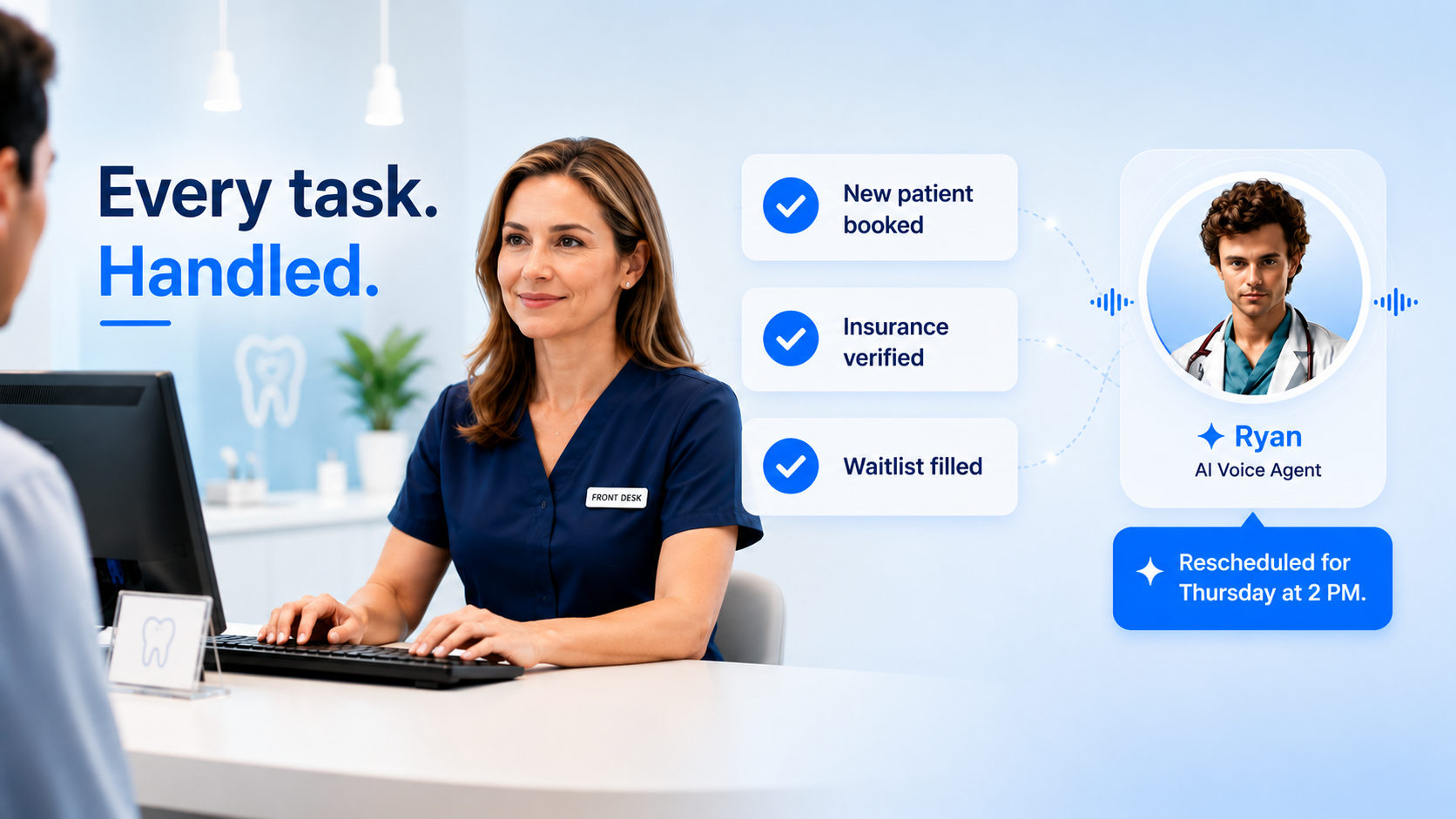
- AI Voice Agents answer every inbound call on the first ring, book and reschedule appointments directly inside the practice management system, send confirmations, run outbound recall, and handle billing inquiries without requiring a single staff member to pick up the phone.
- From our experience, dental practices using Confido Health see a 91% inbound answered call rate and a 60% reduction in cancellations. Patients who would have reached voicemail instead reach a system that completes the task in real time.
- Dental DSOs and multi-location groups benefit from consistent communication standards and centralized call handling without requiring each location to maintain its own dedicated front desk coverage.
- The no-show and cancellation problem is structural. The most effective AI-driven approach combines proactive reminders, real-time rescheduling, and immediate waitlist outreach when a slot opens. See how AI solves practice problems for the broader picture.
Is Your Front Desk Still Running on Two People and a Prayer?
It is a Tuesday morning at a four-operatory dental practice. The hygienist is with a patient at 8:15. The dentist is running behind from a complex crown prep that ran long yesterday. The front desk coordinator, who is also covering for someone who called in sick, is managing check-in for two patients who arrived at the same time, answering a phone call from a patient asking about their insurance coverage, and watching the voicemail notification count tick up on the phone she cannot pick up right now.
By 10 AM, there are seven missed calls. Three of them were patients trying to reschedule. One was a new patient who found the practice on Google and was ready to book. One was a billing question. Two were unknown.
None of those calls will be returned before noon at the earliest. Two of those patients will have booked elsewhere before anyone calls them back.
This is not a staffing failure. It is a structural mismatch between what a two-person front desk was built to handle and what a busy dental practice demands of it every single day.
According to the ADA Health Policy Institute, about 62% of dentists named staffing shortages as their single biggest practice challenge heading into 2025. Among dentists actively recruiting dental hygienists, 91% said it was very or extremely challenging. These are not short-term hiring difficulties. They are structural gaps that have been widening for years.
The question for dental practices is not how to hire more front desk staff. It is how to get more done with the team that is already there.
What the Dental Front Desk Actually Does All Day
The framing of "answering phones" undersells the operational scope of what dental front desk teams manage. The phone is a symptom. The underlying workload is broader.
A fully functioning dental front desk handles inbound scheduling and rescheduling across multiple providers and operative types. It manages insurance verification before every visit, not occasionally. It runs outbound recall for hygiene patients overdue for their six-month appointment, reactivation outreach for patients who have lapsed, and appointment reminders across the full schedule. It handles billing inquiries, processes treatment plan questions, coordinates referrals to specialists, and manages the waitlist to fill cancellation slots before they go empty.
None of these tasks stop because there is a patient standing at the check-in window. None of them stop because the phone is ringing. They all run simultaneously, layered on top of each other, every day.
The result is predictable. The high-urgency tasks get handled. The phone calls that came in get returned eventually. The recall campaign that was supposed to go out last week gets pushed to next week. The patient who cancelled this morning's 9 AM slot did not get replaced from the waitlist because no one had time to work through it. The chair sat empty for 50 minutes.
From our experience working with dental practices, the front office workload problem is not primarily a volume problem. It is a simultaneity problem. Too many things need to happen at the same time for a small team to handle them all without something being dropped.
Where AI Changes the Equation for Dental Practices
An AI Voice Agent built for dental practice operations is not a phone tree with better menus. It is a system that completes the full task loop, from the patient's first ring to a confirmed appointment in the practice management system, without requiring staff involvement for the routine interactions that make up the majority of inbound call volume.
Here is what that means across the specific workflows that define the dental front office.
Inbound Call Handling and Scheduling
When a patient calls to book a new patient exam, the AI Agent answers on the first ring, asks intake questions, checks real-time availability against the provider's scheduling rules, books the appointment, and sends a confirmation by text or email. The appointment is in the PMS before the call ends. Staff open the system, and the work is done.
When a patient calls to reschedule their 2 PM cleaning, the same process applies. The AI Agent identifies the appointment, checks available slots, offers alternatives, books the new time, and cancels the original without creating a task for anyone on the team to action later.
Dental practices serve patients across every age group and communication preference. The AI Agent handles calls in more than 20 languages, which matters for practices serving communities where Spanish, Vietnamese, Mandarin, or Arabic are primary languages. The same scheduling logic and task completion apply regardless of which language the patient calls in.
Outbound Recall and Reactivation
Recall is where dental revenue lives and where most practices are chronically underperforming, not because they do not know they should be doing it, but because the front desk cannot run a proactive outbound campaign while simultaneously managing inbound volume.
AI Agents run recall outreach automatically. Patients who are overdue for their six-month hygiene visit receive a call or text. Patients who have not been in for 18 months or more receive a reactivation sequence. Patients who accepted a treatment plan but never scheduled the work receive follow-up.
From our experience, the recall and reactivation workflow alone consistently recovers appointment production that practices did not realize they were leaving on the table. The calls go out. The appointments get booked. The revenue is recovered without adding a single hour of staff time.
No-Show and Cancellation Recovery
The ADA Health Policy Institute has documented that 81.3% of dentists cite patient no-shows and last-minute cancellations as the primary factor preventing their schedules from reaching full capacity. The financial consequence is meaningful: each empty chair represents production that cannot be recovered and overhead that continues regardless.
The most effective response is not a stricter cancellation policy. It is a faster, more consistent confirmation and waitlist system.
AI Agents send multi-touchpoint confirmations across the days leading up to the appointment. When a patient cancels or does not confirm, the Agent contacts the next patient on the waitlist and offers the newly opened slot. From our experience, practices deploying AI-driven confirmation and waitlist management see a 60% reduction in cancellations, and the slots that do cancel are filled more consistently because the outreach to waitlisted patients happens in real time, not the next morning when a staff member gets to it.
Insurance Verification and Benefits Questions
Dental insurance is among the most patient-confusing categories in healthcare. Coverage limits, frequency limitations, waiting periods, dual-insurance coordination, in-network status: patients call the front desk with these questions constantly, and the answers often require pulling up the eligibility record in real time to give an accurate response.
AI Agents handle benefits inquiries by pulling current eligibility data, confirming in-network status, and answering coverage questions accurately during the call. For verification before appointments, the Agent runs eligibility checks and writes results directly to the patient record without staff involvement. Staff arrive to a verified record, not a task list.
Billing Inquiries and Payment Follow-Up
Outstanding balances, statement questions, and payment plan conversations are high-volume and time-consuming for billing staff. AI Agents handle inbound billing inquiries in real time and manage outbound balance follow-up, reaching patients with outstanding balances at a consistent cadence rather than sporadically when someone has time.
From our experience, the payment follow-up workflow alone contributes to the 15 to 20% increase in revenue collections that practices see after deploying AI Agents. Not because patients are being pressured, but because the follow-up is consistent in a way that manual processes never quite achieve.
New Patient Intake and Referral Coordination
New patient calls are the highest-value inbound call type a dental practice receives. A prospective patient who found the practice online, was referred by an existing patient, or is calling after seeing the practice's signage is ready to commit. The moment they reach voicemail, the conversion probability drops sharply.
AI Agents answer new patient calls immediately, complete intake questions, book the appointment, and send pre-visit information without delay. The new patient is booked and confirmed before they have had a chance to try the next practice on their list.
For practices receiving specialist referrals, the same applies. Referral intake is captured, the patient is contacted, and the appointment is scheduled, without requiring a staff member to work through a stack of referral faxes at the end of the day.
What This Means for DSOs and Multi-Location Groups
The front office challenges that affect a single-location dental practice are compounded at scale. A dental support organization managing 20 or 50 locations cannot guarantee consistent patient communication, uniform scheduling standards, or reliable recall execution at every site by adding front desk headcount proportionally.
AI Agents provide a consistent communication layer across every location simultaneously. The same scheduling logic, the same insurance verification workflow, the same recall and confirmation cadence, applied at every practice in the organization regardless of how many locations are running on a given day.
From our experience with multi-location dental groups, the operational impact is most visible in three places: answered call rates become consistent across locations instead of varying by which front desk team is having a harder day; recall production becomes predictable rather than dependent on whether any given location found time to run the campaign; and the morning backlog of missed-call voicemails that front desks spend the first hour on disappears entirely.
For DSOs evaluating AI for front office operations, the AI vs outsourced call centers comparison covers the financial and operational case in detail.
What to Look for When Evaluating AI for Dental Operations
Does it integrate natively with your practice management software?
A dental AI solution that cannot read and write to your PMS is not completing work. It is collecting information for staff to enter manually. The integration must be bidirectional at the scheduling level: the AI reads availability based on your actual appointment rules, books directly into the system, and writes the result back without requiring reconciliation.
Confido Health integrates with 40+ PMS systems including Dentrix, Eaglesoft, Open Dental, Carestream, and Athenahealth. When a patient books an appointment through the AI Agent, it appears in the PMS in real time. When the Agent cancels and replaces a slot from the waitlist, both the cancellation and the new booking reflect immediately.
Does it handle dental-specific scheduling complexity?
Dental scheduling is not generic healthcare scheduling. Appointment types have specific time requirements, operational types, and provider constraints. A hygiene recall is different from a new patient exam, which is different from a crown prep, which is different from an emergency evaluation. A system that books into generic slots without applying your practice's scheduling rules will create downstream problems that take staff time to fix.
Ask vendors to demonstrate a multi-appointment-type scheduling scenario with your actual scheduling rules active. If the demo requires simplified assumptions, the production deployment will require staff correction.
Does it cover outbound as well as inbound?
The recall and reactivation gap is where dental practices lose the most recoverable production. A system that only handles inbound calls addresses roughly half the operational problem. Ask specifically whether recall outreach, reactivation campaigns, post-visit follow-up, and waitlist management are native capabilities or require a separate tool.
What happens when a patient mentions pain or describes a clinical concern?
Not every dental call is routine. A patient calling to reschedule may mention they are in pain. A patient calling about billing may describe symptoms that indicate they need an urgent appointment. The AI system must be configured to recognize these signals, respond appropriately, and escalate via warm transfer to a staff member or on-call provider in real time.
This is a patient safety design question, not a feature question. Ask for a specific demonstration of how the system handles a call where a patient expresses acute dental pain or describes swelling.
Here's How Confido Health Can Help
Most dental practices are not looking to replace their front desk team. They are looking to give that team a realistic chance of doing the job well, without spending every morning recovering from yesterday's missed calls, without losing recall production because no one had time to run the campaign, and without watching new patient calls go to voicemail during the busy hours when the phone should not have to ring at all.
Confido Health's AI Agents are deployed across dental practices, DSOs, and multi-location dental groups handling exactly this problem. Sara handles the full inbound and outbound communication workflow: scheduling, recall, reminders, insurance verification, billing inquiries, and new patient intake. She integrates directly with the practice's PMS, completes every task inside the system before the call ends, and operates 24 hours a day, 7 days a week, in more than 20 languages.
Here is what practices see in practice:
91% Inbound Answered Call Rate
Patients who call during the busiest hours and after hours reach a system that resolves their request, not a voicemail. Every call answered means every new patient captured and every existing patient retained.
60% Reduction in Cancellations
Consistent multi-touchpoint confirmation and real-time waitlist management fills cancelled slots before the production is lost. When a cancellation does come in, the next waitlisted patient is contacted immediately, not the next morning.
Outbound Recall and Reactivation, Running Continuously
Not when someone finds time. Patients overdue for hygiene, lapsed from care, or holding an unscheduled treatment plan receive outreach automatically. The appointment production that was previously being left on the table gets recovered.
80% Reduction in Manual Admin
Insurance verifications, appointment confirmations, billing follow-ups, and scheduling tasks complete inside the PMS without staff data entry. Staff open the system to a completed record, not a task list.
Live in Under 30 Days
Expert-approved dental workflow templates cover appointment types, scheduling rule configuration, and recall timing. No IT resources required during setup. Most practices are live and handling full call volume within 30 days of kickoff.
Confido Health is more than a dental answering service. It is the operational layer that handles the routine so your team can handle the irreplaceable: the patient experience at the chair, the clinical judgment at the treatment plan conversation, the relationship that keeps patients coming back.
Want to see how Confido Health handles dental front office operations? Book a demo today.
Maria Felipe, Senior Operations Manager at Alpha Dental, put it simply: "Confido Health came in to not just help us reorganize the system but alleviate the pressure of the front desk trying to do three, four things at the same time."
FAQ
What does AI for dental practices actually do?
AI Voice Agents for dental practices answer inbound calls, book and reschedule appointments directly in the practice management system, run outbound recall and reactivation campaigns, send appointment reminders, handle insurance verification, manage billing inquiries, and fill cancelled slots from the waitlist. All of this happens in real time, around the clock, without requiring staff involvement for the routine interactions that make up the majority of daily call volume.
How is AI different from the phone system or answering service we already have?
A phone system routes calls. An answering service takes messages. An AI Voice Agent completes the task: the appointment is booked, the insurance is verified, the record is updated, and the confirmation is sent before the call ends. The difference is whether the work is done or whether it lands in a queue for staff to finish.
Will AI handle our specific appointment types and scheduling rules?
Yes, when the integration is built correctly. Confido Health integrates with Dentrix, Eaglesoft, Open Dental, Carestream, and more than 40 other PMS systems. The AI applies the practice's actual scheduling rules: appointment duration, operative assignment, provider preferences, and time constraints. It does not book into generic slots.
How does AI handle a patient who mentions they are in pain?
Confido Health's AI Agents are configured to recognize clinical escalation signals. When a patient describes acute pain, swelling, or any symptom indicating urgency, the Agent provides appropriate acknowledgment and routes the call immediately via warm transfer to a staff member or on-call provider. The AI does not attempt clinical triage. It ensures the call reaches the right person in real time.
Does Confido Health work for multi-location dental groups and DSOs?
Yes. Confido Health is deployed across single-location practices and multi-location dental groups. For DSOs, the platform provides consistent communication standards, centralized call handling visibility, and uniform recall execution across every location, without requiring proportional increases in front desk headcount as the organization grows.
What is the ROI for a dental practice deploying AI on the front office?
From our experience, the most immediate impact is on answered call rates, cancellation reduction, and recall production recovery. An answered call rate above 90% means fewer lost patients. A 60% reduction in cancellations means more production from the existing schedule. Continuous recall outreach means consistent production from the hygiene schedule that previously went unrealized. The combination of these three workflows accounts for the majority of the measurable ROI practices see in the first 60 to 90 days.
How long does deployment take for a dental practice?
Most dental practices are live with Confido Health in under 30 days. Deployment uses expert-approved dental workflow templates that are configured to the practice's scheduling rules, appointment types, provider preferences, and recall timing. No dedicated IT resources are required during setup.
Does AI support after-hours dental calls?
Yes. Confido Health operates 24 hours a day, 7 days a week. After-hours calls, including patients calling about urgent symptoms, are handled with the same workflow as business-hours calls. Urgent calls escalate via warm transfer to an on-call provider. Routine requests such as appointment scheduling and billing questions are completed in real time, with no morning backlog left for staff.
.webp)
