

.svg)
- Insurance verification and prior authorization remain two of the biggest administrative bottlenecks slowing down healthcare operations and delaying patient care.
- This blog breaks down how manual workflows create claim denials, scheduling delays, staff burnout, and frustrating patient experiences across healthcare organizations.
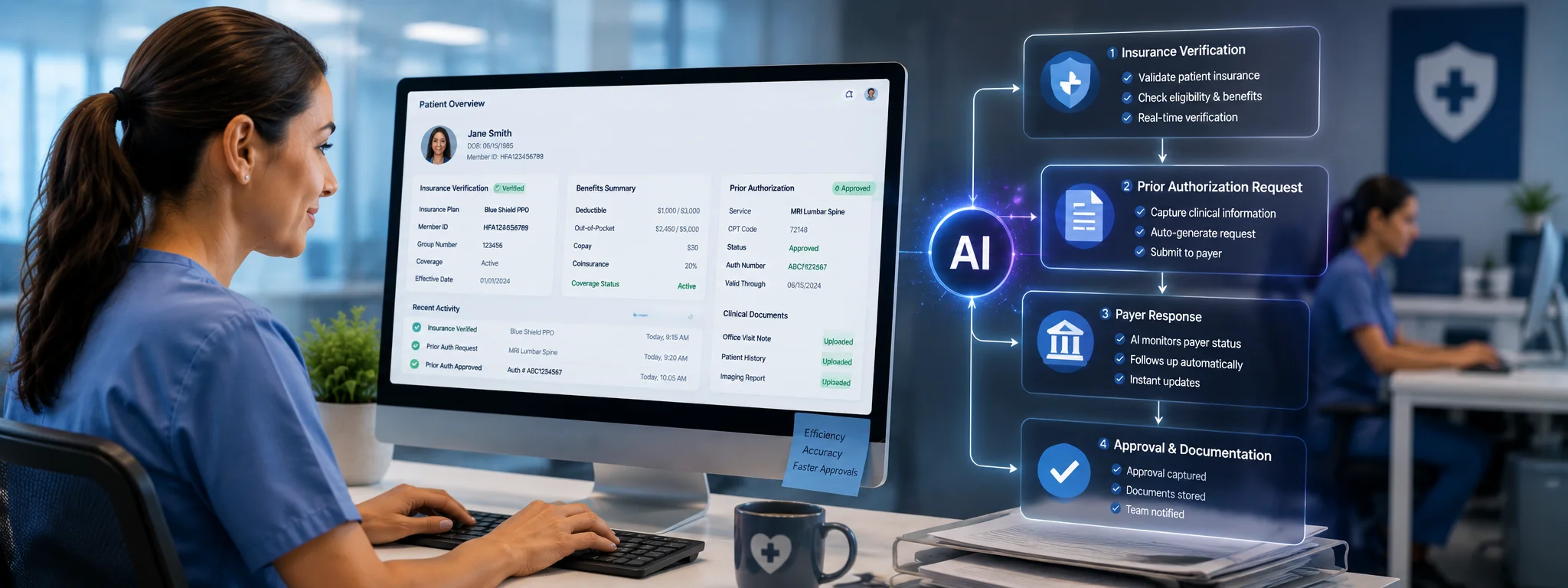
- Discover how AI can automate eligibility checks, prior authorization requests, payer follow-ups, and real-time coverage validation directly within patient workflows.
- The article also explores how automation improves revenue cycle performance by reducing denials, accelerating payments, and eliminating repetitive administrative rework.
- Most importantly, it shows how AI-powered verification and authorization workflows help practices create smoother patient experiences while giving staff more time to focus on care instead of paperwork.
Introduction
94% of physicians say prior authorization delays patient care. That is not occasional, it is happening almost everywhere. And yet, the process still looks the same. Your team is calling payers, filling forms, waiting on responses, and following up again when nothing moves. While all this is happening, your patient is waiting, and your schedule stays uncertain. Insurance verification has a similar story. It is critical to get paid, but it is often done manually, late, or inconsistently. That is where errors, delays, and billing issues start to build.
AI is starting to change this in a very practical way. It is helping teams handle these workflows faster, more accurately, and without all the back and forth. This blog breaks down how these processes work today, where they fail, and what changes when AI handles them.
What Is Insurance Verification
Insurance verification is one of those processes that sounds straightforward until you are actually doing it at scale every day. Understanding what it involves, why it matters, and where it tends to go wrong is the starting point for understanding how to do it better.
What Does Insurance Verification Mean in a Healthcare Workflow
Insurance verification is simply making sure a patient’s coverage is active and actually applies to the visit they are coming in for. It is not just about checking if they have insurance, but understanding the details like plan type, copays, deductibles, and whether your provider is in network. When this is done properly and early, everything that follows becomes easier. But when it is rushed, missed, or done incorrectly, the impact shows up later in denied claims, billing issues, and awkward patient conversations that could have been avoided.
Steps Involved in the Insurance Verification Process
It usually starts with scheduling, when your team collects patient and insurance details like ID numbers and subscriber information. Then someone checks with the payer, either through a portal or over a call, to confirm coverage and understand what is actually included. This includes checking network status, referrals, deductibles, and any limits on the service being booked. Once confirmed, everything needs to be updated correctly in your system so the front desk, clinical team, and billing team are all working with the same information. If any step is missed, the problem shows up later.
Why Insurance Verification Matters Before a Patient Visit
When you verify insurance, it matters just as much as how you do it. If it is done too late, there is no time to fix issues before the patient arrives. Finding out at check-in that coverage has changed or a service is not covered leads to delays, confusion, and tough conversations. But when it is done a few days in advance, your team has time to fix gaps, confirm details, and make sure the visit goes smoothly for both the patient and your staff.
What Is Prior Authorization
Prior authorization adds another layer of complexity on top of verification. It is one of the most time-consuming administrative processes in healthcare, and it is one that directly affects whether and when your patients receive care.
What Does Prior Authorization Mean in Healthcare
Prior authorization is when a payer asks for approval before certain treatments, tests, or medications can be covered. It is their way of making sure the service is medically necessary before they agree to pay for it. For your team, this usually means extra steps before care can move forward. While not every service needs it, the list has grown a lot over time, especially in specialties like cardiology, radiology, and behavioral health.
Steps Involved in the Prior Authorization Process
It starts with checking whether the service actually needs authorization under the patient’s plan. This can vary a lot depending on the payer, service, and provider network. Once identified, your team submits a request with the required clinical details. Then comes the waiting, follow-ups, and sometimes sharing more information. In the end, it is either approved, partially approved, or denied. If anything is missed along the way, it creates delays and extra work later.
Why Prior Authorization Is Required Before Certain Treatments
Payers use prior authorization mainly to control costs and make sure high-cost services are justified. So, simpler or routine treatments usually do not need it, but more expensive or specialized ones often do. For your organization, the key thing is this. If a service that needs authorization is done without it, the claim is almost always denied. That means even correct care can turn into lost revenue, simply because the approval step was missed upfront.
How the Two Processes Connect and Where They Depend on Each Other
Insurance verification and prior authorization are not independent workflows. They are connected at multiple points, and the output of one directly affects the other. Verification tells you what a patient’s insurance actually covers, including whether approval is needed before the visit. If this step is missed or done incorrectly, you may not realise authorization is required, and that usually leads to a denied claim later.
Equally, a prior authorization obtained under incorrect coverage information may not be valid if the patient's actual plan differs from what was on file. The two processes need to run in sequence and in coordination, with accurate information flowing between them, for either one to produce the clean, authorization-supported claim that the revenue cycle depends on. In most manual environments, this coordination depends on individual staff members staying on top of both workflows simultaneously, which creates the gaps and errors that show up downstream in your billing and collections performance.
Why These Workflows Break Down in Most Healthcare Organizations
Understanding that these workflows need to work well is one thing. Understanding why they consistently do not is where the real operational insight sits. The breakdowns are predictable, they are preventable, and they are happening in most healthcare organizations right now.
Volume of Verification and Authorization Requests
For any organization managing high patient volume, the sheer number of verifications and authorizations that need to be handled every day is genuinely substantial. Every scheduled patient requires a verification. A significant proportion of those patients require authorization for one or more services. In a multi-specialty group or a high-volume practice, this easily translates into dozens or hundreds of individual verification and authorization tasks happening simultaneously, each with its own payer, its own requirements, and its own timeline. Managing this volume manually is not just difficult, it is structurally unsustainable at scale. The volume alone creates the conditions for errors, delays, and gaps, regardless of how capable your team is.
Delays Caused by Manual Verification Processes
Manual verification is slow by nature. Checking a payer portal takes time. Calling a payer directly takes longer. Getting accurate, complete benefit information in a single interaction is not always possible, which means follow-up contacts are often required. When your team is handling a high volume of verifications alongside their other responsibilities, verification tasks get prioritized based on appointment urgency rather than being completed thoroughly and in advance. The result is a pattern of verifications happening too close to the appointment date to allow time for resolving discrepancies, which means problems get discovered at check-in when the least can be done about them.
Increasing Timelines in Prior Authorization Workflows
Prior authorization timelines have lengthened significantly over the past several years. Payer processes have become more complex, documentation requirements have increased, and the volume of authorization requests across the industry has grown as the list of services requiring authorization has expanded. What was once a same-day or next-day process for many services now routinely takes several days or longer, and for complex cases, weeks. This creates scheduling uncertainty, clinical delays, and administrative pressure that compounds across a high-volume practice. Your team is managing active authorizations, pending authorizations, expiring authorizations, and denied authorizations simultaneously, all while handling their core scheduling and patient communication responsibilities.
Staff Effort Required for Payer Communication and Follow-Ups
The payer communication involved in verification and authorization is one of the most time-consuming and least fulfilling parts of healthcare administration. Phone holds, portal navigation, documentation requests, status checks, and follow-up calls are a constant feature of the authorization workflow. For staff who entered healthcare to support patients, spending significant portions of their day on hold with payers or navigating opaque portal systems is demoralizing and operationally inefficient. It is also one of the primary drivers of burnout in healthcare administrative roles, contributing to the turnover that creates its own cycle of training costs and institutional knowledge loss.
Impact of Early-Stage Errors on the Revenue Cycle
Errors that enter the revenue cycle at the verification or authorization stage are expensive to correct later. An incorrect insurance ID leads to an eligibility denial at claim submission. A missed authorization results in a coverage denial that requires an appeal or a write-off. A lapsed coverage detail that was not caught before the visit creates a patient billing conversation that is awkward and often unsuccessful. The further downstream these errors travel, the more time and cost are required to resolve them. The organizations with the best RCM performance tend to be the ones that invest in front-end accuracy rather than back-end recovery.
Effect of Delays on Patient Experience
The patient experience impact of verification and authorization failures is significant and often underestimated. A patient who arrives for a visit only to discover their coverage is not valid has a bad experience that they associate with your organization, not their payer. A patient whose procedure is delayed by weeks waiting for an authorization that your team did not initiate promptly is frustrated in ways that affect their trust in your practice. These experience failures drive the patient attrition that shows up as long-term revenue loss, often without anyone connecting the attrition back to the administrative process that caused it.
What It Costs to Handle These Processes Manually
The cost of manual verification and authorization doesn’t show up in one place. It quietly affects your revenue, your team’s time, your patient experience, and even compliance. Here’s how:
Revenue Impact of Eligibility-Related Denials
Eligibility and authorization-related denials are among the most common and most preventable categories of claim denial in healthcare. When insurance information is inaccurate at the time of claim submission, payers reject the claim, and your billing team has to correct and resubmit it, if the window for resubmission has not already closed. A significant proportion of denied claims are never resubmitted, representing direct revenue loss. The ones that are resubmitted require staff time that has its own cost. And if coverage was not in place at the time of service, the claim cannot be recovered, leading to lost revenue and a difficult billing conversation with your patient.
Administrative Cost of Rework and Resubmissions
Every claim that is denied and requires rework costs your organization in staff time, system costs, and delayed cash flow. The administrative cost of a single denial, when you account for the time required to identify the error, correct it, resubmit the claim, and follow up on the resubmission, is much higher than the cost of handling it correctly the first time. Across a large organization, small front-end errors add up quickly. Fixing them later becomes costly, but the impact is rarely traced back to verification and authorization where it actually started.
Clinical Delays Caused by Authorization Bottlenecks
When prior authorization is not initiated promptly, the clinical consequences are real. A patient who needs imaging cannot be scheduled until the authorization is in place. A patient who needs a procedure waits while your team navigates the payer process. These delays have serious clinical implications that extend far beyond the administrative inconvenience. For patients with time-sensitive conditions, authorization delays can affect outcomes. For your providers, uncertain scheduling created by pending authorizations creates gaps and inefficiencies in their clinical day. And for your organization, delays in delivering authorized services mean delays in generating the revenue associated with them.
Staff Burnout From Repetitive Payer Communication
Hours spent on hold with payers, navigating portal systems that are not designed for user experience, responding to documentation requests, and following up on pending authorizations is draining work that does not require the skills your team was hired for. Over time, this kind of work contributes to the high turnover rates in healthcare administrative roles, which creates its own cycle of recruitment cost, training investment, and the institutional knowledge loss that accompanies every departure.
Compliance Risks From Incomplete Documentation
Insurance verification and prior authorization generate documentation requirements that are part of your organization's compliance obligations. Authorization numbers need to be recorded accurately. Expiry dates need to be tracked. Eligibility confirmation details need to be captured in a way that creates a defensible audit trail. When these documentation requirements are handled manually and inconsistently, the gaps they create represent compliance exposure that can surface during audits or payer reviews in ways that are expensive and disruptive to address.
How AI Improves Insurance Verification
The manual verification process described above is solvable. Here is how AI changes each part of it in ways that are practical and immediately impactful for your organization.
Real-Time Eligibility Verification During Patient Interactions
AI-powered verification can confirm a patient's insurance eligibility in real time during the scheduling interaction itself. When a patient calls to book an appointment, the AI Voice Assistant can check eligibility with the payer while the conversation is happening, confirm the relevant coverage details, and update your EHR/PMS with the verified information before the call ends. This eliminates the gap between scheduling and verification that creates the last-minute discoveries and appointment-day surprises that your team currently manages. It also means that every scheduled patient has verified coverage on file from the moment their appointment is confirmed, giving your clinical team and billing team accurate information to work with from the start.
Automated Communication of Coverage and Benefits
One of the most valuable things verification can do for your patients is give them accurate information about what their visit will cost and what their insurance will cover before they arrive. AI can deliver this information directly to patients during the scheduling interaction, explaining their deductible status, their copay requirements, and any out-of-pocket costs they should anticipate. This transparency reduces the friction and frustration that patients experience when financial expectations are not set before a visit, and it supports the collections process by ensuring patients are financially prepared rather than surprised at check-in or after their bill arrives.
Direct System Updates Without Manual Data Entry
Every piece of information confirmed during the verification process needs to end up in your EHR/PMS accurately and without manual intervention. AI verification writes the outcomes of every eligibility check directly into your systems in real time, eliminating the manual data entry that currently sits between the verification interaction and the system record. This real-time accuracy is what ensures that your clinical team, your front desk, and your billing team are all working from the same verified information rather than from records that may be incomplete, outdated, or reconciled manually after the fact.
Pre-Visit Eligibility Checks Triggered Automatically
Rather than relying on staff to initiate verification for upcoming appointments, AI can trigger eligibility checks automatically based on your scheduling data. Verifications can be initiated several days before each appointment, giving your team time to identify and resolve any coverage issues before they become appointment-day problems. This proactive approach changes the character of verification from a reactive last-minute task to a managed, systematic process that protects your revenue cycle without requiring staff to manually initiate each check.
Handling Exceptions and Discrepancies in Verification
Not every verification returns a clean result. Coverage may have lapsed. The patient may have changed plans. The service may not be covered under their current benefits. AI can identify these discrepancies and flag them for follow-up, triggering the appropriate next steps, whether that is reaching out to the patient to collect updated insurance information, escalating to a staff member for resolution, or communicating to the patient that their coverage needs to be confirmed before the appointment proceeds. This intelligent exception handling ensures that discrepancies are caught and addressed before they become denials rather than after.
Changes in Front Desk Workflows With Automation
When AI handles verification automatically and in real time, your front desk team's relationship with the verification process changes significantly. Instead of initiating and managing individual verification tasks, your team focuses on reviewing verification outcomes, handling the exceptions that require human judgment, and communicating with patients about coverage issues that need resolution. The volume of routine verification work that currently occupies your team's time is handled automatically, freeing their capacity for the patient-facing and clinically important work that requires their attention and expertise.
How AI Improves Prior Authorization Workflows
Prior authorization is more complex than verification, so the impact of AI is even bigger. Here is what changes when AI handles these workflows:
Identifying Authorization Requirements Before Scheduling
One of the most common authorization failures happens simply because the requirement was not identified before the appointment was confirmed. AI can check authorization requirements against the patient's specific plan at the time of scheduling, flagging the need for authorization before the appointment is locked in rather than discovering it afterwards. This early identification is the foundation of everything that follows in the authorization workflow, because it creates the time needed to initiate the request, follow up with the payer, and receive approval before the service is delivered.
Automating Initiation and Tracking of Authorization Requests
Once an authorization requirement is identified, AI can initiate the authorization request automatically, submitting the required information to the payer and beginning the tracking process without staff involvement. From the moment the request is submitted, AI monitors its status, tracks the timeline, and maintains an accurate record of where each authorization stands. This automated initiation and tracking eliminates the manual effort currently involved in managing authorization queues and ensures that nothing falls through the cracks because it was not followed up on promptly.
Managing Payer Communication Within the Workflow
A significant proportion of authorization staff time is consumed by payer communication, including status checks, responses to requests for additional information, and follow-ups on delayed decisions. AI can manage this communication automatically, responding to standard payer requests, submitting additional documentation when required, and following up on pending authorizations according to defined timelines. This keeps the authorization workflow moving without your team having to manually contact payers for each outstanding case.
Monitoring Authorization Timelines and Risks
Authorization approvals come with expiry dates and conditions that need to be tracked throughout the patient's care journey. AI can monitor authorization timelines proactively, alerting your team when an authorization is approaching its expiry date, when conditions attached to an approval are at risk of not being met, or when a service is being scheduled outside the authorized parameters. This proactive monitoring prevents the situation where a service is delivered under an authorization that has expired or does not match the actual service provided, which is one of the more avoidable categories of authorization-related denial.
Reducing Manual Follow-Ups With Payers
AI can significantly reduce your follow-up burden by handling routine follow-up contacts automatically, escalating to staff only when a situation genuinely requires human judgment or intervention. The result is that your team's time is focused on the complex, exception-based authorization situations that benefit from their expertise rather than being consumed by routine status checks that the technology can handle just as effectively.
Workflow Changes When Authorization Is Automated
When AI handles authorization initiation, tracking, and payer communication automatically, the authorization workflow changes from a reactive, staff-driven process to a well-managed, system-driven one. Your team can simply oversee the workflow rather than drive every step of it. They can review authorization outcomes, handle escalated exceptions, and manage the cases that require clinical documentation or complex payer negotiation.
The Revenue Cycle Impact of Getting These Workflows Right
When insurance verification and prior authorization are handled properly and on time, the impact will show up across your entire revenue cycle. Claims will go out cleaner because the information is already accurate. Denial rates will drop since common issues like eligibility errors and missing approvals are handled upfront. Payments will come in faster, and your team will spend less time fixing and resubmitting claims. Even collections will improve because patients already have clarity on their coverage before the visit.
The bigger takeaway is simple. Most revenue cycle issues do not actually start in billing - they start much earlier. When the front end is handled well, the back end becomes easier to manage. And the organizations that see the best results are the ones that focus on getting these basics right first, instead of spending time cleaning up avoidable problems later.
What to Look For in AI for Verification and Authorization
Not every platform that claims to streamline verification and authorization delivers the depth of capability that makes a real difference in your operations. Here is what actually matters:
Accuracy and Reliability of Real-Time Payer Data
The value of real-time verification depends entirely on the accuracy of the payer data the system is drawing from. Look for platforms that connect directly to payer systems through reliable, up-to-date integrations rather than using cached or aggregated data that may not reflect a patient's current coverage status. Inaccurate verification data is not just unhelpful - it is very harmful because it creates false confidence that a patient's coverage has been confirmed when it has not.
Ability to Complete Workflows End-to-End
Verification and authorization tools that retrieve data but leave the recording, communication, and follow-up steps to your team have not solved the problem. They have simply moved part of it. Look for platforms that complete the full workflow, from initial check through system update, patient communication, exception handling, and follow-up, without requiring manual intervention at each step.
Depth of Integration With EHR/PMS Systems
Real-time bidirectional EHR/PMS integration is the foundation of effective verification and authorization automation. The platform needs to read scheduling data from your systems to know which patients need verification, and it needs to write the outcomes of verification and authorization back into your systems in real time so that your clinical and billing teams are always working from current, accurate information.
Automation of Authorization Initiation and Tracking
Platforms that identify authorization requirements but still depend on staff to initiate and track the actual request have automated the easy part and left the hard part in place. Look for platforms that handle the full authorization lifecycle automatically, from requirement identification through request submission, payer communication, status tracking, and outcome recording.
Compliance and Audit Readiness Requirements
Every verification and authorization interaction creates documentation obligations. The platform you choose needs to maintain complete, accurate, timestamped records of every interaction in a format that supports your audit and compliance requirements. Gaps in this documentation create compliance exposure that can surface in ways that are expensive to address after the fact.
Support for Multilingual Patient Communication
For organizations serving diverse patient populations, the ability to communicate verification and authorization information to patients in their preferred language should not be optional. Patients need to understand their coverage, their cost exposure, and any requirements associated with their upcoming visit, and they need to receive that information in a language they can act on.
Scalability Across Locations and Patient Volume
The platform needs to handle your current volume and your future volume without performance degrading as your organization grows. For multi-location organizations, it also needs to maintain consistency of process and data quality across every site.
Visibility Into Workflow Performance and Outcomes
Real-time reporting on verification completion rates, authorization approval timelines, denial rates by payer and service type, and exception volumes gives your operations team the visibility they need to identify problems early and optimize continuously. Without this visibility, you are managing the workflow blind.
How Confido Health's AI Voice Assistant Handles Insurance Verification and Prior Authorization
Confido Health's AI Voice Assistant brings a connected, end-to-end approach to insurance verification and prior authorization by handling both workflows within the patient interaction itself. This removes the gap between patient communication and administrative execution, which is where most delays and errors usually begin.
Completing Eligibility Verification Within the Patient Scheduling Interaction
When a patient calls to schedule an appointment, Confido Health's AI Voice Assistant verifies insurance eligibility in real time during the conversation. Coverage is confirmed, benefits are checked, and everything is recorded before the call ends. There is no separate task, no follow-up needed, and no appointment confirmed without verified coverage. This reduces last-minute surprises and helps avoid appointments that later need to be rescheduled due to coverage issues. It also ensures your schedule is built on confirmed information, not assumptions that need fixing later.
Explaining Coverage and Benefits to Patients in Real Time
Patients get clear information about their coverage, copays, deductibles, and expected costs during the same interaction. This removes confusion and sets the right expectations upfront. When your patients know what to expect, check-in becomes smoother, and your front desk is not stuck handling avoidable billing conversations or friction during visits. It also reduces repeated calls from patients trying to understand their coverage after booking.
Identifying Authorization Requirements Before a Visit Is Confirmed
Before confirming an appointment, the system checks if prior authorization is required based on the patient’s plan and the service being scheduled. This ensures nothing is missed upfront, so your team is not chasing approvals after the appointment is already booked or dealing with delays closer to the visit date. It gives your team clarity early, instead of reacting to issues later in the process.
Initiating and Tracking Prior Authorization Requests Automatically
Once authorization is needed, the system initiates the request automatically and keeps track of it without manual effort. Status updates, timelines, and next steps are all managed within the workflow. This removes the constant need for your team to check on requests and keeps everything moving without delays piling up. It also ensures that no request gets lost or overlooked in a busy workflow.
Managing Payer Follow-Up Without Staff Involvement
Routine follow-ups with payers, status checks, and standard information requests are handled automatically. Your team only steps in when something genuinely needs attention. This shifts your staff away from repetitive follow-ups and frees up time for higher-value work. It also keeps follow-ups consistent, so delays caused by missed check-ins are reduced.
Writing Verification and Authorization Outcomes Directly Into EHR/PMS
All verification and authorization updates are written into your systems in real time across integrations like Epic, Athenahealth, and others. This means every team is working with the same accurate information, reducing errors and ensuring claims go out clean without rework later. It also removes the need for manual data entry, which is a common source of mistakes.
Flagging Coverage Gaps and Authorization Risks Before They Become Denials
Discrepancies identified during verification, services requiring authorization that have not been obtained, authorizations approaching expiry, and coverage mismatches are flagged early. Issues are caught before they turn into claim denials or billing problems, giving your team time to act. This proactive approach helps reduce downstream errors and improve overall claim quality.
Supporting Patients Across 20+ Languages Through the Verification Process
Patients can interact in their preferred language, ensuring insurance details and requirements are clearly understood. This removes communication gaps that often lead to incomplete or incorrect information during verification. It also improves the overall patient experience, especially for diverse patient populations.
Giving Operations Teams Real-Time Visibility Into Verification and Authorization Status
Every interaction feeds into real-time dashboards, giving your team visibility into verification rates, authorization timelines, and workflow performance. This makes it easier to spot bottlenecks early and keep operations running smoothly across locations. It also helps leadership make better decisions based on what is actually happening day to day.
Conclusion
Think about this common situation - a patient shows up for a visit, only to find out their insurance wasn’t verified properly, or an approval is still pending. The appointment gets delayed, your team scrambles to fix it, and what should have been a routine visit turns into a frustrating experience for everyone involved.
Now imagine that same scenario handled differently - the insurance was checked in advance, the authorization was already in place, and the patient walks in fully informed. The visit starts on time, the claim goes out clean, and no one has to circle back and fix anything later.
Wouldn’t you want the second scenario for your organization? This is where AI makes a real difference. It brings structure to these workflows, handling them accurately and end-to-end so nothing gets missed and everything stays on track. So, if your verification and prior authorization workflows are still causing delays or extra work, the Confido Health team can show you how Confido Health’s AI Voice Assistant handles them seamlessly from start to finish!
FAQs
Can AI handle prior authorization requests with payers?
Yes, it can handle the process end-to-end. Confido Health’s AI Voice Assistant identifies when approval is needed, initiates the request, follows up with payers, and updates your system without your team needing to manage each step.
How does automated insurance verification reduce claim denials?
Yes, it does. It ensures coverage is checked accurately before the visit, which helps prevent common front-end errors that lead to claim denials.
Can Confido Health's AI Voice Assistant integrate with my existing EHR/PMS systems?
Yes, it connects with leading EHR/PMS systems and updates them in real time. This means verification and authorization details are recorded instantly without any manual entries.
Is AI-powered insurance verification HIPAA-compliant?
Yes, when built correctly. Confido Health’s AI Voice Assistant operates within a fully HIPAA-compliant setup with secure data handling, access controls, and complete audit trails.
How quickly can AI complete an eligibility check compared to manual verification?
Manual checks take longer with calls and follow-ups. Confido Health’s Voice AI verifies eligibility instantly during the patient interaction, without needing a separate step.
What happens when a patient's coverage cannot be verified automatically?
The system flags it right away and triggers the next step, like collecting updated details or routing it to your team. This way, issues are caught early instead of at check-in.
How do you measure the ROI of automating insurance verification and prior authorization?
You’ll start to see it in fewer denials, cleaner claims, faster payments, and the time your team gets back. Together, these show how much smoother your operations and revenue cycle feel with Confido Health’s AI Voice Assistant in place.
.webp)
