

.svg)
- 89% of pediatricians reported non-physician staff shortages in the past 12 months, according to a 2024 AAP survey. Parent-facing communication is the first function to fall behind.
- Pediatric scheduling is not just one appointment type. Well visits, sick visits, vaccine-only appointments, developmental screenings, and sports physicals each require different scheduling logic and provider availability.
- Text message reminders significantly reduce pediatric no-shows. A PMC randomized trial found that no-show rates dropped from 38.1% to 23.5% when text reminders were added to voice calls.
- Parent communication in pediatrics is high-volume and time-sensitive. Sick visit calls, vaccine question lines, after-school appointment requests, and after-hours concerns all land on the same phone at the same time.
- AI Agents answer every parent call on the first ring, complete scheduling in real time, send multilingual reminders, and handle after-hours triage routing without staff involvement for routine interactions.
- See how AI improves patient communication without adding headcount.
What a Pediatric Front Desk Manages Before 9 AM
It is Monday morning at a pediatric group running four locations across the metro area. Each site opens at 8 AM. By 8:30, the front desk coordinators at three of those locations are already behind. One is managing a sick visit surge. Another has two coordinators out this week and a single person covering phones, check-in, and check-out simultaneously. A third location's phones rolled over to the answering service for 20 minutes because no one could get to them.
At the fourth location, things look different. Confido Health's AI Agent answered every call on the first ring from the moment the phones opened. A parent booked a sick visit for a child with a fever. Another confirmed their 15-month-old's MMR appointment. A school nurse received immunization record confirmation. A parent rescheduled their 4-year-old's visit. Two after-hours callbacks were already handled before the team arrived.
It is 8:30 AM. That location's coordinator is at the front desk, focused on the patients walking in. Not the calls still waiting.
This is the difference AI makes in a multi-location pediatric group. Not just faster phones at one site. Consistent, complete patient communication across every location, every day, regardless of who called in sick or how heavy the morning surge is. The patient population is defined by parents who are managing busy lives, calling on behalf of children who cannot advocate for themselves, often anxious about symptoms or delays, and expecting a response that is both fast and reassuring. The communication expectations in pediatrics are higher than in most specialties because the stakes feel more immediate to the people calling.
And the staffing environment is not improving. A 2024 AAP survey of pediatricians found that nearly 9 in 10 reported non-physician staff shortages in the past 12 months. For groups managing multiple sites, that gap compounds with every location added. When front desk capacity shrinks, parent communication is the first function to absorb the impact.
Why Pediatric Scheduling Is a Different Problem
A pediatric practice is not a single-appointment-type operation. It runs multiple parallel scheduling tracks simultaneously, each with its own logic, timing requirements, and clinical constraints.
Well visits follow a structured schedule tied to AAP developmental milestone checkpoints: 2 weeks, 1 month, 2 months, 4 months, 6 months, 9 months, 12 months, 15 months, 18 months, 24 months, 30 months, and annually through adolescence. Each well visit has an associated vaccine schedule. Missing a well visit does not just create a scheduling gap; it may delay immunizations, miss a developmental screening, or defer anticipatory guidance on safety, nutrition, or behavior.
Sick visits run on a different track. They are unscheduled by nature, require same-day or next-day availability, and compete with the well visit schedule for provider time and room availability. A practice with a high sick visit volume that does not manage its scheduling carefully will find well visits getting bumped and recall falling behind.
Vaccine-only appointments, sports physicals, form completion visits, lactation consultations, and behavioral health screenings each add scheduling complexity on top of the core well and sick visit tracks. A parent calling to book a sports physical needs a different appointment slot than a parent calling about a fever. A parent calling for a catch-up vaccine needs eligibility verification before the appointment is booked.
For multi-location and multi-provider pediatric groups running 10 or more locations, this complexity multiplies across every site. Consistent scheduling logic, uniform vaccine recall cadence, and reliable parent communication cannot be delivered through individual front desk teams operating independently.
The Parent Communication Challenge
Parent communication in pediatrics differs from patient communication in adult specialties in a fundamental way: the person calling is not the patient. They are a proxy for the patient, often in a state of low-grade anxiety about their child's health, frequently calling during constrained windows of time, and often managing multiple competing demands while on the phone.
This shapes what effective communication requires. A parent calling because their toddler has had a fever for two days does not want to be placed on hold. A parent calling to understand the vaccine schedule for their six-month-old does not want to navigate a phone tree. A parent who spoke with the practice at 5 PM yesterday and was told someone would call back by 10 AM today expects that callback to happen.
The communication volume in pediatrics is also disproportionately high relative to the patient population size. Well visit recall, vaccine reminders, sports physical season outreach, school form season communication, and flu vaccine campaigns all generate outbound communication demand that runs continuously across the year and spikes seasonally.
Most practices manage this through front desk staff, supplemented by whatever automated reminder system came with their EHR. The automated systems send a reminder. The staff handles everything else. When staffing is short, as it is in 89% of practices, the everything else is where things fall apart.
What AI Changes for Pediatric Practices
An AI Agent deployed in a pediatric practice does not replace the warmth and clinical sensitivity of a skilled front desk team. It absorbs the volume of repeatable, routine interactions that currently prevent that team from providing the communication quality that parents expect and that the practice needs to deliver.
Inbound Parent Call Handling
When a parent calls to book a well visit, the AI Agent answers on the first ring, identifies the child's age, confirms the appropriate well visit type, checks real-time availability against the provider's scheduling rules, books the appointment, and sends a confirmation. The appointment is in the EHR before the call ends.
When a parent calls with a sick visit request, the AI Agent asks intake questions appropriate to the concern, checks same-day or next-day availability, applies the practice's sick visit scheduling logic, books the appointment, and sends pre-visit instructions. If the symptoms described suggest the child should be seen urgently or directed to an emergency department, the Agent escalates appropriately via warm transfer rather than attempting clinical triage.
Calls in more than 20 languages are handled with the same scheduling logic and task completion regardless of language. For pediatric practices serving communities with significant Spanish, Vietnamese, Mandarin, or Arabic-speaking populations, this means every parent receives the same quality of access regardless of which language they call in.
Vaccine and Well-Visit Recall
The well visit recall gap is where pediatric practices lose the most preventive care momentum. A child who is two months overdue for their 18-month well visit is a child whose developmental screening is delayed. A family that has not received an MMR reminder may leave a vaccine gap that the practice was not aware of.
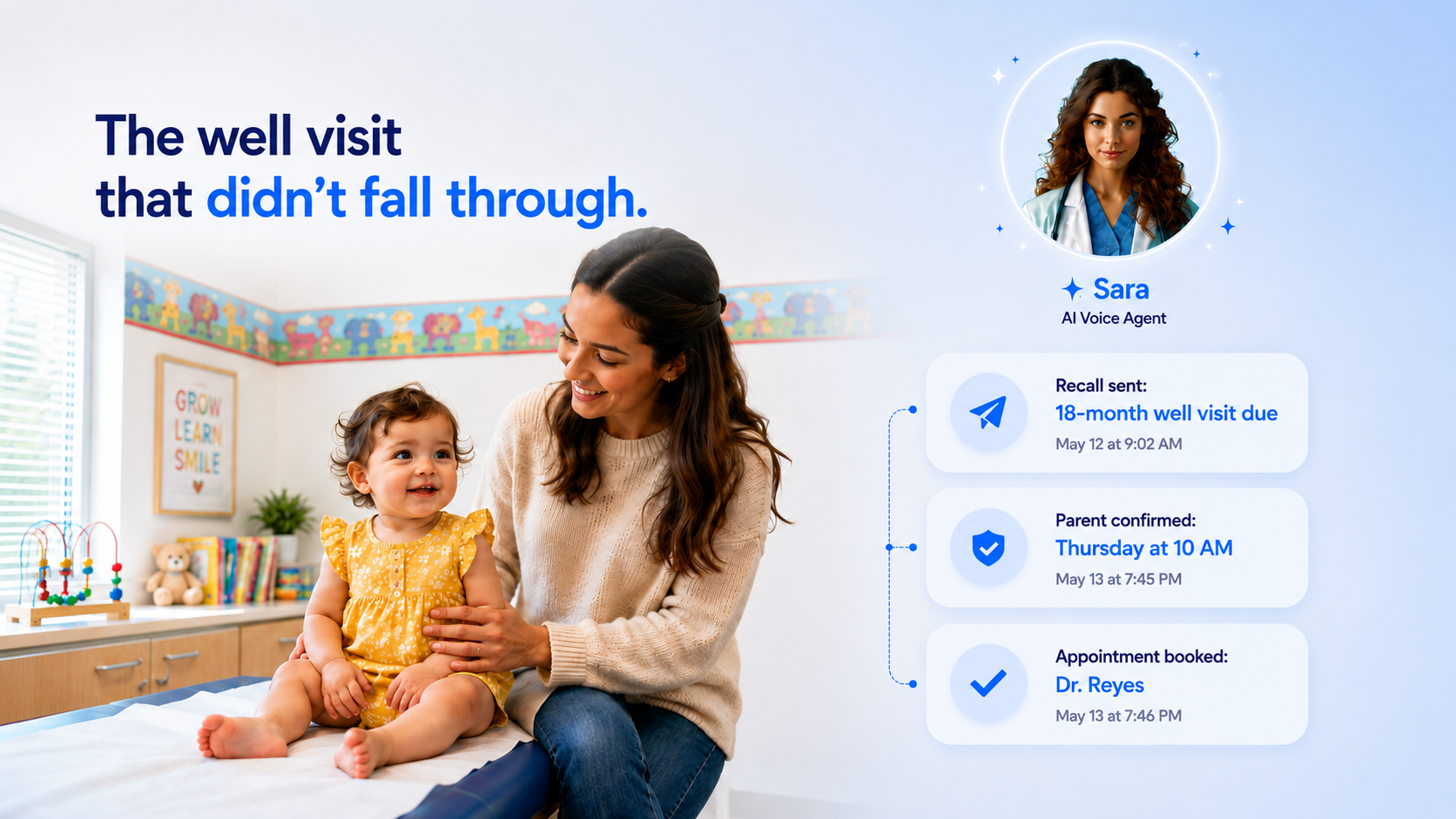
AI Agents run structured well-visit recall automatically. Children approaching each AAP milestone checkpoint generate an outbound outreach call or text to the parent, with booking completed in the same interaction. Vaccine recall for immunization-specific gaps runs on a parallel track. Flu vaccine season campaigns go out to the full eligible population without requiring staff to pull lists and make calls manually.
Sports Physical Season and Form Management
Every August and September, pediatric practices face a surge in sports physical requests and school form completion calls. These are high-volume, low-complexity interactions that consume front desk time disproportionately during the weeks when fall scheduling is also at peak demand.
AI Agents handle sports physical booking, confirm eligibility, send pre-visit instructions, and manage the surge without adding to the front desk burden. Form completion requests are captured, routed to the appropriate clinical staff, and confirmed back to the parent when complete.
After-Hours Parent Calls
After-hours is when pediatric parent calls carry the most emotional weight. A parent calling at 9 PM about a child with a high fever, a rash that appeared after dinner, or a fall that happened at bedtime needs a response, not a voicemail.
AI Agents handle after-hours calls with the same responsiveness as business-hours calls. Routine requests, appointment scheduling, vaccine questions, form requests, complete in real time. Calls involving clinical concerns route via warm transfer to an on-call provider. The parent does not wait until morning, and the on-call provider receives the call with full context already documented. The missed call costs in pediatrics is not only financial, it is the parent who cannot reach the practice and makes a less informed decision about their child's care.
Multilingual Parent Communication
AAP data from 2023 found that pediatricians reported approximately 18.5% of their patient families have limited English proficiency. For practices serving urban and immigrant-heavy communities, that figure is often significantly higher.
AI Agents operating natively in more than 20 languages mean that every parent, regardless of their primary language, receives the same quality of scheduling, recall outreach, and after-hours access as English-speaking families. Not through a translation layer, natively, in the language the parent called in, with the same scheduling logic and task completion.
What This Looks Like Across a Multi-Location Pediatric Group
For pediatric groups operating across 10 or more locations, the operational benefit of AI-driven parent communication is most visible at scale. Consistent vaccine recall execution across every site. Uniform after-hours coverage with no gaps at any location. Sports physical season managed at the group level without each location running its own campaign. A parent calling any location at any hour receives the same quality of response.
From our experience with multi-location pediatric groups, the morning coordination burden, the stack of missed calls, unreturned messages, and voicemail backlogs that front desk teams arrive at each morning, disappears. Staff at every location start the day with a clear queue, focused on the patients already scheduled rather than the calls that came in the night before. For more on the operational case for multi-location scheduling, the pattern is consistent across pediatric settings.
Things to Consider When Evaluating AI for Pediatric Operations
Pediatric Scheduling Logic
Pediatric scheduling is not generic appointment booking. The AI must understand AAP well-visit milestone timing, vaccine schedule logic, the difference between a sick visit slot and a well visit slot, and how to handle a parent calling about a child who needs a catch-up vaccine sequence. Ask vendors to demonstrate a complete pediatric scheduling scenario including a sick visit request and a well-visit recall booking in the same session.
Native Vaccine Recall
Vaccine recall means knowing which vaccines are due for each child at each age, checking what has already been administered, and reaching out to families with accurate, specific information about what is needed and when. This is not generic appointment recall. Ask whether the system integrates with the practice's immunization records in the EHR and whether vaccine-specific recall logic is built in or requires separate configuration.
Urgent Symptom Escalation
A parent calling at 7 PM to describe a child who is breathing rapidly and has a blue tinge around their lips needs immediate escalation. The AI must recognize urgent pediatric clinical signals, respond with appropriate acknowledgment, and route to an on-call provider or direct the parent to emergency services in real time. This is a patient safety requirement, not a nice-to-have. Ask for a specific demonstration before you commit.
Multilingual Coverage, End to End
For practices serving linguistically diverse communities, the question is not just whether the system speaks multiple languages. It is whether it operates natively in each language throughout the full scheduling and recall workflow. A greeting in Spanish followed by English-only booking logic is not multilingual access. Ask vendors to demonstrate a complete end-to-end interaction in the languages most common among your patient population.
Here's How Confido Health Can Help
Pediatric practices run one of the most communication-intensive front office environments in outpatient care. Every interaction involves a parent acting on behalf of a child, often under time pressure, often with a degree of concern that makes the quality and speed of the response feel more important than in most other specialties.
Confido Health's AI Agents are built to handle the full parent communication stack. Our AI agent manages inbound parent calls, well-visit and sick-visit scheduling, vaccine recall, sports physical season surges, after-hours coverage with clinical escalation, and multilingual outreach, integrated directly with the practice's EHR, completing every task before the call ends.
Every Parent Call Answered on the First Ring
No hold time, no voicemail, no morning backlog of unreturned calls. Every parent who calls during the day or after hours reaches a system that completes their request in real time. For multi-location groups, that means consistent first-ring coverage at every site.
Structured Well-Visit and Vaccine Recall
Every child approaching an AAP milestone checkpoint receives outbound outreach with booking completed in the same interaction. Vaccine recall runs automatically based on immunization history in the EHR. Flu vaccine season campaigns go out to the full eligible population without staff running lists manually.
60% Reduction in Cancellations
Multi-touchpoint reminders via call and text, real-time waitlist management, and same-day cancellation recovery. In a pediatric context, reducing cancellations means more children receiving their well visits and vaccines on schedule.
After-Hours Coverage with Clinical Escalation
Routine after-hours calls complete in real time. Calls involving urgent pediatric symptoms escalate immediately via warm transfer to an on-call provider, with full parent and patient context documented. No parent reaches voicemail when their child's situation may require clinical guidance.
20+ Languages, Natively
Every parent communication workflow operates natively in more than 20 languages. Well-visit recall reaches Spanish-speaking families in Spanish. Vaccine reminders go out in the language the family speaks. Scheduling completes in the language the parent called in.
Live in Under 30 Days
Expert-approved pediatric workflow templates cover well-visit scheduling logic, sick visit intake, vaccine recall sequencing, sports physical season management, and after-hours escalation protocols. No dedicated IT resources required during setup.
Confido Health is more than a scheduling tool for pediatrics. It is the operational layer that keeps every child's preventive care on schedule, every parent call answered, and every front desk team focused on the patients already in the room rather than the calls still waiting to be returned.
Want to see how Confido Health works in a pediatric practice? Book a demo today.
FAQ
What does AI for pediatric practices actually do?
AI Voice Agents for pediatric practices handle inbound parent calls, well-visit and sick-visit scheduling, vaccine and immunization recall, sports physical season booking, after-hours call coverage with clinical escalation, multilingual parent communication, and appointment reminders. All workflows integrate directly with the practice's EHR, completing tasks in real time without creating follow-up work for staff.
How does AI handle sick visit calls differently from well-visit calls?
AI Agents apply different scheduling logic depending on call type. A sick visit call triggers intake questions about the child's symptoms, confirms same-day or next-day availability in the sick visit queue, and applies the practice's sick visit scheduling rules. A well-visit call checks the child's age, confirms the appropriate AAP milestone visit type, and books into the well-visit schedule. If symptoms described during a sick visit call suggest clinical urgency, the Agent escalates via warm transfer rather than booking autonomously.
How does AI handle vaccine recall for a pediatric practice?
AI Agents identify children approaching their next AAP-recommended vaccine milestone based on immunization history in the EHR, initiate outbound outreach to the parent, and complete the booking in the same interaction. Vaccine recall operates as a continuous workflow, not a seasonal campaign, so children who fall behind are identified and reached out to as the gap develops rather than at a predetermined point in the year.
What happens when a parent calls after hours with a concern about their child?
Confido Health's AI Agents handle after-hours pediatric calls with the same responsiveness as business-hours calls. Routine requests, appointment scheduling, vaccine questions, form requests, complete in real time. When a parent describes symptoms that may require clinical evaluation, the Agent provides appropriate acknowledgment and routes immediately via warm transfer to an on-call provider. For symptoms that suggest acute urgency, the Agent can direct the parent to emergency services. The AI does not attempt clinical triage. It ensures the call reaches the right person in real time.
Does AI work for multi-location pediatric groups?
Yes. Confido Health is deployed across single-location pediatric practices and multi-location pediatric groups. For larger groups, the platform provides consistent scheduling logic, vaccine recall execution, after-hours coverage, and multilingual communication at every location simultaneously, without requiring proportional front desk staffing increases as the group grows.
How does AI handle multilingual parent communication?
Confido Health's AI Agents operate natively in more than 20 languages. When a parent calls in Spanish, the Agent greets them in Spanish, conducts the intake in Spanish, completes the booking in Spanish, and sends confirmation in Spanish. The same scheduling logic and task completion apply in every supported language. Outbound recall and reminder campaigns can be configured to reach families in their preferred language.
What EHR systems does Confido Health integrate with for pediatric practices?
Confido Health integrates with 40+ EHR systems in production, including Epic, Athenahealth, eClinicalWorks, and others commonly used in pediatric practice. Integration is bidirectional: the AI reads scheduling rules, immunization records, and availability, and writes appointments, task completions, and call outcomes directly back into the system in real time.
How long does deployment take for a pediatric practice?
Most practices are live with Confido Health in under 30 days using expert-approved pediatric workflow templates. Configuration covers well-visit scheduling logic, sick visit intake protocols, vaccine recall sequencing, sports physical season management, after-hours escalation logic, and multilingual communication setup. No dedicated IT resources are required on the practice's side during setup.
.webp)
