

.svg)
- Healthcare organizations are struggling to keep up with rising patient call volumes, creating long hold times, missed calls, and growing pressure on front-desk teams.
- This blog compares traditional outsourced healthcare call centers with AI voice assistants and explains why many practices are rethinking their patient communication strategy.
- Discover how AI voice assistants handle scheduling, insurance questions, prescription requests, and follow-ups directly within healthcare workflows instead of simply routing calls.
- The article also explores the operational impact of AI on patient access, staff workload reduction, appointment management, and long-term cost efficiency.
- Most importantly, it highlights why healthcare organizations are adopting AI-powered voice assistants to create faster, more scalable, and more reliable patient communication experiences.
Introduction
Here’s the reality. Healthcare organizations today are flooded with patient calls. Scheduling appointments, checking insurance, asking about prescriptions, or following up on lab results all usually start with a phone call. And for many practices, that means handling thousands of calls every month, with front desk teams spending a huge part of their day just answering phones. And when call volumes spike, things start to break down quickly. You have patients waiting on hold, calls going unanswered, and voicemails piling up!
To handle this pressure, many practices turned to outsourced call center healthcare services. While this helped absorb some of the call volume, the model still falls short in many cases. In fact, the average hold time in U.S. healthcare call centers is about 4.4 minutes, which is far longer than the Healthcare Financial Management Association benchmark of just 50 seconds.
This is why many healthcare organizations are now exploring a different approach: AI voice assistant healthcare systems that answer patient calls almost immediately and complete tasks directly within the healthcare workflows. So, let’s break down how the two models compare and which performs better for patient access, staff workload, and operational efficiency.
Why Patient Calls Are One of Healthcare’s Biggest Operational Bottlenecks
Healthcare runs on communication. And despite patient portals, apps, and online booking tools, the phone is still the most common way patients reach healthcare organizations. Be it for booking appointments, checking insurance, requesting prescription refills, or even following up after visits. The challenge is that most healthcare practices simply do not have the staff capacity to keep up with the number of calls coming in every day.
The Scale Of Patient Call Volume
A medium-sized healthcare practice can easily receive hundreds of calls every week, while larger multi-location organizations may deal with thousands of patient calls in the same timeframe. Most involve administrative work like checking schedules, accessing patient records, verifying insurance, or coordinating with other teams.
- Calls are not quick interactions: Most patient calls involve tasks that require looking up information, checking availability, or updating records.
- High daily call volume: When hundreds of calls come in each day, even small delays quickly add up.
- Administrative work increases call time: Staff often need to move between multiple systems to answer a single patient request.
- Front desk teams carry the load: In most practices, the same team managing in-person patients is also responsible for answering phones.
This is why front desk teams often feel like they are constantly behind.
Typical Patient Call Types
Every healthcare organization operates differently, but most incoming patient calls tend to fall into a few predictable categories.
- Appointment scheduling and rescheduling: This is the most common reason patients call. They want to book visits, cancel appointments, move schedules, or check provider availability.
- Insurance verification questions: Patients often call to confirm whether their insurance plan is accepted or to understand coverage before an appointment.
- Prescription refill requests: Medication refills generate a steady stream of calls. Patients may request a refill, check the status of a prescription, or coordinate with their pharmacy.
- Post-visit follow-ups: After appointments, patients frequently call with questions about medications, care instructions, or next steps in their treatment.
- Lab result inquiries: Patients often call to ask if their lab results are ready or to understand what their reports mean.
Each of these requests requires access to healthcare systems, context about the patient, and coordination with staff.
Operational Pain Points
When call demand is higher than staffing capacity, many of these problems start showing up.
- Long hold times: Patients may wait several minutes before reaching someone. Many simply hang up before the call is answered.
- Missed calls: If staff are busy helping patients in person or working on administrative tasks, incoming calls go unanswered.
- Voicemail overload: Many practices end up with dozens of voicemails that must be returned later in the day.
- Staff burnout: Front desk teams often spend most of their day answering phones instead of helping patients in the office.
- Limited hours of support: Most healthcare phone lines operate only during business hours, which means patients cannot get help after hours.
Over time, these challenges can end up creating operational friction across your entire organization.
Limitations of Outsourced Call Centers in Healthcare
To manage growing call volumes, many healthcare organizations rely on outsourced call centers. These external teams answer patient calls on behalf of the practice and help absorb some of the incoming demand. At first, this sounds like a practical solution. If the front desk cannot answer every call, an external team can step in and handle the overflow. But in reality, outsourced call centers more often than not introduce a different set of operational challenges.
Limited Integration With Healthcare Systems
One of the biggest limitations of outsourced call centers is system access. In many cases, call center agents do not have direct access to the healthcare organization’s EHR/PMS. Because of this, they often cannot complete tasks during the call itself. Instead, they record the patient’s request and pass it along to clinic staff. What should have been resolved in a single conversation ends up becoming a multi-step process, with the practice needing to call the patient back later to finish the request.
High Operational Costs
Outsourced call centers also introduce significant cost structures that grow as call volume increases. Most vendors charge based on hourly agent rates, per-call billing models, or long-term service contracts. Over time, this can become really expensive for healthcare organizations handling large patient volumes. Even with these costs, staffing coverage is often not enough. Staffing levels in call centers can provide only about 60% of the coverage practices actually need. This leaves an average shortfall of around 23 agents for a center managing roughly 2,000 calls per day!
Inconsistent Patient Experience
Another common challenge with outsourced call centers is the patient experience itself. Call center agents typically rely on scripts designed to handle a wide range of situations across multiple organizations. But healthcare workflows are highly specific to each practice. Agents may not fully understand provider schedules, specialties, or clinic policies. This can lead to frustrating interactions where patients are transferred multiple times or told that someone from the clinic will need to follow up later.
Limited Scalability
Call centers scale by hiring more people. When call volume increases, vendors need to recruit, train, and onboard additional agents before they can handle the demand. This process takes time and adds to operational costs. During sudden spikes in patient calls, even large call centers may struggle to keep up. For healthcare organizations that are growing quickly or operating across multiple locations, this model can become difficult to scale efficiently.
What Is an AI Voice Assistant for Healthcare?
Instead of routing calls to external agents, many practices are now adopting an AI receptionist for medical practices to manage patient communication. These systems have quickly emerged as the most effective healthcare call center alternatives for handling patient calls at scale.
An AI voice assistant uses conversational AI technology to understand what patients need and help complete administrative tasks directly within healthcare workflows. From the patient’s perspective, nothing really changes. They simply call the healthcare organization like they normally would. But instead of waiting on hold or speaking with an outsourced agent, the AI assistant answers instantly and helps the patient resolve their request during the call.
Typical Capabilities Of AI Voice Assistants
AI voice assistants are built to handle many of the routine calls that normally take up a large part of your front desk team’s time. Instead of staff answering every call manually, the assistant can handle these requests automatically while still talking to patients in a natural, conversational way.
- Appointment scheduling and rescheduling: Patients can book new appointments, move existing ones, or cancel visits directly during the call.
- Appointment confirmations and reminders: The system can call or respond to patients to confirm upcoming visits and reduce no-shows.
- Insurance-related inquiries: Patients can ask questions about insurance acceptance or coverage before scheduling a visit.
- Prescription refill requests: Patients can request medication refills or check the status of existing requests.
- Post-visit follow-ups: Healthcare organizations can automate follow-up calls after appointments to check in with patients.
- Smart call routing when needed: If a request requires a staff member, the system can route the call to the right department.
Because the assistant understands natural speech, patients can simply explain what they need. There are no complicated phone menus or long wait times.
Integration With Healthcare Systems
One of the biggest advantages of AI voice assistants is how deeply they integrate with existing healthcare technology. So, instead of working as a separate tool, modern voice AI systems connect directly with the platforms your healthcare organizations already rely on every day.
- Electronic Health Record systems: The assistant can access patient information and update records when needed.
- Practice management platforms: Scheduling, appointment updates, and administrative tasks can be handled directly inside the system.
- Telephony systems: Calls can be answered, routed, and managed within the organization’s existing phone infrastructure.
Because the assistant operates inside these systems, it can complete tasks during the call itself. Patients can schedule appointments, update information, or make requests immediately without waiting for someone to call them back later.
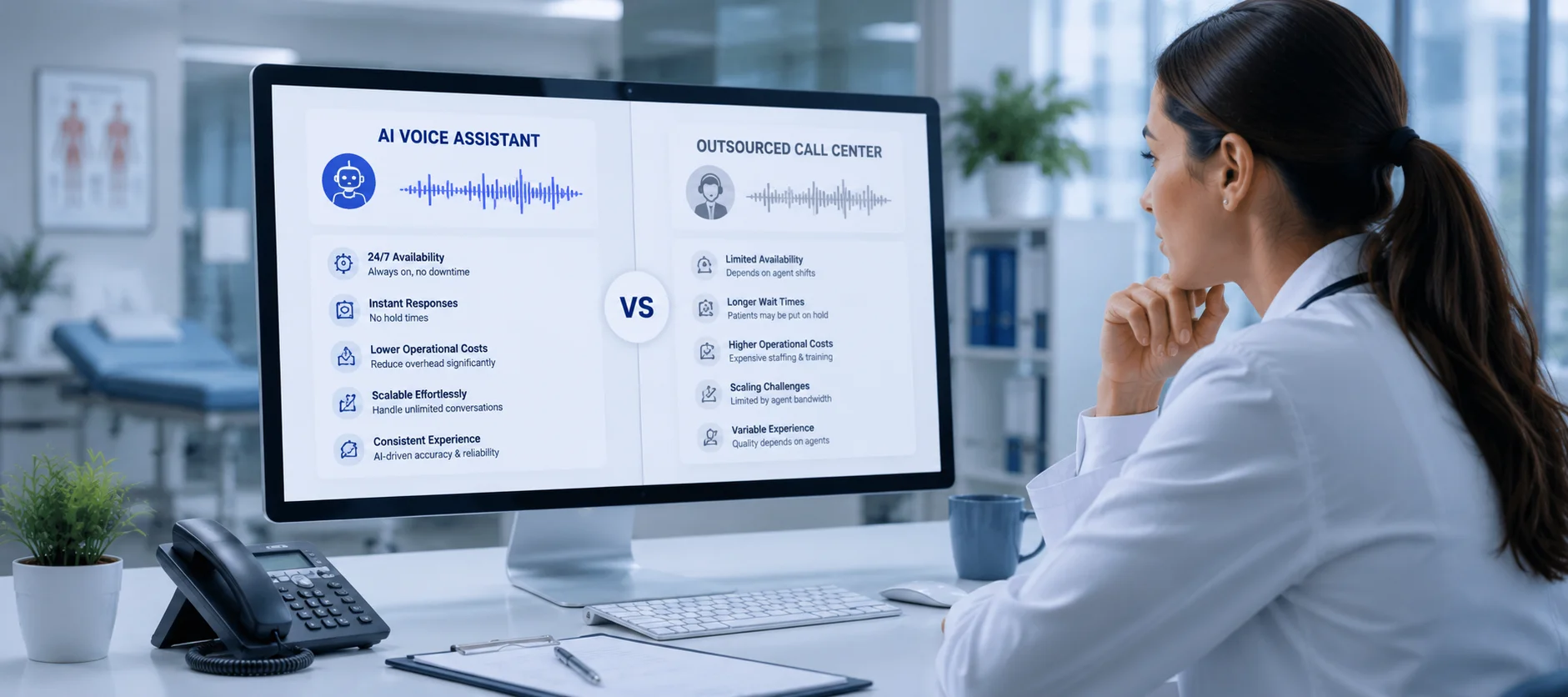
AI Voice Assistant vs Outsourced Call Center: Key Differences
If you are exploring ways to manage patient calls more efficiently, you’ve probably looked at options like outsourced call centers or AI voice assistants. Both aim to reduce the pressure on your front desk team and help your practice handle growing call volumes. But the way they actually work is very different.
Here’s a simple side-by-side comparison to see how the two approaches stack up.
These differences can have a real impact on how smoothly your operations run. If you manage a healthcare organization handling large patient volumes, even small improvements in how calls are handled can make a big difference in patient access and staff productivity. That’s exactly why you must explore tools like an AI receptionist for medical practices to make patient communication easier to manage.
Real World Outcomes Healthcare Organizations Care About
When healthcare leaders evaluate new ways to manage patient communication, they usually focus on real operational results. It’s not just about answering more calls. The goal is to improve patient access, reduce pressure on staff, and make day-to-day operations run more smoothly. These outcomes help determine whether a communication solution actually delivers real value.
Call Volume Management
Healthcare organizations deal with extremely high volumes of patient communication every day. Calls come in for scheduling, prescriptions, insurance questions, and follow-ups. When too many calls arrive at once, requests start piling up, and patients struggle to reach someone. Systems that can handle large volumes of calls simultaneously help prevent backlogs and keep patient communication moving smoothly.
Appointment Confirmation Rates
Missed appointments are one of the biggest sources of lost revenue in healthcare. When patients forget visits or cancel late, it creates gaps in provider schedules and reduces operational efficiency. Improving confirmation rates helps ensure appointment slots stay filled. Automated reminders and confirmations make it easier for patients to respond and keep their scheduled visits.
Patient Satisfaction
Patients expect quick responses when they contact a healthcare provider. Long hold times or unanswered calls often create frustration and negatively affect the patient experience. When patients cannot easily reach a practice, they may delay care or choose another provider. Faster response times and smoother communication access can significantly improve patient satisfaction.
Staff Workload Reduction
Your front desk teams handle many responsibilities throughout the day. They assist patients in person, manage paperwork, coordinate with providers, and answer a constant stream of phone calls. And when call volume becomes overwhelming, their productivity naturally drops, and burnout becomes more likely. So reducing their routine phone work will allow your teams to focus more on patients and less on paperwork.
Operational Cost Control
Healthcare organizations also need to manage operational costs while maintaining high-quality patient access. Traditional call center models end up becoming more expensive as call volume grows. Solutions that scale efficiently without requiring additional staff can provide much stronger long-term value. Over time, improving this communication efficiency can significantly reduce your admin costs.
Patient Data Safety And Compliance
Patient communication also involves sensitive health information, which means safety and compliance are critical. Healthcare organizations must ensure that any communication system protects patient data and follows healthcare regulations. Secure systems with proper safeguards help maintain your patients' trust and protect your organization from compliance risks. Reliable communication tools must prioritize both operational efficiency and patient data security.
Why Some Healthcare Organizations Are Choosing Confido Health Instead of Call Centers
While call centers can help answer phones, they sit outside your clinic’s workflow and mostly pass messages back to staff instead of actually resolving requests. On the other hand, Confido Health’s AI Voice Assistant is purpose-built for healthcare administration and is designed to manage patient calls end-to-end while integrating directly with your EHR/PMS and telephony infrastructure.
Here’s why more healthcare organizations are choosing Confido Health’s Voice AI to support their patient communication workflows:
- Staff hours recovered: Practices often save 4 to 5 staff hours per provider per day by offloading routine phone tasks to Confido Health’s AI Voice Assistant.
- Higher workflow completion: The system can resolve up to 95 percent of common patient communication workflows without needing staff intervention.
- Improved patient satisfaction: Many organizations report around 97 percent patient satisfaction as calls are answered quickly and requests are handled faster.
- Zero unattended voicemails: Calls are answered instantly, helping eliminate missed calls and voicemail backlogs.
- Reduced appointment cancellations: Automated reminders and confirmations help reduce cancellations and keep provider schedules full.
- Faster patient support resolution: Patients can resolve many requests during the call instead of waiting for staff to call them back.
- Equivalent capacity of multiple staff members: Confido Health can handle thousands of patient calls simultaneously, providing the capacity of several full-time front desk staff.
- Supports staff instead of replacing them: The system handles repetitive phone tasks so front desk teams can focus on helping patients inside the clinic.
- Higher scheduling accuracy: Direct integration with EHR/PMS and scheduling systems helps ensure appointments are booked correctly.
- Revenue growth through better access: When calls are answered instantly and appointments are scheduled faster, practices capture more patient demand.
- Deep EHR/PMS integration: Confido Health connects directly with healthcare systems, allowing requests to be completed during the call rather than passed to staff later.
- Enterprise-grade security and compliance: Built specifically for healthcare, Confido Health is HIPAA-compliant and prioritizes patient data protection and regulatory compliance.
- Scales across multiple providers and locations: The system can manage patient communication across 500+ locations up to 1000+ providers without requiring additional staffing.
- Handles thousands of calls simultaneously: High call volumes can be managed without patients waiting on hold.
- Fast workflow deployment: AI communication workflows are typically configured and launched within 4 to 6 weeks.
- Quick operational impact: Healthcare organizations often begin seeing measurable improvements within 60 to 90 days.
- Consistent patient communication: Every call follows the same high-quality workflow, reducing variability in patient experience.
- Better patient access to care: Faster call responses and easier scheduling help patients get care when they need it.
Confido Health isn’t a plug-and-play tool. It’s infrastructure that sits inside your healthcare workflow, helping your team manage growing call demand while keeping patient communication fast and reliable.
Conclusion
Picture this: phones ringing nonstop, patients stuck on hold, and staff trying to manage calls while helping people in person. It gets chaotic fast. Patient calls aren’t slowing down either. If anything, they keep increasing, and most of that pressure lands on the front desk. Outsourced call centers can help for a while, but they often don’t solve the deeper workflow problems inside healthcare organizations.
That’s where AI voice assistants come in. These systems operate directly inside healthcare workflows and can actually complete patient requests during the call itself. So instead of just taking messages or transferring calls, they help schedule appointments, answer questions, and handle routine tasks right away. The result is faster responses for patients and far less pressure on your staff. Curious how this works in real healthcare environments? Talk to our Confido Health team and see how our AI Voice Assistant supports modern healthcare operations!
FAQs
What is the difference between a voice assistant and AI?
AI is the technology that helps systems understand information and make decisions. A voice assistant is one way AI is used in practice. It lets people talk to a system naturally to get things done, like scheduling appointments or asking questions.
Can AI answer patient calls in healthcare?
Absolutely! Healthcare-focused systems like Confido Health’s AI Voice Assistant can answer patient calls, understand what the patient needs, and manage entire workflows end-to-end. It can even route calls to staff when needed.
Are AI voice assistants cheaper than outsourced call centers?
In the longer run, yes. Call centers usually charge per agent or per call, so costs grow as call volume increases. Voice AI agents can handle thousands of calls at once, which makes it easier for healthcare organizations to scale without constantly adding staff.
Are AI voice assistants always listening?
No, they aren’t. Voice AI systems typically activate only when a call starts or when someone interacts with them. Platforms like Confido Health’s Voice AI take security and compliance seriously and operate only during patient calls. They are not constantly listening to conversations.
Is AI making call center agents better or replacing them?
AI is there to support teams, not replace them. Confido Health’s Voice AI can handle your team’s repetitive phone tasks so they can focus on patients who need human help or in-person care.
Which AI has the best voice assistant?
Different AI voice assistants serve different industries, but healthcare requires systems designed specifically for clinical workflows. Platforms like Confido Health’s AI Voice Assistant are built for healthcare operations, with deep integration into EHR/PMS and patient communication workflows.
Do AI voice assistants integrate with EHR systems?
Yes, modern healthcare voice AI platforms integrate directly with your EHR/PMS and telephony platforms. For example, Confido Health’s Voice AI agent works inside these systems, so tasks like appointment scheduling can happen during the call itself.
Are AI voice assistants safe and compliant for healthcare?
Absolutely. AI receptionists for medical practices follow strict security and compliance standards. Confido Health’s AI Voice Assistant is built with enterprise-grade HIPAA-compliant safeguards and healthcare security protocols to ensure your patients' data is protected at every stage of the communication workflow.
.webp)
