

.svg)
- Healthcare organizations are rethinking traditional call handling models as rising patient expectations, growing call volumes, and staff burnout create pressure across front-office operations.
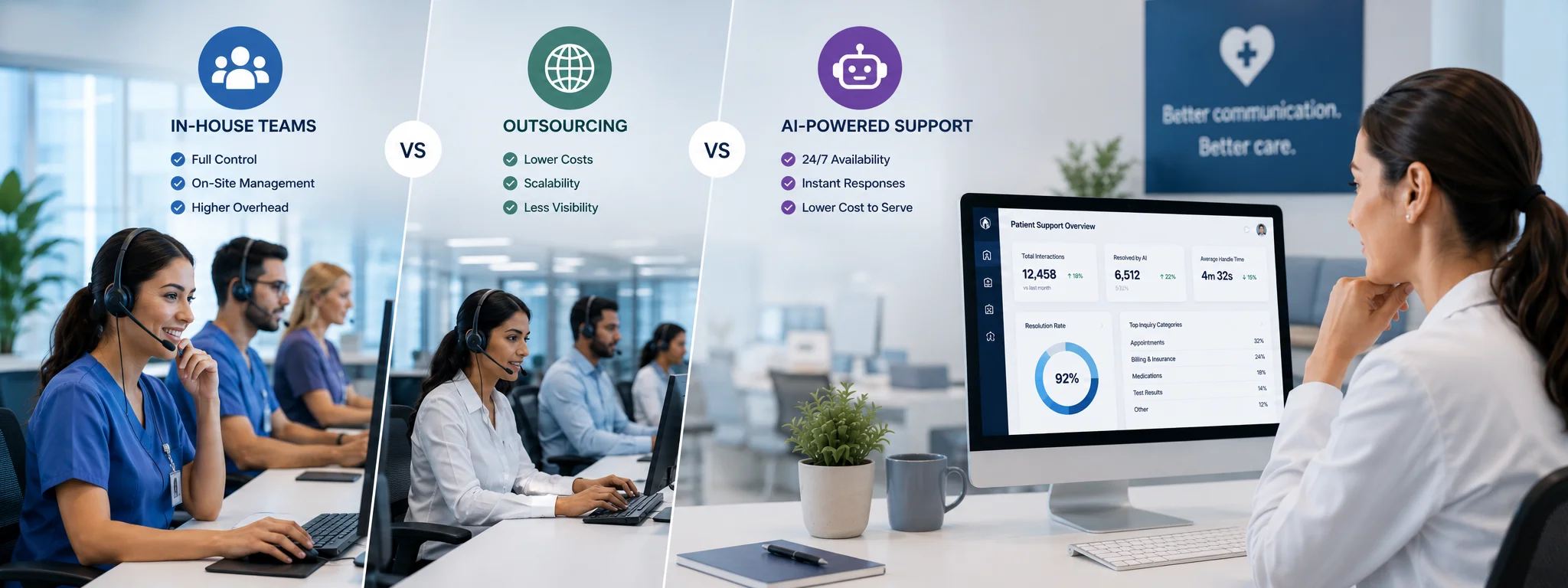
- This blog compares in-house teams, outsourced call centers, and AI Voice Assistants to show how each model impacts patient access, workflow efficiency, and operational scalability.
- Discover where traditional staffing models struggle, why outsourced call centers often create workflow gaps, and how AI is shifting communication from simple call handling to full workflow execution.
- The article also explores how AI Voice Assistants improve scheduling, billing conversations, insurance coordination, multilingual support, and after-hours patient engagement in real time.
- Most importantly, it highlights why healthcare organizations are adopting AI-powered communication infrastructure to reduce operational strain, improve patient experience, and scale patient access more efficiently.
Introduction
Picture three different patients calling their healthcare provider on the same Monday morning. The first patient gets through right away. An AI Voice Assistant answers, understands what they need, and books the appointment before the call even ends. The second patient reaches an outsourced agent. Their details are noted, they are told someone will follow up, and the request is passed back to the internal team to handle later. The third calls the in-house front desk, waits on hold during a busy period, and finally speaks to someone who knows their history and resolves a complex scheduling situation that needed real judgment to handle well.
Same organization, same problem, three very different experiences - all depending on which call handling model was behind that interaction and whether it was the right one for that specific situation. In-house teams, outsourced call centers, and AI Voice Assistants are not just variations of the same thing. They work differently, cost differently, and deliver very different results depending on what your organization actually needs them to do.
Keep reading to learn more about these three models, where each one works, where each one falls short, and what makes the most sense for where your organization is today and where it is headed.
Why Healthcare Organizations Are Rethinking Their Call Handling Model
The pressure to rethink call handling is not coming from one direction - it is coming from all sides at once. And for most healthcare organizations, the question is no longer whether to change the model, but when.
Rising Patient Expectations for Speed and Access
Patients today are not comparing their healthcare communication experience to other healthcare organizations. They are comparing it to every service they use in their daily life - where things are fast, responsive, and resolved on the first interaction. When a patient calls your organization and is put on hold for 10 minutes, or leaves a voicemail that gets returned two days later, they are not thinking about the complexity of running a healthcare operation. They are thinking about how easy it would be to find a provider who picks up. That shift in expectation is real, and it is not going back.
Increasing Call Volumes and Operational Strain
The volume of patient communication has grown substantially over the past several years. More patients, more services, more chronic conditions requiring ongoing management, more administrative touchpoints across the care journey. So if your organization is relying primarily on people to handle this volume, you would've already noticed that the math has stopped working. You cannot hire fast enough to keep pace with growing demand. And even if you could, the cost of doing so is increasingly difficult to justify.
Direct Impact of Communication Gaps on Revenue and Care Outcomes
Missed calls and unresolved patient interactions are not just an operational inconvenience. They have direct financial and clinical consequences. A patient who cannot get through to schedule does not always try again. An appointment that goes unconfirmed is more likely to become a no-show. A referral that falls through the cracks represents lost revenue and compromised continuity of care. These gaps are not abstract risks - they are measurable losses that accumulate quietly across every organization running an understaffed or under-resourced call handling operation.
Limitations of Traditional Staffing-Led Call Handling Models
The traditional way of managing calls and scheduling was built for a much simpler setup. A few staff members handling phones and bookings worked when volume was lower, and things were more predictable. But that model struggles today. It depends on limited staff, stops after hours, and slows down when demand spikes. Small gaps turn into missed calls, delayed responses, and inconsistent experiences across locations. As patient expectations grow and admin work keeps increasing, the gap becomes hard to ignore. What used to be manageable now starts holding teams back and affecting both access and efficiency.
The Three Models of Healthcare Call Handling
Let us deep dive into how each model actually works - not just in theory, but in the day-to-day reality of a healthcare organization trying to manage patient communication at scale.
In-House Teams: Control With Built-In Capacity Limits
For most healthcare organizations, this is where patient communication started. And for many, it is still where most of it lives today. Here is what that actually looks like in practice.
How In-House Teams Operate Across Workflows
In-house call handling means your own staff - typically front desk teams and patient access coordinators managing patient communication directly. Here is what that looks like on the ground:
- Internally managed workflows: Scheduling, billing queries, referral coordination, prescription questions, and insurance verification are all handled by your own team using your own systems
- Front desk dependency: The model runs on the availability and capacity of your front desk and call center staff. Which means it is only as strong as the people showing up that day
- Manual coordination: Information moves between teams and systems through manual effort - someone updates the EHR/PMS, someone flags the follow-up, someone reconciles what was said on the call with what the record shows
- Institutional knowledge at the center: Your team understands your workflows, your providers, and your patients in a way that no external model inherits automatically. And that knowledge is genuinely valuable for complex interactions
Where In-House Teams Perform Well
In-house teams genuinely shine when an interaction needs more than just a correct answer - it needs judgment, context, and a human who actually knows the patient.
- Deep patient context: Your team knows the history, the preferences, and the nuances that make a difference in sensitive or complex interactions, a context that an external team or automated system has to be given, rather than already having
- Trust and communication quality: Patients often feel more comfortable discussing sensitive topics with someone who feels like part of the practice, and that comfort translates into trust that takes years to build
- Workflow alignment: Because your team works inside your systems every day, they understand the rules, the exceptions, and the operational nuances that make your practice run the way it does
- Better handling of edge cases: When something falls outside a standard workflow, in-house staff have the judgment and the system access to handle it without escalating to someone else
Where In-House Teams Face Limitations
The honest limitation of in-house teams is structural, not personal. Their capacity is directly tied to how many people you have and when they are available:
- Headcount-bound capacity: When call volume spikes, your team absorbs the pressure, or the calls go unanswered. There is no flexible middle ground built into this model
- Missed calls and delays at peak: During busy periods, hold times climb, voicemails pile up, and patients who cannot get through often do not try again
- Burnout and inconsistency: High volumes of repetitive, routine interactions like scheduling calls, confirmations, and basic billing questions take a real toll over time, creating retention challenges and inconsistency in how interactions are handled across teams and locations
- Coverage gaps after hours: When your staff goes home, your communication stops - which means every evening and weekend generates a backlog that your team has to work through the following morning
Cost Structure of In-House Teams
The true cost of an in-house model is almost always higher than it first appears on the payroll line:
- Cost per employee vs cost per completed workflow: Base salaries are just the starting point - add benefits, training, management overhead, and recruitment costs driven by turnover, and the total cost per resolved patient interaction climbs significantly
- Ongoing hiring and attrition cycles: Healthcare administrative roles carry high turnover rates, which means your organization is perpetually in some stage of recruiting, onboarding, or covering for departures
- Opportunity cost of repetitive call handling: Skilled, experienced staff spending the majority of their day on interactions that could be automated is a cost that rarely appears on a report, but shows up everywhere in operational efficiency
- Peak demand inefficiency: Staffing to handle peak demand means you are paying for capacity that sits underutilized during quieter periods, and still falling short during the busiest ones
Outsourced Call Centers: Coverage Without Full Ownership
Outsourcing sounds like a logical solution when your in-house team is stretched. And in certain situations, it genuinely is. But the reality is, it does not always solve the core problem. The gap becomes clearer when you look at what patients actually experience. The average hold time in US healthcare call centers is around 4.4 minutes, far above the 50 second benchmark. So even with added capacity, delays and handoffs can still persist. That is why it is important to understand where outsourcing truly helps and where it falls short before committing to it.
How Outsourced Call Centers Operate
Outsourcing means contracting an external organization to manage patient communication on your behalf. Here is how that typically works:
- Delivery model options: External providers operate onshore, offshore, or through hybrid models - each with different cost structures, language capabilities, and operational trade-offs
- Overflow and after-hours use cases: Outsourcing is most commonly used for overflow management during peak periods, after-hours coverage, or high-volume interaction types that do not require deep clinical context
- Script-based workflows: External teams work from predefined scripts and handle a defined set of interaction types - anything outside that scope gets escalated back to your internal team
- No system ownership: External agents operate outside your EHR/PMS and internal systems, which fundamentally limits what they can resolve on behalf of your patients
Where Outsourcing Performs Well
Outsourcing delivers value in specific, well-defined scenarios where simplicity and volume are the primary requirements:
- Expands coverage without internal hiring: You can increase call handling capacity during peak periods or after hours without going through recruitment and training cycles
- Handles predictable, high-volume interactions: For simple, scripted interactions - basic confirmations, standard reminders, overflow during busy periods - external teams can absorb volume without meaningfully affecting patient experience
- Enables basic 24/7 availability: For organizations that need some level of after-hours presence without the investment of a round-the-clock in-house operation, outsourcing provides a relatively quick solution
- Lower upfront investment: Compared to building out an in-house team, outsourcing can be stood up faster and with less operational overhead in the short term
Where Outsourcing Faces Limitations
The moment an interaction moves beyond simple and scripted, outsourced call centers start to struggle, and in healthcare, that happens more often than the initial pitch suggests:
- Limited EHR/PMS access: External teams typically cannot access your clinical systems, which means they cannot complete workflows - only capture requests for your internal team to action later
- Script-based interactions lacking context: External agents work from scripts, not from knowledge of your organization. For anything requiring familiarity with your providers, your scheduling rules, or your patient population, that limitation shows up immediately
- Frequent escalations back to internal teams: When interactions exceed the script, they come back to your team, which means the workload reduction outsourcing promised often does not materialize the way leadership expected
- Inconsistent patient experience: External agents are managing calls for multiple clients simultaneously. Patients calling your organization may receive an experience that feels generic or disconnected, which erodes the trust your in-house team has spent years building
Cost and Efficiency Structure of Outsourcing
The per-call cost looks attractive. The cost per resolved workflow tells a different story:
- Cost per call vs cost per resolved workflow: The surface-level cost comparison favors outsourcing - until you factor in how many interactions are not actually resolved by the external team and still require internal follow-up
- Hidden inefficiencies from handoffs and rework: Every escalation back to your internal team represents time, cost, and a patient who is still waiting. Those handoffs accumulate into a significant operational burden that rarely gets attributed back to the outsourcing model in a cost analysis
- Fragmented ownership of patient interactions: When no single team owns a patient interaction from start to finish, things fall through the cracks, and patients are the ones who feel it most directly
- Rework costs on incomplete interactions: The internal staff time spent completing what the external provider could not is the real hidden cost of outsourcing in healthcare - and in many organizations, it is substantial
AI Voice Assistants: From Call Handling to Workflow Execution
This is where the conversation shifts from managing a problem to genuinely solving it. AI Voice Assistants are not a more efficient version of the previous two models - they represent a fundamentally different way of thinking about patient communication.
How AI Voice Assistants Operate
Rather than routing calls to people who then complete tasks manually, AI Voice Assistants handle the full interaction - the conversation and the workflow behind it - in a single execution:
- Human-like, empathetic conversations: AI Voice Assistants handle patient interactions in a natural, conversational way that patients respond to - not the robotic, menu-driven experience most people associate with automated phone systems
- Workflow execution, not just response: The AI does not just answer questions or capture requests - it completes the task behind the interaction directly inside your EHR/PMS in real time
- Always-on operation: Unlike in-house teams or outsourced agents, AI Voice Assistants operate continuously - the same quality, the same capability, at two in the afternoon or two in the morning
- Concurrent handling at scale: One AI Voice Assistant can handle thousands of simultaneous calls without queues, hold times, or performance degrading under volume
Where AI Performs Strongly
AI Voice Assistants perform at their best in exactly the conditions that strain in-house teams and expose the limitations of outsourcing:
- High call volumes without delays: Thousands of concurrent patient interactions handled simultaneously. No hold times, no missed calls, no voicemail backlogs, regardless of demand
- Consistent, real-time patient responses: Every patient gets the same quality of interaction regardless of which location they contact, what time they call, or how many other calls are happening at the same time
- Routine workflow execution without staff involvement: Scheduling, rescheduling, insurance verification, billing queries, prescription refill coordination - all resolved within the same interaction without your team having to step in
- After-hours coverage with full capability: Not just basic availability after hours - full scheduling and workflow execution capability around the clock, every day
Where AI Creates Operational Advantages
What makes AI Voice Assistants particularly powerful in healthcare extends well beyond the call itself:
- End-to-end workflow completion: AI does not hand off - it finishes. Scheduling confirmed, EHR/PMS updated, follow-up triggered, all before the call ends
- Direct EHR/PMS and telephony integration: Every action is executed inside your existing systems in real time. No manual bridging, no reconciliation, no data entry required after the fact
- Operational data from every interaction: Call volumes, query types, scheduling patterns, peak demand periods - all captured automatically and surfaced through real-time dashboards that give leadership visibility that simply does not exist in staffing-led models
- Staff capacity freed for meaningful work: When AI absorbs routine interactions, your team focuses on the complex, sensitive, judgment-dependent work that actually benefits from a human being doing it, which improves both staff satisfaction and patient experience for those interactions
Value and Efficiency Model of AI
The economics of AI Voice Assistants shift the conversation from cost per call to cost per completed workflow, and that shift changes everything:
- Cost per outcome, not just interaction: When requests are fully handled instead of passed along for follow up, fewer people need to step in. That naturally brings down the overall cost of getting things actually done.
- More capacity without more hiring: When routine work is taken off your team’s plate, they have more time for higher value tasks. This added capacity shows up consistently, without depending on hiring or staffing changes.
- Always available, consistently handled: With fewer missed calls and minimal voicemails, patients get timely responses and tasks move forward without unnecessary delays, even during busy periods.
- Clear impact, quickly visible: When routine communication is handled more efficiently, the difference shows up fast. Improvements in workflows, response times, and overall operations become noticeable within a short span.
Comparing These Three Models: Where Each One Wins and Fails
What Call Center Modernization Really Means in Healthcare
The phrase call center modernization gets used a lot. But being specific about what it actually means is important, because the definition matters for how you approach it.
Moving From Call Handling to Workflow Execution
The most important shift in healthcare call center modernization is not technological - it is conceptual. The goal is not to answer calls faster. It is to complete the work behind the calls more efficiently. A model that handles calls but still requires human intervention to resolve them has not modernized anything meaningful. True modernization means the interaction and the workflow behind it are handled in one continuous execution - without handoffs, without callbacks, without the patient having to follow up to find out if their request was actually processed.
Connecting Patient Interactions Into a Single Continuous Journey
Modern patient communication is not a series of isolated calls. It is a continuous journey, right from the first scheduling interaction through reminders, intake, follow-up, recall, and everything in between. Modernization means connecting all of those touchpoints into a coherent experience, where information flows between systems automatically, and the patient never has to repeat themselves or wonder what happened to their last request.
Reducing Dependency on Staffing for Operational Capacity
One of the most significant outcomes of genuine modernization is that operational capacity stops being directly tied to headcount. When AI handles routine, high-volume interactions, your organization can manage growing patient communication demands without a proportional increase in staff. That does not mean fewer staff - it means staff whose time is being used for work that actually benefits from a human being doing it.
Enabling Always-On Patient Access and Responsiveness
Patients do not organize their healthcare needs around your business hours. They call in the evening, on weekends, during the gaps in their day when they finally have a moment to sort out an appointment. Modernization means your organization is available when patients need it - not just when your team is in the office.
Integrating Communication With EHR/PMS and Core Systems
Patient communication that does not connect to your clinical and operational systems is not really integrated - it is just another layer of manual work. Genuine modernization means every patient interaction, regardless of channel or time of day, results in the right information being captured and actioned in your EHR/PMS automatically. That integration is what eliminates the manual bridging work that absorbs so much of your team's time and creates so many of the errors that downstream teams have to spend their day fixing.
How to Decide What Works for Your Healthcare Organization
There is no single right answer for every healthcare organization. The right model depends on your scale, your complexity, your current pain points, and where you are trying to go. Here is how to think through it:
Evaluating Operational Scale and Complexity
Start with an honest assessment of what your organization is actually dealing with. The volume of daily calls, the complexity of the workflows behind them, the number of locations involved, and the proportion of interactions that genuinely require human judgment versus ones that are routine and repeatable - all of these shape what kind of model you actually need.
Defining Workflow Ownership Requirements
There is a huge difference between a model that answers and routes calls and one that completes the workflows behind them. Being specific about which one you need is one of the most important steps in this evaluation - and one of the most commonly skipped. Understanding exactly where workflow ownership needs to sit and choosing a model that can actually deliver it is what separates a genuine improvement from a repackaged version of the same problem.
Assessing Impact on Staff and Provider Capacity
Think about what your current call handling model is costing your staff in time, attention, and energy - not just in payroll. A better call handling model gives your people back the capacity to do the work that actually benefits from their skills - and over time, that shift shows up in retention, in engagement, and in the quality of the interactions that genuinely need a human touch.
Setting Patient Experience Expectations
Before evaluating any model, define what a good patient communication experience actually looks like for your organization in specific, measurable terms. Response times, first-interaction resolution rates, after-hours availability, consistency across locations - these become your evaluation criteria. Without them, it is very easy to be impressed by a demo that does not actually reflect how the model will perform in day-to-day reality.
Evaluating Integration With Existing Systems
Any call handling model you adopt needs to work within your existing infrastructure - your EHR/PMS, your telephony setup, your internal workflows. This is where surface-level evaluations most commonly miss the details that matter most. Understanding specifically how each model connects to your systems, what real-time integration looks like in practice versus what gets called integration in a sales conversation, and what happens when something in that connection breaks. These are the questions that determine whether a model actually reduces your team's workload or just moves parts of it around.
Determining Long-Term Scalability Needs
The most expensive mistake in this decision is choosing a model based on your current scale rather than where you are headed. A solution that manages today's volume comfortably but cannot handle the complexity of three more locations or a hundred more providers is not a long-term answer - it is a short-term fix that will require a complete rebuild sooner than anyone expects. Choose infrastructure that can grow with your organization rather than one that needs to be replaced every time it does.
Choosing the Right Model: When Each Approach Works Best
The right approach is not just about volume. It is about the kind of organization you are running and the type of work you need handled. Each model plays a different role when used correctly.
When to Choose In-House Teams
- Complex care settings: Best suited for hospitals, specialty clinics, and care environments where conversations require clinical context and a deeper understanding.
- Relationship-driven practices: Works well in setups where patient trust and continuity with providers matter a lot.
- Sensitive interactions: Ideal for escalations, complaints, or situations where empathy and ownership cannot be compromised.
- Final decision layer: Most effective when positioned to handle edge cases and complex scenarios, not routine call volume.
When to Choose Outsourcing
- High-volume, early-stage groups: Useful for growing organizations that need quick support without building internal capacity immediately.
- Overflow and peak coverage: Works well during predictable spikes or seasonal demand where extra bandwidth is needed.
- Basic after-hours support: Can handle simple queries when your internal team is unavailable.
- Limited workflow environments: Best for structured, script-based interactions where deep system access is not required.
When to Choose AI Voice Assistants
- Multi-location organizations: Especially valuable for clinics managing multiple sites where consistency across locations is critical.
- High administrative load: Ideal when teams are spending significant time on repetitive tasks like scheduling, follow-ups, and billing queries.
- Access-driven environments: Strong fit for organizations struggling with missed calls, long wait times, or after-hours gaps.
- Completes work, not just conversations: Ensures requests are fully resolved in real time instead of being passed along for follow-up.
- Always available, no waiting: Responds instantly at any time, eliminating hold times and after-hours gaps.
- Scales instantly with demand: Handles spikes in volume without delays or drop in quality.
How Confido Health Executes Patient Communication at Scale
Confido Health's AI Voice Assistant is built for healthcare organizations where patient communication has become too complex and too high-volume to manage effectively with traditional models alone. Here is what it actually delivers:
End-to-End Handling of Patient Calls Across Workflows
Confido Health's AI Voice Assistant does not route calls - it resolves them. Every patient interaction is handled from the first word to a completed outcome, with the relevant action executed inside your EHR/PMS in real time before the call ends. Scheduling confirmed - record updated - follow-up triggered. No callbacks, no voicemails, no handoffs to staff to finish what the system started.
Intelligent Appointment Scheduling Across Multiple Providers and Locations
Confido Health's Voice AI applies your organization's scheduling rules, provider preferences, specialty requirements, location routing logic, referral checks, and visit type requirements to every booking automatically and consistently. Patients are matched to the right provider at the right location based on your operational rules, without staff needing to make manual routing decisions on every call.
Real-Time Execution Within EHR/PMS and Telephony Systems
With 40+ live EHR/PMS integrations, including Epic, Athenahealth, eClinicalWorks, ModMed, NextGen, and Tebra, every action taken during a patient interaction is written directly into your systems the moment it happens. Confido Health's AI Voice Assistant also works within your existing telephony infrastructure - no changes to your phone setup required.
HIPAA-Compliant Handling of Patient Conversations and Data
Every interaction handled by Confido Health's Voice AI takes place within a fully HIPAA-compliant infrastructure - end-to-end encryption, role-based access controls, audit trails, and a Business Associate Agreement covering every patient touchpoint. Compliance is not a feature that gets added on - it is built into how the system operates.
Multilingual Patient Communication Across Diverse Populations
Confido Health's AI Voice Assistant supports patient conversations in 20+ languages, ensuring that language is never a barrier to accessing care or completing a scheduling interaction. For organizations serving diverse patient populations, this means every patient gets the same quality of experience regardless of their language preference.
Billing, Payments, and Insurance Conversations Within Workflows
Patients can ask about coverage, balances, copays, and payment plans within the same interaction - without being transferred or told to call a different number. Insurance eligibility verification and benefits explanations are handled as part of the workflow rather than as a separate process that requires additional staff involvement.
Prescription, Referral, and Care Coordination Workflows
Confido Health's AI Voice Assistant goes beyond appointment scheduling to handle prescription refill requests, referral coordination, specialist scheduling, and care follow-up - reducing the administrative load on clinical teams and keeping patient care workflows moving without interruption.
Always-On Patient Communication With Consistent, Human-Like Interactions
Confido Health's Voice AI is available around the clock - handling patient calls with the same quality and consistency at two in the morning as it does at two in the afternoon. Patients experience natural, empathetic conversations that feel nothing like navigating a phone menu, and they walk away with a resolved request rather than a voicemail and a wait.
The Future of AI-Augmented Healthcare Operations
The trajectory of AI in healthcare call handling is not inching towards replacing the human elements that matter. It is more about removing the operational friction that has been preventing healthcare organizations from delivering the kind of patient access and experience that patients now expect and deserve.
Patient Access Without Calls, Queues, or Wait Times
The near future of patient communication is one where no patient waits on hold to complete a routine interaction. Where access is immediate, always available, and resolved in a single interaction rather than across multiple callbacks and handoffs. AI is what makes that architecture possible at the scale modern healthcare organizations operate at.
Self-Driving Workflows That Complete Care Tasks End-to-End
As AI capability in healthcare matures, the scope of what AI can execute autonomously will expand beyond scheduling and billing into more complex care coordination workflows - pre-visit preparation, post-visit follow-up, care gap identification, chronic care management outreach. The organizations building AI infrastructure now are the ones who will be positioned to leverage those capabilities as they become available.
Fully Connected Systems That Coordinate Care Across Providers in Real Time
The longer-term vision is a healthcare communication infrastructure where every patient interaction connects seamlessly into the broader care ecosystem - updating records, coordinating across providers, triggering the right follow-up, and keeping the patient informed throughout. That level of connectivity is not science fiction. It is where the best-built AI infrastructure is heading, and it represents a genuine transformation in how healthcare organizations can deliver care coordination at scale.
Conclusion
In-house teams, outsourced call centers, and AI Voice Assistants are not really solving the same problem in the same way. Each one plays a different role, and the difference shows up quickly in how efficiently things actually get done. What high-performing organizations do differently is that they do not rely on one model for everything. They lean on in-house teams where judgment and context matter, use outsourcing where it fits, but increasingly shift routine, high-volume work to AI where it can be handled faster, more consistently, and without adding pressure on teams. That balance is what allows communication to not just function, but actually scale as the organization grows.
So if your current model is asking too much of your team, leaving patient interactions unresolved, and creating gaps in access that are costing you patients and revenue, it is worth having a real conversation about what a more capable infrastructure looks like. Get in touch with the Confido Health team for a demo and see how Confido Health’s AI Voice Assistant can make patient communication smoother across your organization!
FAQs
When should a healthcare organization choose AI over outsourcing?
Choose AI when the real issue is getting work done, not just answering calls. Confido Health’s AI Voice Assistant completes tasks end-to-end inside your EHR/PMS, so your team is not left finishing the job later.
How do you measure the true performance of a healthcare call center beyond call volume?
Call volume only shows how busy things are. What really matters is whether tasks are completed, how quickly patients are helped, how much rework is needed, and how patients feel after the interaction.
What is the difference between call handling and workflow completion in patient communication?
Call handling is just the conversation. Workflow completion is actually finishing the task behind it, like booking the appointment or updating records. Confido Health’s AI Voice Assistant does both in one go.
Why do outsourced call centers struggle with healthcare-specific workflows?
Most outsourced teams do not have deep access to your systems or workflows. So they capture requests but pass the work back to your team, which creates delays and extra effort behind the scenes.
How does AI integrate with EHR/PMS systems without disrupting existing operations?
The right setup fits into what you already use. Confido Health’s AI Voice Assistant connects directly with your EHR/PMS and phone systems, working in real time without changing how your team operates.
What operational risks should healthcare organizations consider when modernizing call handling?
The main risks are poor integrations, data security gaps, and inconsistent patient experiences. With the right platform and setup, these are manageable and can be avoided early on.
How does improving patient communication directly impact provider capacity and revenue?
When communication runs smoothly, schedules stay full, and teams spend less time fixing issues. Confido Health’s Voice AI helps save hours per provider each day, which directly opens up more capacity and reduces lost revenue.
.webp)
