

.svg)
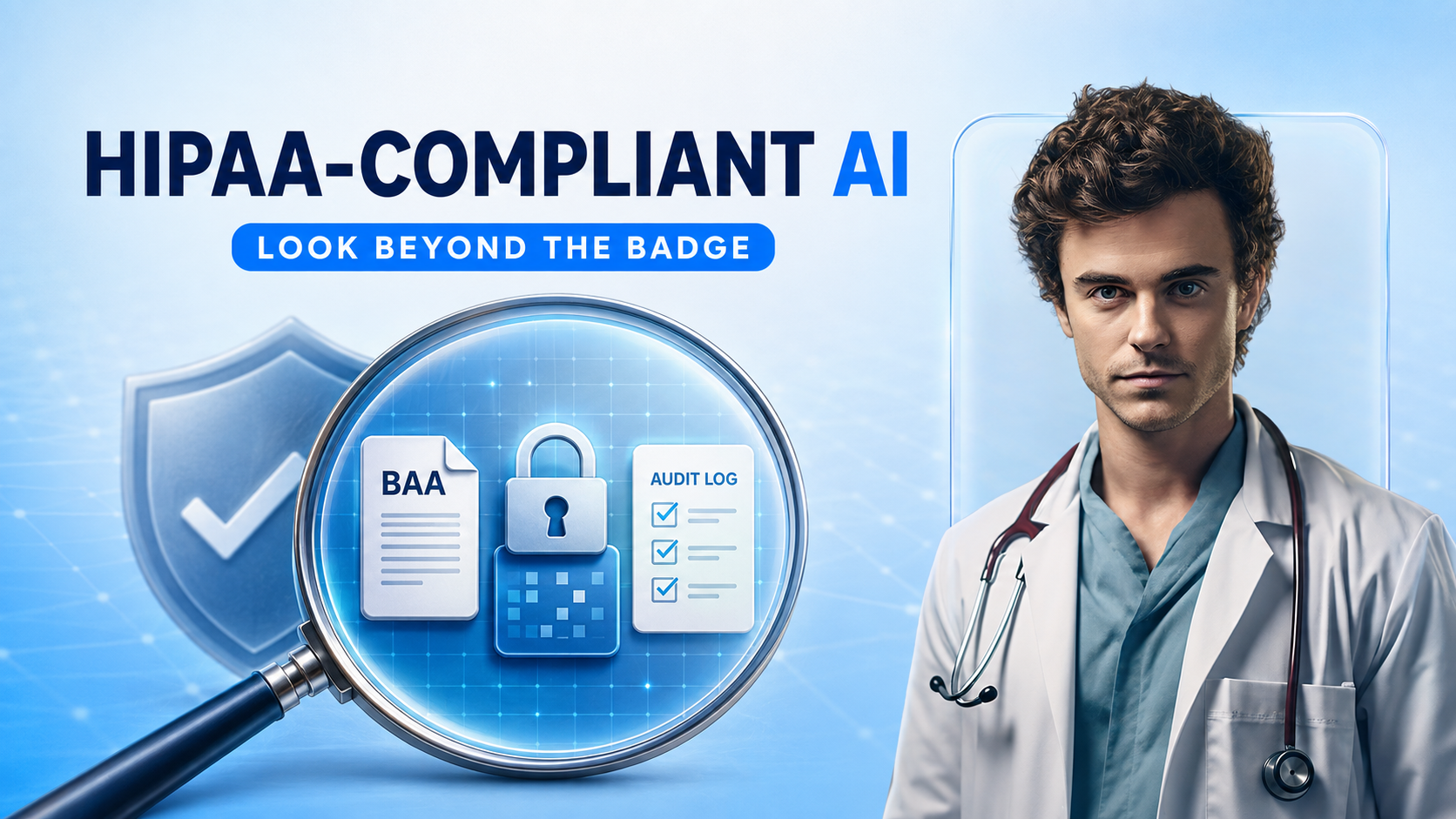
- The compliance badge is the easiest thing on the page to print, so it is the last thing you should trust.
- The real signal is not the certificate, it is whether a vendor will sign a specific, well-written Business Associate Agreement and stand behind it.
- The clause most standard contracts leave out is the one that bars your patients' data from training the vendor's models.
- The surprising risk is that the lighter, safer-looking tool often leaks more PHI, because it creates manual workarounds outside the governed system.
- Compliance is layered, so verify encryption, audit trails, subcontractors, and data ownership with evidence, not adjectives.
- For the category view, see HIPAA-compliant patient communication software compared.
You Have the Vendor's HIPAA Badge. Are You Actually Covered?
You are three demos into an evaluation, and every vendor said the same two words: HIPAA compliant. Each one showed a badge, each one mentioned SOC 2, and each one moved on quickly. On paper, you are covered. So why does the decision still feel unsettled?
That unsettled feeling is worth listening to. A badge on a slide is a claim, not a control, and the gap between the two is where breaches happen. Your evaluation instinct is not the problem. The sameness of every compliance page is.
Here is the shift this guide asks you to make. Stop treating a HIPAA-compliant AI as something you confirm with a certificate, and start treating it as something you verify layer by layer. The vendors truly built for healthcare will welcome that. The ones relying only on a badge will start to sound vague fast. What follows is how to tell the difference before you sign.
Every Vendor Has the Badge. That Is Exactly the Problem.
When every product on your shortlist claims the same thing, the claim stops being useful. Compliance language has become table stakes, printed on every page, which means it no longer separates the careful vendors from the careless ones. If anything, a polished badge can lull an evaluator into skipping the questions that matter.
The reason this is not academic: an AI answering patient calls is handling names, dates of birth, insurance details, and reasons for visit on every single interaction. That is protected health information, continuously. So the real question is not whether a vendor can display the word compliant. It is whether compliance is built into how the product handles PHI, or bolted onto a general-purpose tool at the end.
The realization to carry forward is simple. The badge is where the marketing ends. Your evaluation of a HIPAA-compliant AI should start exactly where the badge stops. Confido Health lays out the same principle for the broader category in its guide to HIPAA-compliant patient communication.
The Contract Tells You More Than the Certificate
If the badge tells you little, the contract tells you almost everything. Under HIPAA, when a vendor creates, receives, maintains, or transmits PHI on your behalf, you are required to have a written Business Associate Agreement obligating that vendor to safeguard the information. Without a signed BAA, using the tool with PHI is a violation on its own, whether or not anything ever goes wrong.
So the first real test is behavioral, not technical. Ask the vendor to sign a BAA, then read it instead of filing it. How a vendor reacts is the tell. Hesitation, delay, or a refusal to commit to specific terms is your answer. A vendor that signs readily and can walk you through the terms is showing you something a badge never could.
Then read for the specifics, because standard templates were written before AI was a deployment consideration. Confirm the agreement spells out permitted uses of PHI, requires safeguards consistent with the HIPAA Security Rule, and defines breach reporting. HIPAA requires a business associate to notify the covered entity of a breach of unsecured PHI without unreasonable delay and no later than 60 days after discovery, so that timeline should be explicit rather than assumed. The insight here is that, for a HIPAA-compliant AI, a contract you have read is worth more than a certificate you have collected.
The Clause Most Contracts Quietly Leave Out
Here is the part that surprises even careful evaluators. Most standard BAAs say nothing about whether your patients' data can be used to train the vendor's models. The template predates the question, so the silence is easy to miss, and silence is not a no.
Sit with what that means. A general-purpose AI product improves by learning from the data it sees. If nothing in your contract forbids it, the conversations your patients have with that AI, and the PHI inside them, could quietly become training material for a model that serves the vendor's other customers. You would never see it happen, and you would still own the exposure.
So ask two blunt questions and get the answers in writing. Does our data ever leave our dedicated environment? And is it ever used to tune your general models? For a HIPAA-compliant AI, both answers should be no, and that no should live in the agreement, not in a sales reassurance. The realization: the most important compliance clause is often the one that is missing.
Where Patient Data Actually Leaks
Now the assumption most worth challenging. It feels safer to pick a lighter tool, one that just answers calls and hands the rest to staff. The instinct is that less capability means less risk. In practice, the opposite is often true.
Think about what a shallow tool actually creates. It captures a request but cannot complete it, so a staff member exports a spreadsheet, copies details into the record by hand, or screenshots a message into an inbox to finish the job. Every one of those workarounds is a place PHI steps outside the governed, auditable system and into somewhere it was never meant to be. The tool looked low-risk in the demo. On a Monday morning it is scattering patient data across a dozen manual steps.
This is the reframe: the breach risk is usually not the AI itself, it is the unfinished work a weak integration leaves behind. A platform that completes the task and writes it back to the record in real time keeps PHI inside one environment you can secure and prove, which is why completion and compliance turn out to be the same goal, not competing ones. Keeping the work inside your EHR is a privacy decision as much as an efficiency one, and it is the quiet advantage of a HIPAA-compliant AI that finishes the task.
The Layers a Real Review Checks
Once you accept that a HIPAA-compliant AI is architecture rather than a badge, the review gets practical. It is layered, and you can ask for evidence at each layer instead of trusting one claim to cover all of them.
Start with encryption, applied consistently in transit and at rest, across voice, text, and system-level interactions, not just the easiest channel to secure. A gap anywhere in that chain is a gap in the whole deployment. Next, audit trails and role-based access: every interaction with PHI logged, and access limited to the minimum necessary for each role. These are the controls that matter during an internal review or a regulator's inquiry. Then look downstream, because the cloud provider and any subcontractor handling PHI must be bound by equivalent obligations under the BAA. Finally, confirm the data lifecycle: where PHI is stored and processed, how long it is retained, who owns it, and how you get it back or destroyed when the contract ends.
Certifications belong here too, read carefully. A SOC 2 Type I report attests that controls are designed properly at a point in time, while a Type II attests that they operated effectively over a period of months. Ask which one a vendor holds and request the report, rather than accepting the logo. The realization across all of this: a credible vendor answers every layer with documentation, and a vague answer at any layer is itself information.
The Part of Compliance You Cannot Outsource
There is one more shift, and it is the one teams most often miss. A signed BAA and a strong platform do not transfer every obligation to the vendor. HIPAA holds you, the covered entity, responsible for due diligence and for the controls inside your own operation.
The vendor secures the platform. Your team still decides who has access, revokes it when someone leaves, sets which interactions are recorded, and reviews the AI's data-access patterns over time. None of that comes in the box. The organizations that deploy AI safely build these steps into their operating procedures from day one, rather than assuming the tool covers them.
So the honest takeaway is that compliance is shared and ongoing. The best HIPAA-compliant AI makes your part easier and gives you the logs and controls to do it well. No vendor makes your part disappear.
What They Claim, and What You Should Confirm
This table turns the HIPAA-compliant AI perspective above into something you can carry into a review. It is a verification framework, not a scorecard. A credible vendor moves through every row with documentation.
Here's How Confido Health Can Help
If the theme of this guide is that a HIPAA-compliant AI should be something you can verify rather than take on faith, Confido Health is built to be verified. Confido Health is a Voice AI healthcare operations platform made for healthcare practices, where compliance is part of the architecture rather than a label added at the end, and where PHI stays inside one governed system because the AI Agents complete the work instead of handing it back.
Here is what Confido Health delivers:
- A Business Associate Agreement you can actually read, with HIPAA-aligned workflows governed by that BAA and your own configuration, and permitted uses, safeguards, and breach reporting defined rather than assumed.
- PHI kept inside one auditable environment, because tasks are completed and written back in real time across your connected systems instead of scattering into spreadsheets, screenshots, and inboxes.
- Controls you can inspect, including role-based access, logged interactions, and a warm transfer with full context when a case needs a person, so nothing is dropped into an ungoverned channel.
- Documentation, not adjectives, with SOC 2 and ISO 27001 attestations and current reports available during evaluation, so you verify the layers rather than trust the badge.
- A clear line on your data, kept in a compliant, access-controlled environment and never treated as training material for general models.
- Support for the part that stays yours, giving your team the logs and access controls to run the ongoing side of compliance well.
From our experience, the calmest evaluations are the ones where the vendor answers every hard question in writing on the first pass. You can see the kind of healthcare teams already relying on that posture in Confido Health's customer stories.
Confido Health is more than a tool. It is the governed layer where patient work gets completed and documented, instead of leaking into the gaps.
Evaluating a HIPAA-compliant AI and want documentation rather than reassurances? Book a demo and ask us to walk the BAA and the controls line by line.
FAQs
Can an AI receptionist be HIPAA compliant?
Yes. A HIPAA-compliant AI receptionist needs the right design, configuration, and use. That means a signed Business Associate Agreement, encryption in transit and at rest, role-based access, audit logs, and an explicit ban on using PHI to train general models. A consumer-grade AI tool with no BAA is not compliant, regardless of the badge on its site.
Is a BAA really mandatory?
Yes. Under HIPAA, a vendor that handles PHI on your behalf must sign a Business Associate Agreement, and using the tool with PHI without one is a violation on its own, whether or not a breach ever occurs. A vendor that will not sign a BAA is not a candidate.
What is the difference between SOC 2 Type I and Type II?
Type I attests that security controls are designed appropriately at a single point in time. Type II attests that those controls operated effectively over a period of months. Ask which one a vendor holds, and request the actual report rather than relying on the logo.
How do I know my patient data will not train the vendor's AI?
Ask directly and get it in writing in the BAA. The agreement should explicitly prohibit using your PHI to train or refine the vendor's general models and confirm your data stays inside your dedicated environment. Silence in a standard template is not the same as a no.
Does using a compliant vendor make my practice automatically compliant?
No. Compliance is shared. The vendor secures the platform, but your team controls who has access, which interactions are recorded, and how often data access is reviewed. Build those steps into your own procedures rather than assuming the tool covers them.
What patient information does an AI voice agent handle?
On a typical call it may touch names, dates of birth, contact details, insurance information, and the reason for the visit, all of which are PHI. That is why the safeguards around it, from the BAA to encryption to audit logging, matter on every interaction rather than occasionally.
Is a shallow tool safer than a full platform for compliance?
Usually not. A tool that cannot complete the task forces staff into manual workarounds, exports, copy-paste, and screenshots, each of which moves PHI outside the governed system. A HIPAA-compliant AI that completes the work and writes it back keeps data inside one auditable environment.
What should a HIPAA BAA include for an AI vendor?
Permitted uses of PHI, safeguards consistent with the HIPAA Security Rule, a defined breach-reporting timeline, obligations that flow down to subcontractors, a ban on training general models with your data, and clear terms for data ownership, retention, and destruction when the contract ends.
Is voice data encrypted with a healthcare AI platform?
It should be, both in transit and at rest, and consistently across voice, text, and system-level interactions. Ask the vendor to confirm encryption across every channel, since a gap in one place is a gap in the whole deployment.
.webp)
