

.svg)
- Choosing the right AI receptionist can determine whether your practice improves patient access and efficiency or ends up adding more operational complexity.
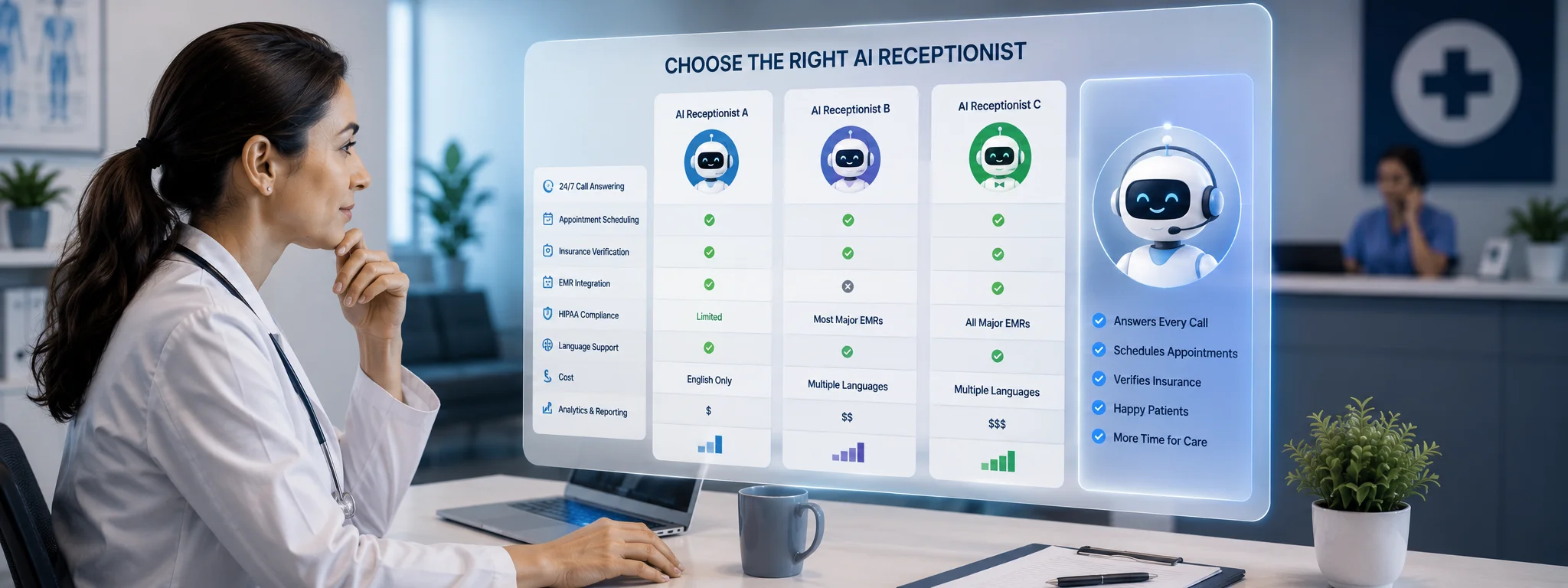
- This guide breaks down what healthcare and dental organizations should look for when evaluating AI receptionists, from EHR integrations to patient experience and compliance.
- Discover why practices are moving away from IVR systems and outsourced call centers toward healthcare-native AI solutions that handle scheduling, follow-ups, and patient communication in real time.
- The article also highlights common mistakes to avoid, including choosing generic AI tools, ignoring workflow integration, and underestimating the importance of empathetic patient interactions.
- Most importantly, it explores how AI receptionists are evolving into a full digital administrative workforce, helping practices reduce burnout, recover revenue, and scale operations more sustainably.
Introduction
Every practice relies on its front desk to be the first point of contact for patients. Yet missed calls remain one of the biggest sources of lost revenue and patient dissatisfaction. In many practices, 30–35% of calls go unanswered, costing hundreds of thousands of dollars annually and leaving staff overwhelmed.
AI receptionists have quickly shifted from an optional add-on to an operational necessity. They ensure every call is answered, scheduling runs smoothly, and staff are freed to focus on in-office care. Still, not all AI receptionists are the same. Choosing the right one can transform patient access and practice efficiency. Choosing the wrong one can create compliance issues, wasted investment, and frustrated patients.
This guide walks you through what to look for, the mistakes to avoid, and how to make the right decision for your practice.
1. Understanding the Role of an AI Receptionist
An AI receptionist is more than a call answering system. It acts as a digital front office worker, managing patient interactions across calls, reminders, and scheduling so that no opportunity is missed.
Different from IVR
Unlike IVR menus that frustrate patients with button pressing, AI receptionists understand natural speech and resolve requests instantly.
Different from call centers
Outsourced call centers may answer calls, but they are expensive, inconsistent, and disconnected from your workflows. AI receptionists work directly with your systems, delivering accurate and timely support.
Built for healthcare
Generic automation cannot manage the complexity of healthcare workflows. Practices need AI that is designed for healthcare, capable of following scheduling rules, capturing insurance details, and managing specialty specific tasks.
2. Why Practices Are Turning to AI Receptionists
Healthcare organizations are facing pressures that traditional staffing models cannot solve. AI receptionists have become essential because they directly address the structural challenges that practices encounter every day.
Rising staffing shortages
By 2030 the healthcare industry is expected to face a gap of more than 13 million workers, including front office and administrative staff. Recruiting and retaining receptionists is already difficult and costly, and relying on constant hiring is not sustainable.
Escalating administrative costs
The industry spends more than 800 billion dollars each year on non clinical administrative work. Much of this involves repetitive phone tasks that could be automated. Practices are under pressure to reduce overhead without compromising patient care.
Patient expectations for around the clock access
Patients today want the same convenience they experience in other industries. They expect to reach their providers at any time of day or night, without waiting on hold or being redirected to voicemail. An unanswered call often results in a patient seeking care elsewhere.
Revenue leakage from missed calls and cancellations
When 30 to 35 percent of calls to a practice go unanswered, the result is lost appointments, delayed care, and significant revenue loss. Cancellations and no shows add to the problem, reducing provider utilization and leaving gaps in the schedule that are difficult to fill.
Staff burnout and high turnover
Front desk staff juggle phone calls, scheduling, insurance checks, and in person patient support. This constant multitasking leads to mistakes, stress, and high turnover rates. The cycle of recruiting and training new staff only adds more cost and instability.
3. Key Benefits You Should Expect
An AI receptionist should deliver measurable improvements across patient access, staff efficiency, and financial outcomes. When evaluating solutions, practices should expect the following benefits.
No missed calls
Every patient call is answered instantly, twenty four hours a day and seven days a week. This ensures that patients are never left waiting on hold or directed to voicemail.
Scheduling and rescheduling
The AI connects directly with your electronic health record or practice management system. It can schedule, reschedule, or cancel appointments in real time without staff involvement.
Follow ups and recalls
Automated reminders, lab result notifications, and post procedure follow ups reduce no shows and improve continuity of care. Patients receive timely outreach that keeps them engaged and on track.
Insurance verification
Eligibility checks can be completed before an appointment, reducing last minute cancellations and billing delays. This saves staff time and ensures that visits are financially cleared in advance.
After hours coverage
Patients who call outside of office hours are not lost. The AI can capture their intent, manage scheduling requests, or trigger follow up calls so that opportunities are recovered instead of slipping away.
Scalability
Whether it is flu season or a sudden surge in demand, an AI receptionist can handle any call volume without adding staff. This makes it easy to scale across multiple locations.
Patient experience
The conversations feel natural and empathetic, building trust and comfort. Patients get the support they need without frustration, and staff are freed to focus on in person care.
4. The Checklist: How to Evaluate an AI Receptionist
Selecting an AI receptionist is not only about features. It is about whether the solution can reliably support your practice, integrate with your systems, and deliver measurable outcomes. Use this checklist to guide your evaluation.
Healthcare Native Workflows
A healthcare environment is not the same as a retail call center. The AI must understand clinical scheduling rules and adapt to specialty specific workflows such as dental recalls, nephrology lab follow ups, or surgical prep instructions. It should also be able to manage referrals, recalls, and chronic care programs without confusion.
Integration Capabilities
The AI must work within your existing systems. Look for deep integrations with your electronic health record or practice management software such as Dentrix, OpenDental, Athena, eClinicalWorks, or NextGen. It should provide real time sync for appointments, demographics, and insurance data. Telephony integration with platforms like RingCentral, Twilio, or 3CX is equally important. The ability to operate in both API and non API environments through robotic process automation ensures the AI can adapt to any setup.
Automation Coverage
Ask what percentage of calls the AI can fully handle without staff involvement. If too many calls are escalated, the value drops quickly. A strong AI receptionist should cover both inbound workflows like scheduling and outbound workflows like reminders and recalls.
Accuracy and Reliability
Accuracy is critical in healthcare. The AI must consistently book appointments in the right slots, verify patient identities, and follow preparation instructions exactly as provided. Error rates should be minimal, and there should be a quality assurance process to review and improve performance over time.
Patient Experience
The patient experience is just as important as efficiency. The AI should sound natural and empathetic rather than robotic. It must be able to handle interruptions, slang, or conversations with emotional patients. When cases are too complex, it should escalate smoothly to a staff member without leaving the patient frustrated. Practices should also measure post call satisfaction scores to ensure patients feel cared for.
Compliance and Security
Healthcare compliance is non negotiable. The AI must meet HIPAA, SOC 2, and TCPA requirements. Every call should generate an audit trail, and all patient data should be securely stored in U.S. servers with clear safeguards in place.
Scalability
The solution should grow with your practice. Whether you are expanding to multiple locations or experiencing seasonal spikes in call volume, the AI should handle the load without downtime or service disruption.
ROI and Measurable Impact
The right AI receptionist must demonstrate clear return on investment. Look at how many staff hours it saves, how many additional appointments it captures, and how much revenue is recovered from missed calls. It should also reduce no shows by improving reminders and confirmations.
Onboarding and Support
Implementation should not drag on for months. The best systems can go live within two to four weeks. Dedicated customer success support is essential to help your team adapt, customize workflows, and achieve fast results. The AI should be flexible enough to fit your practice without forcing disruptive changes.
5. Common Mistakes to Avoid
When evaluating AI receptionists, many practices fall into avoidable traps. Being aware of these mistakes can help you choose a solution that actually delivers long term value.
Choosing generic AI or IVR marketed as AI
Some vendors rebrand IVR systems or generic chatbots as “AI.” These tools may answer calls, but they lack the ability to manage healthcare specific workflows or integrate with practice systems. The result is frustrated patients and no real relief for staff.
Ignoring deep EHR integrations
If the AI does not connect directly to your electronic health record or practice management system, it cannot book appointments accurately or update patient information. Without integration, staff end up duplicating work, which eliminates the efficiency you were trying to gain.
Underestimating the importance of patient experience
Patients will not tolerate robotic or confusing conversations. If the AI feels cold or makes it hard to get answers, patients will disengage or switch providers. A good AI receptionist must deliver a natural, empathetic experience that patients accept and even prefer.
Focusing only on cost rather than outcomes
The cheapest option often turns out to be the most expensive if it does not reduce staff burden or capture revenue. Value should be measured in hours saved, patients recovered, and revenue protected not just in subscription fees.
Overlooking compliance requirements
In healthcare, compliance cannot be an afterthought. If the AI does not meet HIPAA, SOC 2, or TCPA standards, it exposes your practice to serious risk. Always confirm that the system secures patient data and generates a complete audit trail.
6. The Future of AI Reception in Healthcare
AI reception is only the beginning. What starts with answering calls and managing schedules is evolving into a full administrative workforce that can support the entire patient journey.
From front office to back office automation
Today, most practices use AI receptionists for scheduling, reminders, recalls, and call management. The next stage extends into mid office and back office workflows such as pre and post procedure follow ups, chronic care management, and insurance coordination.
Insurance verification and revenue cycle tasks
AI is being trained to handle eligibility checks, claims follow ups, and prior authorizations. These are some of the most time consuming tasks for staff, and automating them reduces delays and prevents lost revenue.
A fully autonomous administrative workforce
The long term vision is clear: a digital workforce that manages calls, verifies benefits, submits claims, handles denials, and routes only the most complex cases to human staff. This frees clinical teams to focus entirely on care while reducing administrative costs across the system.
Clinics that adopt now will be ahead of the curve
Practices that begin using AI reception today are laying the groundwork for this future. They build trust with patients, train their systems on real workflows, and position themselves to scale as new capabilities are added. Those who wait risk falling behind competitors who can deliver faster access, lower costs, and better patient experiences.
How Confido Health Helps Healthcare Practices Lead the Way
Confido Health is more than an AI receptionist. It is a healthcare-native digital front office worker built to meet the unique demands of clinics, dental groups, and specialty practices. Every feature is designed with one goal in mind: to give patients better access and give staff the freedom to focus on care.
Built for healthcare from the ground up
Confido Health understands the complexity of medical and dental workflows. From appointment scheduling and recalls to post-procedure follow ups and lab reminders, it handles the details that generic automation often misses.
Seamless integrations
The system connects directly with leading EHR and practice management platforms as well as with phone systems. Real-time data sync ensures that appointments, demographics, and insurance information are always accurate.
High automation coverage
Confido Health manages more than 95 percent of patient calls without staff intervention. This means fewer interruptions for your team and a consistent, reliable experience for patients.
Proven patient satisfaction
With a 97 percent satisfaction rate, patients often do not realize they are speaking with AI. Conversations feel natural, empathetic, and supportive.
Clear impact on staff and revenue
Practices using Confido Health cut front desk workload by 70 percent while adding more than 40,000 dollars in monthly revenue per location through recovered calls and reduced no-shows.
Ready to scale
Whether you are a single-location clinic or a multi-state health system, Confido Health scales with you. It already supports clinics, dental service organizations, hospitals, and specialty groups across the country.
Fast implementation
Most practices are live within two to four weeks, with dedicated support to ensure smooth onboarding.
Compliance and trust
Confido Health is fully HIPAA, SOC 2, and TCPA compliant. Every call is logged, every workflow is secure, and patient privacy is always protected.
Backed by results
For example, a large nephrology group deployed Confido Health across 45 locations. Within months, they reduced missed calls to zero, cut no-shows in half, and generated more than 40,000 dollars per month in additional revenue per site.
Final Takeaway
The right AI receptionist is not simply a tool for answering calls. It is a partner that transforms the patient journey, safeguards revenue, and frees your staff from repetitive administrative work so they can focus on care.
Confido Health is that partner. Built specifically for healthcare, it combines deep integrations, measurable return on investment, and a patient experience that feels warm, natural, and human. Practices that choose Confido Health are not just solving today’s challenges; they are preparing for the future of healthcare administration.
Ready to see how Confido Health can support your practice? Book a demo today.
.webp)
