

.svg)
- Missed patient calls are not just a front-desk issue — they create a chain reaction that impacts scheduling, provider utilization, patient retention, and long-term revenue.
- This blog breaks down why medical practices struggle to keep up with call volume, despite experienced teams and traditional callback workflows.
- Discover how delayed responses, voicemail backlogs, and fragmented systems quietly reduce appointment conversion rates and increase operational stress.
- The article also explains why simply hiring more staff does not solve the problem and why healthcare organizations are shifting toward AI-powered call handling infrastructure instead.
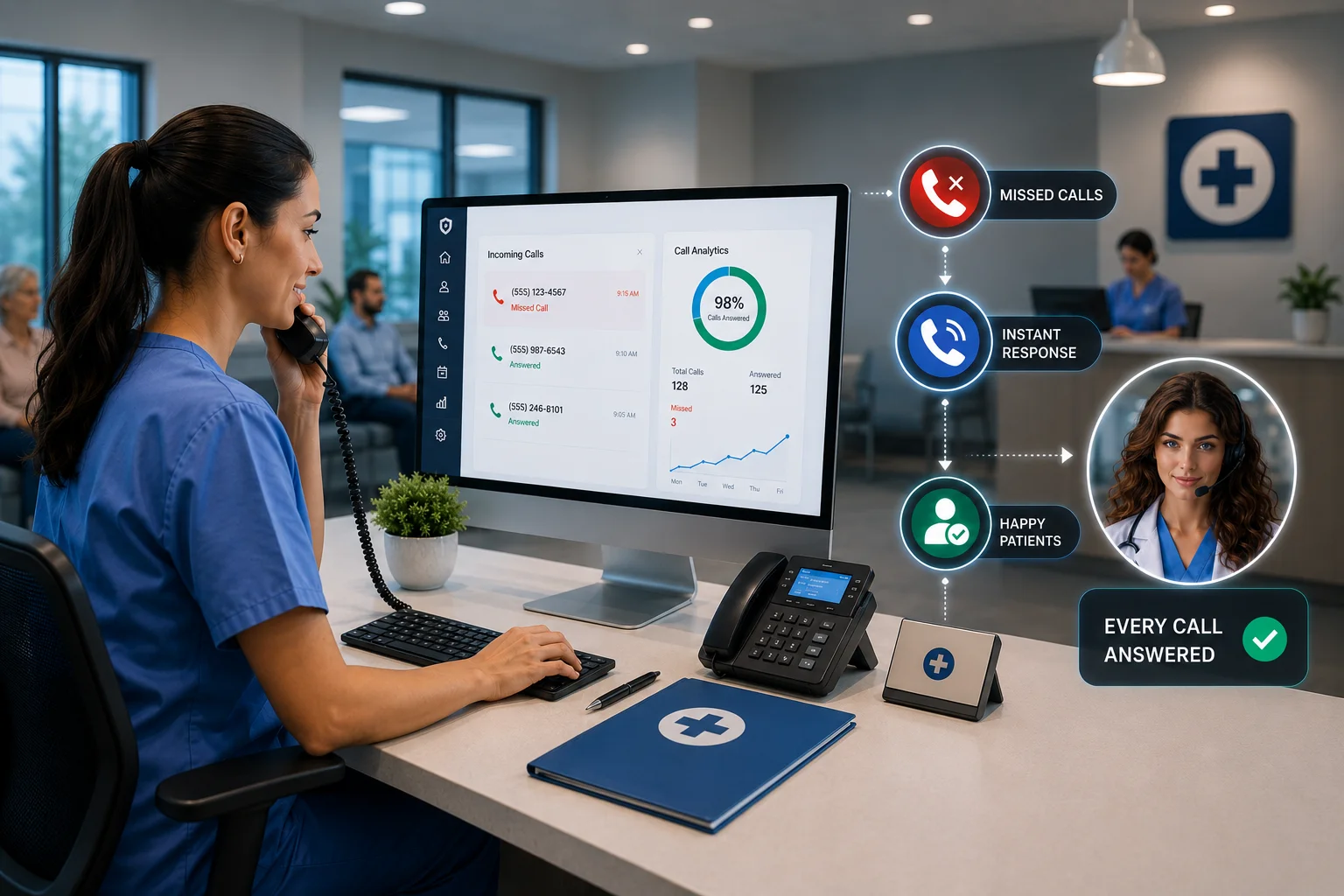
- Most importantly, it shows how AI Voice Assistants can eliminate missed calls entirely by answering instantly, resolving workflows in real time, and creating a more scalable patient access experience.
Introduction
According to research, nearly 60% younger patients who cannot reach their provider switch to a different practice within the year. That is not a patient who had a bad clinical experience. That is a patient who simply could not get through.
Missed calls in medical practices are not just an inconvenience. They are a direct operational and revenue problem that compounds quietly over time. Every unanswered call is a patient who needed something, could not get it, and made a decision about your practice based on that experience. Sometimes they try again. More often, they just do not.
Most practices know they have a missed call problem. What’s really causing it, what it’s costing you, and why fixes fall short is often unclear. So let’s break down what’s actually going on and what truly works!
The Real Role of Patient Calls in Medical Practice Operations
Before getting into why calls get missed and how to fix it, it helps to understand what patient calls actually represent in the context of how a medical practice runs.
A patient call is not just a communication event. It is the starting point for almost every operational workflow in your practice. Scheduling, rescheduling, cancellations, insurance queries, prescription refills, referral coordination, billing questions - the vast majority of these begin with a phone call. When that call is handled well, the workflow behind it moves forward. When it is not, everything downstream stalls.
This is why missed calls have an operational impact that goes well beyond the call itself. Every missed call is a workflow that did not start, a booking that did not happen, a follow-up that will now need to happen through a longer, more expensive process. In a busy practice, this plays out dozens or hundreds of times a day - and the cumulative effect shapes everything from your schedule utilization to your patient retention.
What "Missed Calls" Actually Mean in a Healthcare Context
When most people hear "missed calls," they picture a phone that rings out. But in a medical practice, missed calls take several forms, and some of the most costly ones are not the ones where nobody picks up.
Calls That Go Unanswered During Peak Hours
This is the most visible form. Your phones light up between 8 am and 10 am, and again around lunchtime. Your team is already handling patients at the desk, managing prior authorizations, and dealing with the morning's scheduling changes. Some calls get picked up. Others ring out or hit a busy signal. These are the ones patients most often do not try again, because they called during the time they had available, and your practice was not accessible at that moment.
Calls That Go to Voicemail but Are Never Returned
Voicemail might feel like a safety net. But this is often where patient intent goes to disappear. It is true - a good bunch of voicemails left with any medical practice are never returned. This is not because your team doesn't want to. It’s because they simply can’t because the backlog is too large! And even if they are returned, the callback will happen hours later, at a time that might not work for your patient. The interaction that should have happened in real time becomes a delayed, fragmented exchange, making it less likely to convert.
Calls Answered but Not Resolved During the Interaction
It’s easy to overlook this one. On paper, it’s all correct. Your team answers the call, your patient explains their concern, and a staff member notes it all down just to say that “someone will call them back shortly”. Now, the call was answered, but nothing was actually resolved. The patient is still waiting. The workflow still has not started. And the follow-up task now sits in a queue alongside everything else that needs to be actioned. From an operational standpoint, this is a missed call with extra steps.
Calls Delayed to Callbacks Instead of Real-Time Handling
Callback-based workflows are a structural inefficiency that most practices have simply accepted as normal. A patient calls, gets told they will receive a callback, and waits. The callback happens when it happens, which may or may not align with when the patient is available. If they don’t answer, the whole process starts again. What should be one quick interaction turns into multiple follow-ups, taking more time and making it less likely to get resolved.
How Partial Handling Still Results in Lost Opportunities
Even calls that get answered and partially handled still represent a lost opportunity if they do not result in a completed action. A patient who calls to schedule and is told the system is slow and someone will confirm later is not a converted booking. A patient who asks about their insurance and is told someone from billing will follow up is not a resolved query. Partial handling creates the appearance of responsiveness without the operational reality of it.
Why Medical Practices Struggle to Keep Up With Call Volume
Understanding the problem is one thing. Understanding why it persists in well-run practices with capable teams is another. It's not because your team isn't efficient - it's because the structure and system are broken.
Mismatch Between Patient Demand and Staff Capacity
Patient call volume does not distribute evenly across the day. It peaks sharply in the morning, around lunchtime, and after school hours - exactly when your front desk team is also managing patient arrivals, check-ins, and a range of other responsibilities simultaneously. The mismatch between when patients want to call and when your team has bandwidth to answer creates the gaps where calls fall through. You cannot staff your way out of this without high cost, and still not fully solve the problem.
High Volume of Repetitive Administrative Requests
Most of the calls your team gets are pretty simple. Someone wants to book, reschedule, check on a prescription, or confirm an appointment. Individually, none of this is hard. But there are just so many of these calls that they take up most of the day. So when something more important comes in, it ends up waiting. Your team is just constantly trying to keep up.
Lack of Structured Prioritization Across Call Types
Right now, every call is treated the same. There’s no real sorting before it reaches your team. So a quick “can you confirm my appointment?” call and a detailed insurance question both sit in the same line. Your team just picks up whatever comes next, even if something else actually needed more attention. That’s where a lot of time gets wasted.
Gaps in After-Hours and Overflow Coverage
Patients call when they’re free, not just when you’re open. Evenings, weekends, lunch breaks - that’s when a lot of calls happen. But if no one’s there to pick up, it goes to voicemail. And by the next morning, your team is already starting the day behind, trying to catch up. Then new calls start coming in, and the cycle just keeps going.
Fragmentation Between Telephony and Operational Workflows
Even when a call is answered and handled, the information from that call often has to travel through several steps before it lands in your EHR/PMS. A staff member takes down the details, updates the system separately, and triggers any necessary follow-up manually. This fragmentation between the communication layer and the operational layer creates delay, error risk, and additional work. It also means that the data from your calls is rarely captured in a way that gives you visibility into call performance or patient demand patterns.
What Happens When Calls Are Missed
The consequences of missed calls extend well beyond the individual interaction. They ripple outward across your operations, your revenue, and your patient relationships in ways that are significant and cumulative.
Lost Patient Intent That Directly Turns Into Missed Appointment Opportunities
When a patient calls to schedule and cannot get through, they do not always try again. Research consistently shows that patient intent drops significantly with each failed contact attempt. The call that did not get answered was not just a call - it was an appointment that did not get booked, a slot that will sit empty, and a patient encounter that will not generate revenue.
Callback Queues That Delay Workflows and Reduce Conversion Rates
Every callback represents a workflow that has not yet started. And every delayed workflow is a conversion opportunity that is losing momentum. Patients who are called back hours later are less engaged, less available, and less likely to complete the scheduling interaction than they were when they first called. Callback queues are not a management solution for missed calls - they are a symptom of the problem being managed rather than solved.
Increased Pressure on Front Desk Teams as Work Piles Up Later
When calls are not handled in real time, the work they represent does not disappear - it, in fact, accumulates and comes back to your front desk team in a compressed, high-pressure form. Morning call spikes generate voicemail backlogs that your team spends the first part of every day working through while simultaneously handling the new calls coming in. This piling effect is one of the primary drivers of front desk stress and one of the most common reasons experienced staff leave.
Patient Drop-Offs When Follow-Ups Are Not Immediate
Patient drop-off is a direct consequence of delayed follow-up. A patient who calls with a scheduling request and does not hear back within a short window is increasingly likely to either contact another practice or simply not reschedule at all. The longer the delay between the initial call and the follow-up, the lower the probability of a successful conversion. In a competitive healthcare market, the practice that responds fastest wins the booking.
Scheduling Disruptions That Lead to Unfilled Slots and Inefficiencies
Missed calls and delayed bookings create ripple effects in your schedule. Slots that should have been filled from inbound demand remain open. Waitlisted patients who could have been offered those slots are not contacted in time. Providers end up with gaps in their schedule that represent both lost revenue and underutilized clinical capacity. These scheduling inefficiencies compound over time and show up in your utilization metrics in ways that are difficult to recover from without addressing the underlying call handling problem.
Lower Provider Utilization Due to Missed and Delayed Bookings
Every unfilled provider slot represents a cost that has already been incurred - the provider is there, the facility is ready, and the administrative overhead is running. When missed calls translate into unfilled slots, your cost-per-encounter goes up while your revenue stays flat or falls. Provider utilization is one of the most important drivers of practice financial performance, and missed calls are one of the most direct threats to it.
Higher No-Show Risk Caused by Delayed Engagement
Patients who experience friction or delay in the booking process are more likely to no-show than patients whose booking was handled promptly and completely. The engagement that happens during a well-handled scheduling interaction, including reminder scheduling, expectation setting, and confirmation, creates a positive environment for your patients and drives attendance. And when that engagement is delayed or incomplete, your no-show risk will go up.
Patient Frustration Driven by Poor Access and Long Wait Times
Patient frustration with access and communication is one of the leading drivers of practice switching. A patient who consistently struggles to get through, reaches voicemail more often than a person, or waits days for a callback does not experience your practice as one that values their time. That experience accumulates and shapes the decision to stay or go in ways that are very difficult to reverse once they are established.
Long-Term Patient Loss to Practices That Respond Faster
In a healthcare market where patients have genuine options, responsiveness is a competitive differentiator. A practice that answers every call immediately and resolves requests in real time creates a fundamentally different patient experience from one that answers when it can and follows up when it gets around to it. Over time, the practices that respond faster end up retaining more patients - not because their clinical care is better, but because their access experience is.
Why Fixing Missed Calls Is Not Just a Staffing Problem
Now, the instinctive response to a missed call problem is to add staff. And while adequate staffing matters, it is not the solution. Here’s why:
Limits of Adding More Front Desk Staff
More front desk staff increases your baseline capacity, but it does not solve the structural problem. Peak-hour call spikes will still exceed the capacity of any reasonably sized team. After-hours calls will still go unanswered. The coordination overhead of a larger team creates its own inefficiencies. And the cost of staffing to peak demand means you are paying for significant capacity that sits underutilized during quieter periods. Staffing is a linear solution to what is fundamentally a non-linear problem.
Why Peak-Hour Demand Cannot Be Matched Linearly
Call volume in a medical practice is not evenly distributed. It concentrates in short windows, often within the first hour of the day and around transition times. To staff for peak demand, you would need a team large enough to handle the highest volume you have ever experienced, which means overstaffing significantly during other operating hours. The finances of this approach just do not work, and the logistics of managing a team scaled to peak demand create their own operational complexity.
The Inefficiency of Callback-Based Workflows
Callback workflows multiply the effort required to resolve a single patient interaction. What should take one interaction takes two, three, or more. Each touchpoint requires staff time, creates another opportunity for the patient to have moved on, and adds to the backlog rather than clearing it. A practice that relies heavily on callbacks is not managing its call volume efficiently - it is deferring the work and hoping the patient is still interested when the callback happens.
Operational Complexity Increasing With Scale
As practices grow, the call handling problem gets harder, not easier. More providers, more locations, more specialties, more patients - all of these add volume and complexity to an already stretched call handling operation. The approaches that managed adequately at one location often break down at three or five. And rebuilding the call handling infrastructure every time the practice grows is neither sustainable nor efficient.
Need for Infrastructure Instead of Incremental Fixes
The missed call problem requires an infrastructure solution, not an incremental one. Adding staff, adjusting scripts, and tweaking callback protocols address symptoms. They do not change the fundamental capacity constraint that creates missed calls in the first place. What eliminates missed calls is infrastructure that can handle any call volume, at any time, and complete the workflows behind those calls without depending on staff availability. That is not a staffing question - it is a technology and systems question.
What Eliminating Missed Calls Actually Requires
Genuinely eliminating missed calls is not about doing the same thing better. It requires a different model entirely. Here is what that model needs to deliver:
Immediate Response to Every Patient Call
Every call needs to be answered immediately, regardless of what else is happening. No queues. No hold times. No voicemails as a default. The moment a patient calls, something responds - and that response begins the interaction in real time rather than deferring it to a callback queue.
Ability to Handle Multiple Calls at the Same Time
Peak-hour call volume requires concurrent handling capacity. When ten patients call at the same moment, all ten need to be answered. A system that handles calls sequentially will always create a queue during peak demand. True elimination of missed calls requires the ability to handle any volume of simultaneous calls without performance degrading.
Completing Workflows During the Interaction Itself
Answering a call is not the same as resolving it. The workflow behind the call, whether that is booking an appointment, verifying insurance, processing a refill request, or answering a billing query, needs to be completed during the interaction itself. Not deferred to a callback. Not queued for a staff member to action later. Done, in real time, before the call ends.
Seamless Integration With EHR/PMS and Scheduling Systems
Completing a workflow in real time requires direct, bidirectional integration with the systems where that workflow lives. An appointment cannot be confirmed without writing to the scheduling system. Insurance cannot be verified without reading the patient record. Every workflow completion requires a system action, and every system action requires integration depth that goes beyond surface-level connectivity.
Consistent Handling Across All Locations and Time Periods
A solution that works during business hours but not after hours has not solved the problem. A solution that works at your main location but not your other clinics has not solved the problem. Consistent, complete handling across every call, every location, and every hour of the day is the standard that genuinely eliminates missed calls.
How AI Voice Assistants Change Call Handling
AI Voice Assistants address the missed call problem at its root rather than managing its symptoms. Here is what changes when AI is handling your calls:
Removing Wait Times With Instant Call Pickup
Every call is answered the moment it comes in. No rings, no queues, no hold music. The patient is in a conversation immediately, and that conversation begins moving toward resolution from the first second. The wait time experience that drives so much patient frustration simply does not exist.
Handling Concurrent Calls Without Capacity Limits
Ten calls at 8 am, fifty calls at noon, a hundred calls on a Monday morning after a long weekend - an AI Voice Assistant handles all of them simultaneously, with the same quality and the same responsiveness on every call. There is no peak hour. There is no capacity ceiling. Volume that would overwhelm any staffed operation is handled without delay.
Completing Scheduling and Queries Within the Same Call
The AI does not just collect information and pass it to someone else. It completes the workflow. A patient calls to schedule, and the appointment is confirmed before they hang up. A patient calls with an insurance question, and the answer comes from a real-time eligibility check completed during the call. The interaction and the action behind it happen in the same conversation, which is what actually makes the call not missed in any meaningful operational sense.
Eliminating Dependency on Voicemails and Callbacks
When every call is answered, and every request is resolved in real time, the voicemail and callback infrastructure becomes unnecessary. There is no backlog because there is nothing waiting to be actioned. There is no callback queue because there are no deferred interactions. The workflow that previously stretched across multiple touchpoints happens once, completely, and moves on.
Standardizing Patient Experience Across Interactions
Every patient who calls gets the same quality of experience, regardless of when they call, which location they contact, or how many other calls are happening at the same time. The inconsistency that comes from different staff members handling calls differently, or from calls being handled well during quiet periods and poorly during busy ones, is removed. The experience your patients have when they call your practice becomes predictable and reliable.
Driving Higher Appointment Conversion From Inbound Demand
When every inbound call is answered immediately, and scheduling is completed during the call, your conversion rate from patient intent to booked appointment goes up significantly. The patient who called to schedule leaves the call with a confirmed appointment rather than a callback promise. That difference in conversion rate, across the volume of calls your practice receives, translates directly into more booked appointments, better schedule utilization, and higher revenue.
Reducing Administrative Backlog and Follow-Up Work
When calls are handled completely in real time, the backlog that currently builds up across your front desk team's day stops accumulating. The voicemails that need returning, the callbacks that need to be made, the scheduling requests that need to be actioned - all of these represent work that AI eliminates by handling the interaction completely at the point of contact. Your team's day becomes more manageable because the work that feeds the backlog is no longer being deferred.
Improving Provider Schedule Utilization
When inbound demand converts to booked appointments at a higher rate, and when cancellations and no-shows are managed through automated follow-up and waitlist backfill, your providers' schedules run fuller and more predictably. Utilization improves not because you are pushing more volume through the same process, but because the process is capturing and converting more of the demand that already exists.
Enhancing Patient Access and Satisfaction
Access is one of the most consistent predictors of patient satisfaction in healthcare. Patients who can reach your practice when they need to, get their questions answered in real time, and complete scheduling without friction are more satisfied with their care experience than those who cannot. Improving call handling is not just an operational improvement - it is a patient experience improvement that shows up in satisfaction scores, retention rates, and word-of-mouth referrals.
Enabling More Predictable and Scalable Operations
When call handling is managed by AI infrastructure rather than staffing, your operations become more predictable and more scalable. Volume increases do not require headcount increases. New locations do not require rebuilding your call handling model from scratch. After-hours demand does not create morning backlogs. The operational stability that comes from having a call handling infrastructure that does not depend on staffing availability changes how your practice plans, grows, and manages its resources.
What to Look For in a Solution to Eliminate Missed Calls
Not every AI call handling solution delivers what eliminating missed calls actually requires. Here is what to evaluate seriously:
End-to-End Workflow Execution, Not Just Call Routing
A solution that answers calls and routes them to a staff member has not eliminated missed calls - it has just moved where they happen. Look for platforms that complete the workflow behind the call, not just the call itself. Scheduling confirmed, records updated, queries resolved - all within the interaction, without handoff.
Real-Time EHR/PMS Integration
Workflow completion requires system integration. If a platform cannot read from and write into your EHR/PMS in real time, your team is still doing manual data entry after the call ends. That is not elimination - it is delegation. True integration means the system action and the patient interaction happen simultaneously.
Scalability Across Call Volumes and Locations
A solution that handles your current volume but degrades under higher demand, or that works at one location but not across your network, has not solved the problem - it has managed it temporarily. Look for infrastructure that scales with you, handles concurrent calls without limits, and maintains consistent quality across every location.
Reliability, Compliance, and Data Security
Patient calls involve sensitive health information. The platform handling them needs to operate within a fully HIPAA-compliant infrastructure, with end-to-end encryption, audit trails, and a Business Associate Agreement that covers every interaction. Reliability matters equally - a solution that works most of the time still creates missed calls some of the time.
Visibility Into Call Performance and Outcomes
You cannot manage what you cannot see. Look for platforms that give your operations and leadership teams real-time visibility into call volumes, resolution rates, call types, peak demand patterns, and workflow completion rates. This data is what allows you to continuously optimize and to demonstrate the operational impact of the solution to stakeholders.
How Confido Health's AI Voice Assistant Eliminates Missed Calls
Confido Health's AI Voice Assistant was built specifically for the operational realities of medical practices managing high call volumes across multiple providers and locations. Here is what it actually delivers:
Every Call Answered Instantly Without Queues
When a patient calls any of your locations, Confido Health's AI Voice Assistant picks up immediately. No rings, no hold music, no voicemail. Every call, every time, at every location, regardless of how many are coming in simultaneously. The zero missed call outcome starts here - with the certainty that no call ever goes unanswered.
Patient Requests Handled and Completed in Real Time
Confido Health's Voice AI does not just answer calls - it resolves them. Scheduling requests are confirmed. Insurance queries are answered from real-time eligibility data. Prescription refill requests are coordinated. Billing questions are resolved. Every interaction moves from patient request to completed action within the same call, with no callbacks and no deferred workflows sitting in a queue.
No Unattended Voicemails or Delayed Callbacks
When every call is answered and every request is resolved in real time, the voicemail backlog and callback queue stop existing. There is nothing to return because nothing was missed. There is nothing to action because everything was completed at the point of contact. The morning backlog that your front desk team currently spends their first hour working through simply does not accumulate.
Deep Integration With EHR/PMS and Telephony Systems
Confido Health's AI Voice Assistant supports 40+ live EHR/PMS integrations, including Epic, Athenahealth, eClinicalWorks, ModMed, NextGen, and Tebra, with real-time bidirectional connectivity. It also works within your existing telephony infrastructure without requiring changes to your phone setup. Every scheduling confirmation, record update, and workflow completion happens inside your systems automatically, the moment it is agreed during the call.
Consistent, Empathetic Conversations at Scale
Every patient who calls gets a natural, empathetic conversation that feels nothing like navigating a phone menu. Confido Health's AI Voice Assistant communicates in more than 20 languages, handles unexpected patient responses without breaking down, and maintains the same quality and warmth on the ten thousandth call as on the first. The consistency that is impossible to achieve with staffing-led models becomes the default.
Full Visibility Into Call Outcomes and Operational Performance
Every call handled by Confido Health's Voice AI generates operational data that your leadership and operations teams can act on. Call volumes, resolution rates, call types, scheduling conversion rates, peak demand periods - all captured in real time and surfaced through dashboards that give you a clear picture of how your call handling is performing and where opportunities exist to optimize further.
Conclusion
Missed calls in a medical practice are not a minor inconvenience. They are an operational leak that affects your revenue, your team, your provider utilization, and the patients who needed to reach you and could not.
The good news is that this is a solvable problem. Not by adding headcount or refining your callback protocols, but by building the kind of call handling infrastructure that makes missing a call structurally impossible. Every call answered. Every request resolved in real time. Every workflow completed before the patient hangs up. That is not an aspirational standard - it is what the right AI infrastructure delivers every day.
If your practice is still managing missed calls rather than eliminating them, it might be time to see what a different model looks like. Get in touch with the Confido Health team for a demo and see how Confido Health's AI Voice Assistant can make missed calls a thing of the past for your practice!
FAQs
Why do medical practices miss so many patient calls?
The core reason is structural. Call volumes peak at certain times, and your team can only handle so much while managing other responsibilities. After-hours calls add to the load. Over time, this creates a clear gap between demand and capacity, and missed calls are simply a result of that.
How do missed calls impact revenue in healthcare practices?
Every missed call is a potential appointment that did not get booked, a slot that sits unfilled, and a patient who may not try again. At scale, this means lower schedule utilization, reduced provider productivity, and long-term patient attrition to practices that respond faster. Which eventually impacts revenue.
Can AI completely eliminate missed calls in a medical office?
Yes, when it is built for end-to-end workflow execution rather than just call routing. Confido Health's AI Voice Assistant answers every call instantly, handles requests completely in real time, and integrates directly with your EHR/PMS so that no call goes unanswered and no interaction ends without a resolved outcome.
Can Confido Health's Voice AI handle multiple patient calls at the same time?
Yes! Confido Health's AI Voice Assistant handles thousands of concurrent calls simultaneously without performance degrading. There is no queue, no hold time, and no capacity ceiling. Peak-hour demand that would overwhelm any staffed team is handled completely and consistently, every time.
What happens to complex patient requests during AI-handled calls?
Confido Health's Voice AI handles a wide range of patient interactions end-to-end. For interactions that genuinely require a human, such as complex clinical questions or sensitive situations that need staff judgment, the AI assistant escalates through a warm transfer that carries the context of the conversation. So your patients never have to start from scratch.
How quickly can we implement an AI solution to reduce missed calls?
Confido Health typically deploys AI workflows within 4-6 weeks, with measurable impact on call answer rates and scheduling completion visible within the first 60 to 90 days. Implementation involves aligning your scheduling workflows and integrating with your existing EHR/PMS and telephony infrastructure, and the Confido Health team supports that process from start to go-live.
.webp)
