

.svg)
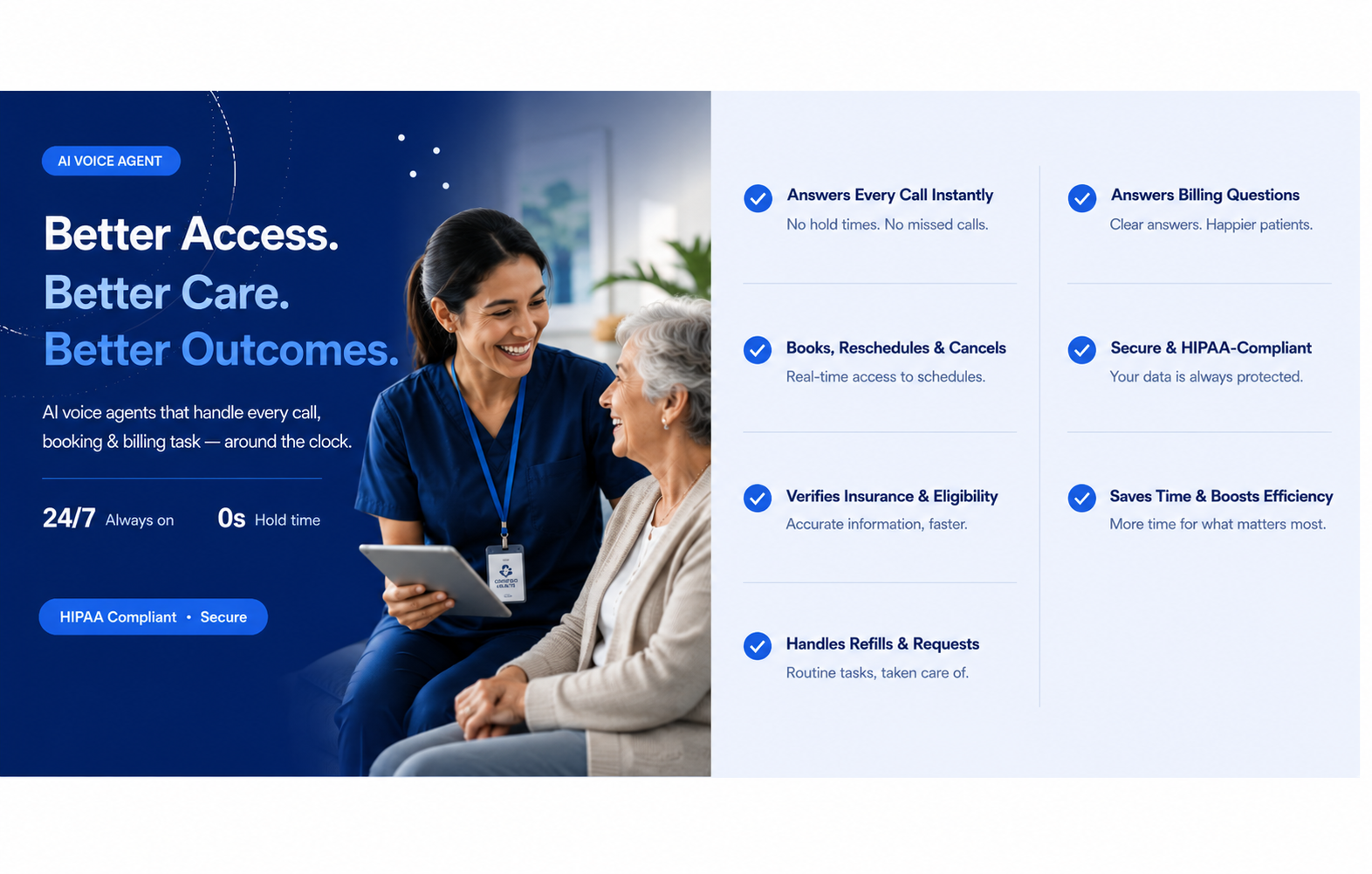
An AI voice agent in healthcare is a virtual assistant that talks to patients over the phone and completes the work behind every call. How it differs from a chatbot:
- Channel: voice agents answer phone calls, where most patients are; chatbots only handle typed messages on websites and portals
- Capability: voice agents book and reschedule appointments, take refills, verify insurance, and answer billing questions start to finish; chatbots stop at FAQs and a basic booking
- EHR/PMS: voice agents read and write records in real time; chatbots rarely go beyond logging a primary booking
- Scale: voice agents handle thousands of simultaneous calls with zero hold time
- Safety: healthcare-grade platforms are HIPAA compliant, SOC 2 certified, and sign a BAA
- Outcome: every call answered on the first ring, fewer no-shows, and hours back for staff, without adding headcount
Does Every Morning at Your Practice Start in Chaos?
Your phone lines open at 8:00. By 8:01, all of them are blinking. One patient is on hold trying to reschedule, another is calling about a refill, a third just wants to know if their insurance covers tomorrow's visit, and a real person is standing at the front desk, waiting to check in. It is not a bad day. It is just Tuesday. And Wednesday. And every day after that, because in healthcare, the phones never really stop.
Here is the thing: your team is not the problem. They are working as hard as anyone can. The problem is that US healthcare is short-staffed everywhere, and patients still have to fight through “press 1, press 2” phone trees just to book an appointment. Every call that slips through is a missed appointment, delayed care, and lost revenue. Patient access suffers. The patient experience suffers. And your staff goes home exhausted.
This is exactly the problem artificial intelligence is finally starting to solve. AI in healthcare has moved past the buzzword stage; practices across the country are using it to answer calls, book appointments, and lift the routine admin work off their team's shoulders, without hiring a single extra person.
But the market is crowded, and a lot of very different tools get lumped together as “AI.” The two you will hear about most are chatbots and AI voice agents, and they are not the same thing. Not even close. So let's break down the difference in plain language, friend to friend, so you can pick the right patient communication platform for your practice and skip the expensive disappointments.
What Is an AI Voice Agent in Healthcare?
An AI voice agent is a virtual assistant that talks to your patients over the phone, the same way your front desk team does. No phone trees. No “press 1 for appointments.” No hold music. Just a warm voice that picks up and helps.
Picture this. A patient calls your office. The AI voice agent answers instantly, greets them like a human receptionist would, and gets to work. The patient wants to book an appointment? The AI agent finds a slot that fits the provider's schedule, books it, and updates your EHR/PMS before the call even ends. The patient will not notice the difference, and honestly, that is the point.
And here is the part that surprises most practice leaders: it does not handle one call at a time. The same AI agent can take thousands of calls at the same moment, keep full context on each conversation, and finish the work behind every single one. Nobody waits in a queue because “the agent is busy.” That 8:01 rush we talked about? It just stops being a rush.
This goes far beyond call routing or taking messages. AI voice agents manage the entire spectrum of patient communication: scheduling appointments, verifying insurance eligibility, taking prescription refill requests, answering routine billing questions. Because the AI agent reads and writes directly into your EHR and practice management systems, just like your human staff does, nobody has to re-enter a single thing after the call ends.
Our AI Agents at Confido Health are a good example of this in action. They answer every patient call on the first ring and actually complete the request, whether it is booking a new visit, confirming an upcoming procedure, or answering a quick question, right inside your existing EHR/PMS. Patients receive immediate, accurate help. They never sit on hold listening to elevator music, and they never have to leave a voicemail hoping someone calls them back hours later.
How AI Voice Agents Differ from Chatbots in Healthcare
Both run on AI, and to be fair, chatbots are not useless. Most live on your website or patient portal, answer simple questions like clinic hours, and many are connected to your EHR/PMS well enough to take a primary booking and fire off an automated confirmation. But that is the bare minimum, and it is also the ceiling. A reminder cadence as the visit approaches? Rescheduling around a provider's availability? A no-show follow-up, an insurance check, a billing question? The chatbot quietly hands all of that right back to your overloaded phone lines and your staff.
An AI voice agent meets your patients where they actually are: on the phone.
Here is a side-by-side look at what that difference means for your practice.
Why the Distinction Between AI Voice Agents and Chatbots Matters
It comes down to one simple fact: most of your patients still pick up the phone. Think about the last patient who could not get through to your office. Maybe they hung up after four minutes on hold. Maybe they left a voicemail that sat in the backlog overnight. Some of those patients call back. The honest truth is, some of them book with the practice down the street instead. If your "AI investment" only lives on your website, it does nothing for that caller, and nothing for your team digging through voicemails every morning.
Choose an AI voice agent, and the math changes. Every call gets answered on the first ring, even during the morning rush. Your front desk finally gets to look up and focus on the patient standing in front of them. Better patient access, less pressure to keep hiring, and a calmer, happier team, all from getting this one decision right.
Where AI Voice Agents Help Most: Use Cases in Medical Practices
AI voice agents help across dozens of daily workflows, but you do not have to boil the ocean. These are the places where practices feel the relief first.
Appointment Management
The most popular use case, for a reason. On inbound calls, the AI agent handles new bookings, rescheduling, and cancellations while strictly following each provider's scheduling rules, triages urgent versus routine requests, covers after-hours calls, and warm-transfers to your staff when a human is genuinely needed. On the outbound side, it runs confirmations, a steady reminder cadence, immediate no-show follow-ups, and even backfills open slots from your waitlist. It also sends intake forms and pre-visit instructions right after booking, so patients arrive prepared and your front desk is not chasing paperwork.
Prescription Refills
Refill calls are quick for the patient and endless for your staff. With an AI agent, the patient calls in, the request gets logged accurately for clinical review, and anything that needs clinical judgment is escalated straight to the right person. Your front desk never gets pulled into the middle, patients get a faster turnaround, and your clinical team gets fewer interruptions.
Insurance Verification and Billing Questions
Eligibility checks and routine billing questions quietly eat hours of staff time every week. The AI agent runs pre-visit eligibility checks and writes real-time copay and deductible details straight back to the patient's chart, answers coverage questions, explains balances and statements, walks patients through payment plans, and follows up on outstanding balances, which keeps your lobby moving and makes downstream claims cleaner. We have covered how AI handles insurance verification and prior authorizations in more depth if you want to go further.
Referral Management
Referrals are where patients fall through the cracks: a fax arrives, sits in a queue, and the patient never hears back. The AI agent captures referrals as they come in, reaches out to the patient to confirm details and book the visit, and follows up with referring providers when information is missing. Fewer dropped referrals, faster scheduling, and better continuity of care.
Patient Recall and Reactivation
The AI agent does not just wait for the phone to ring. It recalls patients who are due for expected care, annual wellness visits, screenings, chronic condition check-ins, and books them on the spot. And for patients who have gone quiet or left a treatment plan unfinished, it runs reactivation outreach to bring them back for that first return visit. Nobody slips through the cracks, your patients feel looked after, and your schedule stays steady.
Multi-Location Workflows
If you run multiple clinic locations, you know the juggling act: different schedules, different providers, different rules at every site. An AI voice agent keeps patient communication consistent across all of them while respecting each location's specific workflows, so you can grow without growing your admin headcount.
How AI Voice Agents Work with Your EHR and PMS
This is the part that separates a real solution from a fancy answering machine. Without a deep connection to your EHR and practice management system, a voice agent is just a pleasant conversation, your staff still has to do all the actual work after the call. And that defeats the whole purpose.
It Reads and Writes, Just Like Your Staff
A capable AI voice agent pulls up the patient's record during the call and updates it in real time. It checks history, follows your scheduling rules, and writes back every booking, cancellation, and demographic update, exactly the way a staff member would, minus the manual data entry that burns people out.
It Should Work with the Systems You Already Have
You should not have to rip out software your team already knows. Confido Health integrates directly with over 40 major EHR and PM systems, including Epic, Athenahealth, and eClinicalWorks, so the AI works inside your existing setup from day one. Curious what actually happens under the hood? Here is our guide to integrating AI reception into your EHR.
One Thing to Demand in Every Demo
Ask the vendor to show you a live EHR writeback during the demo, an appointment booked by the AI agent appearing instantly in your system. Do not settle for theoretical promises. If they cannot show it, the “integration” probably is not real. You deserve better than a slide deck.
Is It Safe? HIPAA Compliance and Patient Data Security
Your patients trust you with the most personal information they have. Any technology that touches their calls touches Protected Health Information, so before you fall in love with any platform's features, make sure the vendor takes that trust as seriously as you do.
HIPAA Compliance Is Non-Negotiable
Enterprise-grade AI voice platforms protect PHI with end-to-end encryption and strict role-based access controls, from the moment the call connects until the data lands safely in your EHR. Here is what every practice should know about HIPAA-compliant patient communication using AI.
Always Sign a BAA
A Business Associate Agreement is mandatory, not optional. It legally binds the vendor to protect PHI and holds them accountable to federal and state healthcare regulations. If a vendor hesitates on the BAA, that hesitation is your answer.
Look for the Right Credentials
Ask for documentation up front: HIPAA compliance, SOC 2 certification, secure telephony infrastructure, and complete audit logs of every patient interaction. These show a structural commitment to protecting your patients, not just a checkbox on a sales sheet.
How AI Voice Agents Understand Context and Get Smarter Over Time
At this point you might be thinking: “okay, but my clinic is complicated. Can AI really keep up with us?” Fair question, and you are right to ask it. One of our customers has 71 different appointment types. Seventy-one. Booking the right visit, with the right provider, for the right duration is genuinely hard, even for experienced staff.
Here is the good news: an AI voice agent does not arrive knowing your clinic. It learns it. It adapts to your specific workflows, your appointment rules, your provider preferences. And every call makes it better. The AI agent remembers context, who the patient is, what their appointment status is, what was discussed last time, so the patient never has to start from scratch or repeat their story. The more it works in your clinic, the better it gets at your clinic's particular complexity. Think of it like a great new hire who ramps up in weeks instead of months, and never forgets a thing.
That same context powers proactive care. Because the AI agent knows who is due for a wellness visit, a screening, or a post-discharge follow-up, it reaches out before the gap becomes a problem, without taxing your nursing staff. Fewer no-shows, fewer patients falling through the cracks, and a communication rhythm that feels calm and intentional instead of a daily scramble.
What's Next for AI Voice Agents in Healthcare
If you are going to invest in this technology, it helps to know where it is headed. The short answer: somewhere exciting.
From Answering Needs to Anticipating Them
AI voice agents are quickly getting better at predicting what a patient needs before they say it, using past visits and care guidelines to suggest the right next step the moment the call connects.
Connecting with Wearables and Remote Monitoring
Expect deeper ties between voice agents and remote patient monitoring. Picture a voice assistant that coordinates with a patient's heart monitor or glucose tracker and checks in when something needs attention, before the patient even thinks to call.
From Isolated Calls to Continuous Care
The bigger shift is from reactive support to continuous engagement. Voice agents will stop being a scheduling touchpoint and become the communication layer that supports entire care journeys, from diagnosis to recovery. It is a big part of how patient engagement itself is changing, and the practices building their AI foundation today will be the ones ready for it.
Here's How Confido Health Can Help
Confido Health is built specifically for healthcare practices. Unlike generic AI tools that treat a clinic like just another call center, it understands the realities of front desk operations, the 8:01 phone rush, the 71 appointment types, the staff stretched across phones and the front counter, and integrates directly with your EHR or practice management system.
Here is what Confido Health delivers:
- Deep healthcare-native workflows designed for scheduling, rescheduling, reminders, refills, insurance checks, and patient follow-ups.
- Integration-first approach with 40+ leading EHR and PMS systems, including Epic, Athenahealth, and eClinicalWorks, so no work is ever duplicated.
- Always available, answering every call on the first ring and managing thousands of conversations at once, around the clock.
- Empathetic, natural conversations that patients genuinely respond to, with 97 percent patient satisfaction.
- Proven ROI, with up to 70 percent reduction in staff call burden and a 15 to 20 percent increase in revenue collections.
- Live in under 30 days using expert-approved templates, without demanding dedicated staff time to launch.
Confido Health is more than a tool. It is the AI front desk that keeps your practice running smoothly and your patients cared for, while your team finally gets to do the work they signed up for.
Want to see how Confido Health can transform patient access and free your staff from repetitive calls? Let's get started today.
Still in research mode? That is okay too. Start with our breakdown of the top AI patient communication software for clinics and hospitals, and come back when you are ready.
FAQ
How does an AI voice assistant improve patient access?
It answers every call immediately, which eliminates hold times and full voicemail boxes. Patients can book, reschedule, or verify insurance around the clock, even at 9 PM on a Sunday. Less friction for your patients, better access for your practice.
Can AI voice agents integrate with my existing EHR system?
Yes. Confido Health's AI Agents read and write directly with over 40 major EHR and PM systems, including Epic, Athenahealth, and eClinicalWorks. Appointments, updates, and notes land in your system in real time, with no manual entry from your staff.
Are AI voice agents HIPAA compliant?
Reputable, healthcare-specific platforms are. Look for end-to-end encryption, role-based access controls, SOC 2 certification, and a vendor that signs a Business Associate Agreement on day one. If any of those are missing, keep looking.
Will an AI voice agent replace my front desk staff?
No, and it should not. It is built to support your team, not replace them. The AI agent absorbs the repetitive calls and data entry, so your staff can focus on the patients in the waiting room and the conversations that genuinely need a human touch.
How quickly can we deploy an AI voice agent?
With Confido Health, AI Agents go live in under 30 days using expert-approved templates, without pulling your staff away from their day jobs during setup. Most practices see measurable results within the first couple of months.
What operational outcomes can we expect?
Practices working with Confido Health see up to 70 percent of their staff call burden lifted, a 15 to 20 percent increase in revenue collections, lower no-show rates, and 97 percent patient satisfaction, because every call gets answered on the first ring, every time.
.webp)
