

.svg)
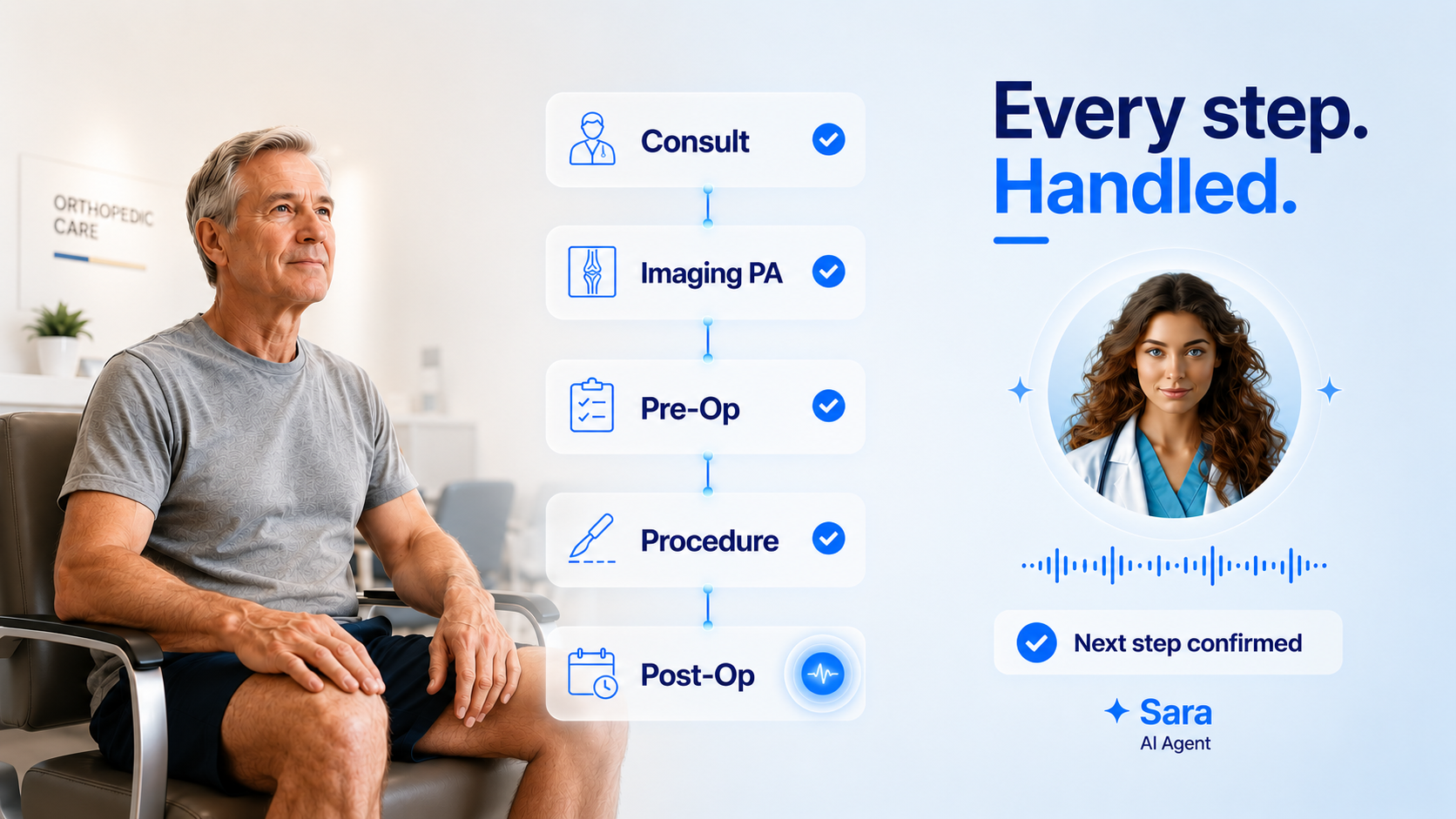
- Orthopedic scheduling is a multi-step chain: consultation, imaging, pre-op clearance, procedure, post-op visits, each with different provider, room, and equipment requirements. Managing it manually is where capacity breaks down.
- PA burden is severe. AMA's 2024 PA survey found physicians spend 12 hours per week on PA, with 35% of practices employing staff dedicated exclusively to it.
- Post-visit coordination breaks down consistently. PT referrals, post-op follow-up, medication reminders, and wound care instructions rarely get executed at the volume and cadence patients need.
- AI Agents handle multi-type inbound scheduling, PA status tracking, outbound payer follow-up, and post-visit communication without staff involvement for routine interactions.
- Practices using Confido Health see 75% faster PA turnaround and 80% reduction in manual admin. See how AI handles insurance and PA in depth.
What Does the Week Actually Look Like for an Orthopedic Front Office?
Monday morning at a four-surgeon orthopedic practice. The schedule for the week shows surgical cases on Tuesday and Thursday, clinic days on Monday, Wednesday, and Friday, and a full imaging queue sitting alongside it all.
The phones open at 8 AM. By 8:30, the coordinator has fielded six inbound calls: two new patient referrals, a patient asking whether their MRI has been pre-authorized, a post-op patient with a wound care question, someone requesting to reschedule their two-week follow-up, and a patient calling back about a physical therapy referral they never received.
Simultaneously, there are three prior authorization requests pending with two different payers, a stack of fax referrals from primary care offices that need to be matched to charts, and a post-op call list for last week's surgical patients that has not been started yet.
The coordinator gets to do what she can. The PA follow-up calls to payers go out by 10 AM. The post-op call list starts at noon. The new patient referrals are entered by 2 PM. The physical therapy referral from the 8:30 call gets actioned before the end of day. The rescheduling request was resolved immediately.
What did not get done: the recall list for patients overdue for their follow-up imaging. The confirmation calls for Wednesday's clinic. The outbound check-in for a patient who had surgery eight days ago and has not called in.
None of what got dropped was unimportant. It simply did not fit.
This is the operational reality of an orthopedic front office. Not a staffing failure. A structural mismatch between what the workload demands and what a small team can realistically execute in a single day.
Why Orthopedic Scheduling Is a Different Problem
Orthopedics does not schedule one appointment at a time. A new patient presenting with knee pain may need a consultation visit, then an MRI, then a return visit to review imaging, then pre-op clearance with an internist, then the surgical case itself, then a two-week post-op visit, then a six-week post-op visit, then a physical therapy referral and a follow-up to confirm the patient is enrolled.
Each step in that chain has different scheduling requirements. The consult is in a standard exam room with any available surgeon. The MRI requires imaging availability and insurance pre-authorization before it can be scheduled. The pre-op clearance requires coordination with a separate provider. The surgical case requires an OR slot, an anesthesiologist, and specific equipment. The post-op visits need to land at clinically appropriate intervals. The physical therapy referral requires a preferred provider in the patient's insurance network.
Managing this chain manually, across dozens of active patients at different stages simultaneously, is where orthopedic scheduling complexity concentrates. A scheduling error at any step does not just affect that appointment. It can delay the entire care pathway by weeks.
MGMA's 2025 data shows that while orthopedic surgery reported a decrease in average new patient wait times in 2025, nearly one-third of medical groups still reported increased wait times overall. The challenge for orthopedic practices is not just scheduling speed. It is scheduling precision: getting the right patient into the right appointment type at the right point in their care journey, with all dependencies confirmed before the slot is booked.
AI Agents handle this with direct EHR integration. The system reads the provider's scheduling rules, applies appointment type constraints, checks real-time availability, confirms that prior requirements are in place before booking downstream steps, and completes the booking in the system before the call ends. The coordinator does not recreate this workflow manually for each patient. The chain manages itself.
The Prior Authorization Problem in Orthopedics
No operational challenge in orthopedic practice generates more friction, more cost, and more clinical consequences than prior authorization. Imaging. Implants. Procedures. Physical therapy. Almost every significant clinical decision an orthopedic surgeon makes requires advance approval from a payer before it can proceed.
The administrative weight this creates is documented by the AMA in consistent annual detail. The AMA's 2024 prior authorization survey found that prior authorization requires the equivalent of 12 hours of physician and staff time per week for a single physician. More than a third (35%) of practices have hired staff dedicated exclusively to prior authorization work. 94% of physicians report that PA delays access to necessary care, and 93% report that PA has a negative impact on patient clinical outcomes. 78% report patients have abandoned recommended treatment because of authorization struggles with their insurer.
For orthopedic practices specifically, the combination of imaging requirements, implant authorizations, and post-operative therapy approvals means the PA burden is not intermittent. It is continuous. Every surgical case carries a PA chain. Many imaging orders require pre-authorization before the patient can schedule the scan. Physical therapy referrals require authorization before the first session.
A patient who needs a total knee replacement may wait through separate PA processes for the MRI to confirm the diagnosis, the surgical implant, the inpatient or outpatient facility, and the post-operative physical therapy. Each one requires submission, follow-up when there is no response, appeals when the initial request is denied, and documentation updates when the payer requests additional clinical information.
Most of this work falls on the front office or a dedicated PA team. It is mostly phone calls and portal navigation, performed in parallel with everything else the team is managing. It rarely happens as fast as the clinical timeline requires.
AI Agents change this by handling the high-volume, process-driven elements of PA workflow that do not require clinical judgment. Eligibility checks before procedures are submitted. Status tracking and automated follow-up when payer responses are pending. Outbound calls to payers for updates, with results logged to the patient record. Notification to clinical staff when a determination arrives. Escalation to the PA specialist or surgeon when a denial requires clinical appeal.
From our experience, orthopedic practices deploying AI Agents in the PA workflow see a 75% reduction in time to authorization. The calls still happen. The follow-up still happens. The difference is that staff are notified when action is needed rather than spending their day initiating the same status inquiries repeatedly.
Post-Visit Coordination: Where Orthopedic Care Continuity Breaks Down
Orthopedic care does not end when the patient leaves the clinic or the OR. For surgical patients especially, the post-operative period is where recovery either goes well or begins to go wrong, and the difference often comes down to whether the patient received consistent, timely outreach.
In orthopedics, the post-operative period encompasses more touchpoints than most specialties. A patient recovering from hip arthroplasty needs post-operative wound care instruction delivery, medication reminder calls, a two-week follow-up appointment confirmed before discharge, a six-week follow-up scheduled at the two-week visit, physical therapy enrollment confirmed and attendance tracked, and a check-in call if they have not called in and something seems off.
None of this is optional. All of it is labor-intensive to execute consistently across a full panel of post-surgical patients when the front office is simultaneously managing inbound calls, scheduling new patients, and running PA follow-up.
The result, in most practices, is that post-op coordination is completed when time allows. It is executed for some patients and skipped for others. The patients who call in get managed. The ones who do not call tend to drift.
AI Agents close this gap by making post-visit outreach a structured, automated process rather than a best-effort one. Every surgical patient receives a scheduled call on day two, day seven, and day fourteen after their procedure. Every physical therapy referral generates an outbound call to confirm the patient has enrolled. Every post-op appointment generates a reminder at the appropriate interval. Every wound care instruction goes out by text on the day of discharge. When a patient does not respond to a check-in, the system flags them for clinical review rather than leaving them uncontacted.
The front office does not have to manage this manually. The workflow runs in the background, surfaces the exceptions, and hands the clinical escalations to staff with full context already documented.
Referral Management and the Fax Stack
Orthopedic practices are referral-heavy on both ends. They receive referrals from primary care, urgent care, and emergency departments. They generate referrals to physical therapy, pain management, rheumatology, and other specialists. Both directions are operationally demanding and frequently handled through fax and manual chart matching.
Incoming referral faxes require identification of the patient, creation or matching of a chart record, verification of insurance, scheduling of the consult, and communication back to the referring provider. In a busy practice, this stack accumulates faster than it can be processed. Patients whose referrals sit unactioned for several days are patients who may call the referring office asking what happened, or simply book elsewhere.
AI Agents process incoming referral faxes, extract relevant patient information, match to existing records or flag for new chart creation, initiate insurance verification, and prompt scheduling of the consult. The coordinator opens the morning queue and finds completed intake records rather than a pile of unprocessed faxes.
For outgoing referrals, AI Agents confirm that preferred specialist offices have received the referral, follow up when there is no acknowledgment within 48 hours, and notify the orthopedic team when the referral has been actioned. The patient does not fall through because no one had time to check.
What Integration Looks Like in an Orthopedic Practice
The workflows described above only deliver their value if the AI Agent is deeply integrated with the practice's systems. Surface-level integration, where the AI reads information but staff still complete the work, does not reduce the workload. It reformats it.
For orthopedic practices, meaningful integration means the AI Agent reads the scheduling rules for every appointment type across every surgeon and facility. It applies those rules in real time when booking or rescheduling. It writes the result back to the EHR without requiring manual entry. It accesses the PA status in the practice management system, logs updates when they come in from payers, and surfaces pending authorizations to the right team member automatically.
Confido Health integrates with 40+ EHR systems in production with bidirectional read and write capability. Appointments book into the actual schedule, not a separate system requiring reconciliation. PA updates log to the patient record. Post-visit call outcomes are documented. Nothing creates a parallel workflow that staff have to merge later.
For practices evaluating what this integration actually involves operationally, the EHR integration guide covers the specifics without overpromising what the setup requires.
What to Look for When Evaluating AI for Orthopedic Operations
Can it handle multi-step care pathway scheduling?
Generic scheduling AI is built for single-appointment booking. Orthopedic scheduling requires the system to understand appointment dependencies: that the MRI cannot be scheduled before the PA is confirmed, that the post-op visit should land at a specific interval from the procedure date, that the surgical case requires an OR slot and not just a clinic room. Ask vendors to demonstrate a complete care pathway booking, not just a single consult.
How does it handle prior authorization specifically?
PA management varies enormously between systems. Some can only check eligibility. Others track PA status and send outbound notifications. The most capable handle the full loop: submission prompting, status tracking, payer follow-up calls, documentation logging, and clinical escalation when a denial requires human review. Ask for a demonstration of what happens when a PA is denied and an appeal is required.
Does it cover outbound post-visit coordination natively?
Inbound call handling addresses one part of the orthopedic front office burden. The post-visit coordination problem is primarily outbound: check-in calls, PT enrollment confirmation, medication reminders, follow-up scheduling. Ask specifically whether these workflows are native to the platform or require a separate tool. A system that only answers inbound calls leaves the post-operative coordination gap unaddressed.
What happens when a post-op patient calls with a clinical concern?
A patient calling on day five after rotator cuff surgery to report increasing pain and swelling needs to reach a clinical team member immediately. The AI Agent must recognize this as an escalation call, provide appropriate acknowledgment, and route to the appropriate clinical staff via warm transfer in real time. Ask vendors how their system distinguishes a routine rescheduling call from an urgent post-operative concern, and how the escalation actually functions during and after office hours.
Here's How Confido Health Can Help
Orthopedic practices do not have a single operational problem. They have three that compound each other every day: complex scheduling that requires precision across an entire care pathway, prior authorization workflows that consume a disproportionate share of staff time, and post-visit coordination that is structurally underfunded relative to the clinical continuity it supports.
Confido Health's AI Agents are built to work across all three simultaneously, integrated directly with the practice's EHR. Ryan handles the clinical and procedural coordination layer. Sara runs the front office communication workflows. Together, they cover the operational stack from new patient intake through post-operative follow-up, without requiring staff to manage the routine interactions that consume most of their day.
Scheduling Across the Full Care Pathway
From new patient consult through pre-op clearance, procedure booking, and post-op follow-up. Appointment type logic, provider constraints, and imaging dependencies apply in real time through direct EHR integration. Every step in the chain books correctly the first time, without manual coordination between front office and clinical staff.
Prior Authorization Automation
Eligibility checks before submission, status tracking, outbound payer follow-up calls, documentation logging, and clinical escalation when a denial requires human review. From our experience, practices see a 75% faster turnaround from PA submission to determination.
Structured Post-Visit Coordination
Day-two and day-seven check-in calls, PT referral enrollment confirmation, medication reminders, wound care instruction delivery, and post-op appointment confirmations running automatically for every surgical patient, without front office intervention.
Referral Intake Processing
Incoming fax matching, chart creation or patient identification, insurance verification prompt, and consult scheduling. Outgoing referral acknowledgment follow-up confirms specialist receipt without a staff member chasing the loop manually.
80% Reduction in Manual Admin
Up to 70% reduction in staff call burden. In an orthopedic context, that means the team manages exceptions and clinical escalations rather than status calls and routine scheduling.
Confido Health is more than a scheduling tool. It is the operational layer that holds the orthopedic care pathway together from the first call to the final post-op visit, and surfaces the exceptions that require human judgment without burying staff in the routine interactions that should never have required them in the first place.
Want to see how Confido Health works in an orthopedic practice? Book a demo today.
FAQ
What does AI for orthopedic practices actually do?
AI Voice Agents for orthopedic practices handle inbound scheduling across multiple appointment types and provider constraints, manage prior authorization status tracking and outbound payer follow-up, run structured post-operative patient outreach, process incoming referral faxes, confirm PT referral enrollment, and handle billing inquiries, all integrated directly with the practice's EHR and PMS.
How is orthopedic scheduling different from general practice scheduling?
Orthopedic patients often move through a multi-step care pathway: consult, imaging, pre-op clearance, procedure, and multiple post-op visits. Each step has different provider, room, and equipment requirements, and some cannot be scheduled until prior authorization is confirmed for the preceding step. AI Agents that integrate at the scheduling rule level apply these dependencies in real time rather than requiring a coordinator to manage them manually.
How does AI help with prior authorization in an orthopedic practice?
The AMA's 2024 prior authorization survey found that a single physician's PA work consumes 12 hours of physician and staff time per week. AI Agents handle the process-driven elements: eligibility checks before submission, status tracking, outbound payer follow-up calls, documentation logging, and escalation to clinical staff when a denial requires human review. Staff are notified when action is needed rather than spending the day initiating status inquiries.
What post-visit coordination workflows does AI handle for orthopedic patients?
For surgical patients, AI Agents run scheduled check-in calls on days two and seven after the procedure, confirm physical therapy referral enrollment, send medication reminders, deliver wound care instructions by text at discharge, and confirm post-op appointment attendance. When a patient does not respond to a check-in or expresses a clinical concern, the system escalates to the appropriate staff member with full context documented.
How does AI handle a patient who calls after surgery with a concern?
Confido Health's AI Agents are configured to recognize escalation signals during post-operative calls. When a patient describes symptoms that may indicate a complication, such as increasing pain, swelling, or fever, the Agent acknowledges the concern and routes immediately via warm transfer to a clinical team member or on-call provider. The AI does not make clinical assessments. It ensures the patient reaches the right person in real time, regardless of the hour.
Can AI manage referral intake for an orthopedic practice?
Yes. AI Agents process incoming referral faxes, extract patient information, match to existing records or flag for new chart creation, initiate insurance verification, and prompt scheduling of the consult visit. For outgoing referrals, the system confirms specialist receipt and follows up when there is no acknowledgment within the defined window. Coordinators work from a processed queue rather than a raw fax stack.
Does Confido Health work with orthopedic-specific PMS systems?
Confido Health integrates with 40+ EHR and PMS systems in production, including those commonly used in orthopedic practices. Integration is bidirectional at the scheduling level: the AI reads scheduling rules, applies appointment type constraints, books directly into the system, and writes outcomes back to the patient record without requiring manual reconciliation.
How long does deployment take for an orthopedic practice?
Most practices are live with Confido Health in under 30 days using expert-approved workflow templates. Deployment includes configuration of orthopedic-specific appointment types, scheduling rule setup, PA workflow parameters, and post-visit outreach sequences. No dedicated IT resources are required on the practice's side during setup.
.webp)
