

.svg)
- 53% of medical group leaders cite finding candidates as their top staffing challenge, according to a 2024 MGMA poll. For groups running 10 or more locations, that gap compounds at every site.
- Phone access ranked among the top patient access priorities for medical group leaders heading into 2026, per a 2025 MGMA poll.
- Family medicine practices average 23.5-day new patient wait times in 2025, up 14% since 2022, according to AMN Healthcare's 2025 physician appointment survey.
- An AI receptionist for family medicine handles inbound scheduling, chronic disease recall, prescription refill routing, after-hours calls, and preventive care outreach consistently across every location, without proportional headcount increases.
- Multi-location groups see immediate impact in answered call rates, no-show reduction, and recall production recovery at scale. See the full patient access crisis context.
- The goal is not to replace front desk teams. It is to give every location the same operational capacity, regardless of staffing on any given day.
What a Multi-Location Family Medicine Group Is Actually Up Against
A family medicine group running 12 locations across a metro region. Each site has its own front desk team, typically two to three people per location. Some sites are fully staffed on a given day. Others are running short because someone called in sick, a position is vacant, or seasonal volume has spiked beyond what the local team can absorb.
What has changed across this group in the last several years: call volume has increased at every site. Insurance complexity has increased. The patient panel has aged, which means more chronic disease management, more medication questions, more care coordination between specialists, and more patients who call frequently rather than once a year. Prior authorization burden has grown. No-show rates fluctuate unpredictably from site to site. Recall campaigns for preventive care run inconsistently, executed well at some locations and barely at all at others, because there is never quite enough front desk capacity to run them everywhere alongside everything else.
What has not scaled proportionally: front desk headcount at each individual location.
This is the structural tension at the center of operating a multi-location family medicine group. The operational demands at each site have compounded year over year, but the staffing model at each location is still built for a smaller, simpler version of the job. And because each site staffs independently, the group as a whole cannot guarantee a consistent patient experience. A patient calling location A on a fully staffed Tuesday gets a different experience than a patient calling location F on a Monday when two coordinators are out.
This is not unique to any one group. The US healthcare system has a staffing problem that runs deep. Front desk and administrative roles across primary care have seen growing attrition as workers move to less stressful, comparably paid jobs in other industries. The pipeline of qualified candidates has not kept up. A 2024 MGMA Stat poll found that 53% of medical group leaders named finding candidates as their top staffing challenge, with 59% reporting that challenge had worsened over the prior year. For a group operating 10 or more locations, that hiring difficulty does not happen once. It happens repeatedly, at every site, every time someone leaves.
An AI receptionist for family medicine is not a replacement for front desk staff at any individual location. It is the operational layer that makes consistent execution possible across every site simultaneously, regardless of local staffing conditions on any given day.
The Phone Problem Across Every Location
Family medicine is, above almost any other specialty, a relationship-driven practice. Patients return for years, sometimes decades. They call with questions between visits. They call when something does not feel right and they want to know whether to come in. They call to refill medications, to ask about lab results, to understand a specialist's recommendation, and to reschedule appointments they cannot make.
Most of these calls do not require a physician. They require a front desk team that can answer the phone, apply the right protocol, and complete the task. The problem is volume and timing, multiplied across every location in a group. Family medicine front desks receive some of the highest inbound call volumes in primary care. According to MGMA data, primary care practices receive approximately 53 calls per physician per day. Across a 12-location group with four physicians per site, that is thousands of inbound calls daily, distributed unevenly depending on which sites are fully staffed.
The MGMA phone poll found that phones remain a consistent bottleneck costing medical practices time. Phone access ranked as one of the top four patient access priorities heading into 2026, alongside no-shows, online scheduling, and wait times. For a multi-location group, the phone bottleneck does not appear uniformly. It appears wherever staffing is thinnest on a given day, which means the patient experience varies by location and by shift rather than reflecting a single, group-wide standard.
When patients cannot reach a location, they either call back later and flood that site's afternoon queue, call a competing urgent care, or do not seek care at all. The last outcome is the most clinically significant: a patient with a chronic condition who cannot get through to their family medicine practice may delay medication refill, skip a follow-up, or miss a concerning symptom. The patient access gap in primary care is documented and widening, and it widens fastest at the locations within a group that are least consistently staffed.
What AI Handles Across a Family Medicine Group
An AI receptionist for family medicine is not a phone tree. It is a system that understands natural language, applies each location's scheduling rules, accesses the EHR in real time, and completes the task before the call ends, with the same logic and quality applied identically at every site in the group. The distinction matters because family medicine calls are rarely simple: a patient calling to reschedule might also have a question about their blood pressure medication. A patient calling for a refill might mention a new symptom. The AI handles the administrative layer and escalates the clinical layer immediately, regardless of which location the patient is calling.
Inbound Scheduling and Rescheduling
When a patient calls to book a sick visit, the AI Agent asks the right intake questions, checks same-day or next-day availability at the patient's preferred or nearest location, applies that site's scheduling rules, and books the appointment. When a patient calls to reschedule their annual wellness visit, the Agent identifies the appointment, finds the next available slot, books the new time, and cancels the original. Everything completes in the EHR before the call ends, at any location the patient calls.
For a multi-provider group, the AI applies provider-specific and location-specific scheduling preferences: which providers accept new patients at which sites, which locations have walk-in availability, which have longer appointment blocks for complex care needs. The patient gets the right appointment at the right time with the right provider, regardless of which site's phone line they reached.
Chronic Disease Recall and Preventive Care Outreach Across Every Site
Family medicine is where preventive care either happens or does not. Annual wellness visits, diabetes management follow-ups, hypertension monitoring appointments, cancer screening reminders, these are the interactions that catch problems before they become crises, and they are the interactions that most multi-location groups struggle to execute consistently across every site because the outbound workload at each location exceeds what that site's front desk can manage alongside inbound call volume.
AI Agents run structured recall campaigns automatically and identically across every location. Patients overdue for annual wellness visits receive an outbound call or text regardless of which site manages their chart. Patients with diabetes or hypertension who have not been seen in the appropriate monitoring window receive proactive outreach. The outreach runs continuously at every location, not when a coordinator at that specific site finds time, which means the recall gap that typically develops unevenly across a group's locations does not happen. For groups looking at how to cut admin load without adding headcount at every site, chronic disease recall automation is one of the clearest demonstrations of the operational shift.
Prescription Refill Routing
Refill requests are one of the highest-volume call types in family medicine. Patients on long-term medications call regularly. When someone runs out, they call urgently. When insurance changes, they call to confirm their prescription is still covered.
Sara handles all of it. She captures the request, confirms eligibility, and routes it to a clinical staff member only when it actually needs one. That means escalation happens when a patient has hit their refill limit, when they are overdue for a visit, or when the medication requires a clinical review. For every routine refill, Sara takes care of it start to finish. Staff never see it unless there is a reason to.
After-Hours Coverage Across the Group
For a multi-location family medicine group, after-hours coverage is typically the most inconsistent part of the patient access chain. Some locations may have an answering service. Others route to voicemail. Coverage standards vary by site, by region, and by whatever arrangement that particular location made independently.
AI Agents handle after-hours calls the same way they handle business-hours calls, at every location, with one consistent standard: completing the routine tasks in real time and escalating urgent calls via warm transfer to an on-call provider. A patient calling at 9 PM with a medication question gets an answer, regardless of which site they are a patient of. A patient calling with a concerning symptom gets routed to clinical staff immediately. The morning backlog disappears at every location because the work from the night before was completed in real time, group-wide.
Appointment Reminders and No-Show Recovery
A December 2025 MGMA Stat poll found that no-shows were the top patient access priority for medical group leaders heading into 2026, with 27% of leaders naming it their primary focus. For a multi-location group, every empty slot at every site represents revenue that does not return and a patient who may be drifting from care across the entire organization. No-show prevention at scale is not an administrative nicety. It is a clinical and financial priority that compounds across every location in the group.
AI Agents send multi-touchpoint reminders via call and text at configurable intervals, applied identically across every site. When a patient cancels or does not confirm, the Agent contacts the next waitlisted patient at that location immediately and offers the slot. Cancellation patterns are documented in the EHR across the full group, enabling leadership to identify high-risk appointment types and adjust the reminder cadence at the locations where it matters most.
Insurance Verification and Billing Inquiries
Eligibility verification before every appointment is a best practice that most multi-location groups intend to perform at every site but do not always execute consistently, particularly at locations where the front desk is managing high call volume with limited staffing. AI Agents run eligibility checks automatically as appointments approach, write results to the patient chart, and surface any coverage changes before the patient arrives, applied uniformly across the group.
For billing inquiries, AI Agents handle inbound patient questions about statements, copays, and payment plans in real time, without routing every billing call to a staff member at any individual site. Escalation happens when a question requires human judgment, not as the default.
Why Multi-Location Groups Are Turning to AI Now
Multi-location family medicine groups have historically run on a federated model: each site staffs and operates independently, which means quality and consistency vary by location. That model worked when the demands were lower. It does not work anymore.
Patient communication demands have gone up at every site at once. The staffing market has made it harder to keep every location fully resourced. The gap between what patients expect and what each individual site can reliably deliver keeps widening.
What is different today is that the technology to close that gap is ready. Groups are deploying an AI receptionist across their full footprint right now, seeing results in the first 30 days at every location, and running front desk teams that can finally focus on the patients in front of them.
The future of patient engagement in primary care is not about replacing the human relationships that define family medicine. It is about removing the inconsistency between locations that keeps those relationships from being the focus of every interaction, at every site.
For groups operating 10 or more locations, the case for AI is structural. Front desk decisions made independently at each site cannot deliver a group-wide standard. AI is the only practical way to apply the same scheduling logic, recall cadence, and after-hours coverage across every location without scaling headcount at each one.
What to Look for When Evaluating an AI Receptionist for a Multi-Location Group
Does it apply consistent logic across every location?
A system that requires separate configuration and separate management at each site does not solve the consistency problem a multi-location group is trying to fix. Ask vendors whether scheduling rules, recall cadence, and escalation logic can be configured once and applied uniformly, with site-specific overrides only where truly needed.
Does it handle chronic disease recall natively, at scale?
Generic appointment recall based on visit history is different from disease-specific recall based on diagnosis and monitoring protocol, and it needs to run identically whether a patient's chart sits at location 1 or location 11. Ask whether the system can identify patients with diabetes who have not had an A1C check in the appropriate interval, or patients with hypertension overdue for monitoring, based on EHR data group-wide.
Does it cover both inbound and outbound workflows across the group?
An AI receptionist that only handles inbound calls addresses approximately half the front office burden, at every site. Recall campaigns, appointment reminders, preventive care outreach, and post-visit follow-up are outbound workflows. Ask specifically whether these are native, group-wide capabilities or require separate configuration and a separate tool at each location.
How does it handle a patient who mentions a new symptom during a routine call?
A patient calling to refill their metformin who mentions they have been experiencing chest pain in the past two days needs clinical escalation, not a completed refill request, regardless of which site they called. The AI system must recognize clinical signals in the context of routine administrative calls and escalate immediately, with the same reliability at every location. Ask for a demonstration of this specific scenario.
Here's How Confido Health Can Help
Multi-location family medicine groups are managing more complexity at every site with front desk teams that cannot scale proportionally. The operational gap between what modern primary care demands and what an individually staffed front desk at each location can execute is not a staffing failure at any single site. It is a structural one across the entire group, and it is precisely what AI is built to address.
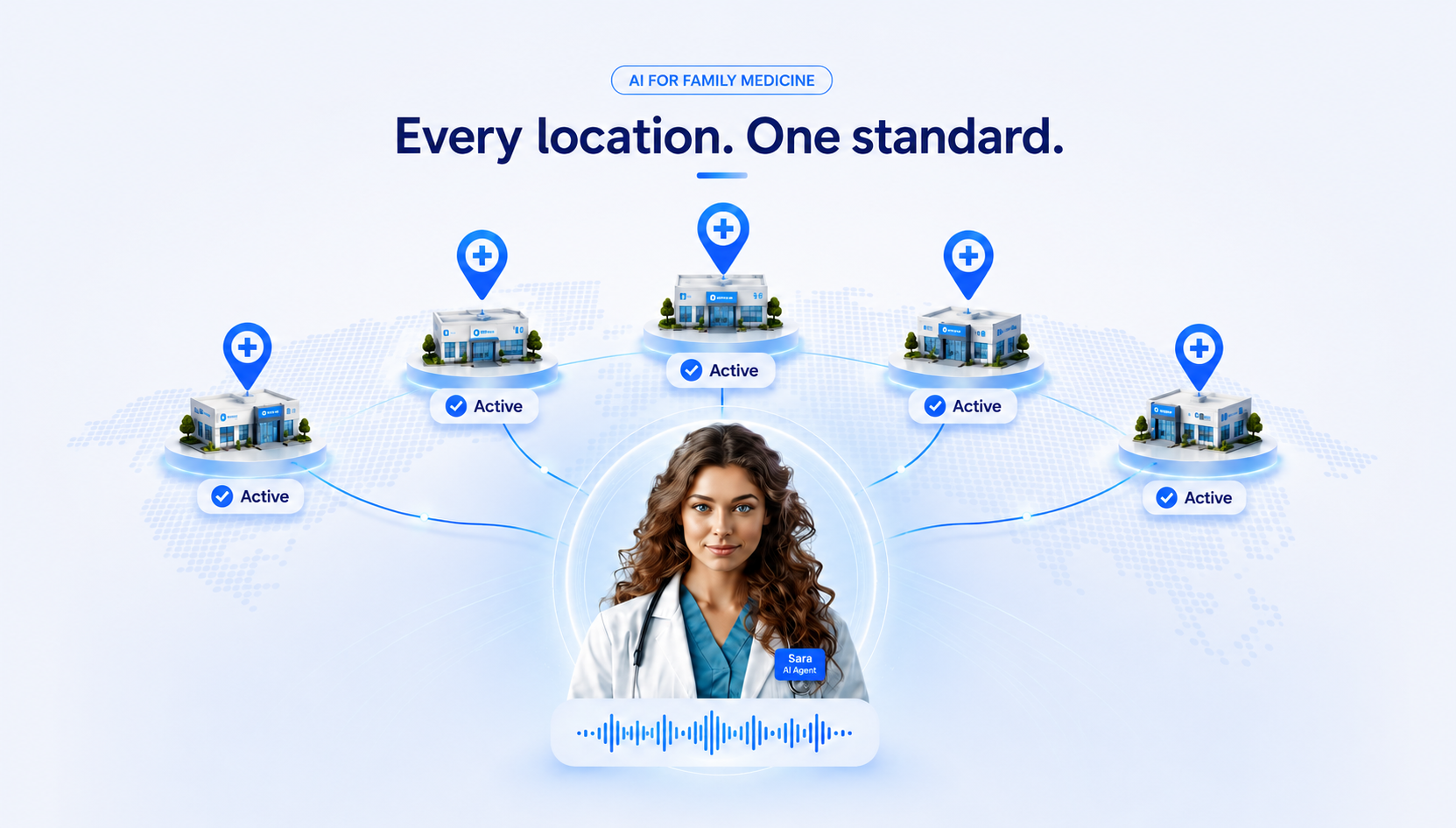
Confido Health's AI receptionist for family medicine handles the full inbound and outbound communication stack, applied identically across every location, integrated directly with the group's EHR. Sara manages scheduling, refill routing, insurance verification, billing inquiries, chronic disease recall, preventive care outreach, appointment reminders, and after-hours coverage at every site. Front desk teams manage clinical relationships, care coordination, and the calls that require human judgment, with a consistent operational foundation under every location.
Every Call Answered on the First Ring, At Every Location
24 hours a day, 7 days a week, in more than 20 languages, applied identically across the full group. No missed calls, no voicemail backlog, no morning recovery time lost to last night's messages, at any site. Every patient who calls any location reaches a system that completes their request in real time.
Structured Chronic Disease Recall, Group-Wide
Every patient overdue for a chronic disease monitoring visit or preventive care screening receives outbound outreach at the right interval, with booking completed in the same interaction, regardless of which location holds their chart. Recall runs continuously and consistently across the entire group, so the patient panel stays engaged rather than drifting at understaffed sites.
70% Reduction in Staff Call Burden
AI Agents absorb the routine, repeatable inbound call types that consume most of the front desk's day at every location. Staff at each site focus on the patients in the room, the calls that require clinical coordination, and the relationships that keep patients engaged with the group.
60% Reduction in Cancellations
Multi-touchpoint reminders via call and text, real-time waitlist management, and same-day cancellation recovery, applied uniformly across every site. Every filled slot is revenue protected and a patient who remains engaged with their care, group-wide.
15–20% Increase in Revenue Collections
Consistent billing follow-up, eligibility verification before every appointment, and payment inquiry handling that does not require a billing staff member for every call, at every location in the group.
Live in Under 30 Days, Across the Full Footprint
Expert-approved family medicine workflow templates cover acute and chronic scheduling logic, refill routing protocols, recall sequencing, preventive care outreach, and after-hours escalation. Deployment scales across every location in the group without requiring dedicated IT resources at each site individually.
Confido Health is more than an AI receptionist. It is the operational infrastructure that lets a multi-location family medicine group deliver the same access, consistency, and patient experience at every site, without depending on local staffing conditions to determine the standard of care a patient receives.
Want to see how Confido Health works across a multi-location family medicine group? Talk to our team.
FAQ
What does an AI receptionist for family medicine actually do?
An AI receptionist for family medicine answers inbound patient calls, books and reschedules appointments directly in the EHR, handles prescription refill routing, runs chronic disease and preventive care recall outreach, sends appointment reminders, manages after-hours call coverage with clinical escalation, and handles billing and insurance inquiries. For multi-location groups, all of these workflows apply identically across every site, with outcomes documented in the EHR in real time.
How is an AI receptionist different from the automated system we already have?
Most existing automated systems route calls or take messages. An AI receptionist completes the task: the appointment is booked, the refill is routed, the eligibility is verified, and the record is updated before the call ends, at whichever location the patient called. The patient does not wait for a callback. The staff member does not receive a task to complete.
How does the AI handle patients with chronic conditions who need regular follow-up?
AI Agents identify patients overdue for chronic disease monitoring visits based on diagnosis history and last visit date in the EHR, initiate outbound outreach, and complete the booking in the same interaction. For a group managing large panels of patients with hypertension, diabetes, or other chronic conditions across multiple locations, this structured recall runs automatically and consistently at every site rather than depending on individual front desk capacity.
Can the AI handle multilingual patient communication in family medicine?
Yes. Confido Health's AI Agents operate natively in more than 20 languages. When a Spanish-speaking patient calls any location, the Agent greets them in Spanish, conducts the scheduling intake in Spanish, completes the booking, and sends confirmation in Spanish. Outbound recall and reminder campaigns can be configured to reach patients in their preferred language, group-wide.
How does the AI handle a patient who mentions a clinical concern during a routine call?
Confido Health's AI Agents are configured to recognize clinical escalation signals during routine calls, regardless of which location the patient is calling. When a patient mentions a new symptom, describes a concerning change in their condition, or asks a question that requires clinical judgment, the Agent acknowledges the concern and routes immediately via warm transfer to a staff member or on-call provider with full context documented. The AI does not attempt clinical assessment. It ensures the right person is reached in real time.
Does Confido Health work for groups with fewer than 10 locations?
Confido Health is built for multi-location groups, clinic networks, and multi-provider organizations, typically running 10 or more locations or providers. The platform's value is most evident at this scale, where consistent execution across every site cannot be achieved through independent local staffing alone.
What EHR systems does Confido Health integrate with for family medicine?
Confido Health integrates with 40+ EHR systems in production, including Epic, Athenahealth, eClinicalWorks, and others commonly used in primary care and family medicine. Integration is bidirectional: the AI reads scheduling rules, patient history, and eligibility data, and writes appointments, task outcomes, and call documentation back to the patient record in real time, across every location in the group.
How long does deployment take across a multi-location family medicine group?
Most groups live with Confido Health in under 30 days using expert-approved family medicine workflow templates, deployed across the full footprint simultaneously. Configuration covers acute and chronic scheduling logic, recall protocol sequences, refill routing rules, preventive care outreach, and after-hours escalation, applied consistently at every site. No dedicated IT resources are required at each individual location during setup.
.webp)
