

.svg)
Millions of Americans delay or abandon care every year because they cannot get through to their provider's office. They hit a full voicemail. They sit on hold. They try the patient portal, find it confusing, and give up. Patient access in healthcare is the official term for this problem, but behind the term is something much more human: a person who needed care and did not get it.
This blog looks at the patient access crisis honestly, without jargon and without pretending the problem is simple. It examines why access breaks down across US healthcare, what it costs both patients and practices, and how AI is beginning to do something about it. Not by replacing the people who work the front desk, but by making sure that the patients who reach out never fall through a crack again.
If you run a medical practice and have ever watched your voicemail count climb on a Monday morning, this one is for you.
The Call That Never Got Answered
Maria is 58. She has been managing Type 2 diabetes for six years. Her primary care provider retired last spring, and she has been trying to establish care with a new provider ever since. She has called three different offices. Two went to voicemail. One put her on hold for eleven minutes before she had to hang up because her lunch break ended. She did not call back. She told herself she would try again next week. She hasn't.
Maria is not a statistic. But she is not alone, either. According to the National Center for Health Statistics 2022 National Health Interview Survey, more than 1 in 10 US adults could not find an available appointment when they needed one. That figure does not even account for those who stopped trying before they ever reached a scheduler.
The difficult truth is that most of this does not show up anywhere in your practice data. Maria never made it to a no-show report. She never made it to a cancellation log. She just... disappeared. And somewhere in your schedule today, there are more patients just like her.
This is what the patient access crisis in healthcare actually looks like. Not dramatic. Not loud. Just quiet gaps, one unanswered call at a time.
So What Is Patient Access in Healthcare, Really?
If you search the term, you will find definitions involving phrases like "continuum of care" and "healthcare delivery infrastructure." That language is accurate, but it does not capture what patient access in healthcare feels like from the inside.
At its simplest, patient access is everything that happens between a person deciding they need care and actually getting it. It is whether they can reach your office. Whether your hours work for someone who cannot take time off work. Whether they can get an appointment in a reasonable amount of time. Whether the process of scheduling, verifying insurance, and showing up does not feel like a second job.
Healthcare researchers describe it across five dimensions:
1. Availability (are there enough providers?)
2. Accessibility (can the patient physically get there?)
3. Accommodation (do the hours and systems work for them?)
4. Affordability (can they cover the costs?)
5. Acceptability (do they feel respected and understood when they arrive?)
A breakdown in any single one of those dimensions blocks access, even when everything else is in place.
The operational version of this, the one that matters most for a practice running day-to-day, is simpler. Patient access in healthcare is whether your patients can get through. Whether they get scheduled. Whether they show up. Whether they come back.
And right now, across the US, that chain is breaking more often than most practices realize.
The Numbers That Should Make Every Practice Leader Pause
From our experience working with healthcare organizations across the country, we hear the same story in nearly every conversation: the phone rings more than staff can handle, voicemails pile up overnight, and patients who could not get through simply do not call back. The data backs this up.
According to AMN Healthcare's 2025 physician wait times survey, the average new patient appointment wait time has reached 31 days, a 19% increase since 2022 and the longest average in the survey's history, which dates back to 2004. For obstetrics-gynecology, that average is now 41.8 days. For gastroenterology, 40 days. These are not edge cases; they reflect a system running consistently over capacity.
Meanwhile, the NCHS 2022 National Health Interview Survey found that 10.6% of US adults could not get a medical appointment when they needed one. That is a number representing tens of millions of people per year. And per an AHA market scan citing Accenture's survey of 8,000 US adults, nearly 1 in 5 consumers switched providers in the past year, with roughly 90% of those switchers saying the organization was simply hard to do business with.
These numbers tell the same story from different angles. Patient access in healthcare is not a niche operational concern. It is the front door to your practice, and right now, that door is harder to open than it should be.
Why Patient Access Keeps Breaking Down
There is no single villain in this story. Patient access in healthcare breaks down because of a collision of pressures that have been building for years, most of them well outside any individual practice's control.
There are not enough people to answer the phones
The US is short on healthcare workers at every level. The physician shortage gets the most attention, but the staffing gap that hits patient access in healthcare hardest is at the front office. According to data compiled in our Healthcare Staffing Shortage Report, 33% of medical practices specifically struggled to hire administrative and front desk staff. Industry observers note that front desk roles have seen growing attrition to other sectors. Workers are leaving for less stressful, comparably paid jobs elsewhere. When those roles stay vacant for weeks, the phones stop getting answered.
The phone is still how most patients try to reach you
There is a widespread assumption in healthcare that patients have shifted to digital channels. Some have, but for a very significant portion of the patient population, including older patients, patients managing chronic conditions, non-English-speaking patients, and patients without reliable internet, the phone is still the first and only tool. A meaningful share of calls arrive after hours, at times when no one at the practice is available to respond. Those patients leave voicemails. Most of those voicemails feed into backlogs that exhaust staff every Monday morning.
The admin burden has quietly multiplied
Prior authorizations. Insurance eligibility checks. Referral coordination. EHR documentation requirements. Each of these tasks has grown more complex over the past decade. The front office team is not just answering phones. They are also managing a PMS, verifying benefits in real time, chasing PA approvals, and trying to keep the schedule from collapsing when three providers have conflicting blocks. Every minute spent on admin complexity is a minute not spent answering a call. Patient access suffers quietly, in the background, every single day.
If PA approvals are where your team loses the most time, our guide on AI for insurance verification and prior authorizations goes deeper on that specifically.
The Hidden Cost No One Talks About
When a practice thinks about revenue, it usually looks at what came in: charges, collections, reimbursements. What it almost never measures is what never showed up at all.
Every call that went to voicemail and never got returned is an appointment that was never booked. Every patient who tried to schedule after hours and hit dead air is a visit that was lost before it was ever logged. These losses are invisible in the revenue cycle. They do not appear as denials. They do not show up as uncollected balances. They simply do not exist anywhere in the system.
From our experience working with healthcare organizations of all sizes, we have seen this pattern repeat: practices with strong clinical operations and satisfied in-person patients are simultaneously losing a significant volume of potential appointments they never even know about. Those patients never got through to become patients in the first place. Industry research on unanswered call rates in busy practices consistently points to a pattern where each missed call represents meaningful lost revenue, compounded across weeks and months.
For a full breakdown of how these losses accumulate and how to calculate them for your practice, our guide on the hidden cost of missed calls maps this in detail.
There is also the patient lifetime value dimension. A patient who leaves because they could not get through is not just one lost visit. Research consistently shows that acquiring a new patient costs significantly more than retaining an existing one. The moment that patient finds a practice that picks up on the first ring, the relationship is over.
Patient access in healthcare is, in this sense, a revenue conversation as much as it is a care delivery conversation. The practices that treat access as a secondary operational concern are quietly losing money they will never see on a report.
What Fixing Patient Access Actually Looks Like
The instinct when patient access breaks down is to throw more staff at it. More people to answer phones. More people to work the schedule. And yes, when staffing is the primary bottleneck, adding capacity helps. But the reality is that most practices cannot hire their way out of this problem. The candidates are not there. The budget is not always there. And even when you do hire, you are adding a person to a system that has not changed, which means the same pressure builds again within months.
Fixing patient access in healthcare requires changing the system, not just adding more people to a broken one. That means looking honestly at where the biggest gaps are: When are calls going unanswered? Which workflows are consuming the most front office time? Where are patients falling off between inquiry and appointment? Where are no-shows clustered, and are the right reminders going out at the right time?
It also means meeting patients where they are. Not assuming they will use a portal. Not assuming they check email. For many patients, a phone call that gets answered on the first ring is still the gold standard. For others, a text reminder at the right time is what keeps them from missing an appointment. The practices improving patient access fastest are the ones that stop treating all patients the same and start building communication workflows that adapt.
A few things make a measurable difference
After-hours coverage is one of the most impactful and most overlooked fixes. A meaningful share of calls arrive outside business hours from patients who needed something and got nothing. Closing that gap alone can recover a meaningful volume of appointments and reduce the voicemail backlog that exhausts your team every morning.
Waitlist management is another. When a cancellation opens a slot, the window to fill it is short. Practices that actively manage a waitlist and can reach patients quickly, whether through a call, a text, or an automated outreach, fill far more of those gaps than practices that rely on staff to manually work through a list.
Reminder cadence matters more than most practices appreciate. Research consistently shows that patients who miss appointments often did not do so intentionally. The appointment was too far out, life got in the way, and no one followed up. A well-timed, personalized reminder is not just a nudge. It is a re-commitment to the care plan.
If unanswered calls are where your access chain is breaking first, our step-by-step guide on eliminating missed calls in medical practices is the right place to start.
How AI Is Changing the Math on Patient Access
Here is the honest framing: AI is not a magic fix for patient access in healthcare. It does not solve the physician shortage. It does not eliminate administrative complexity. It does not replace the judgment and empathy of a skilled front office coordinator.
What it does do is absorb the volume. The relentless, repetitive, high-stakes volume that breaks the access chain every day.
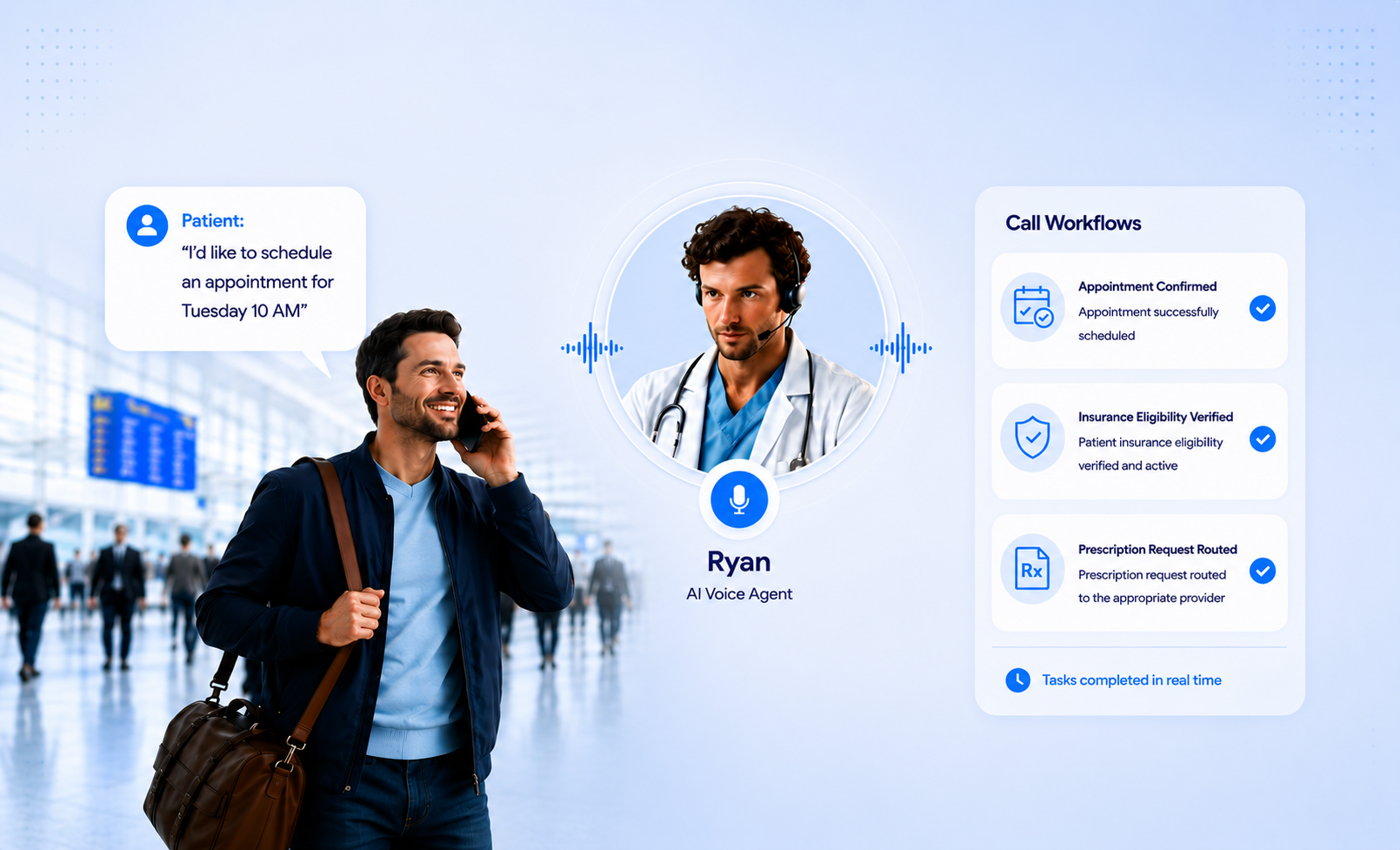
AI Agents in healthcare are built to handle the structured, high-frequency interactions that consume most of the front office's time: appointment scheduling, reminders, prescription refill routing, insurance eligibility questions, after-hours calls. These are not simple tasks, but they follow known patterns. They can be handled correctly, consistently, and at any hour, without a human having to be available at that exact moment.
What does that mean for a real practice?
It means a patient who calls at 7 PM on a Sunday gets scheduled instead of sending a voicemail into a Monday morning backlog. It means the waitlist gets worked automatically when a slot opens, not when someone on the team has a free moment. It means the reminder that would have prevented a no-show actually goes out on time, every time. Not just when the schedule is quiet enough for someone to make calls.
From our experience with customers, we have seen that the shift is less about deploying a new technology and more about experiencing a different daily reality: a team that is not buried, a front desk that has time to look up when a patient walks in, and staff who are not choosing between answering the phone and helping the person standing right in front of them.
Confido Health's AI Agents integrate directly with your EHR and PMS, which means the AI is not working around your systems. It is working inside them, reading real-time availability, writing confirmed appointments directly to the schedule, and keeping patient records updated without anyone having to enter anything twice.
If you want to understand how AI scheduling compares to what your EHR already does, our guide to integrating AI into your EHR is a good next read.
Here's How Confido Health Can Help
Patient access in healthcare breaks at the operational layer. That is exactly where Confido Health is built.
Our AI Agents are not a generic call center product applied to healthcare. They are purpose-built for medical workflows, designed to run across both front-office and back-office operations, and integrated directly into the systems your team already uses.
Here is what that looks like in practice:
Appointment Management
Our AI handles inbound scheduling, rescheduling, cancellations, provider and location selection, after-hours calls, and urgent-versus-routine triage, all without staff involvement unless a clinical decision is required. Outbound, it manages confirmation calls, reminder texts, no-show follow-ups, waitlist backfills, and pre-visit instruction delivery. Practices using Confido Health have seen a 60% reduction in cancellations, a 91% inbound answered call rate across locations, and 4 to 5 hours of staff time saved per provider per day.
Payment and Revenue Cycle
Beyond the front desk, Confido Health's AI Agents handle billing inquiries, payment plan enrollment, copay clarification, outstanding balance outreach, Text-to-Pay reminders, and failed payment retries, all autonomously. From our experience with customers in this space, we have seen 3x growth in monthly collections after AI implementation and collection rate improvements in the 15 to 30% range with AI-driven outreach.
Insurance Verification and Prior Authorization
Our agents run real-time eligibility checks via clearinghouse integration, confirm coverage and benefits, and write results directly back to the patient chart. This eliminates the 10 to 15 minutes per patient that front desk staff previously spent on manual verification. For prior authorizations, AI-assisted submission has reduced PA turnaround from 5 to 14 days down to 2 to 4 hours in many cases, with 30% fewer initial denials through structured, complete submissions.
Patient Recall and Reactivation
Whether the goal is bringing patients back for scheduled preventive care or recovering dormant patients who have left treatment incomplete, Confido Health runs structured outbound campaigns that scale without adding headcount. Customers in dental and eye care verticals have reported 50% reductions in no-shows and missed appointments, and $40,000 or more per month in recovered revenue from reactivation campaigns alone.
Referral Management and Fax Processing
Confido Health handles inbound referral intake via phone and fax, matches patients to providers, coordinates specialist scheduling, and follows up with referring providers on missing information. This reduces referral leakage and improves time-to-appointment from the point of referral intake.
Integration-first, live in under 30 days
Confido Health integrates with 40+ EHR and PMS systems, including Epic, Athenahealth, and eClinicalWorks. Expert-approved templates mean most practices go live in under 30 days with no dedicated IT resource required during setup.
Confido Health is the operational capacity layer your practice has been missing, running quietly in the background so your team can be fully present for the patients right in front of them.
Want to see how Confido Health can help more patients get through, get scheduled, and get the care they need? Book a demo today.
Still researching? Start with our guide to integrating AI into your EHR to understand how the technology actually works before you decide.
Frequently Asked Questions
What does patient access in healthcare actually mean?
Patient access in healthcare describes everything between a patient deciding they need care and actually receiving it, including whether they can reach the practice, get a timely appointment, navigate insurance, and show up without the process breaking down along the way. It is not just a clinical concept. It is a daily operational reality for every medical practice.
Why is patient access in healthcare such a problem in the US right now?
A combination of front office staffing shortages, rising administrative complexity, and growing patient demand has stretched patient access in healthcare past its capacity. Practices are managing more calls, more prior auth requests, and more scheduling complexity with the same or fewer staff. The result is calls going unanswered, appointments going unfilled, and patients quietly disengaging from care.
How long do patients typically wait for an appointment in the US?
AMN Healthcare's 2025 Survey of Physician Appointment Wait Times found the average new patient appointment wait time is 31 days, up 19% since 2022. Wait times vary by specialty and geography, with obstetrics-gynecology averaging 41.8 days and gastroenterology averaging 40 days. Long wait times are one of the most common reasons patients delay or abandon care.
What happens to patients who can't get through to their provider?
CDC and NCHS data show that more than 10% of US adults in a given year could not get a medical appointment when needed. Research from the AHA highlights that roughly 1 in 5 consumers have switched providers, with the vast majority citing difficulty accessing and doing business with their prior practice. These patients do not file complaints. They simply stop trying, and their health often suffers for it.
How does poor patient access in healthcare affect a practice's finances?
The financial damage from poor patient access in healthcare is mostly invisible. Unanswered calls never appear as missed revenue in any report. From our experience, the practices that take a close look at their missed call volumes are often surprised by how much potential revenue was never captured. Our breakdown of the hidden cost of missed calls maps this in detail.
What is the connection between patient access in healthcare and no-show rates?
No-shows are often the final step in an access failure, not an isolated event. A patient who never received a timely reminder, could not easily reschedule when their plans changed, or booked too far in advance is statistically more likely to miss the appointment. Improving the communication and scheduling process around an appointment reduces no-shows by keeping patients connected to their care plan.
Can AI improve patient access in healthcare without replacing front office staff?
Yes. Improving patient access in healthcare does not require replacing your front office team. AI Agents work alongside staff by absorbing the high-volume, repetitive interactions that consume most of the team's day, including scheduling calls, reminders, after-hours inquiries, and refill routing. This frees staff to focus on in-person patient needs and complex tasks that genuinely require human judgment. The goal is a team that is more effective, not a smaller one.
What role does after-hours coverage play in patient access in healthcare?
A significant and often unmeasured share of patient calls arrive outside business hours. These patients cannot reschedule, cannot confirm appointments, and often cannot get the information they need to prepare for a visit. AI Agents that operate around the clock close this gap, converting after-hours calls into confirmed appointments rather than unread voicemails.
How do AI Agents help with scheduling and no-show reduction specifically?
AI Agents manage the full appointment lifecycle: booking, confirming, reminding, rescheduling, and following up after a no-show. When a slot opens due to a cancellation, AI can immediately reach out to waitlisted patients and fill the gap before it disappears. Each step in this chain reduces no-show rates and keeps the schedule fuller.
How quickly can a practice improve patient access in healthcare with AI?
Confido Health goes live in under 30 days using expert-approved templates that reflect real healthcare workflows. No dedicated IT resources are required during setup, and integration with existing EHR and PMS systems is handled as part of onboarding. Most practices see measurable improvement in answered call rates and appointment volume within the first few weeks.
.webp)
