

.svg)
- As of 2023, 27.3 million people in the US, 9% of the population aged five and older, had limited English proficiency. According to KFF's 2025 LEP analysis, Asian and Hispanic people, immigrants, and those with lower incomes are disproportionately affected.
- Federal law requires it. Under Title VI of the Civil Rights Act and Section 1557 of the ACA, healthcare organizations receiving federal funding must provide free, timely language assistance at every point of contact, including the phone, scheduling, and billing.
- AI Voice Agents answer in the patient's language from the first ring. No hold time, no interpreter wait, no degraded service compared to English-speaking patients. The appointment books, the eligibility verifies, and the EHR updates before the call ends.
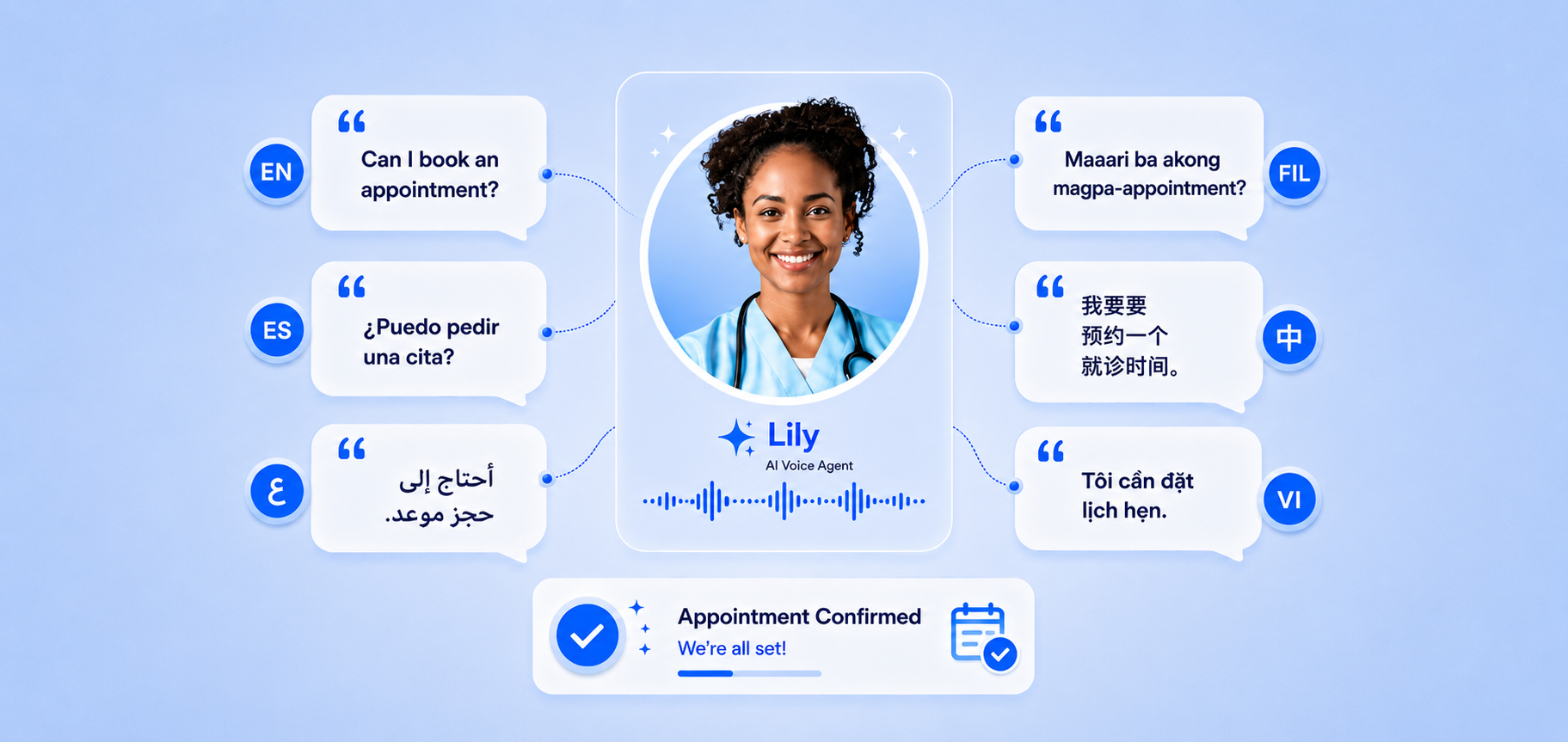
- Confido Health's AI Agents operate in more than 20 languages. The same scheduling logic, insurance verification, and task completion that apply in English apply in Spanish, Mandarin, Vietnamese, Arabic, Tagalog, and beyond.
- Language access is a direct determinant of whether a patient returns. Patients who cannot navigate the administrative layer of a practice are less likely to follow up, more likely to miss appointments, and more likely to seek care elsewhere. See how AI solves everyday practice problems including access gaps like this one.
What Happens When the Language Is the Barrier?
A patient calls a primary care clinic on a Tuesday afternoon. She speaks Spanish. She needs to make an appointment and ask whether her insurance covers the specialist her doctor mentioned. The front desk team is skilled and well-meaning. None of them speaks Spanish.
Someone puts her on hold. Someone else looks for a bilingual colleague. That colleague is with a patient. The caller is transferred to a voicemail she cannot understand. She hangs up.
She does not call back. The appointment is never rescheduled. The referral goes unaddressed. The care gap widens.
This is not a story about a poorly run practice. It is a story about a structural mismatch between the linguistic reality of American healthcare and the tools most practices use to manage patient communication. That mismatch has consequences that reach well beyond a single missed call.
According to KFF's 2025 analysis of 2023 ACS data, 27.3 million people aged five and older in the United States (9% of that population) have limited English proficiency (LEP). Asian and Hispanic people account for the largest shares, and immigrants and lower-income households are disproportionately represented. These are not edge-case populations. They are core patient populations in community health centers, FQHCs, safety-net practices, and large multispecialty groups across the country.
The patient access crisis in healthcare affects everyone, but it falls hardest on the patients least equipped to navigate it alone.
The Barrier Does Not Begin in the Exam Room
There is a common assumption that language access in healthcare is primarily a clinical problem: making sure a provider can communicate with a patient during a visit. That matters. But the access failure almost always begins before the patient ever sees a provider.
KFF's 2023 survey found that about half of adults with LEP report encountering at least one language barrier in a healthcare setting in the past three years. Specifically, 25% say language barriers made it difficult to schedule a medical appointment, 33% say it made it difficult to communicate with medical office staff, and 30% report difficulty understanding a provider's instructions.
What this means operationally is that the phone is where the access failure begins. A patient who cannot communicate their request to the person answering the phone cannot book the appointment that leads to the visit that leads to the diagnosis. The entire care pathway is gated by that first administrative interaction.
Most practices are not resourced to handle that interaction in more than one or two languages. Hiring bilingual front desk staff for every language a practice serves is not financially viable. Scheduling on-demand interpreters for every inbound call adds cost and friction most practices cannot absorb. After-hours calls in non-English languages are almost entirely unserved.
Language access in healthcare, despite being a legal obligation, operates as a best-effort function in most practices. It works when the right staff member happens to be available. It fails quietly when they are not, and the patients who need it most stop trying.
What Federal Law Actually Requires
This is not just a care quality problem. It is a legal compliance obligation that many practices underestimate.
Under Title VI of the Civil Rights Act and Section 1557 of the ACA, any healthcare organization receiving federal financial assistance (which includes virtually every practice accepting Medicare or Medicaid) must provide free, accurate, and timely language assistance to patients with limited English proficiency. HHS has confirmed that failure to provide language access constitutes discrimination on the basis of national origin.
The phrase "at every point of contact" is the part most practices miss. The obligation applies to scheduling calls. It applies to appointment reminders. It applies to outbound recall campaigns. It applies to billing inquiries and prescription refill requests. It applies to after-hours communication.
Communication failures are consistently identified as a leading root cause of serious adverse events in healthcare, and language barriers contribute directly to patient safety disparities between English-speaking and LEP patients. The administrative layer of healthcare (the phone calls, the scheduling system, the follow-up process) is where those barriers most commonly appear.
From our experience working with healthcare practices, the gap between what federal law requires and what is operationally delivered is wide. Not because practices do not want to comply, but because the infrastructure to do so consistently at scale has not existed until now.
Where AI Changes the Equation
An AI Voice Agent that operates natively in multiple languages is not a translation layer bolted onto an English-first system. It is a system that receives the call in the patient's language, processes the request in that language, applies the practice's scheduling logic, and completes the workflow, all without switching languages or requiring an intermediary.
That distinction matters for three reasons.
Accuracy
Translation-dependent systems introduce a step where meaning can be lost. A system that operates natively in a language from the start of the interaction does not carry that risk. The patient says what they need, the system understands it in the language they used, and the task is completed.
Dignity
Patients who are put on hold while someone finds an interpreter, or who navigate a phone tree in a language they do not fully understand, receive a signal about how the practice values their time and their presence. A system that answers in their language from the first ring sends the opposite signal.
Consistency
A bilingual staff member can only be in one place at once. They are unavailable after hours, during peak volume, and during their own patient-facing work. An AI Agent is available for every call, in every supported language, at the same time. Coverage does not depend on who is working that shift.
This is what AI voice agents make possible for multilingual patient populations that no staffing model can replicate at scale.
What This Looks Like Across the Patient Journey
Language access is not a single interaction. It is a continuous need across every touchpoint in the patient relationship.
Inbound Scheduling and Rescheduling
When a Spanish-speaking patient calls to book a new appointment, the AI Agent greets them in Spanish, asks intake questions in Spanish, checks availability against the provider's scheduling rules, books the appointment, and sends confirmation. The EHR is updated before the call ends. No hold time, no interpreter wait, and no degraded service relative to what an English-speaking patient receives.
When a Mandarin-speaking patient calls to reschedule, the same workflow applies. Same scheduling logic. Same EHR integration. Same task completion. The language changes. The service does not.
Insurance Verification and Coverage Questions
Understanding insurance coverage is among the most language-sensitive interactions in healthcare. Copays, deductibles, in-network status, prior authorization requirements: these are complex concepts that are difficult to communicate clearly even in English. For a patient whose primary language is Arabic or Vietnamese, a staff member reading policy language back to them is rarely sufficient.
An AI Agent handles these inquiries in real time, in the patient's language, drawing on current eligibility data from the EHR. The patient gets an accurate answer. No staff member is pulled into an interaction they are not equipped to handle confidently.
Prescription Refill Requests
Refill requests are among the most common after-hours call types across every patient population. For patients with LEP, the inability to leave an intelligible voicemail means these requests often go unsubmitted entirely. An AI Agent that answers in the patient's language captures the request accurately, confirms eligibility, routes to clinical staff for review, and notifies the patient when the prescription has been processed without a language gap at any step.
Appointment Reminders and Outbound Recall
KFF's survey data shows that adults with LEP are less likely than English-proficient adults to have had a healthcare visit in the past three years and less likely to have a usual source of care. A significant share of this gap traces to accumulated friction at every administrative touchpoint. Outbound recall and reminder campaigns delivered in the patient's preferred language remove a direct layer of that friction.
When a practice runs an annual wellness recall campaign that reaches Vietnamese-speaking patients in Vietnamese, Spanish-speaking patients in Spanish, and Arabic-speaking patients in Arabic with appointment booking completed in the same call, response rates improve. Not because health needs changed, but because the barrier was removed.
Post-Visit Follow-Up and Care Continuity
Post-discharge instructions, medication reminders, and follow-up coordination are where language barriers carry the clearest clinical consequences. LEP patients who do not receive adequate language assistance experience higher rates of adverse outcomes, lower medication adherence, and weaker continuity of care. An AI Agent handling post-visit outreach in the patient's language is not a convenience feature. It is a clinical continuity tool for the patients most at risk.
The Scale Problem Staffing Cannot Solve
Practices serving linguistically diverse populations face a problem that human staffing cannot resolve: the linguistic needs of the patient population exceed what is financially and operationally possible to staff for.
A clinic in South Texas may serve patients speaking Spanish, English, and indigenous languages from Mexico and Central America. A community health center in Queens serves patients speaking Mandarin, Korean, Bengali, Spanish, Haitian Creole, and dozens of others. A multispecialty group in Southern California has a patient population spanning virtually every major world language.
No hiring plan covers this. No interpreter scheduling system answers every call at every hour across every language. The gap is structural, and it produces outcomes documented consistently: lower preventive care utilization, higher emergency department use, weaker chronic disease management, and more adverse events connected to communication failures.
AI closes the gap by operating at a scale that staffing cannot reach. 20+ languages are supported simultaneously, around the clock, with the same scheduling rules, EHR integration, and task completion regardless of which language the patient is calling in. For multi-location and multi-provider groups, that consistency across every site is particularly consequential; the same language access standard applies at every location without depending on local staffing.
What to Look for When Building Language Access Into Your AI Infrastructure
Does the system operate natively in each language, or does it translate?
Ask vendors directly: when a patient calls in Spanish, does the AI process that conversation in Spanish from the beginning, or does it translate the input into English first and process from there? A translation-dependent system introduces latency, increases the risk of meaning loss on clinical or administrative concepts, and often produces conversations that feel unnatural to native speakers. Native language processing from the start is materially different.
Does language access cover the full workflow, not just the greeting?
Some systems answer in multiple languages but revert to English-only capability when the interaction becomes complex. Booking a multi-provider appointment, verifying insurance eligibility, or routing a refill request requires full-stack multilingual capability throughout the entire task completion loop, not just a greeting and a menu option. Confirm what the system can actually complete in each language it claims to support.
Is HIPAA compliance consistent across all languages?
PHI does not become less sensitive because it was communicated in Arabic or Vietnamese. The encryption standards, access controls, Business Associate Agreement, and audit trail requirements apply to every call in every language. For what HIPAA-compliant AI communication requires, verify explicitly that the vendor's compliance architecture covers all supported languages under the same standards as English.
Can it scale as your patient population evolves?
US Census data shows that linguistic diversity in the US is increasing, not stabilizing. A practice that serves primarily Spanish-speaking patients today may see meaningful shifts in its linguistic profile within a few years. Ask whether adding language support requires a new implementation or whether the platform expands language capability without operational disruption.
Here's How Confido Health Can Help
For practices serving multilingual communities, the language gap shows up in the most basic place: the phone call that was never answered in the patient's language, the appointment that was never booked, the follow-up that was never understood.
Confido Health's AI Agents operate natively in more than 20 languages. A Spanish-speaking patient calling your practice is greeted in Spanish, helped in Spanish, booked in Spanish, and confirmed in Spanish. The appointment is in the EHR. The eligibility is verified. The interaction is complete. What they received is exactly what an English-speaking patient received two calls later.
That takes place at 9 PM. It is held during the outbound recall campaign reaching Vietnamese-speaking patients due for their annual visit. It is held for the Arabic-speaking patient who has a billing question on a Saturday morning. The federal obligation to provide language access does not have business hours, and neither does Confido Health.
20+ Languages, Natively
Lily handles multilingual outreach, care gap calls, and recall campaigns. Sara manages inbound scheduling and insurance queries. Both operate in the patient's language from the first ring, not through a translation layer, but natively, with the same scheduling logic and EHR integration as every English-language call.
Same Workflow. Every Language.
Insurance verification, appointment booking, refill routing, billing inquiries: every workflow completes in the patient's language. Nothing is handed off to staff because the language changed. The task finishes before the call ends.
40+ EHR Integrations, Bidirectional
Confido Health integrates with Epic, Athenahealth, eClinicalWorks, ModMed, NextGen, and Dentrix. Regardless of which language the patient called in, the appointment is booked, the eligibility result is written to the chart, and the record is updated in real time.
Around the Clock, Across Every Location
Multi-location and multi-provider groups get consistent language access at every site, not dependent on which staff happen to be working. After-hours calls in Spanish, Mandarin, or Arabic are handled the same way as a Tuesday afternoon call: completely, in real time.
97% Patient Satisfaction
Empathetic, natural conversations in every supported language. The same quality of interaction at 9 PM as at 9 AM, in Spanish as in English.
Live in Under 30 Days
Expert-approved workflow templates configured to the practice's scheduling rules, provider preferences, and language access requirements. No lengthy implementation. No dedicated IT resources required.
For practices that have been managing language access through best-effort bilingual staffing, the shift to AI-driven multilingual coverage means something specific: every patient, in every language, every time. The care access equity that federal law requires, and that patients deserve, is no longer a best-effort outcome. It is the default one.
Want to see how Confido Health handles multilingual patient populations at your practice? Book a demo today.
Still thinking through your patient access approach? See what conversational AI means before you evaluate platforms.
FAQ
Why do language barriers in healthcare matter beyond the clinical visit?
Language barriers affect every administrative touchpoint before a patient ever reaches a provider. KFF's 2023 survey found that 25% of adults with LEP have found it difficult to schedule a medical appointment due to language barriers, and 33% have struggled to communicate with medical office staff. When patients cannot navigate scheduling and administrative communication, they are less likely to book appointments, attend follow-ups, or manage chronic conditions effectively.
What does federal law require regarding language access?
Under Title VI of the Civil Rights Act of 1964 and Section 1557 of the Affordable Care Act, healthcare organizations receiving federal financial assistance must provide free, accurate, and timely language assistance to patients with LEP at every point of contact. This includes phone-based administrative interactions such as scheduling, billing inquiries, and prescription refill requests, not just clinical encounters.
How is AI-driven language access different from hiring bilingual staff?
Bilingual staff provide excellent service but cannot cover every language a practice's patient population speaks, at every hour, across every call type. An AI Agent operating natively in more than 20 languages answers every call in the patient's language, applies the practice's scheduling rules, completes the task in real time, and updates the EHR with no dependency on staff availability, shift schedules, or which languages happen to be represented on a given day.
What languages does Confido Health support?
Confido Health's AI Agents operate in more than 20 languages, covering the major LEP populations in US healthcare including Spanish, Mandarin, Vietnamese, Arabic, and Tagalog. The same scheduling logic, insurance verification, and task completion apply in every supported language as they do in English.
Does multilingual AI apply to outbound calls and reminders as well?
Yes. Outbound appointment reminders, patient recall campaigns, reactivation outreach, and post-visit follow-up all operate in the patient's preferred language. For LEP populations who are less likely to engage with English-only outreach, multilingual outbound communication directly improves appointment adherence, preventive care participation, and care continuity.
How does Confido Health maintain HIPAA compliance across multiple languages?
HIPAA compliance applies equally across all supported languages. All conversations regardless of language are handled under the same encryption standards, PHI data protections, Business Associate Agreement, and audit trail requirements. There is no reduced compliance posture for non-English interactions.
How does this help with the patient access problem specifically?
Language barriers are one of the most significant and most avoidable drivers of the patient access gap. When patients cannot navigate the administrative layer of the practice that is supposed to serve them, they delay care, miss appointments, and disengage from the health system. Removing the language barrier from the first point of contact is one of the highest-leverage interventions available to practices serving multilingual communities.
What problems do AI voice agents solve beyond language access?
Language access is one dimension of a broader set of everyday practice problems that AI voice agents address, including after-hours coverage, call volume management, no-show reduction, and staff burnout from repetitive inbound calls.
.webp)
