

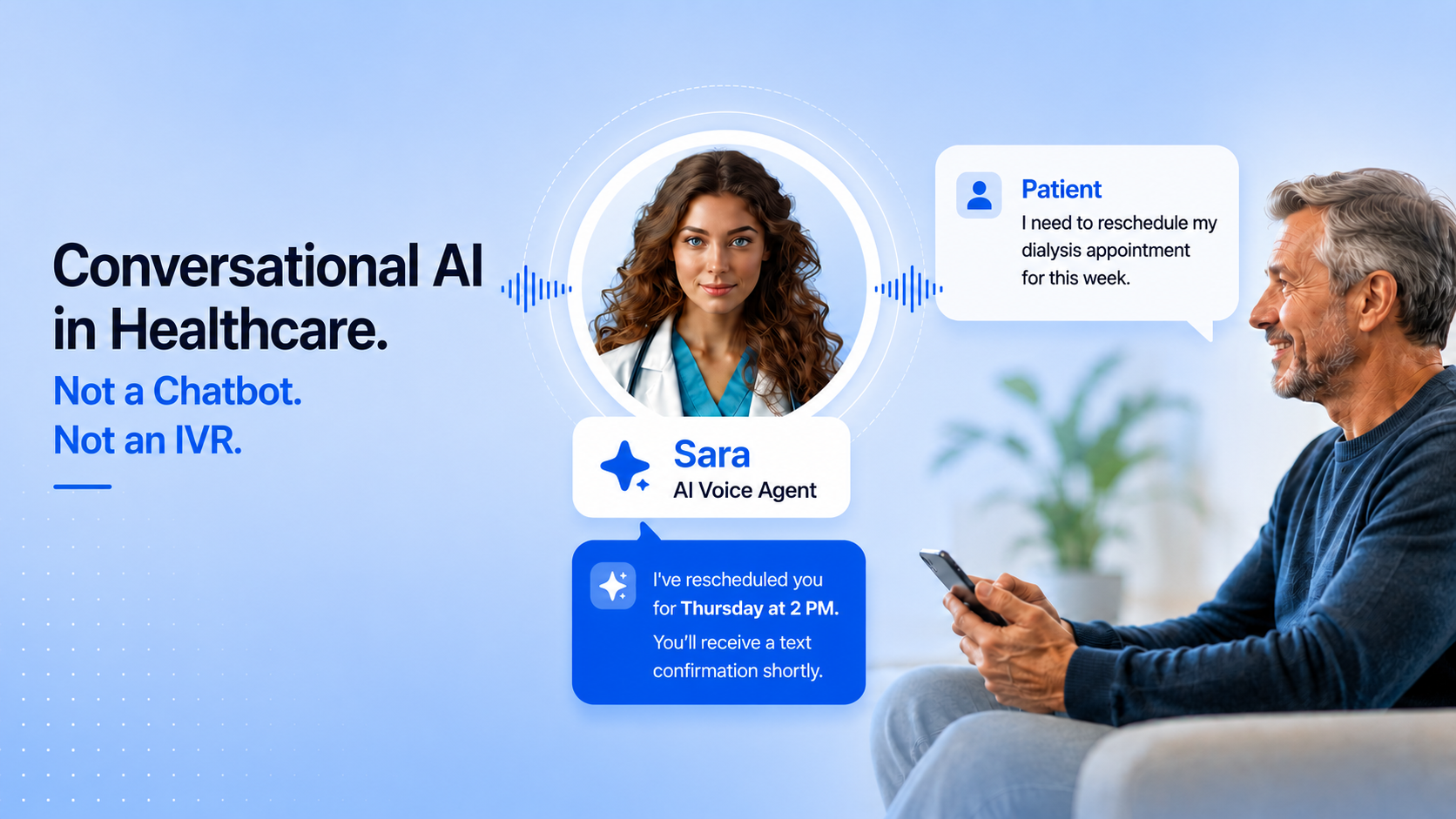
.svg)
- "Conversational AI" is used to describe at least four different kinds of technology, from basic chatbots to full AI Voice Agents that complete tasks inside your EHR. The term has become almost meaningless on its own, and buying the wrong thing has real operational consequences.
- Conversational AI in healthcare means a system that understands natural language, reasons through healthcare-specific workflows, and completes a task without a human having to finish it afterward. Understanding language is only half the capability.
- A chatbot is text-based, answers questions using pre-programmed responses, and cannot take a phone call or act inside a scheduling system. It informs. It does not resolve.
- An IVR routes calls through a fixed menu. It cannot understand a sentence. It moves calls somewhere. A human still does the work. According to Forrester's 2024 US CX Index, CX quality across US brands fell to an all-time low for the third consecutive year, with healthcare among the hardest-hit industries.
- True conversational AI resolves. It takes a patient from need to outcome in the same interaction, with no task left in a queue for staff to finish.
- Conversational AI in healthcare is used across appointment management, insurance verification, prior authorization, payment and revenue cycle, patient recall, referral management, and prescription refills. See how AI handles insurance verification and prior authorizations as one example of end-to-end resolution.
- When evaluating vendors, the questions that matter are whether the system resolves or routes, whether integration is at the workflow level or surface level, and whether it can handle natural unscripted conversation. Our guide to what to look for in AI medical appointment scheduling software covers the evaluation criteria in more detail.
The Terminology Problem Nobody Talks About
A vendor pitches their product as "conversational AI." What they are actually selling is a phone menu with a few extra voice commands, or a chat widget that matches keywords to a list of pre-written answers. The practice leader buys it, the team spends weeks setting it up, patients try to use it, and within a month the front desk is fielding complaints.
The product was not necessarily bad. It was mislabeled. And the practice bought it because they could not tell the difference.
This problem exists because "conversational AI" is used to describe at least four completely different kinds of technology: a basic rule-based chatbot, a classic IVR phone tree, a natural language text assistant, and a full AI Voice Agent that completes tasks inside your EHR in real time. All four are marketed using the same language. The term has become almost meaningless on its own.
From our experience working with healthcare organizations, this confusion creates real operational consequences. A practice invests in a tool that was never built to solve the problem they have. The result is the same staff burden, the same patient frustration, and the added cost of technology that is not doing what it promised.
Getting clear on what conversational AI in healthcare actually means is not an academic exercise. It is the prerequisite to making a decision that works.
What Conversational AI in Healthcare Actually Means
Conversational AI in healthcare refers to AI systems that can understand, process, and respond to natural human language in healthcare contexts, and then act on that understanding to complete a real task.
That last part is important. Understanding language is only half the capability. The other half is doing something useful with it: booking an appointment, checking insurance eligibility, routing an urgent call, processing a refill request, updating a patient record.
A system that can hold a natural conversation but cannot complete a task is a demonstration, not a healthcare operations tool.
According to the Frost and Sullivan 2025 report on conversational AI in healthcare, the global market was valued at $18.83 billion in 2025 and is projected to reach $59.12 billion by 2030, growing at a compound annual growth rate of 25.7%. That growth is not driven by novelty. It is driven by measurable operational outcomes in practices and health systems that have deployed the real thing.
Conversational AI in healthcare operates across voice and text, through phone calls, chat interfaces, SMS, and patient portals. But the defining characteristic is not the channel. It is the combination of three things working together: the ability to understand natural language, the ability to reason through a healthcare-specific workflow, and the ability to complete the task without a human having to step in.
When all three of those are working, patients get through. When one of them is missing, patients get frustrated.
How It Actually Works: The Technology Without the Jargon
Most explanations of how conversational AI works lean on acronyms: NLP, NLU, LLM, ASR. Here is a plain-language version of what is actually happening when a patient calls a practice and speaks to a well-built AI Voice Agent.
The patient calls and says: "Hi, I need to reschedule my appointment with Dr. Patel on Thursday. I also wanted to check if my insurance is still on file."
The system does several things at once.
Step one is speech to text. It converts the patient's spoken words to text using speech recognition.
Step two is intent recognition. The system uses natural language understanding to identify what the patient actually wants. Not just the keywords, but the intent behind the words. It recognizes two requests: a rescheduling action and an insurance confirmation. It holds both in context for the rest of the conversation.
Step three is real-time system access. It connects to the practice's EHR and PMS in real time. It checks the existing appointment, finds available slots that match the provider's schedule, presents options to the patient, and confirms the new time.
Step four is parallel task resolution. It simultaneously checks the insurance record on file, confirms the details with the patient, and flags any discrepancy for follow-up if needed.
All of this happens inside the same call. The patient does not wait for a callback. No task sits in a queue for staff to finish later.
This is fundamentally different from a chatbot, which works only in text, cannot make phone calls, and has no connection to your scheduling system. It is also fundamentally different from an IVR, which presents a fixed menu of options and cannot understand a sentence like the one above.
The three technical components that make this work are natural language understanding, deep integration with healthcare backend systems, and the ability to complete multi-step workflows autonomously. Each piece depends on the others. Without deep system integration, the AI can talk but cannot act. Without strong language understanding, the integration is useless because the system cannot correctly interpret what the patient is asking for.
What a Chatbot Is and Where It Stops
In its most basic form, a chatbot is a text-based interface that responds to messages using a set of predefined rules or keyword matches. You type something in. The system finds the closest match in its list of pre-programmed responses and returns it.
More advanced chatbots use large language models to generate responses that feel more natural and contextual. These are useful for certain kinds of interactions: answering frequently asked questions, guiding a new patient through an intake form, explaining what to bring to an appointment.
Where chatbots stop is at action. A chatbot can tell a patient what your cancellation policy is. It cannot cancel the appointment, update the EHR, and send a confirmation. It can explain what prior authorization is. It cannot initiate the PA workflow, submit documentation to the payer, and track the status.
There is also the channel problem. Chatbots are text-based and live on a screen. The majority of patient contacts in US healthcare still happen over the phone. A chatbot on a website does not address the patient access crisis in healthcare that originates from unanswered calls, not unanswered chat messages.
For healthcare practices dealing with high inbound call volumes, staff shortages, and after-hours access gaps, a chatbot solves roughly ten percent of the actual problem. It handles text-based, information-seeking interactions during business hours. Everything else still falls on the front desk.
What an IVR Is and Why It Falls Short for Patients
IVR stands for Interactive Voice Response. It is the system responsible for the most universally disliked experience in healthcare: calling your doctor's office and hearing "Press 1 for appointments, press 2 for billing, press 3 for prescription refills."
IVR has existed since the 1970s. The original purpose was reasonable: route high call volumes without requiring every caller to speak with a human. For simple, predictable interactions it works. For the complexity of a real patient call, it breaks down almost immediately.
The core limitation of a traditional IVR is that it operates on rigid, branching logic. Every possible patient need has to be anticipated in advance and mapped to a numbered option. When a patient's need does not fit neatly into one of those options, which is most of the time, one of two things happens: the patient gets misrouted and ends up in the wrong queue, or the patient does what the industry calls "zeroing out," pressing zero repeatedly until a human picks up.
Both outcomes push more work onto the front desk.
According to Forrester's 2024 US Customer Experience Index, CX quality among US brands fell to an all-time low for the third consecutive year, with healthcare among the hardest-hit industries. A significant driver of that decline is the friction patients experience when they try to reach their providers and encounter systems that cannot help them. The hidden cost of missed calls in healthcare extends far beyond the individual call: it affects scheduling rates, patient satisfaction, and revenue.
Even vendors who now describe their IVR systems as "AI-powered" or "intelligent" are mostly referring to the addition of basic voice commands in place of button presses. The underlying logic is still fixed and rule-based. The system still cannot understand a sentence like "I need to reschedule because I have a conflict" and respond intelligently. It can only parse "reschedule" and route accordingly, often to a queue that a human then manages.
The distinction matters because practices that buy an "AI-enhanced IVR" thinking they are getting conversational AI end up with a slightly better phone tree, not a fundamentally different patient experience.
The Real Difference: Routing vs. Resolving
Here is the clearest way to explain the difference between a chatbot, an IVR, and true conversational AI in healthcare.
An IVR routes. It takes a call and moves it somewhere. The actual work still happens elsewhere, usually with a human. A chatbot informs. It answers a question or explains a policy. It does not change anything in any system. A conversational AI Agent resolves. It takes a patient from need to outcome in the same interaction, with no human required unless the situation calls for one.
Take a patient calling to book a new appointment as a practical example. An IVR routes them to the scheduling queue. A chatbot cannot take the call at all. A conversational AI Agent confirms provider preference, checks real-time availability, applies scheduling rules, books the appointment, verifies insurance eligibility, and sends a confirmation, all within the same conversation.
From our experience with customers, the shift from routing to resolving is where measurable operational impact actually appears. Staff time saved does not come from handling fewer calls. It comes from handling fewer callbacks, fewer follow-up tasks, and fewer instances of patients calling back because their first interaction did not actually solve anything.
This is why the label on a technology matters so much. A practice that buys an IVR expecting resolution will be disappointed. A practice that understands what conversational AI actually delivers can plan operations around what it can do.
Where Conversational AI in Healthcare Gets Used
The most common mental model for conversational AI in healthcare is patient-facing inbound calls. That is a real and important use case, but it covers only a fraction of where this technology is actually being deployed.
Appointment Management
The most visible use case. AI Voice Agents handle inbound scheduling, rescheduling, and cancellations, provider and location selection, after-hours calls, urgent triage, and outbound confirmations, reminders, no-show follow-ups, waitlist backfills, and pre-visit instruction delivery. From our experience, practices using purpose-built conversational AI for this workflow see a 60% reduction in cancellations and answered call rates above 91% across locations. For a deeper look at AI-powered appointment scheduling for medical practices, the mechanics of how this works at the workflow level matter as much as the outcome numbers.
Insurance Verification and Prior Authorization
This is where a significant amount of clinical and administrative friction originates. AI Agents run real-time eligibility checks through clearinghouse integration, confirm coverage and benefits with patients before appointments, and write results directly back to the patient chart. Prior authorization submissions are handled electronically, bringing PA turnaround down from 5 to 14 days to 2 to 4 hours in many cases. For practices that want to understand the full scope of what AI handles across insurance verification and prior authorizations in healthcare, the workflow coverage goes well beyond status inquiries.
Payment and Revenue Cycle
Billing inquiries, payment plan questions, copay clarification, outstanding balance outreach, and failed payment retries are all high-volume, repetitive interactions that conversational AI handles autonomously. Collections staff time shifts from manual outreach to exception handling, and patients get faster, clearer responses to their billing questions.
Patient Recall and Reactivation
Scheduled preventive care reminders, annual visit recalls, and outreach to patients who have incomplete treatment plans are all conversational AI workflows. The difference from a blast text or email campaign is that these are real conversations: the AI can answer questions and complete the booking in the same interaction.
Referral Management and Fax Processing
Inbound referral intake via phone and fax, patient matching, provider selection, specialist scheduling, and follow-up with referring providers are all areas where conversational AI reduces the manual coordination burden significantly.
Prescription Refill Routing
Refill requests, eligibility confirmation, and escalation to clinical staff when required are handled without consuming front desk time on every interaction.
The common thread across all of these is not the channel or the specific workflow. It is the combination of natural language understanding, real system integration, and end-to-end resolution. Any of these use cases handled by a chatbot or IVR leaves significant work on the back end for staff. Handled by a properly integrated conversational AI system, the work is done when the conversation ends.
What to Look for When Evaluating Conversational AI
Not every platform that calls itself conversational AI is built the same way. These are the criteria that actually separate a system that delivers operational change from one that delivers a better phone tree.
Does it resolve or just route?
Ask the vendor to walk through a specific workflow end-to-end. Not a demo with curated inputs but a real scenario: a patient calling to reschedule, check insurance, and ask about their copay. At what point does the AI hand off to a human? What does the AI actually complete inside your systems?
Confido Health resolves what can be completed autonomously and routes intelligently when a human is needed. When a patient calls to reschedule, check insurance, and ask about their copay, the AI Agent handles all three in the same call. It finds the next available slot that matches the provider's scheduling rules, confirms the new appointment, pulls the insurance record on file, verifies eligibility in real time, and provides the copay amount based on the patient's current coverage. Every action is written back into the EHR before the call ends. When a situation requires clinical judgment, urgent triage, or a patient asks to speak with someone directly, Confido Health routes via warm transfer with the patient's full context already surfaced to the receiving team member. Routing is the exception, not the default.
Does it integrate at the workflow level, not just the surface?
Surface-level integration means the AI can pull information from your EHR to display it. Workflow-level integration means the AI reads from and writes back to your EHR in real time, completing actions rather than just informing. The practical difference is whether your staff still need to enter data after every AI-handled interaction.
Confido Health integrates at the workflow level across 40+ EHR and PMS systems including Epic, Athenahealth, eClinicalWorks, ModMed, and NextGen. Appointments are booked, insurance eligibility is written to the patient chart, and records are updated within the same call. Nothing sits in a queue waiting for a staff member to finish it.
Can it handle natural, unscripted conversation?
Patients do not follow scripts. They change topics mid-sentence, ask multiple questions at once, and express themselves imprecisely. Run a test with unexpected inputs before committing to any platform. A system that breaks when a patient says something off-script is not conversational AI. It is a sophisticated phone tree.
Is it built for healthcare specifically?
General-purpose conversational AI platforms adapted for healthcare carry assumptions baked in from other industries. A healthcare-native system understands clinical terminology, scheduling rule complexity, insurance workflows, and HIPAA requirements as foundational design decisions, not add-ons. Ask the vendor how long they have worked exclusively in healthcare and which specialties they have live deployments in.
What does HIPAA compliance actually look like?
Every vendor will say they are HIPAA compliant. The questions that actually matter are whether there is a signed Business Associate Agreement, where patient data is stored and for how long, what encryption standards apply to data in transit and at rest, and what access controls exist for conversation logs. Compliance is architecture, not a checkbox.
What does ROI look like at 90 days?
A conversational AI platform that is working produces measurable improvements within the first few weeks: answered call rates, staff hours saved, scheduling completion rates, no-show rates. Ask any vendor for metrics from comparable deployments, not just polished case study highlights. If they cannot produce specific numbers from a practice similar to yours, that is worth noting before you sign.
Here's How Confido Health Can Help
The terminology confusion this blog describes is not just theoretical. Practices that buy an IVR expecting resolution, or a chatbot expecting phone coverage, end up with the same operational burden they started with, plus the cost and disruption of a technology that did not deliver.
Confido Health is not an IVR. It is not a chatbot. It is a healthcare-native AI Agent platform built to run the full operational layer of a medical practice, front office and back office, from the first ring of an inbound call to a completed task inside your EHR.
Here is what that looks like in practice:
- Conversational AI that resolves, not just routes: Every patient call is answered, understood, and resolved in real time. Scheduling, insurance verification, billing inquiries, refill routing, referral intake. The task is complete before the call ends, with no work pushed to a queue for staff to finish.
- Deep EHR and PMS integration across 40+ systems including Epic, Athenahealth, eClinicalWorks, ModMed, NextGen, and Tebra. Appointments are booked, records are updated, and eligibility results are written to the patient chart automatically when the call ends.
- Full front-office and back-office workflow coverage across appointment management, payment and revenue cycle, insurance verification and prior authorization, patient recall and reactivation, referral management, and fax processing. Each workflow handled end to end, not just initiated and handed off.
- Always on, in more than 20 languages, answering every call on the first ring with the same natural, empathetic conversation quality regardless of call volume or time of day.
- Live in under 30 days using expert-approved workflow templates, with no dedicated IT resources required during setup.
Confido Health is more than a voice tool. It is the operational capacity layer that quietly runs the work your team should never have had to do manually, so they can be fully present for the patients right in front of them.
Want to see how Confido Health works inside a real practice? Book a demo today.
Still evaluating your options? Our guide to the best patient access software for multi-specialty groups is a good next read.
FAQ
What is conversational AI in healthcare?
Conversational AI in healthcare refers to AI systems that understand natural human language, reason through healthcare-specific workflows, and complete tasks autonomously in real time, including booking appointments, verifying insurance, processing refills, and handling billing inquiries, without requiring a human to finish the task after the interaction ends.
What is the difference between conversational AI and a chatbot?
A chatbot is a text-based tool that answers questions using pre-programmed responses or language model outputs. It informs. Conversational AI, particularly voice-based AI Agents, can take a live phone call, understand what the patient needs, connect to backend healthcare systems, and complete the task in the same conversation. A chatbot cannot make or receive phone calls. A conversational AI Agent can.
What is the difference between conversational AI and an IVR?
An IVR routes callers through a fixed menu of numbered options. It cannot understand natural language or complete tasks. A conversational AI Agent understands free-form speech, holds a multi-turn conversation, accesses your EHR and scheduling systems in real time, and resolves the patient's request without requiring a human to pick up. The IVR moves calls somewhere. The AI finishes the job.
Is conversational AI in healthcare HIPAA compliant?
Purpose-built healthcare conversational AI platforms can be fully HIPAA compliant, with Business Associate Agreements, end-to-end encryption, PHI data protections, and audit trails. General-purpose AI platforms adapted for healthcare require more careful evaluation. Ask any vendor specifically about their BAA, data storage policies, and encryption standards before deployment.
What healthcare workflows can conversational AI handle?
Conversational AI handles appointment scheduling, rescheduling, and cancellations, insurance eligibility verification and prior authorization, billing inquiries, payment plan enrollment, and outstanding balance outreach, prescription refill routing, patient recall and reactivation campaigns, referral intake and coordination, and fax processing and document classification. The right platform handles these end to end, not just the intake portion.
How is conversational AI different from a consumer virtual assistant like Siri or Alexa?
Consumer virtual assistants are designed for general-purpose tasks across a wide range of domains. Healthcare conversational AI is purpose-built for clinical and administrative workflows, with direct integration into EHR and PMS systems, healthcare-specific language understanding, HIPAA compliance infrastructure, and the ability to complete multi-step healthcare tasks in real time. A consumer assistant can set a reminder. A healthcare AI Agent can book an appointment, confirm it, verify insurance, and document the interaction, all in the same call.
Does conversational AI replace front desk staff?
No. The goal is to absorb the high-volume, repetitive interactions that consume most of the front desk's day: scheduling calls, after-hours inquiries, refill routing, billing questions. This frees staff to focus on in-person patient needs and complex tasks that require human judgment. Practices that use conversational AI well end up with a team that is more effective, not a smaller one.
How quickly can a practice deploy conversational AI?
With a platform like Confido Health, most practices are live in under 30 days using expert-approved workflow templates. No dedicated IT resources are required during setup. Integration with existing EHR and PMS systems is handled as part of onboarding. Measurable improvements in answered call rates and scheduling completion typically appear within the first few weeks.
What should I look for when evaluating conversational AI vendors in healthcare?
Whether the system resolves or just routes, workflow-level EHR integration rather than surface-level data access, the ability to handle unscripted natural language inputs, HIPAA compliance specifics including BAA and data storage, and ROI metrics from comparable deployments rather than curated case study highlights. Our guide on what to look for in AI medical appointment scheduling software covers the operational criteria in more detail.
Is conversational AI in healthcare the same as an AI receptionist?
An AI receptionist is one application of conversational AI in healthcare, typically focused on inbound call handling and scheduling. But conversational AI in healthcare covers a much broader operational range, including revenue cycle, insurance verification, prior authorization, patient recall, and referral management. For a full comparison of what to look for, see our complete buyer's guide to AI receptionists for healthcare.
.webp)
