

.svg)
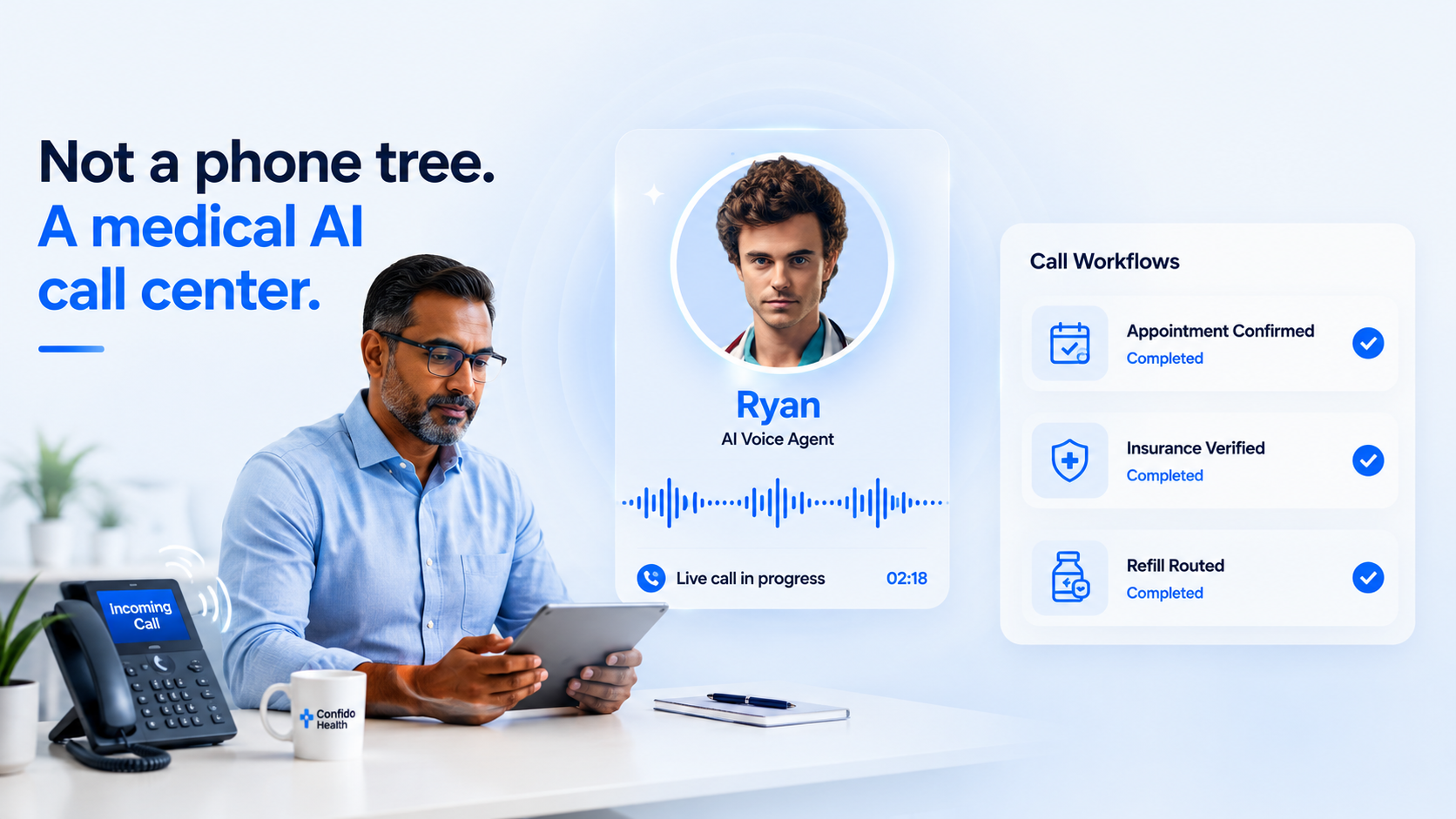
- A medical AI call center is not a phone tree, answering service, or staffed call center with AI bolted on. It is an AI-native layer that handles patient communication end-to-end and completes tasks inside the EHR in real time.
- Unlike a traditional call center, IVR, or answering service, a medical AI call center resolves. Appointment booked, insurance verified, refill routed, record updated before the call ends.
- Workflow-level EHR integration is the defining capability. Without it, AI collects information but does not complete work.
- Covers inbound and outbound: scheduling, insurance, prior auth, billing, refills, recall, reactivation, and referral coordination.
- AI Agents absorb repeatable, high-volume work. Staff focus on patients and calls that need them. See how Confido Health compares call center models for a direct trade-off.
What the Phone Situation Actually Looks Like in Most Practices
Consider the operational picture at a mid-sized primary care practice on a Tuesday. By 9 AM, there are four voicemails from after-hours callers. Two front desk staff members are managing check-ins while the phone rings. One caller wants to reschedule. Another has a billing question. A third is calling about a prescription refill. A fourth needs to know whether their insurance covers the procedure scheduled for Thursday.
Each call is legitimate. Each one needs a real answer. None of them are the same. And the staff managing them are also greeting patients at the door, verifying insurance at check-in, handling a fax that came in overnight, and tracking down a referral that was never confirmed.
This is not a failure of effort. It is a failure of infrastructure. The tools most practices use to handle patient calls were built for a simpler version of this problem, and that mismatch grows more costly every year.
Automated after-hours healthcare calls are how that gap gets closed, but they represent only one dimension of the problem. The full picture requires a different kind of infrastructure entirely.
What a Medical AI Call Center Actually Is
A medical AI call center is an AI-native patient communication infrastructure that handles healthcare workflows end-to-end, from the first ring of an inbound call to a completed task inside the practice's EHR.
That definition has three parts that all matter equally.
AI-native means it was built from the ground up on AI, not a traditional call center or phone tree with AI features added later. The system understands natural language, reasons through healthcare-specific workflows, and completes tasks autonomously.
Patient communication infrastructure means it covers the full range of channels through which patients contact a practice: inbound calls, outbound calls, voicemails, and SMS. It is not a single-channel tool.
End-to-end means the work is done when the interaction ends. Not handed to a queue. Not left for staff to complete after the call. The appointment is booked, the insurance is verified, the refill is routed, the record is updated. The task is complete.
This is fundamentally different from every other option a practice has used before. The difference is not features. It is the level of ownership the system takes over the outcome of the interaction.
How It Differs from a Traditional Call Center
A traditional healthcare call center, whether in-house or outsourced, is staffed by human agents whose job is to handle patient calls. That model has real strengths: human empathy, clinical judgment in escalation moments, and the ability to handle truly complex interactions.
It also has structural limitations that no amount of hiring or training fully solves.
Staffing a call center is expensive and unpredictable. As the Confido Health analysis of healthcare call center costs details, the average healthcare call center costs approximately $13.9 million per year to operate, with an average cost of $4.90 per call. And call center turnover in healthcare is persistently high, which means the investment in hiring and training is constantly being rebuilt from scratch. According to MGMA staffing research, finding qualified candidates for administrative and front desk roles remains the top staffing challenge for medical group leaders, ahead of compensation and retention.
A traditional call center also scales poorly. When call volume spikes, wait times go up. When agents are out sick, coverage gaps appear. After-hours volume goes to voicemail or an outsourced service with limited capability. And every call a human agent handles generates after-call work: documentation, follow-up tasks, EHR updates. The call ends but the work does not.
A medical AI call center handles all of this differently. It does not get sick. It does not create after-call work. It scales to handle as many concurrent calls as the practice receives. And it completes the task during the call, not after it.
Where a traditional call center remains valuable is in calls that require human judgment: a patient expressing a clinical concern, a complex billing dispute, a situation requiring empathy and decision-making that no automated system should attempt. A medical AI call center handles the high volume of repeatable interactions and routes those moments to staff instantly via warm transfer, with full context already surfaced.
How It Differs from an IVR
An IVR (Interactive Voice Response) routes. It takes an inbound call and moves it somewhere: to a queue, a voicemail box, or a department. The actual work still happens downstream, usually by a human.
The limitation of an IVR is that it operates on fixed, branching logic. Every possible patient need has to be anticipated and mapped to a numbered option before the call happens. When a patient's need does not fit neatly into one of those options, one of two things happens: they get misrouted, or they press zero until a human answers.
Even "AI-enhanced" IVRs add voice recognition on top of the same underlying logic. A patient can say "scheduling" instead of pressing 1, but the system still routes rather than resolves. It still cannot understand "I need to reschedule my Thursday appointment and also check if my new insurance is on file" as a single, two-part task to complete in the same conversation.
The HFMA has established that the benchmark hold time target for healthcare is 50 seconds. The average hold time in healthcare call centers running traditional IVR infrastructure runs well beyond that. A medical AI call center answers on the first ring, with no hold queue at all.
A medical AI call center understands a patient's full request. It holds both parts in context, completes both tasks inside the EHR, and confirms both outcomes before the call ends. No menu, no queue, no downstream work.
How It Differs from an Outsourced Answering Service
Outsourced answering services occupy a specific part of the healthcare call landscape: after-hours coverage, overflow during peak times, and basic triage for practices that cannot staff phones continuously.
The limitation of an answering service is that its agents have limited access to the practice's actual systems. They can take a message. They can page a provider. They can deliver a scripted response to a common question. What they generally cannot do is book an appointment directly into the EHR, verify insurance eligibility in real time, check a patient's prescription refill history, or process a payment inquiry against an actual account balance.
Every interaction with an answering service creates a follow-up task for the in-house team. The service takes the call; the practice staff does the work the next morning. The patient still waits, the task still lands on the front desk, and the cost of the answering service is additive to, not instead of, the internal workload.
A medical AI call center replaces this loop entirely. It handles after-hours calls the same way it handles business-hours calls: completing the task in real time, writing results into the EHR, and sending confirmation to the patient before the call ends. There is no morning backlog of messages to action.
What a Medical AI Call Center Handles
The scope of a well-built medical AI call center extends well beyond appointment scheduling. It covers the full range of patient-initiated communication workflows that currently consume front desk and call center time.
Appointment Management
Inbound scheduling, rescheduling, and cancellations across providers and locations. Scheduling rule enforcement so the AI books within the practice's actual constraints. After-hours and urgent call handling. Outbound confirmations, reminders, no-show follow-ups, and waitlist management. From our experience, practices deploying AI-native appointment management see a 60% reduction in cancellations and answered call rates above 91% across locations.
Insurance Verification and Prior Authorization
Real-time eligibility checks before appointments, with results written directly back to the patient chart. Inbound coverage and copay inquiries answered without staff involvement. Prior authorization status inquiries handled and outbound payer follow-up coordinated. For a full breakdown, see how AI handles insurance and prior auth across specialty workflows.
Payment and Revenue Cycle
Billing inquiries, copay clarification, payment plan questions, outstanding balance outreach, and failed payment follow-up. These are among the most repeatable and high-volume calls any practice receives, handled without requiring billing staff to pick up the phone for each one.
Prescription Refill Routing
Inbound refill requests captured, eligibility confirmed, and requests routed to clinical staff only when escalation is required. The patient is notified when the prescription has been sent. Clinical staff are engaged only when their judgment is actually needed.
Patient Recall and Reactivation
Outbound recall for preventive care, annual visits, and patients due for follow-up after a procedure or diagnosis. Structured reactivation outreach for patients who have lapsed from care. These campaigns generate consistent revenue and improve population health outcomes but almost never happen consistently in a manual environment because staff do not have time to run them alongside everything else.
Referral Coordination and Fax Processing
Inbound referral intake, patient matching, provider selection, and specialist scheduling. Fax processing and classification with data extraction and chart filing, eliminating the manual sorting that consumes back-office time in most specialty practices.
Pre-Op and Post-Op Engagement
Pre-operative instructions, clearance reminders, and test coordination delivered proactively before procedures. Post-discharge follow-up, medication reminders, and FAQ handling in the recovery period. This is where continuity of care is most often lost in a manual model, and where AI-driven outreach has the clearest patient safety implications.
The Role of EHR Integration
The difference between a medical AI call center and a sophisticated answering service comes down to one thing: whether the system can read from and write back to the EHR in real time.
Without deep EHR integration, the AI can take information from a caller, but cannot use it. It cannot check whether a slot is actually available under the provider's scheduling rules. It cannot confirm that the patient's insurance is on file and current. It cannot route a refill request that has already exceeded the refill limit. It is collecting information, not completing work.
With workflow-level EHR integration, the AI operates as a genuine extension of the practice's systems. It reads the schedule, applies scheduling logic, books the appointment, verifies insurance eligibility, and writes results back to the patient record, all in real time, all within the same call. Staff open the EHR after an AI-handled call, and the work is already done.
This is the capability gap between a phone tree and a medical AI call center. A phone tree routes. A medical AI call center resolves. For practices that want to understand what EHR integration actually involves operationally, the integration depth matters more than almost any other evaluation criterion.
Confido Health integrates with 40+ EHR systems, including Epic, Athenahealth, eClinicalWorks, ModMed, NextGen, and Dentrix, with bidirectional read and write capability across all of them.
What to Look for When Evaluating a Medical AI Call Center
Does it resolve or just route?
Ask the vendor to walk through a specific workflow end-to-end. Not a demo with curated inputs but a real scenario: a patient calling to reschedule, check insurance, and ask about their copay. At what point does the AI hand it off to a human? What does the AI actually complete inside your systems?
Confido Health resolves what can be completed autonomously and routes intelligently when a human is needed. When a patient calls to reschedule, check insurance, and ask about their copay, the AI Agent handles all three in the same call. It finds the next available slot that matches the provider's scheduling rules, confirms the new appointment, pulls the insurance record on file, verifies eligibility in real time, and provides the copay amount based on the patient's current coverage. Every action is written back into the EHR before the call ends. When a situation requires clinical judgment, urgent triage, or a patient asks to speak with someone directly, Confido Health routes via warm transfer with the patient's full context already surfaced to the receiving team member.
Does it integrate at the workflow level?
Surface-level integration means the AI can display information from your EHR. Workflow-level integration means it reads from and writes back to your EHR in real time, completing actions rather than just informing. The practical test is whether staff still need to do data entry after an AI-handled call.
Confido Health integrates at the workflow level across 40+ EHR systems. Appointments are booked, eligibility is written to the patient's chart, and records are updated within the same call. Nothing sits in a queue waiting for a staff member to finish it.
Does it cover inbound and outbound?
A medical AI call center that only answers calls is still reactive. Inbound coverage without outbound capability means recall campaigns, reactivation outreach, appointment reminders, and payment follow-ups still require staff or a separate tool. Ask whether outbound workflows are native or bolt-on.
Is it built for healthcare specifically?
General-purpose AI adapted for healthcare carries assumptions built for other industries. A healthcare-native system understands scheduling rule complexity, clinical terminology, insurance workflows, and HIPAA requirements as foundational design decisions, not add-ons.
What does HIPAA compliance mean in practice?
Ask specifically about the Business Associate Agreement, where PHI is stored and for how long, encryption standards for data in transit and at rest, and what audit controls exist for conversation logs. For what HIPAA-compliant AI communication requires, compliance is architecture, not a checkbox.
What does deployment actually look like?
A medical AI call center that takes six months to implement is not solving the problem you have today. Ask for actual go-live timelines from comparable deployments, the staffing required on your end during implementation, and what the first 30 days of operation look like. Confido Health is live in under 30 days using expert-approved workflow templates, without requiring dedicated IT resources during setup.
Here's How Confido Health Can Help
Most practices do not have a call center problem. They have an infrastructure problem. The tools they use to manage patient communication were not built for what patient communication has become: a continuous, multi-workflow operation that runs across scheduling, insurance, billing, refills, and clinical follow-up, all day, every day, on the same phone line.
Confido Health is a medical AI call center built specifically for healthcare practices. Not a phone answering service. Not an IVR with a conversational interface. An AI-native platform that handles patient communication end-to-end and integrates directly into the EHR systems the practice already runs on.
Full Inbound and Outbound Workflow Coverage
Sara and Ryan handle appointment management, insurance verification, prior authorization, payment inquiries, prescription refill routing, patient recall and reactivation, referral coordination, and pre- and post-operative engagement. Every workflow is handled end-to-end, not just initiated.
40+ EHR Integrations, Bidirectional
Confido Health integrates with Epic, Athenahealth, eClinicalWorks, ModMed, NextGen, and Dentrix. The AI reads the schedule, applies scheduling rules, books appointments, verifies eligibility, and writes results back to the patient chart within the same call. Nothing sits in a queue.
Every Call Answered on the First Ring
24 hours a day, 7 days a week, in more than 20 languages. No hold queue. No voicemail backlog. No after-hours gap in coverage across any location.
97% Patient Satisfaction
Empathetic, natural conversations whether the patient is booking an appointment, asking about their bill, or following up after a procedure. The same quality at 9 PM as at 9 AM.
70% Reduction in Staff Call Burden
Staff call volume drops by up to 70%, with a 15–20% increase in revenue collections. Measurable improvements typically appear within the first few weeks of deployment.
Live in Under 30 Days
Expert-approved workflow templates configured to the practice's scheduling rules, provider preferences, and escalation protocols. No dedicated IT resources required. No lengthy implementation.
Confido Health is more than a call center upgrade. It is the operational infrastructure that lets your practice handle every patient interaction without the structural constraints of headcount, hours, or hold time.
Want to see how Confido Health works inside a real practice? Book a demo today.
Still evaluating your options? See how Confido Health compares all models for the full trade-off analysis.
FAQ
What is a medical AI call center?
A medical AI call center is an AI-native patient communication platform that handles healthcare workflows end-to-end, from the first inbound call to a completed task inside the practice's EHR. It differs from a traditional call center, IVR, or answering service in that it resolves patient requests autonomously in real time, without creating downstream work for staff.
How is a medical AI call center different from an IVR?
An IVR routes calls through a fixed menu of numbered options. It cannot understand natural language or complete tasks. A medical AI call center understands free-form speech, holds a multi-turn conversation, accesses your EHR in real time, and resolves the patient's request within the same interaction. The IVR moves calls somewhere. A medical AI call center finishes the job.
How is a medical AI call center different from an outsourced answering service?
An outsourced answering service takes messages and pages providers. It has limited or no access to the practice's EHR, which means every interaction creates a follow-up task for in-house staff. A medical AI call center integrates directly with the EHR, completes the task during the call, and writes results back to the patient record in real time. There is no morning backlog of messages to action.
What workflows does a medical AI call center handle?
Appointment scheduling, rescheduling, and cancellations. Insurance eligibility verification and prior authorization status. Billing inquiries and payment follow-up. Prescription refill routing. Patient recall and reactivation outreach. Referral coordination and fax processing. Pre- and post-operative patient engagement. A well-built medical AI call center covers all of these, not just inbound scheduling.
Does a medical AI call center replace front desk staff?
No. A medical AI call center absorbs the high-volume, repeatable interactions that currently consume most of the front desk's day: scheduling calls, insurance inquiries, refill requests, billing questions, and after-hours volume. Staff remain in control of patient relationships, clinical coordination, and anything requiring human judgment. The result is a team that spends less time on the phone and more time on the patients in front of them.
Is a medical AI call center HIPAA compliant?
Purpose-built healthcare AI call center platforms are designed for HIPAA compliance, with Business Associate Agreements, end-to-end encryption, PHI data protections, and audit trails. Ask any vendor specifically about their BAA, data storage policies, and access controls for conversation logs before deployment.
Does a medical AI call center handle outbound calls?
It should. A system that only handles inbound calls is still reactive. Outbound capability means the platform can run appointment reminders, recall campaigns, reactivation outreach, payment follow-ups, and post-visit check-ins without requiring staff to make those calls manually. Ask vendors specifically whether outbound workflows are native to the platform or handled by a separate tool.
How long does it take to deploy a medical AI call center?
With Confido Health, most practices are live in under 30 days using expert-approved workflow templates. Integration with existing EHR systems is handled during onboarding. No dedicated IT resources are required on the practice's side during setup. Measurable improvements in answered call rates and scheduling completion typically appear within the first few weeks.
What EHR systems does Confido Health integrate with?
Confido Health integrates with 40+ EHR systems including Epic, Athenahealth, eClinicalWorks, ModMed, NextGen, Dentrix, Tebra, and many others. Integration is bidirectional: the AI reads scheduling rules, availability, and patient data, and writes appointments, eligibility results, and updates directly back into the system in real time.
What results do practices typically see after deploying a medical AI call center?
From our experience working with healthcare practices, the most immediate changes are in answered call rates and voicemail backlog elimination. Beyond that, practices typically see a reduction in staff call burden of up to 70%, a 60% reduction in cancellations, and a 15 to 20% increase in revenue collections. No-show rates drop as outbound reminders and waitlist management become consistent rather than best-effort.
.webp)
