

.svg)
- Most patient calls arrive when front desks are closed: evenings, early mornings, weekends. A 2026 MGMA Stat poll found that phones remain a consistent bottleneck costing medical practices time they cannot afford.
- Voicemail is not a safety net. Most patients hang up without leaving a message. The appointment is lost, and often the patient is too.
- Missed calls carry a real financial cost that compounds across every after-hours shift.
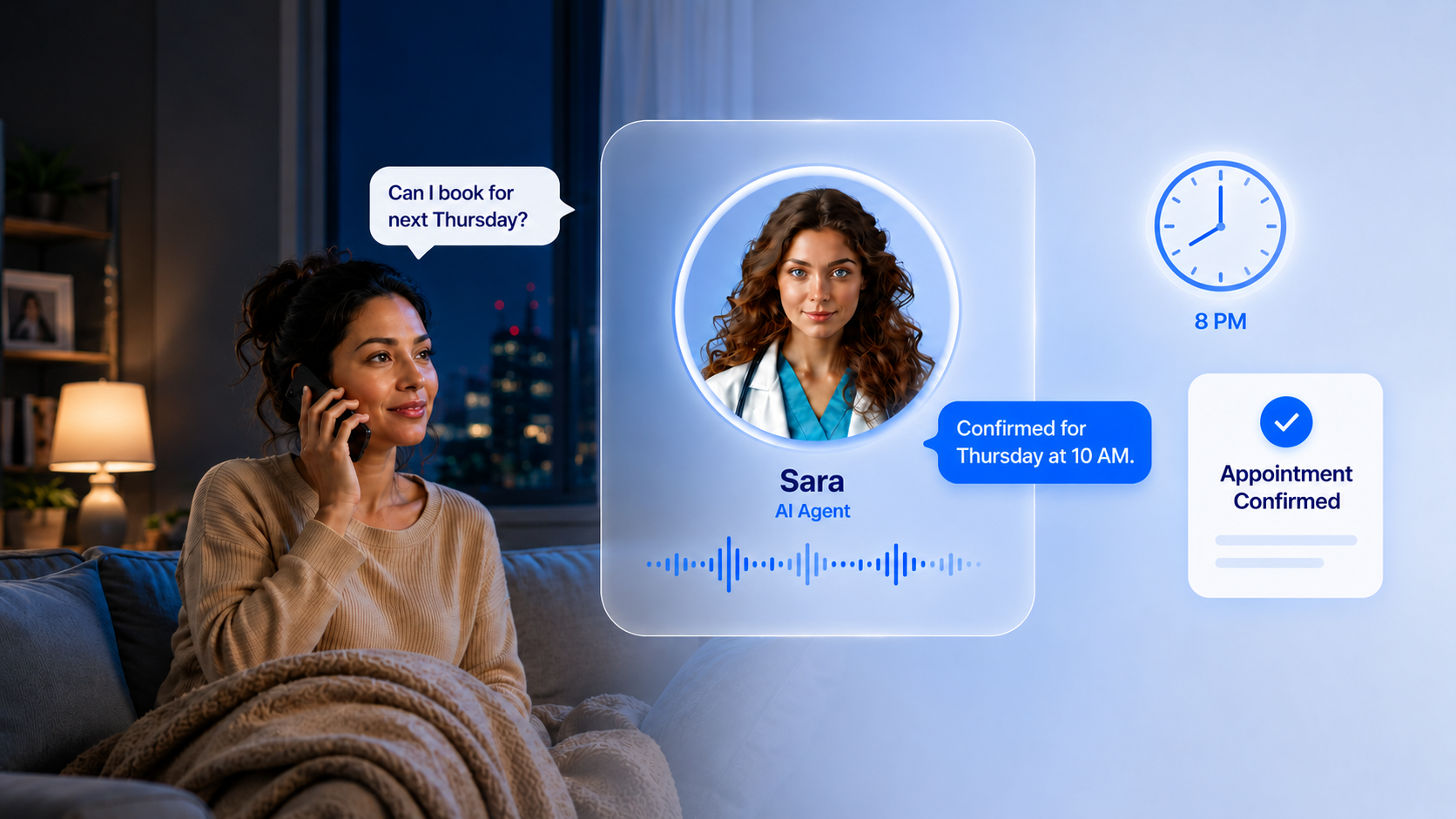
- AI Agents complete the full workflow after hours: scheduling, insurance verification, refill routing, billing questions, all written to the EHR before the call ends.
- The morning backlog disappears. Staff arrive in a clear queue and focus on today's patients, not last night's voicemails.
- After-hours AI covers outbound too: reminders and recall reach working patients in the evenings when they are actually available.
- See how AI voice agents work and the problems they solve in everyday practice operations.
Is Your Practice Reachable When Patients Actually Try to Call?
A patient notices something worrying on a Wednesday evening. She is a working professional: her day runs from 8 to 5, her children need to be picked up, and her own health is managed in the margins. By 7 PM, she has a moment. She picks up her phone and calls her practice.
She gets voicemail.
She does not leave a message. Most patients do not. She makes a mental note to call back during lunch tomorrow. By tomorrow, she will be busy. By the following week, the concern has either escalated or faded. Either outcome is a failure of patient access, and neither shows up in a call log.
This scenario plays out across American healthcare practices every single day. Not because practices do not care, but because the window when patients can actually call rarely overlaps with the window when practices can actually answer.
According to MGMA data, primary care practices receive approximately 53 inbound calls per physician per day. A four-physician practice handles more than 200 calls daily. A significant share of those calls arrive outside staffed hours, including early mornings, evenings, and weekends, exactly when most front desks are closed. A March 2026 MGMA Stat poll found that phones remain a consistent bottleneck costing medical practices time they cannot afford. The gap between when patients need to reach their practice and when their practice can respond is not a minor inconvenience. It is one of the central drivers of the patient access crisis in healthcare.
Automated after-hours healthcare calls are how that gap gets closed.
What After-Hours Actually Means for a Medical Practice
For most practices, "after hours" means anything outside 8 AM to 5 PM on weekdays. That window covers less than a third of the hours in a week. Every call that arrives outside it goes to voicemail, an answering service, or nowhere at all.
The volume is not trivial. A four-physician practice handles more than 200 calls daily. A meaningful share of those arrive outside staffed hours. Unlike business-hours calls, after-hours calls almost never get resolved at first contact.
What is actually calling after hours? From our experience working with healthcare practices, after-hours calls cluster into predictable categories: appointment requests from patients who cannot call during the day, urgent symptom questions that fall short of an ER visit, prescription refill requests, billing inquiries, and appointment cancellations or rescheduling requests from patients who realized after the workday ended that they cannot make it.
None of these are complex. Most of them have a clear answer. But without a system to handle them in real time, every one of them becomes a voicemail that someone on the front desk has to take action the next morning, before the phones start ringing again for the current day.
That is the backlog problem. And it does not just affect operational efficiency. It directly affects patient safety, patient retention, and practice revenue.
Why Voicemail Is Not a Solution
Voicemail is often framed as the fallback: patients can always leave a message. In practice, most do not.
When patients reach voicemail after hours, a significant share hangs up without leaving a message. They either call back later, call a different practice, or do not seek care at all. The hidden cost of missed calls is not just the lost appointment fee. It is the patient who moved to a competitor, the urgent symptom that went unaddressed, and the refill that did not get processed until the patient ran out.
Voicemail also creates a structural problem for the team. Every message left overnight becomes a task that has to be actioned the next morning, before the incoming calls for the day have even started. Front desk staff arrive, check messages, start calling people back, and spend the first hour of the day on yesterday's backlog rather than today's patients.
From our experience, this pattern is one of the most consistent sources of front desk stress and scheduling delay. The morning is the highest-volume call period of the day. Starting it already behind is a structural disadvantage that compounds through every shift.
A properly deployed automated after-hours healthcare call system eliminates this loop entirely. There is no voicemail to check in the morning because there are no voicemails. Every call that came in after hours was answered, handled, and completed in real time.
What Automated After-Hours Healthcare Calls Actually Handle
The phrase "automated after-hours" often conjures a basic answering service or a phone tree that tells patients the office is closed and to call back. That is not what AI-driven after-hours coverage looks like.
AI Agents handle the same workflows after hours that they handle during the day. There is no degraded service after 5 PM.
Appointment Scheduling and Rescheduling
A patient calling after hours to book a new appointment gets booked. The AI Agent checks real-time availability against the provider's scheduling rules, asks the right intake questions, confirms the appointment, and sends confirmation directly to the patient. The appointment is in the EHR before the call ends. The patient does not wait until morning, and neither does the slot.
When a patient calls to cancel or reschedule, the AI Agent handles that too. The slot is freed, the patient is rebooked if they want an alternative time, and the waitlist is checked for a patient who could take the cancelled appointment. That recovery happens at 9 PM exactly the same way it would at 2 PM.
Urgent Triage and Warm Transfer
Not every after-hours call can be handled autonomously. A patient describing symptoms that may need clinical evaluation should not be left to a voicemail. AI Agents are configured to identify urgent calls, provide appropriate reassurance, and route via warm transfer to an on-call provider or emergency services when the situation requires it. The AI does not make clinical decisions. It makes sure the call reaches the right person, with full context, without delay.
This is one of the clearest distinctions between a medical AI call center and a basic answering service. An answering service takes a message. An AI Agent escalates appropriately in real time.
Prescription Refill Requests
Refill requests are among the most common after-hours call types in primary care. Patients who work long hours realize at 8 PM that their medication is running low. AI Agents capture the refill request, confirm eligibility, and route to clinical staff for review the next morning, with all required information already documented. The patient gets confirmation that the request has been received and is being processed. Clinical staff find a clean, complete request in the system rather than a voicemail they have to decipher and action manually.
Billing and Insurance Inquiries
A patient who just received an Explanation of Benefits that does not make sense, or who wants to understand their copay before an upcoming appointment, does not have to wait until business hours to get an answer. AI Agents handle billing inquiries and insurance questions in real time, providing accurate information based on what is in the system. When a question requires escalation to a billing team member, the AI captures the details and routes them for follow-up the next morning.
Patient Recall and Appointment Reminders
Outbound after-hours coverage matters as much as inbound. AI Agents send appointment reminders and conduct recall outreach in the evenings and on weekends, precisely the windows when working patients are most likely to engage. A reminder sent at 7 PM is more likely to be seen and acted on than one sent at 11 AM when the patient is in a meeting.
For practices running patient recall campaigns, the ability to conduct outbound outreach outside business hours is particularly valuable. Patients due for annual visits, post-procedure follow-ups, or preventive care screenings are more reachable in the evening than during the day.
The Integration Question: Why After-Hours AI Without EHR Access Is Not Enough
A common misconception about after-hours AI solutions is that answering the call is the main deliverable. It is not. Answering without completing is still a burden on the practice.
If an AI Agent answers a patient's after-hours call, takes down their appointment request, and then leaves a note for staff to complete the booking in the morning, the practice has not eliminated the backlog. It has renamed it.
The defining capability of a properly built automated after-hours healthcare call system is workflow-level EHR integration. The AI reads the schedule, applies scheduling logic, books the appointment, verifies insurance eligibility, and writes everything back to the patient record in real time. When the practice opens in the morning, the work from the night before is already done.
Confido Health integrates with 40+ EHR systems, including Epic, Athenahealth, eClinicalWorks, ModMed, NextGen, and Dentrix. That integration is bidirectional: the AI reads from and writes back to the practice's existing systems, which means no additional data entry, no reconciliation work, and no parallel records to maintain.
For practices that want to understand what EHR integration actually involves operationally, the process is significantly lighter than most administrators expect, with most practices live in under 30 days.
What Changes When After-Hours Calls Are Automated
The operational impact of eliminating the after-hours gap extends beyond the calls themselves.
The morning routine changes. Staff arrive in a clear queue rather than a voicemail backlog. The first hour of the day is spent on current patients, not yesterday's unresolved calls.
The schedule fills differently. Slots that would have sat empty because a patient tried to book after hours and gave up are now filled. Cancellations that came in overnight are recovered from the waitlist before the practice opens.
Patient retention improves. A patient who reaches a voicemail after hours and does not get a prompt resolution is at higher risk of switching providers. After-hours inaccessibility delivers the same experience as a missed call during the day: the patient could not get through, and the practice did not resolve it.
Staff burnout reduces. The backlog that builds overnight is one of the more demoralizing parts of the front desk job. Arriving to a clear system every morning changes the emotional texture of the workday, and that matters for retention in a staffing environment that remains challenging across the industry.
What to Look for in an After-Hours AI Solution
Not every solution marketed as after-hours AI coverage operates the same way. These are the distinctions that matter.
Does it complete the task or capture a message?
The test is simple: if a patient calls at 9 PM to book an appointment, is the appointment in the EHR by 9:01 PM? If the answer is no, the system is an answering service, not an AI call center. Ask vendors specifically what happens to the data from an after-hours interaction. If the answer involves a queue, a review process, or staff action the next morning, the backlog has not been eliminated. It has been reformatted.
Does it handle urgency appropriately?
After-hours calls include patients who are worried, in pain, or uncertain whether their situation requires immediate care. The system needs to be configured to identify these calls, escalate appropriately, and route to an on-call provider or emergency services when clinically warranted. A system that cannot distinguish between a patient calling to reschedule and a patient describing chest pain should not be answering medical after-hours calls.
Does it integrate at the workflow level?
Without bidirectional EHR integration, after-hours AI reduces to a sophisticated voicemail. This is the single most important technical criterion. The AI must read scheduling rules, write appointments, update patient records, and verify insurance in real time, not queue tasks for staff to complete the next morning.
Is the language quality consistent with your brand?
Patients calling after hours are often anxious. The quality of the conversation matters. AI Agents should speak with clarity, empathy, and accuracy regardless of the time of day. A system that sounds robotic or formulaic after hours damages the patient relationship rather than supporting it.
Does it cover outbound as well as inbound?
After-hours AI that only handles inbound calls misses the outbound opportunity: reminders, recall, reactivation, and follow-up that work best when patients are available in the evening. For a full picture of the problems AI voice agents solve across both inbound and outbound workflows, the coverage gap is consistent across specialties.
Here's How Confido Health Can Help
The after-hours gap is not a technology limitation anymore. The technology exists to answer every patient call, complete every task, and write every result back to the EHR before the interaction ends, whether that interaction happens at 2 PM or 2 AM.
Confido Health's AI Agents are available 24 hours a day, 7 days a week, in more than 20 languages. They answer on the first ring, handle the full range of patient communication workflows, and integrate directly with the EHR systems the practice already runs on.
Every Call Answered on the First Ring
No hold time, no voicemail, and no morning backlog for staff to work through before the current day begins. Every after-hours call is answered and resolved in real time, across every location.
Full Workflow Completion After Hours
Sara and Ryan handle appointment scheduling, insurance eligibility verification, prescription refill routing, billing inquiries, and urgent triage with warm transfer when clinically warranted, completing every task before the call ends, not queuing it for staff the next morning.
40+ EHR Integrations, Bidirectional
Confido Health integrates with Epic, Athenahealth, eClinicalWorks, ModMed, NextGen, and Dentrix. Appointments are booked, eligibility results are written to the chart, and records are updated in real time throughout all 24 hours of the day.
Outbound After-Hours Coverage
Lily manages appointment reminders, patient recall, and reactivation outreach in the evenings and on weekends, reaching working patients in the windows when they are actually available and most likely to respond.
97% Patient Satisfaction
The same empathetic, natural conversation quality at 9 PM as at 9 AM. Confido Health maintains 97% patient satisfaction across all interactions regardless of when they occur.
Live in Under 30 Days
Deployment uses expert-approved workflow templates configured to the practice's scheduling rules, provider preferences, and escalation protocols. No dedicated IT resources required. No lengthy implementation.
Confido Health is more than an after-hours answering solution. It is the operational layer that removes the gap between when patients need to reach their practice and when the practice can respond.
Want to see how Confido Health handles after-hours call volume for a practice like yours? Let's get started today.
Still evaluating your options? See how Confido Health compares outsourced call centers for a direct trade-off analysis.
FAQ
What are automated after-hours healthcare calls?
Automated after-hours healthcare calls are patient calls handled by an AI Voice Agent outside standard office hours, including evenings, weekends, and holidays. Unlike a voicemail or basic answering service, a properly built system completes the task in real time: booking appointments, routing refill requests, answering billing inquiries, and writing results back to the EHR before the call ends.
Why do patients call after hours?
After-hours calls come primarily from working patients who cannot call during business hours. Common call types include appointment scheduling and rescheduling, prescription refill requests, billing questions, symptom inquiries that fall short of requiring emergency care, and cancellations. A March 2026 MGMA Stat poll identified phones as a persistent bottleneck in medical practice operations, driven largely by the mismatch between when patients are free to call and when practices are staffed to answer.
What happens when a patient calls after hours with an urgent symptom?
AI Agents are configured to identify calls that require clinical escalation. When a patient describes symptoms that may need immediate attention, the AI Agent provides appropriate reassurance and routes the call via warm transfer to an on-call provider or emergency services. The AI does not make clinical decisions. It ensures the call reaches the right person in real time.
How is after-hours AI different from an answering service?
An answering service takes a message. An AI Agent completes a task. An answering service has limited or no access to the practice's EHR, which means every after-hours interaction creates a follow-up task for staff the next morning. An AI Agent with workflow-level EHR integration books the appointment, verifies insurance, and updates the patient record before the call ends. There is no morning backlog.
Will patients notice a difference in service quality after hours?
With a well-configured AI Agent, the conversation quality after hours is the same as during business hours: natural language understanding, empathetic responses, and accurate information based on real-time EHR data. Confido Health maintains 97% patient satisfaction across all interactions regardless of when they occur.
Does after-hours AI handle outbound calls as well?
Yes. Outbound after-hours coverage includes appointment reminders, patient recall for preventive care and annual visits, reactivation outreach for lapsed patients, and payment follow-ups. Working patients are more reachable in the evenings and weekends, making after-hours outbound one of the highest-engagement windows for proactive patient communication.
What EHR systems does Confido Health integrate with for after-hours coverage?
Confido Health integrates with 40+ EHR systems including Epic, Athenahealth, eClinicalWorks, ModMed, NextGen, and Dentrix. Integration is bidirectional and operates in real time throughout the full 24-hour period, not just during business hours.
How long does it take to set up after-hours AI for a practice?
Most practices are live with Confido Health in under 30 days. After-hours coverage is included from day one, using expert-approved workflow templates configured to the practice's scheduling rules, provider preferences, and escalation protocols.
What happens to the morning backlog when after-hours calls are automated?
It disappears. When every after-hours call is answered and completed in real time, there are no voicemails to action, no messages to return, and no unresolved patient requests to catch up on before the current day begins. Staff arrive in a clear queue and can focus immediately on the patients scheduled for that day.
Is after-hours AI HIPAA compliant?
Yes. Confido Health is built for HIPAA compliance, with a Business Associate Agreement, end-to-end encryption, PHI data protections, and audit trails that apply across all hours of operation. For a deeper look at what HIPAA-compliant AI communication requires in practice, compliance does not have business hours.
.webp)
