

.svg)
- Dermatology runs two service lines (clinical and cosmetic) on one front desk with different scheduling logic and insurance rules.
- Dual-practice complexity overloads generic tools. See how AI handles prior authorizations.
- AI Agents cover clinical workflows: new patient scheduling, biopsy follow-up, prior auth inquiries, prescription refills.
- On the cosmetic side: consult booking, provider matching, cancellation recovery, waitlist, and rebooking outreach.
- Outbound recalls and reminders are chronically under-resourced. The missed call cost hits both service lines.
- Confido Health integrates with 40+ EHRs including Nextech and ModMed. EHR integration is lighter than practices expect.
- Multi-location and multi-provider groups live in under 30 days. AI absorbs repeatable volume so staff focus on patients in the room.
Two Practices in One: The Reality Behind a Dermatology Front Desk
Picture the week after a long weekend at a dermatology practice. The voicemail queue has grown. A patient who noticed something on their back while on vacation needs to know whether it is urgent enough to come in. Someone else is calling to confirm whether their biologic prescription has been pre-authorized for the next refill cycle. A third patient wants to move their laser treatment to a different provider because they heard she has a gentler touch. And then there is the referral fax from last Thursday, still sitting in the pile, that no one has matched to a chart yet.
None of these are simple calls. None of them follow the same script. And all of them are landing on a front desk that may have one or two people managing the entire patient-facing operation across multiple locations and multiple providers.
This is not a staffing failure. It is a structural one. Dermatology is one of the few outpatient specialties that operates as two distinct businesses under the same roof: a clinical practice with insurance workflows, pathology coordination, and prior authorization demands, and a cosmetic practice with self-pay patients who expect a concierge-level experience from the first call. For groups running 10 or more locations or providers, that structural tension compounds with every added site. The tools most practices use were built for one kind of practice, not both.
That mismatch is what makes the front desk feel impossible, and it is exactly the problem that AI for dermatology practices is built to solve.
Why Dermatology Call Volume Is a Different Problem
Most high-volume specialties have one dominant call type. Dermatology has several, and they require different handling, different scheduling logic, and different levels of urgency triage.
The Dual-Practice Reality
On the clinical side: acne management, psoriasis, eczema, full-body skin checks, biopsies, pathology follow-ups, and insurance-heavy biologic prescriptions. On the cosmetic side: injectables, fillers, laser resurfacing, chemical peels, and skincare consultations. Each carries its own patient type, its own appointment logic, and its own communication expectations.
The average new patient wait time for dermatology sits at 34 days, according to the Merritt Hawkins 2022 Survey of Physician Appointment Wait Times, among the longest of any specialty surveyed. Part of that is supply. But a significant portion comes from scheduling inefficiency: front desk teams spending the bulk of their day on reactive inbound calls, with no capacity left for proactive scheduling, waitlist management, or outbound follow-up. In multi-provider groups, that inefficiency is multiplied across every site.
The patient access crisis is well documented. In dermatology, it is sharper than most because the clinical urgency of some calls (a suspicious lesion) exists on the same phone line as the low-urgency, high-value cosmetic inquiries that directly affect revenue.
The Insurance and Authorization Burden
Medical dermatology carries a heavier insurance burden than almost any cosmetic workflow. Biologics for psoriasis and atopic dermatitis require prior authorization before each refill cycle. Eligibility verification is required at every visit. According to the AMA's prior authorization survey, physicians and their staff spend the equivalent of nearly two full business days per week completing prior authorization requests. That time does not come from nowhere: it comes directly from the front desk's capacity to handle patient calls.
Cosmetic patients, by contrast, are almost entirely self-pay. They do not require insurance work, but they are far more sensitive to the booking experience. Hold times, unanswered calls, and slow confirmations translate directly into lost cosmetic revenue.
From our experience working with specialty practices, dermatology front desk teams are not failing to prioritize. They are managing two distinct patient populations, across multiple providers and locations, with a single set of tools and a phone that does not stop.
The Clinical Side: What AI Agents Handle in Medical Dermatology
AI Agents deployed in medical dermatology workflows take on the highest-volume, most repeatable call categories first, freeing staff for calls that require clinical judgment or escalation.
New Patient Scheduling and Triage Routing
A new patient calling about a suspicious lesion needs to be scheduled, but the logic matters. Is this urgent? Does it require a specific provider? Is the patient within a covered network? AI Agents ask the right intake questions, apply the practice's scheduling rules, book the appointment directly into the EHR, and send pre-visit instructions, all without a staff member picking up the phone.
When a call requires clinical triage, the AI Agent escalates immediately via warm transfer, with the patient's information already surfaced to the receiving staff member.
Biopsy and Pathology Follow-Up Coordination
Patients waiting for biopsy results call. Often more than once. AI Agents handle the inbound inquiry, confirm that results are pending, provide an expected timeline based on what is in the system, and schedule a follow-up appointment when results are available, without requiring clinical staff to field every status check.
Prior Authorization Status and Insurance Inquiries
Patients on biologics call to check PA status, confirm coverage, and understand what documentation is pending. AI Agents handle these inbound inquiries and coordinate outbound follow-up with payers, reducing the staff time spent on portal navigation and payer callbacks.
Prescription Refill Requests
Refill requests for topical medications, antibiotics for acne, and maintenance prescriptions are among the most repeatable calls any dermatology practice receives. AI Agents capture the request, confirm eligibility for refill, route to clinical staff only when escalation is required, and notify the patient when the prescription has been sent.
The Cosmetic Side: How AI Manages Aesthetic Appointment Workflows
Cosmetic dermatology patients are often self-pay, highly engaged, and sensitive to the experience of booking. Friction at the scheduling stage directly affects whether they book at all.
Cosmetic Consult Booking and Provider Matching
A patient calling to book a cosmetic consultation wants to know which provider performs the treatment, what the appointment involves, and how soon they can get in. AI Agents handle this end-to-end: confirming provider availability, explaining what to expect, booking the appointment, and sending a confirmation with pre-visit details. No hold time. No callback needed.
Treatment-Specific Intake and Pre-Visit Preparation
Cosmetic patients call with pre-appointment questions: what to avoid before a laser treatment, downtime after a chemical peel, whether a consultation is required before injectables. These do not need a clinician. They need an accurate, immediate answer. AI Agents deliver this through natural conversation, reducing the inbound volume in the days before cosmetic appointments.
Cancellation Recovery and Waitlist Management
A last-minute cosmetic cancellation is a revenue gap that is difficult to fill manually in real time. AI Agents manage waitlists actively: when a cancellation occurs, the system identifies the next eligible patient, reaches out automatically, and books the slot without staff involvement. The same logic applies to no-show recovery across both clinical and cosmetic lines.
Post-Treatment Follow-Up and Rebooking
Cosmetic patients who feel followed up with return. AI Agents handle outbound post-treatment check-ins, confirm patient satisfaction, and prompt rebooking when appropriate, whether that is a touch-up, a follow-up series, or a skincare consultation. From our experience, practices that automate this outreach see meaningfully higher return rates without any additional staff time.
Where Clinical and Cosmetic Calls Collide
The operational complexity in dermatology does not just come from having two types of patients. It comes from the fact that the same patient is often both.
A patient coming in for a full-body skin check may ask about cosmetic options at the end of the visit. A cosmetic patient who develops a skin concern books through the same phone line as a new medical patient. The front desk does not always know in advance which kind of call is coming in, and the scheduling rules for each are meaningfully different. For multi-location groups, inconsistency in how these calls are handled across sites compounds the problem.
This is where AI for dermatology practices provides a structural advantage. The AI Agent does not have a cognitive load limit. It applies the right scheduling logic to the right call type every time, based on how the practice has configured its workflows, without fatigue, without confusion, and without putting a patient on hold while someone figures out the right provider or slot.
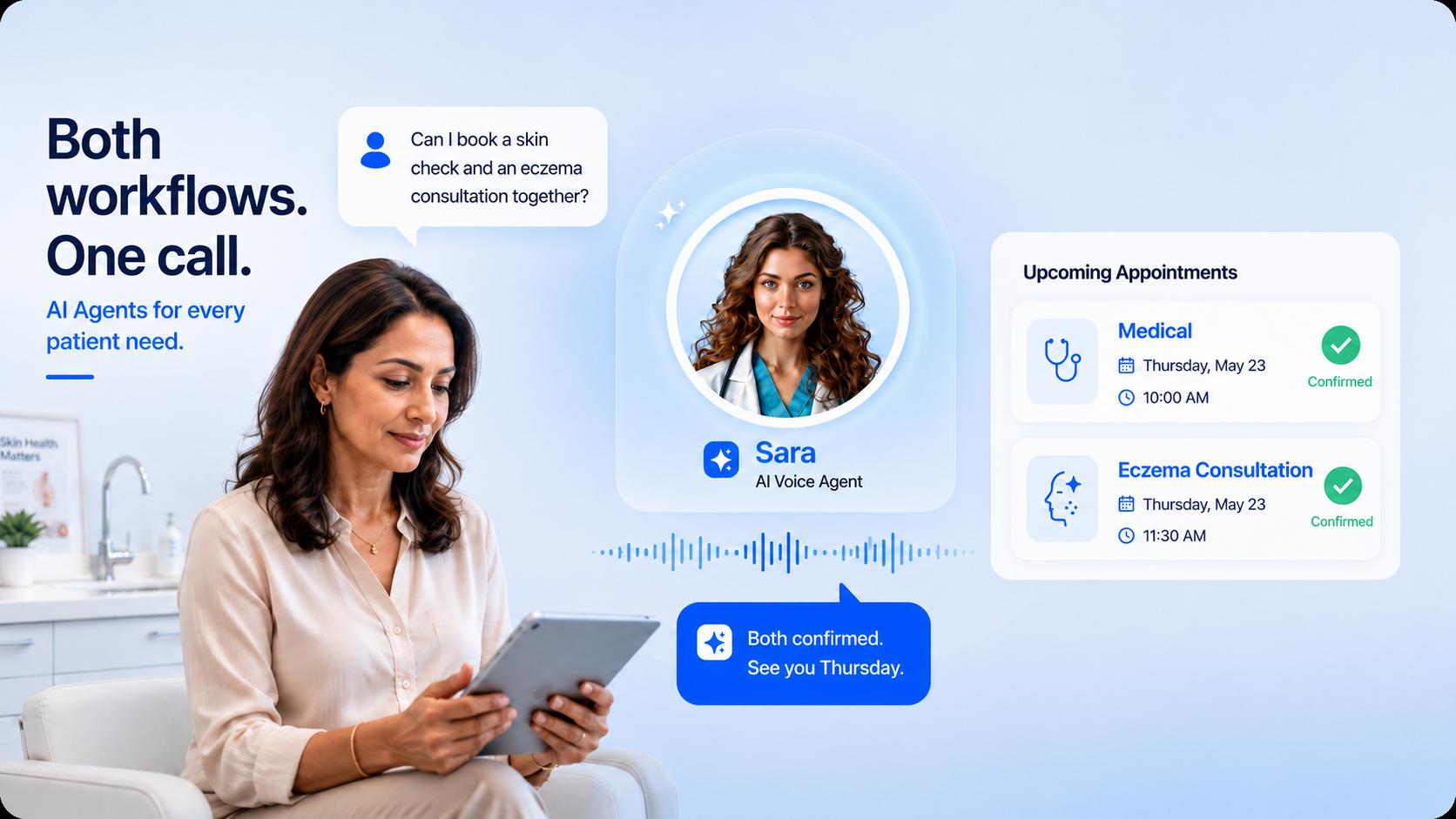
Insurance verification adds another layer. For a patient who has both a medical and a cosmetic visit to discuss, the AI Agent can confirm insurance eligibility for the medical component while making clear the cosmetic portion is self-pay, without the patient having to navigate two separate conversations or two separate staff members.
Outbound Workflows That Dermatology Practices Are Missing
Most dermatology practices are reactive by default. They answer the phone when it rings. Proactive outbound communication, the kind that prevents cancellations, recovers lapsed patients, and fills schedule gaps before they become revenue losses, is almost entirely manual. Which means it usually does not happen consistently, and across multi-location groups, it rarely happens at all.
Appointment Reminders and No-Show Reduction
A missed medical dermatology appointment is a lost clinical slot. A missed cosmetic appointment is lost revenue with no insurance backstop. AI Agents send automated, personalized reminders via call and text, confirm attendance, and identify cancellations early enough to fill the slot from a waitlist. For practices looking to understand the full picture of eliminating missed calls, the dermatology context amplifies every dimension of the problem.
Patient Recall for Annual Skin Checks
Patients who had a suspicious lesion removed, a biopsy performed, or a skin cancer diagnosis managed need to return. Not all of them remember to schedule. AI Agents run recall campaigns, identifying patients due for follow-up based on clinical history, reaching out proactively, and booking the appointment, all without a staff member pulling a list and making calls manually.
Reactivating Lapsed Cosmetic Patients
A cosmetic patient who came in 14 months ago and has not returned is not necessarily gone. They may simply not have been contacted. AI Agents identify lapsed patients based on practice-defined thresholds and run structured reactivation outreach, prompting rebooking for seasonal treatments, new service offerings, or routine touch-ups. Practices using automated reactivation campaigns see meaningfully higher rebooking rates without any additional headcount.
What Integration Looks Like in a Dermatology Practice
For AI to work in a dermatology practice, it must work inside the existing systems. That means reading and writing directly into the EHR the practice already uses. Confido Health integrates with over 40 EHR systems, including platforms common in dermatology such as Nextech and ModMed, as well as Epic, Athenahealth, and eClinicalWorks, alongside the telephony infrastructure already in place.
The integration is bidirectional. The AI Agent reads the schedule, applies scheduling rules, writes the appointment, and updates the patient record in real time. Staff do not receive a list of tasks to complete after the AI finishes. The task is complete.
For multi-provider groups, that means consistent workflow execution across every location: the same scheduling logic, the same escalation rules, the same patient experience, without relying on individual staff behavior at each site.
Most practices are live in under 30 days, using workflow templates built for healthcare operations from day one. That is the same shift practices in other specialties are already making: cutting admin load without adding staff by letting AI Agents absorb the repeatable volume.
Here's How Confido Health Can Help
Dermatology practices, especially those running multiple providers or locations, carry one of the most operationally complex call environments in outpatient care. A clinical side with insurance-heavy workflows, prior authorization cycles, and pathology coordination. A cosmetic side where the booking experience directly affects whether a patient returns. Both of them landing on the same phone line, managed by the same team.
Confido Health's AI Agents are built to handle both, integrating directly into the EHR systems your practice already runs on.
End-to-End Workflow Coverage
Sara and Ryan handle the full call range: new patient scheduling, biopsy follow-up routing, prior authorization inquiries, prescription refill handling, cosmetic consult booking, waitlist management, and patient recall, across both service lines simultaneously.
40+ EHR Integrations, Bidirectional
Confido Health integrates with Epic, Athenahealth, eClinicalWorks, Nextech, and ModMed. The AI reads scheduling rules and availability, and writes appointments and updates directly back into your system in real time. No manual reconciliation. No data lag.
Every Call Answered on the First Ring
Around the clock, every call is answered, so no medical patient goes to voicemail and no cosmetic patient walks away to book somewhere else. For multi-location groups, that means consistent availability across every site without adding headcount at each one.
97% Patient Satisfaction
Confido Health's AI Agents are built for natural, empathetic conversation, whether the caller needs clinical sensitivity for a biopsy follow-up or a concierge-level experience for a cosmetic booking.
70% Reduction in Staff Call Burden
Staff call volume drops by up to 70%, with a 15–20% increase in revenue collections. Your team spends less time on the phone and more time on the patients already in the room.
Live in Under 30 Days
Deployment uses dermatology-ready workflow templates configured to your scheduling rules, provider preferences, and service lines. No lengthy implementation. No dedicated IT project. No extended staff retraining.
Confido Health is more than a scheduling tool. It is the operational layer that keeps your clinical and cosmetic workflows moving without the bottleneck at the front desk.
Want to see how Confido Health can manage your dermatology call volume across both service lines? Let's get started today.
FAQ
What makes AI for dermatology practices different from general healthcare AI tools?
Dermatology operates across two distinct service lines: medical and cosmetic. General healthcare AI tools are typically built for one patient type and one scheduling logic. AI Agents configured for dermatology apply different workflow rules depending on call type, manage insurance verification for clinical visits while handling self-pay cosmetic bookings, and support both inbound and outbound workflows across the full practice.
Can AI handle both medical and cosmetic appointment scheduling in the same practice?
Yes. AI Agents are configured with the scheduling rules for each service line separately. A call about a skin check routes differently from a call about a cosmetic consult. The AI applies the correct logic, books the correct provider schedule, and sends the accurate pre-visit instructions without staff needing to triage the call first.
How does AI manage prior authorization for dermatology treatments like biologics?
AI Agents handle inbound prior authorization status inquiries from patients and coordinate outbound follow-up with payers for missing information or pending submissions. The AMA's prior authorization survey found that prior authorization work consumes nearly two full business days per week per physician. AI substantially reduces the staff time absorbed by this process.
Will AI recognize when a call needs escalation to a clinical team member?
Yes. AI Agents are configured to identify when a call requires clinical judgment and escalate immediately via warm transfer, with the patient's information surfaced to the receiving staff member. The AI handles the operational workflow around clinical decisions. It does not attempt to make them.
How does Confido Health support multi-location dermatology groups?
Confido Health deploys consistent workflow logic across every location in a group. The same scheduling rules, escalation protocols, and patient communication standards apply at every site, without relying on individual staff behavior to enforce them. Groups with 10 or more locations see the compounding benefit most clearly: volume absorbed at scale, with no added headcount per site.
How does an AI Agent handle a patient who wants both a medical and a cosmetic appointment?
The AI Agent manages each component according to its own scheduling rules. It confirms insurance eligibility for the medical portion, handles the self-pay booking for the cosmetic portion, and schedules both within the same call where appropriate, reducing the number of touchpoints the patient has to navigate.
How does AI reduce no-shows in dermatology practices?
AI Agents send automated appointment reminders via call and text at configurable intervals before each appointment. When a patient confirms or cancels, the system updates the schedule in real time. Waitlist patients are contacted immediately when a slot opens, recovering revenue before the gap becomes permanent.
Can AI help reactivate lapsed cosmetic patients?
Yes. AI Agents run structured reactivation outreach for patients who have not returned within a practice-defined window. Outreach is personalized, timely, and tied to rebooking prompts for seasonal treatments, new service offerings, or routine follow-ups.
What EHR systems does Confido Health integrate with for dermatology?
Confido Health integrates with 40+ EHR systems, including Nextech and ModMed alongside broader platforms like Epic, Athenahealth, and eClinicalWorks. Integration is bidirectional: the AI reads scheduling rules, availability, and patient data, and writes appointments and updates directly back into the system in real time.
How long does it take to deploy AI in a dermatology practice?
Most practices are live in under 30 days. Implementation uses pre-built workflow templates configured to the practice's scheduling rules, provider preferences, and service lines, without requiring a dedicated IT project or extended staff retraining.
Does AI replace front desk staff in a dermatology practice?
No. AI Agents absorb the high-volume, repeatable work: answering calls, scheduling appointments, sending reminders, handling refill requests, and managing routine inquiries. Front desk staff remain fully in control of patient relationships, clinical coordination, and anything requiring human judgment. The result is a team that spends less time on the phone and more time on the patients in front of them.
.webp)
