

- This guide is for CFOs and VPs of Operations at insurance-heavy groups with 10 or more providers, where coverage gaps and stalled authorizations push procedures off the calendar every week.
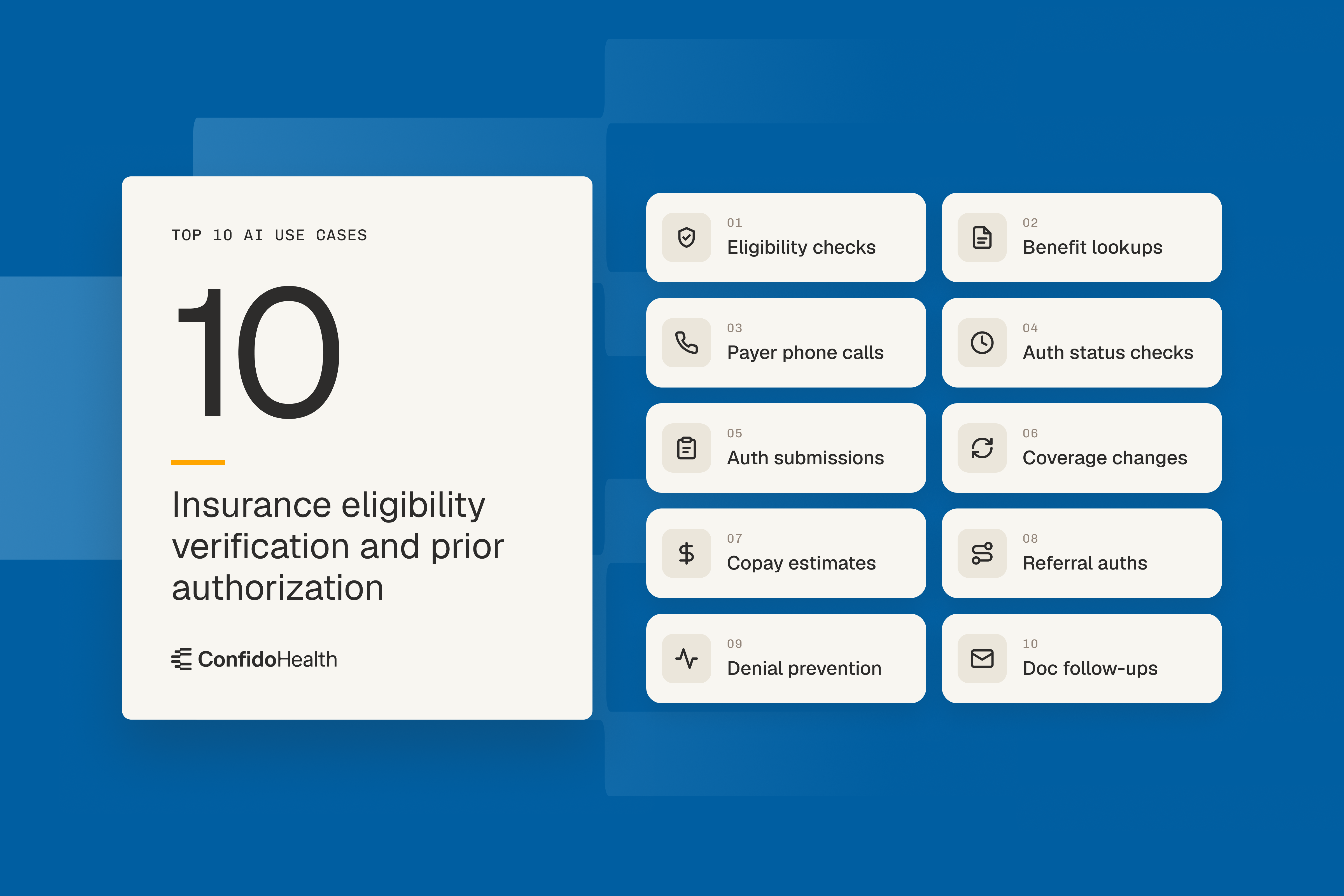
- It walks through 10 AI use cases in 2 stages: verifying coverage before the visit and clearing authorization before the procedure.
- Confido Health AI Teammates run both stages in one connected workflow, from the first eligibility check to an approved authorization written back to the chart.
- For vendor comparisons, see our guide to prior authorization software. For the wider revenue cycle, see our breakdown of AI in revenue cycle management.
Introduction
A VP of Operations at a 20-location specialty group opens the monthly operations report and finds a familiar line: dozens of procedures pushed back or canceled last month because the prior authorization had not cleared in time. The patient was ready. The provider had the slot open. The delay sat in a payer portal, a fax queue, or a phone call nobody had reached yet.
A few rows down sits the other half of the problem: visits rescheduled at check-in because coverage on file had lapsed. Both failures start in the same place, insurance work that happens too late and by hand. This guide covers 10 AI use cases that move that work earlier, and how Confido Health handles each one.
Why Eligibility and Prior Authorization Are a CFO Priority
Prior authorization is now a federal focus. The CMS Interoperability and Prior Authorization Final Rule requires impacted payers, including Medicare Advantage, Medicaid, CHIP, and federal marketplace plans, to decide standard requests within 7 calendar days and expedited requests within 72 hours starting in 2026. Payers must give providers a specific reason for each denial and publicly report prior authorization metrics. By January 2027, those payers must support electronic prior authorization through standard APIs. Payers carry the mandate, but groups that still submit by portal, phone, and fax will not see the full benefit of faster payer timelines.
The stakes for patients and revenue are well documented. A 2022 HHS Office of Inspector General review of Medicare Advantage plans found that 13% of denied prior authorization requests met Medicare coverage rules and should have been approved. Many of those denials traced to requests the plan considered incomplete or poorly documented, which is exactly what a structured submission workflow prevents.
How We Selected These Use Cases
- Point in the process. Whether the use case clears coverage before the visit or authorization before the procedure.
- Integration depth. Whether results write back to the EHR or PMS, instead of living in a portal or a spreadsheet.
- Multi-payer fit. Whether the use case holds up across dozens of payers and plan types, including HMO and IPA rules.
- Revenue impact. Whether it reduces delayed procedures, denials, or rework.
- Scale across locations. Whether it runs the same way at every site.
Top 10 AI Use Cases for Eligibility Verification and Prior Authorization
Eligibility Verification
1. Eligibility, Copay, and Deductible Checks at Scheduling
How Confido Health Handles This
Confido Health checks eligibility, copay, and deductible when the visit is booked and writes the results to the patient chart, so staff do not look them up later and patients hear their expected cost before they arrive.
Where the Broader Market Stands
Eligibility checks are widely available through clearinghouses. The difference is whether the result reaches the chart and the patient conversation, or stays in a separate portal.
2. Insurance Data Capture From Intake
How Confido Health Handles This
Confido Health captures insurance details from patient intake and existing EMR records, instead of staff keying them in from a scanned card. Fewer transcription errors means fewer denials traced to a wrong member ID or a mismatched name.
Where the Broader Market Stands
Card scanning and digital intake tools are common. Fewer connect captured data to the same workflow that verifies coverage and submits authorizations.
3. Outreach for Incomplete or Expired Coverage
How Confido Health Handles This
When coverage on file is incomplete or expired, Confido Health AI Teammates call the patient before the visit to collect updated insurance and recheck eligibility. The problem gets solved days ahead, not at the front desk with the patient already in the waiting room.
Where the Broader Market Stands
Most tools flag a coverage problem for staff to chase. A call that reaches the patient and resolves it removes the task from the front desk entirely.
4. Multi-Payer Checks Through Clearinghouse Connections
How Confido Health Handles This
Confido Health runs pre-visit eligibility checks through clearinghouse connections across every payer a group bills, instead of staff logging into a different portal for each plan. When a clearinghouse response is incomplete, AI Teammates call the payer to confirm benefits.
Where the Broader Market Stands
Clearinghouse eligibility is mature. The gap is the follow-up when a response comes back incomplete, which still lands on staff in most groups.
5. Clean Eligibility Data Into Claims and Billing
How Confido Health Handles This
Because coverage, copay, and deductible data is captured once and written to the chart, the same data carries into billing and claims. Claims go out on verified information, without a second round of checks before submission.
Where the Broader Market Stands
Billing systems often re-verify eligibility before a claim goes out because they cannot trust front-end data. A single verified record removes that duplicate step.
Prior Authorization
6. Authorization Requirement Checks Before Booking
How Confido Health Handles This
Confido Health checks whether a procedure needs prior authorization for that patient's payer and plan when the visit is booked. Catching the requirement early gives the request time to clear before the procedure date, instead of the group finding out after the visit is already on the calendar.
Where the Broader Market Stands
Payer rule engines can identify authorization requirements. The value comes from tying that check to scheduling, so the request starts the moment the visit is booked.
7. Submission Through Payer and IPA Portals
How Confido Health Handles This
Confido Health submits prior authorization requests through payer and IPA portals with the documentation each payer expects, including HMO and IPA referral and delegation rules. Staff do not log into a different portal for every payer.
Where the Broader Market Stands
Electronic submission networks are growing as payers prepare for the 2027 API requirement. Many payers and IPAs still require portal submission, so a workflow that handles both covers more of a group's volume.
8. Denial Management and Resubmission
How Confido Health Handles This
When an authorization is denied, Confido Health AI Teammates classify the denial by reason, contact the payer to confirm what is missing, correct and resubmit the request, and track the appeal to resolution. Cases that need clinical judgment, such as a peer-to-peer review, go to the right staff member with the full case attached.
Where the Broader Market Stands
Many prior authorization tools stop at submission and status. Denial follow-up is where staff time and lost revenue pile up, so a workflow that carries the request through to resolution closes the largest gap.
9. Status Tracking and Renewal Reminders
How Confido Health Handles This
Confido Health tracks every pending request and follows up with the payer on a set schedule, so a stalled request surfaces before the appointment slips. For ongoing treatment, it flags expiring authorizations before they lapse, so a course of care does not stop over a missed renewal date.
Where the Broader Market Stands
Status checks by portal are common. Scheduled payer follow-up and renewal tracking across every location are where most groups still rely on spreadsheets.
10. Payer-Ready Documentation
How Confido Health Handles This
Before a request goes out, Confido Health checks it against the documentation that payer expects for that service and gathers missing items from the chart or the care team. Requests go out complete the first time, which is what lowers initial denials, and the denial reasons Confido Health sees on resubmission feed back into the checks it runs before submission.
Where the Broader Market Stands
Utilization management and clinical decision support vendors offer payer criteria libraries. Criteria matter most when they are applied inside the workflow that builds and submits the request.
Why CFOs and VPs of Operations Choose Confido Health
One workflow from coverage to approval
Insurance data captured at scheduling carries into authorization and billing, so a group is not reconciling 3 systems for one patient.
Built for multi-payer complexity
Clearinghouse connections, payer and IPA portal submission, and HMO and IPA rule handling hold up across dozens of payers and plan types.
Every step ends in a documented outcome
Each verification, submission, payer response, and resubmission writes back to the EHR or PMS, so staff see one record instead of checking portals.
Staff time moves to clinical judgment
AI Teammates handle portal work, payer calls, and follow-up, so staff spend their time on peer-to-peer reviews and cases that need a clinician.
Final Thoughts
Eligibility verification and prior authorization fail for the same reason: the work happens too late and by hand. The groups seeing the strongest results move both earlier, check coverage and authorization requirements at booking, submit complete requests the first time, and follow every denial through to resolution.
Before choosing a platform, map last month's delayed and canceled procedures by cause and payer, and ask each vendor to show a request moving from requirement check to approval, and a denial moving to resubmission, in your own systems. For related reading, see our comparison of prior authorization software, our breakdown of RCM versus AI-driven operations, and our analysis of the cost of missed calls.
See Where Your Authorizations Stall
Running 10+ locations or providers? Send us last month's delayed procedures by payer, and we will show you where Confido Health would clear them first.
Book a demo or browse our specialty webinars.
Frequently Asked Questions
What are the most common AI use cases for insurance eligibility verification?
The most common are eligibility, copay, and deductible checks at scheduling, insurance data capture from intake, outreach for incomplete or expired coverage, multi-payer checks through clearinghouse connections, and carrying verified data into billing. Confido Health runs all of them and connects them to prior authorization in the same workflow.
Does Confido Health handle prior authorization, or only eligibility?
Both. Confido Health checks authorization requirements at booking, submits through payer and IPA portals, tracks status, flags renewals, and manages denials through resubmission and appeal.
Does Confido Health handle denials?
Yes. Confido Health AI Teammates classify denials by reason, contact payers to confirm what is missing, correct and resubmit requests, and track appeals to resolution, with every update written back to the EHR or PMS.
How does Confido Health reduce initial denials?
By submitting complete requests the first time. Confido Health checks coverage and authorization requirements at booking, verifies documentation against what each payer expects, and gathers missing items before submission.
What does the CMS prior authorization rule change for provider groups?
The rule requires impacted payers to decide standard requests within 7 calendar days and expedited requests within 72 hours, give a specific reason for each denial, and support electronic prior authorization by January 2027. Groups with a structured, electronic submission workflow are positioned to benefit from those faster timelines.
Can one platform handle eligibility and authorization across many payers?
Yes. Confido Health works across payers through clearinghouse connections and payer and IPA portal submission, with rules set per payer and plan type, including HMO and IPA edge cases.
Does Confido Health replace the authorization team?
No. AI Teammates take the portal work, payer calls, and follow-up, so the team spends its time on clinical reviews, peer-to-peer calls, and complex cases.