

.svg)
- Healthcare scheduling becomes exponentially harder as organizations scale across providers, specialties, locations, referrals, and rising patient demand.
- This blog compares traditional EHR scheduling with AI scheduling assistants to show where manual, staff-dependent workflows start breaking down at scale.
- Discover how AI scheduling assistants improve patient access through conversational booking, real-time scheduling, proactive follow-ups, and intelligent provider routing.
- The article also explores how AI reduces front-desk workload, manages high call volumes, fills cancellations faster, and improves scheduling accuracy across multi-location healthcare systems.
- Most importantly, it highlights why healthcare organizations are moving toward AI-driven scheduling infrastructure to reduce operational friction, improve utilization, and create a faster, more seamless patient experience.
Introduction
Managing patient scheduling might sound really simple at first. But it rarely stays that way for long. As your organization grows, so does the complexity - unfortunately. You deal with multiple providers, different specialties, manage constant referrals, and your patients try to book or reschedule all the time. A lot is going on at the same time.
Here’s your patient's POV - they call to book an appointment, wait on hold, get transferred, and are asked to call back later. Now, in another scenario, the same patient reaches out and gets an instant response. The appointment is booked in seconds, without any back and forth. That difference is not just about speed. It comes down to how easy it is for your patients to actually access care.
And that ease matters more than ever. Studies show that a staggering 78% of people say ease of navigation is a major reason they leave their healthcare provider! When scheduling feels slow or confusing, it impacts both your patients and teams. Patients struggle to get timely access, while your staff ends up handling constant calls, follow-ups, and manual coordination. This is exactly where AI scheduling assistants come in. They make scheduling conversational and seamless for your patients. Not only that, but they also reduce the operational load on your front desk teams. According to McKinsey, this shift can reduce manual workload for scheduling teams by 10 to 20% while improving overall efficiency.
What Is EHR Scheduling?
EHR scheduling is the appointment booking system inside your electronic health record. It helps manage your doctor's calendars, book patient visits, and keep schedules in place. So when a patient calls to book a consultation, your front desk team will check the doctor’s availability in the EHR, select the visit type, and book a slot manually.
The system follows a set of predefined rules. But the actual coordination still pretty much depends on your team. It works well for keeping things structured, but since it does not handle patient communication on its own, your staff has to manage calls, updates, and changes.
What EHR Scheduling Typically Handles
Here’s what most EHR scheduling systems are built to manage:
- Basic booking: Lets your team book appointments based on available slots and doctor schedules.
- Provider calendars: Keeps track of doctors' availability, shifts, and blocked time in one place.
- Visit types: Allows selection of appointment types like consultation, follow-up, or procedures.
- Time slot setup: Uses fixed durations for different visit types to keep scheduling consistent.
- Department routing: Helps assign appointments to the right specialty or department using the set rules.
- Manual rescheduling: Your team updates or shifts appointments when patients call in.
- Cancellation tracking: Records cancellations and opens up slots. This is usually handled by your staff manually.
- Patient info linking: Connects appointments with patient records inside the system.
- Schedule view: Gives your team a clear view of daily or weekly schedules for coordination.
- Rule-based logic: Follows fixed rules for booking, like slot limits or provider assignment.
Where EHR Scheduling Works Well
EHR scheduling works best when things are simple and predictable:
- Smaller setups: Easier to manage when you have fewer doctors and lower patient volume.
- Predictable visits: Works well when your healthcare organization’s appointment types follow a fixed pattern.
- Lower call volume: Suitable when your team can comfortably handle incoming requests.
- Single specialty clinics: Less coordination needed across departments makes scheduling simpler.
- Staff managed workflows: Works fine when front desk teams handle most of the scheduling.
- Occasional changes: Handles rescheduling well when it is not happening too frequently.
What Are AI Scheduling Assistants?
AI scheduling assistants are tools that help manage your patient appointments by actually handling the interaction, not just the calendar part. So, instead of your staff managing every call or message, the AI can directly talk to your patients, understand what they need, and take action instantly.
For example, if your patient calls to book an appointment, the AI assistant can understand the request, check availability across your providers, and book the right slot in real time. Absolutely no hold time, no back and forth. These assistants sit right on top of your existing systems and make scheduling feel faster and more seamless. It’s a win-win for both your patients and your teams managing the workload behind the scenes.
What AI Scheduling Assistants Do Differently
Here’s where AI scheduling assistants really stand apart:
- Handle conversations: Can answer patient calls or texts, respond instantly, and guide them through booking without staff involvement.
- Understand intent: Goes beyond keywords to understand what the patient actually needs, whether it is a new visit, follow-up, or reschedule.
- Real-time actions: Books, cancels, or reschedules appointments instantly without delays or manual intervention.
- Context awareness: Considers factors like provider availability, visit type, urgency, and patient history while scheduling.
- Cross-system access: Works across EHR/PMS and telephony systems to pull and update information seamlessly.
- Multi-channel support: Handles requests across calls, SMS, or chat, so your patients can book however they prefer.
- Smart routing: Directs patients to the right provider or department based on their needs, not just fixed rules.
How AI Scheduling Assistants Fit Into Modern Healthcare Workflows
These AI assistants are not here to replace your systems. They work like an intelligent layer on top of your systems that makes them work much better:
- Layer over systems: Works with your existing EHR/PMS and telephony setup without needing a full replacement.
- Front-end interaction: Handles patient communication directly, so your team does not have to manage every request.
- Reduced workload: Takes over repetitive tasks like booking, rescheduling, and follow-ups, freeing up staff time.
- Always available: Operates 24/7, so patients can schedule even outside working hours.
- Scales easily: Handles high volumes of requests without delays, especially during peak times.
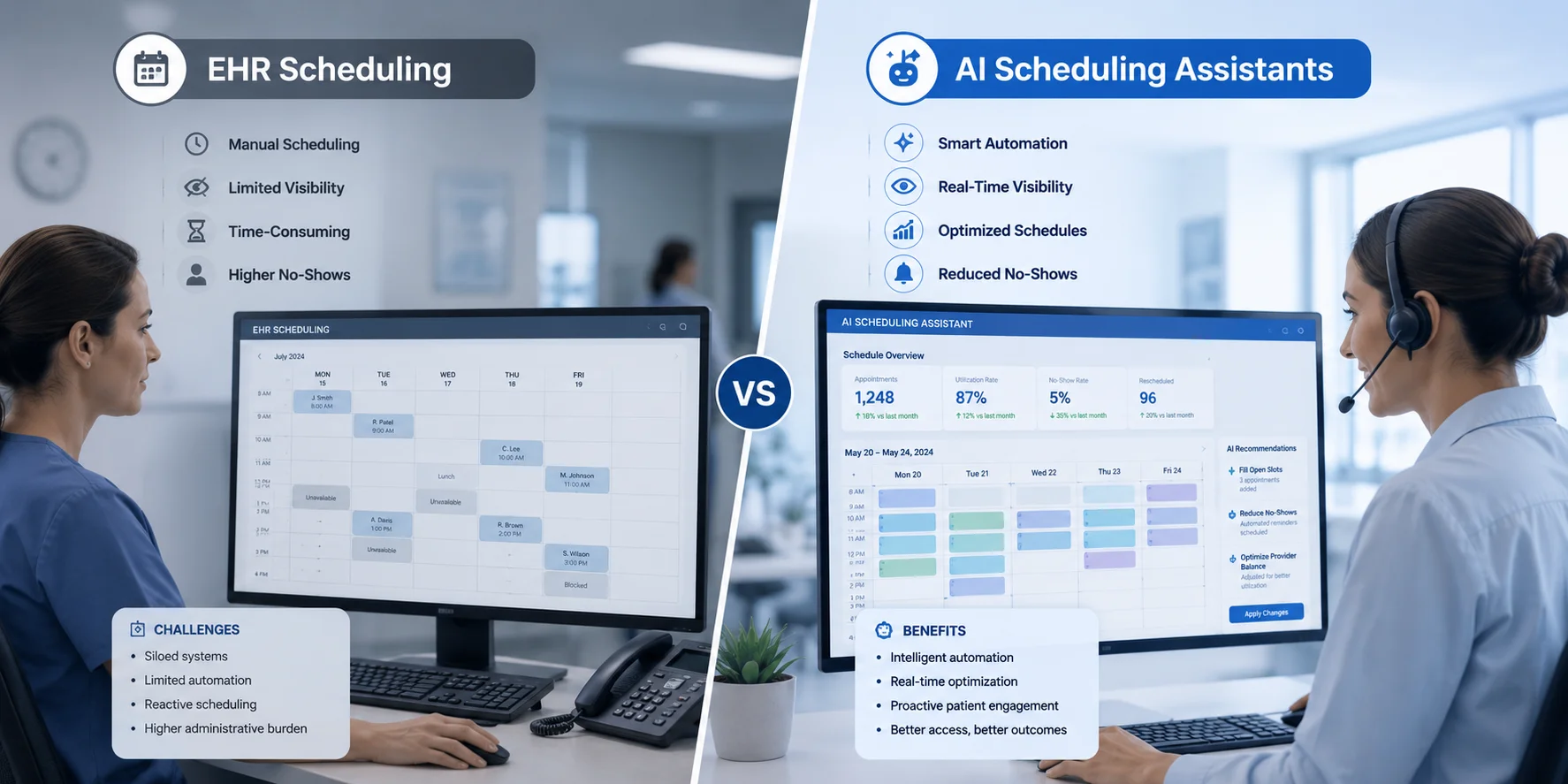
EHR Scheduling vs AI Scheduling Assistants: Key Differences
Let’s look at how traditional EHR scheduling compares with AI scheduling assistants across different aspects of patient access.
As you can see, EHR scheduling is great for structure, but AI scheduling assistants bring the much-needed speed, flexibility, and a smoother experience for both your patients and teams.
Where EHR Scheduling Starts to Break at Scale
As your organization grows, scheduling stops being just a calendar problem and becomes an operational challenge. More providers, more locations, and more patient requests mean your systems are constantly under pressure. This is where traditional EHR scheduling starts to fall short.
Limited Patient Interaction
Your EHR system is not built to communicate with patients. It stores schedules but cannot handle real conversations or guide patients through the booking process. So when someone wants to check availability or reschedule, they have to rely on your team. This creates delays, especially when patients expect quick responses across calls or messages. Over time, this gap directly affects how easy it is for patients to access care.
Heavy Dependence on Staff
Your scheduling process depends heavily on your front desk or access teams. They are constantly switching between calls, systems, and patient requests throughout the day. And as your patient volume grows, this workload naturally becomes difficult to manage. Even simple actions like booking or rescheduling start taking longer, and your team ends up spending most of their time on repetitive coordination instead of higher-value tasks.
No Real-Time Context Handling
Your EHR follows fixed rules, but it does not understand context. It cannot factor in urgency, patient history, or real-time changes across providers. So when a patient has a specific need, your team has to step in and figure things out manually. This slows down decision-making and increases the chances of suboptimal scheduling, especially when multiple variables are involved.
Fragmented Workflows Across Departments
In larger organizations, your scheduling workflows are spread across departments and specialties. But your EHR more often than not treats these as separate systems rather than a connected flow. This means your teams have to coordinate manually when patients move between departments. The back and forth increases, handoffs become slower, and the overall experience starts to feel disjointed for both your teams and your patients.
Inability to Handle High Call Volumes
As your organization scales, the number of incoming calls and requests increases significantly. But your EHR cannot handle this load on its own since every interaction depends on your staff. During peak times, your teams struggle to keep up. Your patients may face long hold times or missed calls, and your staff feels the pressure of constantly playing catch-up.
No Proactive Scheduling Capability
Basically, your EHR reacts to requests; it does not anticipate them. It will not follow up with patients, fill open slots, or reduce no-shows all on its own. So when there is a last-minute cancellation, odds are the slot will remain unused unless your team actively fills it. And over time, this will lead to many lost opportunities and underutilised capacity across your schedules.
Limited Visibility Across Locations
If your organization operates across multiple locations, your scheduling becomes even harder to manage. Your EHR often does not give you a unified view across all centres. So when one location is fully booked, and another has availability, your team has to manually check and redirect patients. This slows down access and creates unnecessary friction in the process.
Rigid Scheduling Logic
Your EHR relies on predefined rules and templates that are not easy to change. While this keeps things structured, it also makes your system less adaptable. When real-world situations change, like sudden spikes in demand or provider availability shifts, your system cannot adjust quickly. Your team has to step in and manually rework schedules to keep things running.
How AI Scheduling Assistants Solve These Gaps
As your organization grows, you need more than just a system that stores schedules. You need something that can actively manage patient access, reduce pressure on your teams, and adapt in real time. That is exactly where AI scheduling assistants shine.
Conversational Scheduling
Instead of relying on your staff to handle every request, AI assistants can directly talk to your patients through calls or messages. They understand what the patient needs and guide them through booking without any back and forth. So whether someone wants to book, reschedule, or even ask a question, it all happens instantly. This removes the friction patients usually face when trying to access care.
Reduced Staff Dependency & Always On Availability
AI takes over repetitive scheduling tasks that your team would otherwise handle manually. This includes booking appointments, managing changes, and answering common queries. It also works around the clock. So even outside working hours, your patients can schedule appointments without waiting. This can significantly reduce the load on your access teams and help them focus on more important tasks.
Context-Aware Scheduling Decisions
AI does not just follow fixed rules. It understands context. It can factor in urgency, provider availability, patient history, and visit type before making scheduling decisions. So instead of your team manually figuring out the best option, the system does it instantly. This naturally leads to much more accurate scheduling and better utilisation of your resources.
Cross Specialty Coordination
AI assistants can coordinate across departments and specialties without manual intervention. They have visibility across your entire system, not just one schedule at a time. This means patients can be routed to the right provider or specialty seamlessly, without your teams having to manage multiple handoffs or internal coordination.
Handles High Volume Without Delays
AI can manage thousands of scheduling requests at the same time without slowing down. Whether it is peak hours or sudden spikes in demand, it continues to respond instantly. This ensures your patients are not stuck waiting on calls, and your teams are not overwhelmed trying to keep up with incoming requests.
Proactive Scheduling & No Show Reduction
AI does not just react. It basically works proactively in the background. It can send reminders, follow up with patients, and even adjust schedules to fill open slots when cancellations pop up. This way, it helps you stay ahead of no-shows. In fact, some AI models can predict no-shows with up to 86% accuracy by identifying patterns in patient behavior! This can allow your team to take actions much earlier. They can send reminders or even offer those slots to other patients, so your schedules stay better utilised.
Unified Visibility Across Locations
AI gives you a connected view across all your locations and providers. It can instantly check availability across centres and route patients to the best option. So instead of your team manually coordinating between locations, the system ensures patients get the earliest and most convenient appointment available.
Flexible and Adaptive Scheduling Logic
AI systems are not locked into rigid rules. They continuously adapt based on real-time data, demand patterns, and operational changes. This means your scheduling stays dynamic. Whether there is a sudden surge in demand or a provider becomes unavailable, the system adjusts automatically without needing constant manual intervention.
Where AI Scheduling Assistants Actually Make the Biggest Impact
AI scheduling assistants start showing real value when your operations get complex and volume increases. These are the areas where they take the most pressure off your teams while also improving utilisation and revenue.
High Call Volume Environments
When your organization is handling a large number of calls daily, your front desk teams end up struggling to keep up. Long hold times and missed calls become common. And during the dreaded peak hours, it is not unusual for multiple patients to call at the same time while your team is already busy handling ongoing requests. AI assistants can handle all of these conversations in parallel, so no opportunity is missed and more appointments get booked without adding pressure on your team.
After Hours and Weekend Scheduling
A large portion of patient requests come in outside working hours. When your patients get free from their work and other responsibilities. But if no one is available to respond, those opportunities are lost. Think about a patient trying to book an appointment late at night after work. Instead of waiting until the next day, they can instantly book through AI. This keeps your schedules filling even when your team is offline and directly improves appointment volume.
Large Multi-Specialty Healthcare Groups
As you scale across specialties, scheduling becomes harder to manage. Your teams have to navigate multiple providers, departments, and workflows. For instance, a patient looking for a specific type of specialist may not know which department to choose. AI understands the requirement and routes them correctly in one go, reducing confusion for the patient and effort for your team.
Last Minute Cancellations and Waitlist Management
Empty slots from cancellations go unfilled because your team does not have time to manage waitlists actively. But if a patient cancels an appointment for the next day, AI can immediately offer that slot to someone else who was waiting. This ensures your schedule always stays full without your team having to manually call patients.
New Patient Intake and First Time Bookings
Handling new patient requests usually involves multiple steps like collecting details, identifying the right provider, and booking the first visit. Instead of your team going back and forth to gather information, AI can ask the right questions in one flow and complete the booking instantly. This makes onboarding new patients faster and smoother.
Follow-Up and Repeat Appointment Scheduling
Follow-ups generally depend on manual tracking and outbound calls from your team, which can be inconsistent. For example, after a consultation, patients may forget to book their next visit. But AI, on the other hand, can proactively reach out and help them schedule it within seconds, ensuring better continuity and more consistent bookings.
Referral Heavy Workflows Across Departments
In a referral-driven setup, your teams end up spending a lot of time coordinating between departments and providers. When a patient is referred from one specialty to another, AI can directly pick this up and schedule the next appointment without requiring multiple internal handoffs. This speeds up the entire process.
Insurance-Based Appointment Routing
Matching patients with the right provider based on insurance coverage can be painfully time-consuming for your staff. Instead of your team checking eligibility manually, AI can instantly route the patient to the correct provider. This avoids booking errors and reduces unnecessary back and forth.
Multi-Location Scheduling Coordination
When you have multiple locations, your team often ends up checking availability across each one manually. If one centre is full but another nearby has open slots, it can take time to figure that out. AI makes this much simpler. It can instantly check across locations and offer the nearest available option to the patient. This helps fill more slots across your network and takes a lot of pressure off your team.
What to Consider Before Choosing Between EHR vs AI Scheduling
Before you decide what works best for your organization, it really does help to step back and evaluate how your current scheduling setup is performing.
Your Current Scheduling Challenges
Start by identifying where things are breaking today. Are patients waiting too long to book? Are your teams handling too many manual requests? If scheduling feels slow or dependent on constant follow-ups, it is a clear signal that your current setup is not built for scale. The more workarounds your team uses, the more inefficiencies build over time. You may also notice delays in response, missed calls, or gaps in scheduling that directly affect patient access.
Patient Volume and Complexity
Think about how many requests your organization handles daily. Is it steady, or does it spike unpredictably during certain hours or seasons? As your volume grows, complexity increases with it. Multiple providers, specialties, and locations make it much harder to manage scheduling manually. What feels manageable today quickly becomes chaotic as demand increases.
Staffing Constraints
Look at how much of your team’s time goes into scheduling tasks. Are they spending most of their day answering calls, making changes, and coordinating internally? If your growth depends on hiring more people just to manage scheduling, it may not be sustainable. Over time, this also leads to burnout and slower response times, which affects both team efficiency and patient experience.
Integration Requirements
Your scheduling system needs to work with everything else you use. This includes your EHR/PMS and communication tools. AI scheduling assistants usually sit on top of your existing setup, which makes adoption easier. This also means you can enhance your workflows without disrupting systems your teams already rely on.
Patient Experience Goals
Think about what kind of experience you are aiming to deliver. If convenience and speed are priorities, your scheduling system needs to support that. Even small delays or repeated back and forth can impact how your patients perceive your organization and whether they choose to come back.
Cost and ROI Impact
Cost and ROI are not just about the tool itself. You also need to look at what inefficiencies are costing you today. Think about staff time spent on calls, missed bookings, or empty slots that could have been filled. Even small gaps like these add up. When scheduling improves, utilisation goes up and so does revenue - all without increasing your headcount.
Scalability and Future Readiness
Finally, think about where your organization is headed. Will your current system support you as you grow across locations and specialties? If your scheduling setup struggles today, it will only become harder to manage as demand increases. Choosing a solution that will scale with you ensures that you won't be constantly fixing or replacing systems as you expand.
Once you’ve evaluated these factors, the right direction becomes much clearer. It is about choosing what helps your teams work better and makes patient access easier. For many healthcare organizations, this is where solutions like Confido Health’s AI Voice Assistant start to fit naturally, helping streamline scheduling, reduce missed opportunities, and improve overall utilisation and revenue.
How Confido Health Brings AI Scheduling Into Your Existing EHR Workflows
With Confido Health, you won’t be replacing systems or changing how your teams work entirely. Confido Health’s AI Voice Assistant fits into your existing workflows and takes over repetitive, high-volume scheduling tasks that usually slow everything down.
What Confido Health Does Differently
Most solutions handle conversations. Confido Health’s AI Voice Assistant performs the actual work behind the scenes. When a patient calls, the task gets done end-to-end, whether it is booking, rescheduling, or follow-ups. This is why organizations see up to 95% workflow success and zero unattended patient calls or voicemails. It is not just faster response, it is better outcomes, with higher scheduling accuracy and fewer dropped requests.
How It Works With Your Existing EHR/PMS and Telephony Systems
Confido Health’s AI Voice Assistant can integrate directly into your EHR/PMS and telephony systems and operate within your existing rules. It reads and writes data in real time, so everything stays updated without manual effort. Your workflows remain the same, just faster and more consistent. Most organizations start seeing measurable impact within 60 to 90 days.
Handling Patient Conversations End-to-End
Your teams do not have to handle every call anymore. Confido Health’s AI Voice Assistant manages the entire conversation, from the first interaction to completing the task. Booking, confirmations, reschedules, and follow-ups all happen in one flow. This means patients get help much faster, and the overall experience feels smoother, which is why organizations see around 97% patient satisfaction.
Managing Scheduling Across Specialties and Locations
As your organization grows, scheduling will become more complex. Confido Health’s AI Voice Assistant manages this by coordinating across providers, specialties, and locations in one flow. Patients are guided to the right provider, and appointments are booked across locations without friction. Referrals are also handled faster, reducing leakage and improving conversion. Everything stays consistent, even at scale.
Reducing Load on Your Access Teams
This is where your teams feel the biggest shift. Instead of being tied up with calls all day, your staff get 4 to 5 hours back per provider per day. Routine scheduling work is handled independently, so your teams can focus on patient coordination and higher-value tasks. The constant call pressure drops, burnout reduces, and overall productivity improves without adding more staff.
Scaling Patient Access Without Adding Headcount
Growth no longer means hiring just to keep up with calls. Confido Health’s Voice AI can handle thousands of interactions at the same time, ensuring every call is answered instantly. That means no missed opportunities and no long wait times for patients. You are able to expand access while keeping operations lean, which directly improves utilisation and revenue.
Improving Scheduling Outcomes and Reducing Revenue Leakage
Scheduling gaps directly affect revenue, and this is where the impact becomes clear. Confido Health’s AI Voice Assistant improves scheduling accuracy and ensures consistent follow-ups. Organizations see up to a 60% reduction in cancellations, which leads to more completed appointments and fewer empty slots. Over time, schedules become more predictable, and provider capacity is used more effectively.
Turning Scheduling Into Measurable Operational Gains
A few of the biggest advantages are visibility and consistency. With zero missed calls, faster resolutions, and reliable task completion, scheduling becomes a structured system instead of a daily struggle. With 95% workflow success and 97% patient satisfaction, you see both operational and patient experience improvements. This naturally leads to better utilisation, smoother workflows, and stronger, more predictable revenue.
The Future of Scheduling in Healthcare
Scheduling is no longer just about filling time slots. It is becoming a smarter, more connected system that actively improves access, reduces inefficiencies, and supports both patients and teams in real time. As expectations rise and operational pressure increases, this shift is already underway.
Shift Toward Conversational Interfaces
Scheduling is moving away from forms and long hold times. Patients now expect to simply say what they need and get it done quickly. Whether it is booking, rescheduling, or asking a question, the experience feels more natural and instant. For your teams, this means fewer repetitive calls and much smoother interactions overall.
Predictive and Proactive Scheduling
Scheduling is no longer just reactive. Systems can now spot patterns from past behavior and identify appointments that might get cancelled or missed. This allows you to step in early, send reminders, or adjust schedules before issues happen. At the same time, outreach for confirmations, recalls, and follow-ups happens automatically. The result is a more stable calendar, fewer gaps, and better utilisation without adding extra work for your team.
Unified Access Systems
One of the biggest shifts is towards bringing everything into a single, connected access layer. So, instead of managing calls, messages, referrals, and scheduling across disconnected systems, everything starts to work together. This creates a more seamless experience for patients and a much more manageable workflow for your teams.
Conclusion
Scheduling is where most organizations quietly lose revenue without realising it. Missed calls, cancellations, front desk overload - it all adds up! But when that layer starts working smoothly, everything changes. Your teams are less stretched, your patients get faster access, and your schedules actually start working in your favour.
If you are already feeling the pressure of high call volumes and growing demand, this is exactly where Confido Health’s AI Voice Assistant can make a difference. It fits right into your existing workflows, supports your teams, and helps you turn scheduling into a true growth lever. Get in touch with the Confido Health team and see what that shift could look like for you!
FAQs
What is the difference between EHR scheduling and AI scheduling assistants?
EHR scheduling helps you manage calendars, but your team still has to handle calls and complete the work. AI scheduling assistants like Confido Health’s Voice AI actually handle patient conversations and complete tasks end-to-end, reducing workload and missed opportunities.
Can AI scheduling assistants work with existing EHR systems?
Yes, that is the whole point. Confido Health’s AI Voice Assistant integrates directly with your EHR/PMS and telephony systems, so you do not need to change your workflows. It works within your setup and makes everything faster and more reliable.
What happens when a patient's request is too complex for AI to handle?
In those cases, the request is smoothly routed to your team with full context. Confido Health’s AI Voice Assistant handles routine workflows but ensures your staff steps in when human judgement is needed, so nothing falls through the cracks.
Is AI scheduling safe and compliant in healthcare?
Yes, enterprise-grade solutions like Confido Health’s Voice AI are built to be secure and compliant with healthcare standards. They are designed to work safely within your systems while protecting patient data at every step.
Do AI assistants replace front desk staff?
Not at all. They support your team, not replace it. Confido Health’s AI Voice Assistant takes repetitive calls off your staff’s plate, giving them time back to focus on patients and higher-value tasks.
What kind of healthcare organizations benefit most from AI scheduling?
Organizations with high patient volumes, multiple locations, or complex scheduling needs benefit the most from AI scheduling assistants.
How do AI scheduling assistants improve patient experience compared to traditional systems?
AI scheduling assistants answer every call, complete bookings and changes in real-time, and remove delays from the process. Your patients get instant responses instead of waiting on hold or calling back. This leads to a much smoother scheduling experience and a higher patient satisfaction rate.
Can AI scheduling assistants handle complex cases like referrals and insurance-based routing?
Absolutely! Modern systems are built for that level of complexity. Confido Health’s AI Voice Assistant can manage referrals, route patients based on insurance and provider rules, and ensure appointments are booked correctly across departments.
.webp)
