

- FQHC patient intake extends beyond forms to Medicaid eligibility checks, sliding fee recertification, accurate demographics, scheduling, and multilingual outreach.
- Confido Health AI agents support patients in 20+ languages, booking, confirming, and rebooking visits while recording results directly in the EHR.
- Proactive eligibility outreach identifies lapsed or expiring coverage before visits, helping enrollment teams focus on patients who need assistance.
- Care gap outreach helps bring overdue patients back for preventive and chronic care, using clinical-team-approved rules to support UDS measures and value-based care programs.
- Urgent concerns, crisis calls, and requests for a person go to staff. AI agents handle routine administrative work while clinical judgment stays with healthcare teams.
- The blog reports measurable access improvements: an 11-location FQHC resolved 94.7% of inbound calls without transfer, while a 16-location community health center reduced unanswered calls from 25% to 8% and missed visits by 20%.
Introduction
A patient once walked into a community health center we work with and asked to meet the woman he talked to on the phone.
Staff thought they knew who he meant and brought out 2 nurses with the name he gave. He shook his head. Not them. The one on the phone. The one who always called him back.
He meant the AI assistant.
Patients at community health centers do not much care whether the voice that booked their child's well visit is a person or an AI agent. They care that someone answered, understood them, and got them on the schedule. For most FQHCs, that is the hard part. Not the care itself, but everything that has to happen before a patient gets to it: reaching the health center, sorting out coverage, getting a reminder in a language they read, and hearing from someone when they have fallen behind on care.
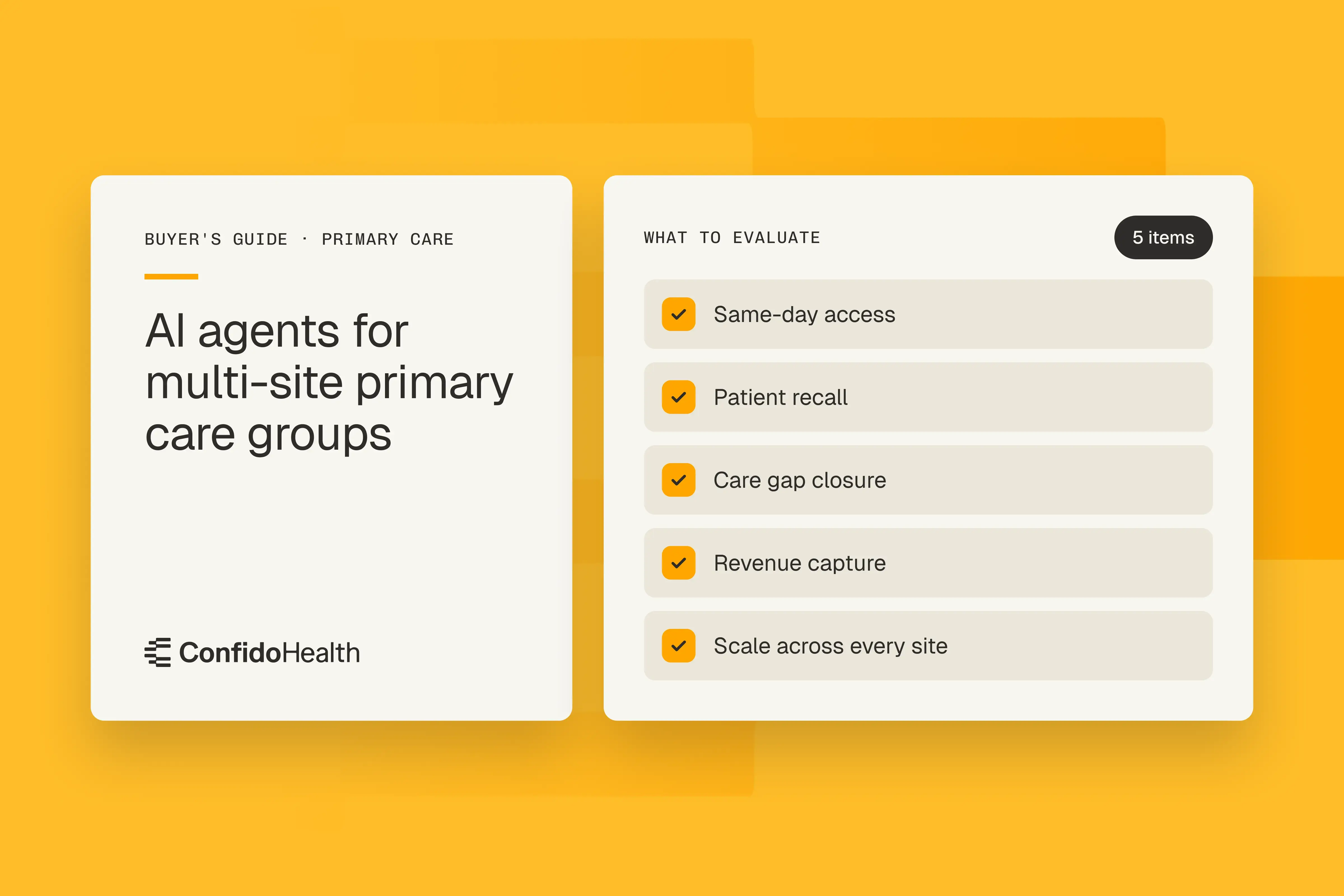
This guide covers what FQHC patient intake software and AI agents should handle at a community health center, how they work with Medicaid eligibility, languages, triage, and care gaps, how the options compare, and what results community health centers are seeing.
Which AI tools help FQHCs with patient outreach and eligibility?
The tools that help most do more than answer calls. They find patients who need something, such as lapsed coverage, an overdue visit, or a sliding fee recertification. They reach those patients in their own language, book the visit on the same call, and record it in the EHR. If the patient does not pick up, they try again on a schedule the health center sets.
Plenty of tools can produce a list of overdue patients. The ones worth paying for get those patients back on the schedule.
What should FQHC patient intake software actually do?
Most FQHC patient intake software is built around forms: demographics, insurance cards, consents. That covers the paperwork. It does not cover the intake work that actually decides whether a patient gets seen.
At a community health center, intake also means:
- Confirming coverage before the visit, including Medicaid status, managed care plan, and sliding fee eligibility
- Catching recertifications before a sliding fee scale expires
- Collecting demographics accurately enough for UDS reporting
- Reaching patients in the language they speak
- Booking, confirming, and rebooking visits in the EHR
AI agents handle that broader intake work, by phone, in the patient's language, with every result written back to the chart.
Where does access break down at community health centers?
At the phone
Many community health centers staff a full scheduling team and still miss a large share of calls. When a team is on the phones all day, and patients still cannot get through, the complaints start: online reviews and social media comments that say nobody ever answers.
At the language barrier
Bilingual staff help, but they cannot cover every language or every hour. When the bilingual scheduler is on lunch, a patient waits, or the call goes to an interpreter service that takes far longer.
At cancellations
Community clinics typically see 15% to 25% of bookings cancel, and some centers run much higher. Each cancelled slot that is not refilled is a visit someone else needed.
At the patients who stop coming
On most community health center rosters, a meaningful share of patients have not been seen in a year or more. They are the patients most likely to show up later in an emergency room, and the ones who pull down quality measures.
How do AI agents handle Medicaid eligibility verification for FQHCs?
Medicaid coverage changes constantly. Patients lose coverage at redetermination, switch managed care plans, or move onto a sliding fee scale. A check run when the visit is booked can be wrong by the time the patient arrives.
Confido Health AI agents run eligibility across the patient panel and flag who is active, lapsed, or expiring. They catch patients due for sliding fee recertification, then call those patients before the visit, in their language, to sort it out. Because one call can also close a care gap or address a balance, the patient hears from the health center once instead of 3 times.
How do AI agents support patients in 20+ languages?
Confido Health AI agents speak 20+ languages and understand regional accents and dialects. For a community health center, that changes 2 things.
First, routine calls no longer wait for the one bilingual staff member who is free. Patients get help on the first call, at any hour.
Second, the voice can fit the community. Health centers can tune how the AI agent sounds so patients hear someone familiar. One health center tested this by having its bilingual providers, with different Spanish accents, call the AI agent to see how it handled them. It understood both, and the providers approved it for patients.
How do AI agents handle triage and routing at an FQHC?
AI agents handle the administrative side of a call: scheduling, confirmations, eligibility, and general questions. Clinical judgment stays with people.
That boundary has to be clear before go-live. Calls from patients in distress, patients describing urgent symptoms, behavioral health crises, and anyone who asks for a person 3 times go straight to staff, following the health center's own rules. Most centers keep a small team on the phones specifically for those calls.
How does AI care gap closure support UDS measures?
Care gaps at a community health center affect more than individual patients. They show up in UDS measures and in value-based contracts. Care gap closure means reaching patients who are overdue and getting them back on the schedule, which is exactly the work most teams never have time for.
Let the clinical team set the rules
Confido Health can run many care gap rules, from preventive visits to diabetes follow-up and cancer screenings. The clinical team decides which ones to run and on what criteria. Starting with 1 or 2, such as adult preventive visits and well-child visits, keeps the rollout focused.
Work the list on the health center's terms
The care gap list refreshes from the EHR. Patients who are deceased, opted out, or have no phone number are excluded. Outreach is spaced over weeks rather than repeated in one week. When a patient cannot be reached, the AI agent opens a case in the chart so staff can follow up another way.
Book the visit on the call
The AI agent calls on behalf of the patient's own provider and offers a specific time. The aim is a booked visit, not another reminder.
What results are community health centers seeing?
An 11-location FQHC
This health center went live across all 11 locations in 30 days, with English and Spanish from day 1 and parent and guardian handling for pediatric patients. AI agents now handle about 99% of outbound calls and resolve 94.7% of inbound calls without a transfer. When it comes to keeping appointments, the AI agents do better than the old manual process: 80% of patients confirmed by an AI agent show up for their visit, about 10% more than patients confirmed by staff calls.
A 16-location community health center in Atlanta
Live since July 2026, this health center cut its share of unanswered calls from 25% to 8%. In October alone, its AI agents handled about 720 hours of patient calls, roughly 4 FTEs of work. Its kept-visit rate rose from 74.3% to 76.1% across 12,751 visits, and missed visits are down 20% since go-live.
What do these results have in common?
Both health centers started with a defined set of workflows, rolled out across every site, and kept urgent calls with staff. Neither added schedulers to get there. The work they took off their teams went back to patients in the clinic.
How do the options compare for a community health center?
What should a community health center look for in an AI partner?
Will they come on site?
The rollouts that work start with the vendor's team in the clinics, walking the workflows, sitting with schedulers, and mapping how every type of call should be handled, including the urgent ones.
Will they start small?
Start with a few providers or one workflow, test with the patients who speak other languages, and expand once it works. Nothing goes perfectly the first time.
Will they work inside your EHR and phone system?
Results should land in the system your team already uses, whether that is Athena, NextGen, eClinicalWorks, or another EHR.
Will they keep a person in the loop?
Ask exactly how urgent calls, crisis calls, and requests for a person are handled before you sign.
Will they show you the numbers?
You should see calls resolved, appointments booked, care gaps closed, and staff hours freed, every week.
How much could AI agents return to your health center?
You can estimate this with 4 numbers from your EHR and phone system.
How many patients are overdue?
Pull patients with no visit in 12 months or more, and compare that with your total roster.
What is your cancellation rate?
Compare it with the 15% to 25% range typical for community clinics. Every point above that is a slot you could refill.
How many calls go unanswered?
Check missed and abandoned calls, including after hours.
How many staff hours go to the phone?
Count the people whose main job is answering calls.
Together, those numbers show how many patients you could bring back, how many visits you could keep, and how much staff time you could move to work that needs a person. For a health center running on tight margins and grant cycles, that is capacity you already pay for, put to better use.
How does Confido Health help FQHC teams?
Confido Health is an agentic operating system for healthcare operations. At a community health center, that means one set of AI agents working across every site, sharing the same patient record, and taking on the routine work that keeps pulling your teams away from patients. Here is what changes for each team.
Schedulers and patient access staff
Your schedulers stop spending the whole day answering routine calls. AI agents book, reschedule, and confirm visits across every site and department, at any hour, in 20+ languages, and write every appointment to the EHR. When a patient cancels, an AI agent calls back to rebook. Your staff takes the calls that need a person: urgent symptoms, patients in distress, complicated situations, and anyone who asks for a human.
Eligibility and enrollment staff
Instead of finding coverage problems at check-in, your team sees them days earlier. AI agents run eligibility across the patient panel, flag lapsed and expiring Medicaid coverage, catch sliding fee recertifications before they expire, and call patients to start fixing it before the visit. Your enrollment staff spends their time helping patients through the process, not hunting for who needs help.
Quality and care coordination teams
The care gap list stops being a report nobody has time to work. Your clinical team sets the rules, such as which gaps to close, which patients qualify, and how often to reach out. AI agents call overdue patients on behalf of their own provider, in their language, and book the visit. Patients who cannot be reached are flagged in the chart for follow-up. That gives your quality team steady progress on UDS measures and value-based contracts, without pulling care coordinators onto the phones.
Billing and revenue staff
AI agents answer balance questions, explain sliding fee charges, set up payment plans, and send text-to-pay links. When claims are denied, they work the denial with the payer and track it to resolution. Your billing team gets fewer interruptions and fewer aging balances.
Leadership
You see the same numbers for every site: calls answered and resolved, appointments booked and kept, care gaps closed, coverage issues caught, and staff hours freed. When you add a site or take on a new grant program, the same AI agents and rules extend to it. You do not have to hire a new team first.
What stays the same
Your EHR, your phone system, and your people. Confido Health works inside 50+ EHR, PMS, and phone systems, including athenahealth, eClinicalWorks, NextGen, Epic, Veradigm, and phone systems such as RingCentral and 3CX. Health centers on different EHRs, or in the middle of switching from one to another, keep running the same workflows across every site. Every appointment, eligibility result, and care gap outcome is written back to the chart, so your team always works from one record.
Your clinical team's rules stay in charge, and urgent calls always go to your staff. Confido Health is HIPAA compliant and SOC 2 Type II certified.
How fast can a health center go live?
Most health centers are live in 4 to 6 weeks. Your team defines the scheduling rules, routing, and escalation paths for each site, and Confido Health handles the build, the EHR and phone integration, and testing. Nothing gets migrated, and your staff does not have to learn a new system. One 11-location FQHC went live across all of its sites in 4-6 weeks.
Is it time to change how your health center reaches patients?
Community health centers are not short on commitment. They are short on hours. Every call that goes unanswered, every coverage change nobody catches, and every overdue patient nobody reaches is time your team never had in the first place.
AI agents give that time back, across every site and in every language your patients speak, while your staff stays focused on the care only they can give. The health centers seeing the strongest results started small, chose a partner that learned how they work, and expanded from there.
Send us your overdue patient count, cancellation rate, and monthly call volume by site. We will show you how many patients Confido Health could bring back to your health center, and what that means for your team and your budget.