
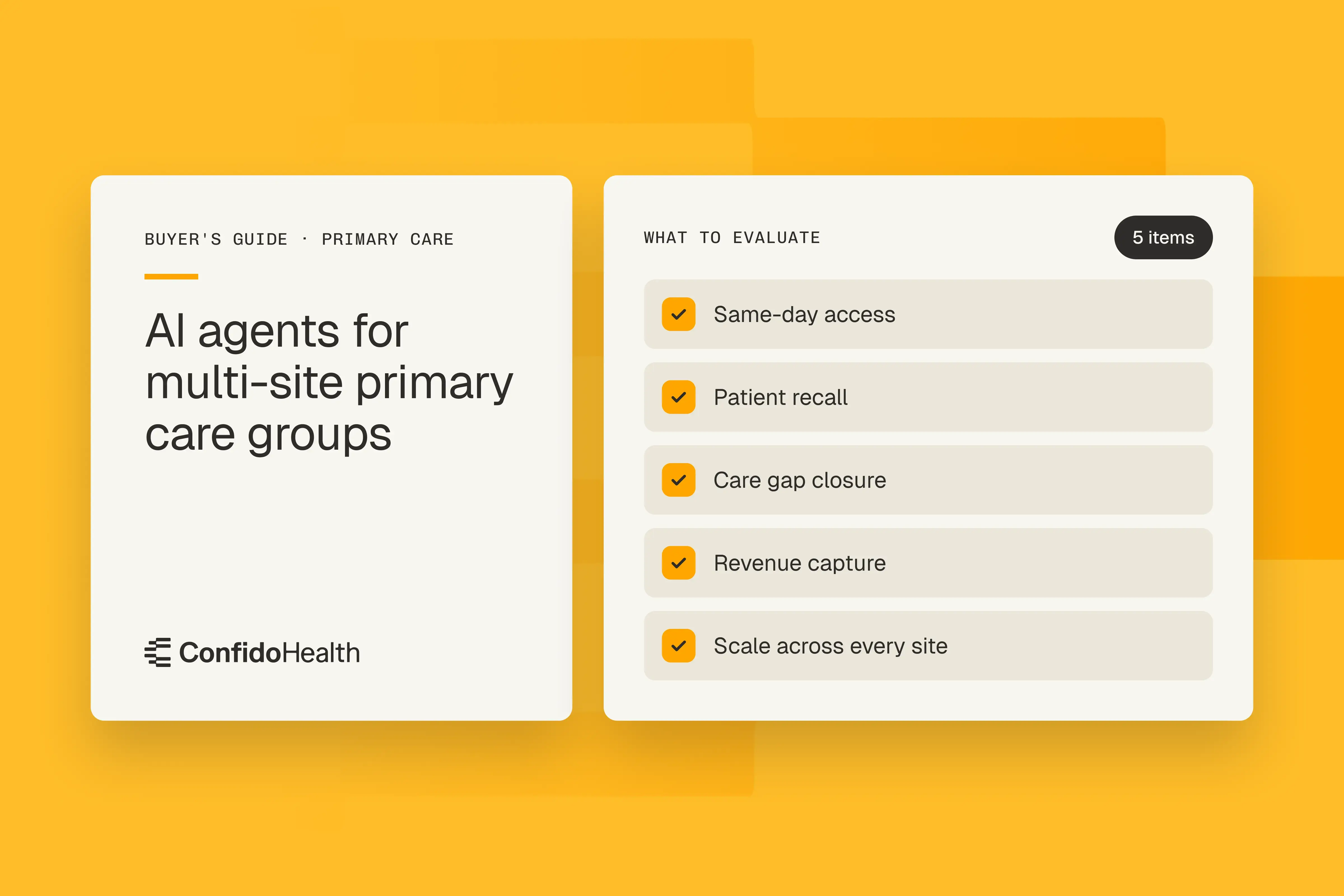

- AI agents help multi-site primary care groups connect patients with available care by answering calls, booking across locations, filling same-day slots, and handling routine after-hours requests.
- Consistent outbound outreach supports ongoing care: appointment confirmations, missed-visit rebooking, annual wellness recall, chronic care follow-ups, and outreach for overdue screenings.
- Clinical decisions stay with healthcare staff. AI agents capture refill requests and route clinical or urgent concerns according to the group’s protocols, without providing medical advice.
- Confido Health connects patient access with revenue cycle work, including insurance verification, prior authorizations, referral and fax processing, patient payments, and denial resolution.
- Existing systems remain central: bookings and completed tasks are written back to the EHR, with scheduling and escalation rules tailored to each site.
- The blog reports that Formé Medical Center went live in 5 weeks, with AI resolving 60% of inbound calls, handling 90% of outbound calls, managing 6,300+ appointments, and providing capacity equivalent to 3+ full-time staff.
Introduction
What would change at your group if every patient who tried to get in this week actually got in?
Not more patients. The ones already trying. The parent who called at 8:05 on Monday and gave up after 6 minutes on hold. The diabetic patient whose A1c follow-up slipped past 6 months because nobody called. The woman who has meant to book her annual exam since spring. The patient who cancelled Thursday and was never offered another slot, while a provider across town sat with an open 3:30.
Primary care groups rarely have a demand problem. Patients want in. Most groups have the providers and the hours, too, scattered across sites in 15-minute gaps. What they do not have is enough people to connect the two, every hour of every day, at every location. The phones take the front desk's whole morning. The outreach list never gets touched. And after the visit, a second set of gaps opens up: coverage nobody confirmed, authorizations nobody chased, faxes nobody filed, and balances nobody collected.
This guide is a working map of both sides of that problem in a multi-site primary care group. It covers where patient access breaks, where revenue leaks after the visit, what AI agents can take on, how to evaluate vendors, and how to size the opportunity at your own group. Throughout, we use Formé Medical Center, a primary and urgent care practice serving more than 15,000 patients, as a real example.
How can a multi-site primary care group automate patient access?
By handing AI agents the 2 jobs that swamp primary care teams: answering and resolving every inbound call, and working the outbound list every day.
On the inbound side, AI agents answer on the first ring, understand why the patient is calling, apply your scheduling rules, book or reschedule in your EHR, and route anything clinical to your staff. On the outbound side, they confirm upcoming visits, rebook missed ones, run recall for wellness and chronic care, and call patients with open care gaps, then book them on the call.
The best setups do not stop at the appointment. The same AI agents verify coverage before the visit, chase authorizations, process faxes, collect balances, and work denials. That way, the visit that got booked also gets paid. Your staff keeps the work that needs a person: clinical questions, urgent symptoms, complicated situations, and the patients standing in front of them.
What should patient access services cover in primary care?
"Patient access" often gets reduced to scheduling software or a call center. In primary care, it covers every touchpoint between a patient wanting care and that patient sitting in an exam room, then coming back when they should.
Most patient access software covers 1 or 2 of these rows. The rest falls on your staff, and that is where groups start losing patients.
Where does patient access break down in primary care?
When the phones take over the front desk
At most primary care sites, the same people answer phones, check patients in, collect copays, and handle whatever walks up to the counter. When the waiting room fills, the phones lose. Before Confido Health, Formé's front desk was in a state its CEO calls chaos: appointments slipped, calls went unanswered, and patients complained about long holds and messages that were never returned. "I could feel the stress from staff," says Formé CEO Maria Trusa.
When scheduling rules live in someone's head
Primary care scheduling looks simple until you try to write it down. New patient visits, physicals, sick visits, follow-ups, procedures, and wellness visits each have their own lengths and rules. Some providers take same-day sick visits, and some do not. Some slots are held for hospital follow-ups. When those rules live only in experienced schedulers' heads, bookings go wrong the day those people are out, and patients end up in the wrong slot or with the wrong provider.
When same-day demand cannot find same-day capacity
A patient calls the site nearest home. If that site is full or the line is busy, the patient often ends up at urgent care or the emergency room, even when another site in your group had room that afternoon. That is a visit lost, and in a value-based contract, it can also mean an avoidable cost charged against your panel.
When after-hours calls go to voicemail
Patients call when they are free: at lunch, after work, and on weekends. Voicemail turns those calls into a callback list that someone works the next morning, if the morning allows. Many of those patients have already booked somewhere else.
When language becomes a wait
Many primary care groups serve large Spanish-speaking populations. When the bilingual staff member is busy, those patients wait longer, or hang up and try somewhere else.
When nobody owns the outbound list
Confirmations, recall, and follow-up on missed visits are the first things to go when a team is stretched, and the last things anyone gets back to. At Formé, tracking which patients were due for preventive care was a manual job that kept slipping.
How do AI agents handle same-day access and sick visits?
When a patient calls with a same-day need, an AI agent works through it the way an experienced scheduler would. It identifies the visit type, checks which providers take that type today, looks for openings across your sites, and offers the patient real-time options. Once the patient picks one, it books the visit in the EHR while the patient is still on the line.
The clinical line stays where it belongs. AI agents do not triage symptoms or give medical advice. When a patient describes something urgent, they follow your protocols: routing to your triage nurse, directing the patient to the right care setting, or escalating to staff. Your clinical team writes those rules, and the AI agent follows them every time, which is more than most groups can say about a busy front desk at 8 a.m. on a Monday.
How do AI agents handle after-hours calls?
After hours, AI agents answer just as they do during the day. They book, reschedule, and confirm appointments, answer routine questions about hours and locations, and take refill requests for staff to process in the morning. Anything urgent follows your after-hours protocol: transfer to the on-call provider or nurse line, or direct to emergency care. Patients get help when they call, and your team starts the morning with completed bookings instead of a voicemail backlog.
How do AI agents handle refill requests and clinical questions?
Refill requests are one of the most common reasons patients call primary care, and one of the most disruptive for staff, because each one usually needs a callback just to collect the details. AI agents capture the request, confirm the patient, medication, and pharmacy, and route it to your clinical team in the EHR. Prescription refills are one of the workflows Formé runs with Confido Health.
The same approach works for results questions and anything else that needs clinical eyes. AI agents gather the details and route the request, so staff do not have to call the patient back just to find out what they wanted. Clinical decisions stay with your providers.
How do AI agents support Spanish-speaking patients?
Confido Health AI agents speak 20+ languages, including Spanish. More than 90% of Formé's patients are Latino, so its team trained the AI agent in Spanish alongside staff. Patients now get the same fast, accurate answers in the language they are most comfortable speaking, at any hour, without waiting for a bilingual staff member. For groups serving other communities, the same holds across many languages, at every site.
How do AI agents cut no-shows and rebook missed visits?
Confirmations that patients actually answer
A text reminder is easy to ignore. A call that lets the patient confirm, reschedule, or cancel in one conversation is not. A cancellation 2 days out is a slot you can refill. A no-show is not.
Rebooking on the same day
When a patient misses a visit or cancels, an AI agent calls to rebook, offering specific times instead of asking the patient to call back. In primary care, a missed visit is rarely just a lost slot. It is often a chronic patient falling out of their care plan.
Backfilling the schedule
Slots freed by cancellations can go to patients who need to be seen sooner, so the schedule stays full, and the people who need care get it first.
How do AI agents run recall for primary care?
Recall is where primary care groups leave the most care, and the most revenue, untouched. AI agents work the recall list every day and book patients with their own provider.
Annual wellness visits and physicals
AI agents call patients who are due, explain what the visit covers, and book it. For groups with large Medicare panels, annual wellness visit recall alone can move both patient outcomes and revenue.
Chronic care follow-ups
Patients with diabetes, hypertension, COPD, or heart failure need regular visits and labs. AI agents call patients whose follow-up is overdue and book them before small problems become hospital admissions.
Preventive screenings and women's health
At Formé, AI agents reach out when patients are due for mammograms, GYN exams, and colonoscopies once a patient turns 45, and book them on the call. Staff no longer track those reminders by hand. For one patient, the call meant more than a reminder: she started to cry, surprised that anyone cared enough to call about her exam.
No-show follow-up
Patients who missed a visit go back on the list until they are rebooked, so nobody falls through the cracks.
How does AI care gap closure work in primary care?
Care gaps decide how a primary care group performs on quality measures and value-based contracts. Care gap closure means finding patients who are overdue for things like A1c checks, blood pressure control visits, mammograms, colorectal screenings, or immunizations, and getting them on the schedule.
Your clinical team sets the rules: which gaps to target, which patients qualify, how often to reach out, and when to stop. AI agents call those patients on behalf of their own provider, in their language, and book the visit on the call. Patients who cannot be reached after several tries are flagged in the chart for another kind of outreach. Instead of a quality report showing the same gaps every quarter, the list shrinks month by month, and your quality team spends its time on the hard cases.
Where does revenue leak after the visit in primary care?
Getting patients in is half the job. The other half is getting paid for the care they receive. In primary care, the margins per visit are thin, so the revenue cycle leaks matter more than in most specialties.
Eligibility problems that surface at check-in
Patients change plans at the new year, lose Medicaid at redetermination, or move into managed care plans that assign them to a different primary care provider. When coverage gets checked at check-in, the problem shows up with the patient standing at the desk. When it gets missed entirely, it shows up as a denial.
Authorizations that hold up care
Primary care orders a steady stream of things that need prior authorization: advanced imaging, certain specialty medications, and some referrals under HMO plans. Each one means portal logins, faxed forms, and follow-up calls, usually by clinical staff who should be with patients.
Faxes that pile up
Primary care still runs on fax: specialist consult notes, hospital discharge summaries, lab results, records requests, pharmacy refill requests, and prior authorization forms. When the fax queue falls behind, results reach the chart late, and follow-ups get missed.
Denials that age out
Eligibility denials, missing authorizations, and coordination of benefits issues all need someone to find the reason, fix it, and resubmit before the deadline. When billing is stretched, denials sit.
Patient balances that go uncollected
High-deductible plans mean more of every visit is owed by the patient. Statements in the mail get ignored, and balances age.
Payers paying less than the contract
Short payments on primary care codes are small per claim and easy to miss. Across a multi-site group and a year of claims, they add up.
Each of these is follow-up work, much like the outbound list in patient access, and AI agents handle it the same way.
How should you evaluate AI patient access vendors?
Every vendor will show you a smooth demo call. These questions tell you what happens after it.
Can it follow our real scheduling rules?
Bring your 3 hardest scenarios: a new patient who needs a specific provider, a same-day sick visit when the home site is full, and a physical that needs a long block. A strong vendor builds your rules into the system and shows you each scenario working in your EHR.
What lands in our EHR, and what does staff still type?
Ask to watch a booking, a refill request, and an insurance update appear in your own EHR during the demo. If staff have to copy anything over, the work has not really moved.
How does it handle urgent and clinical calls?
Ask exactly how calls about chest pain, breathing trouble, or a patient in distress are routed. You want your protocols, your escalation paths, and a clear line between scheduling and clinical judgment.
Does it run outbound work, or just answer calls?
Confirmations, rebooking, recall, and care gaps are where much of the value is. Ask which outbound workflows are live and how bookings land on your schedule.
Does it handle revenue cycle work?
Ask whether the same platform verifies insurance, chases authorizations, processes faxes, collects balances, and works denials, or whether you need separate vendors for each.
How does it work across sites?
Ask how rules are set per site and provider, how a new site gets added, and what leadership sees across the group.
How long until we are live, and what is our team's role?
A strong answer covers the timeline, what your team needs to define, what the vendor builds and tests, and how your team stays involved.
What will we measure, and how often?
You should see answer rates, resolution, bookings, recall, care gaps, and revenue cycle outcomes by site, every week.
How do the options compare for a primary care group?
What changed at Formé Medical Center?
Formé Medical Center cares for more than 15,000 patients across primary and urgent care. Before Confido Health, its only answer to rising call volume was hiring more people. Instead, it went live with Confido Health AI agents in 5 weeks, connected to eClinicalWorks and RingCentral.
AI agents took the routine calls
AI agents answer calls, book and reschedule appointments, confirm visits, and route prescription refill requests. They resolve 60% of inbound calls on their own, have handled more than 41,000 calls, and have managed more than 6,300 appointments.
Every patient hears back
Complaints about long holds and unreturned calls have stopped. Formé's hold-time complaints went to zero.
Outreach reaches patients first
AI agents handle 90% of outbound calls, from appointment confirmations to annual wellness recall, women's health recall, and preventive care reminders.
The team got capacity back
The AI agents now do the work of more than 3 full-time staff, without Formé adding headcount.
"I would highly recommend the Confido team," says Maria Trusa. "With AI, I know that I'm going to make a difference not only financially, but in their lives."
Read the full Formé Medical Center customer story.
What do primary care leaders worry about before switching?
Most primary care leaders who look at AI agents have the same 5 concerns. They are reasonable ones. Here is how each plays out in practice.
Will our patients accept talking to an AI?
This is usually the first worry, and the one that tends to fade fastest. Patients care far more about getting through than about who answers. At Formé Medical Center, complaints about long holds and unreturned calls stopped entirely once AI agents took over routine calls. For many patients, the experience got more personal, not less. When an AI agent called one Formé patient about an overdue exam, she started to cry, surprised that anyone had cared enough to reach out.
Language matters here too. More than 90% of Formé’s patients are Latino, and its team trained the AI agent in Spanish alongside staff, so patients get fast answers in the language they are most comfortable speaking. Groups can also tune the AI agent’s voice and tone to sound like their own team. Alpha Dental trained its AI agent on its own call recordings so patients would hear something familiar.
Can AI really handle our scheduling rules?
Primary care scheduling has more rules than it looks: visit types, lengths, provider preferences, same-day sick slots, and held time. The AI agent does not guess at these. Your team defines them, Confido Health builds them in, and the AI agent applies them on every call, including at 8 a.m. on a Monday, when a busy front desk is most likely to slip.
The results at Formé show it works in a mixed primary and urgent care setting. AI agents resolve 60% of inbound calls with no staff involvement and have managed more than 6,300 appointments in eClinicalWorks.
How will our staff react?
Staff often worry that AI means fewer jobs. In practice, the work AI agents take on is the part of the job most front desk teams like least: the endless ringing, the hold queue, and the callbacks that never end. Before Confido Health, Formé’s CEO described the front desk as chaos. “I could feel the stress from staff,” she says. Today, the AI agents do the work of more than 3 full-time staff, and Formé did not have to add headcount to keep up with rising volume.
What staff gain is time for the patients in front of them and the calls that genuinely need a person. That is usually the part of the job they came for.
Is it clinically safe?
AI agents handle the administrative side of a call: scheduling, confirmations, refill intake, coverage, and general questions. They do not triage symptoms or give medical advice.
Your clinical team sets the rules for anything urgent. A patient describing chest pain, trouble breathing, or distress is routed to your triage nurse, on-call provider, or emergency care, following your protocols every time. Refill requests are captured and routed to your clinical team in the EHR. The decision stays with your providers.
What happens when the AI cannot resolve a call?
It hands the call to a person, with the context already gathered, so your staff does not start from scratch. Patients who ask for a person get one.
That handoff is designed in from the start. At Formé, AI agents resolve 60% of inbound calls on their own, and the rest reach staff with the details already collected. At Alpha Dental, complex questions go straight to staff while AI agents handle routine calls from start to finish. The goal is not to keep every call away from your team. It is to make sure the calls that reach them actually need them.
What should a primary care group measure?
Track these by site before you start, then every month after.
Access measures
- Answer rate, including after-hours
- Inbound resolution: the share of calls resolved without a transfer
- Same-day fill rate: same-day slots filled versus left open
Outreach measures
- No-show and cancellation rate, and how many are rebooked
- Recall completion: patients due versus patients booked
- Care gap closure: open gaps by measure, month over month
Revenue measures
- Eligibility-related denials, by site and payer
- Days from authorization request to approval
- Patient balances over 60 days
- Payments below contracted rates, by payer
Team measures
- Staff hours on the phone
- Fax queue backlog
Together, these tell you where access and revenue are breaking at each site, and they show leadership exactly what changed once AI agents went live.
How much is your group leaving on the table?
Pull these numbers from last month.
How many calls went unanswered?
Count missed and abandoned calls by site, including lunch and after-hours.
How many same-day slots went unfilled?
Compare open same-day slots at day's end against calls that did not get booked.
How many missed visits were never rebooked?
Look at no-shows and cancellations, and how many of those patients have nothing on the schedule now.
How long is your recall and care gap list?
Count patients overdue for wellness visits, chronic care follow-ups, and screenings.
How much is aging in denials and patient balances?
Look at eligibility-related denials and patient balances over 60 days.
Multiply missed calls and unrebooked visits by your average visit value for a conservative floor on the access opportunity. Add recall, care gaps, denials, and balances, and you have the full picture.
How does Confido Health help primary care groups?
Confido Health is an agentic operating system for healthcare operations. For a multi-site primary care group, that means one set of AI agents working across every site, sharing the same patient record, following each site's rules, and covering both patient access and the revenue cycle.
Patient access
AI agents answer, book, reschedule, and confirm across every site, at any hour, in 20+ languages. They fill same-day slots across locations, handle after-hours calls, and route refills and clinical questions to the right staff in the EHR.
Outreach
Confirmations, missed-visit rebooking, annual wellness recall, chronic care follow-up, preventive screening outreach, and care gap campaigns run every day, with each booking written to the schedule.
Revenue cycle and back office
Insurance verification
AI agents verify eligibility, copays, deductibles, and plan changes before the visit, including Medicaid redeterminations and HMO primary care assignments. When coverage has changed, they reach the patient before the appointment, and results are written to the chart.
Prior authorization
AI agents check whether imaging, specialty medications, or referrals need authorization, submit through payer portals, follow up on status, handle denials and resubmission, and track renewals, so care is not held up and providers are not stuck on the phone.
Referral management
Incoming referrals are read, matched to the right patient, and booked, with the referring office kept updated.
Fax processing
Specialist notes, discharge summaries, lab results, records requests, pharmacy refill requests, and authorization forms are read, matched to the right patient, filed to the chart, and acted on. The fax queue stops being a backlog.
Payment management
AI agents answer balance questions, explain charges, set up payment plans, send text-to-pay links, and follow up on open balances, so collections do not depend on mailed statements.
Denial management
Denials are classified by reason. AI agents contact the payer to confirm what is missing, correct and resubmit, and track the appeal to resolution.
Payer intelligence
Payer responses become data that shows which payers are paying less than their contracts, so your team has specifics for contract conversations.
What changes for each team
Front desk staff take the patients in front of them and the calls that need a person. Clinical staff complete refill and results requests and enter them in the chart. Care coordinators work exceptions instead of call lists. Billing staff work the hard cases instead of chasing balances and resubmissions. Leadership sees access, outreach, and revenue outcomes by site, measured the same way everywhere.
What stays the same
Your EHR, phone system, and people. Confido Health works inside 50+ EHR, PMS, and phone systems, including athenahealth, eClinicalWorks, NextGen, Epic, Veradigm, RingCentral, and 3CX, with every action written back to the chart. It is HIPAA-compliant and SOC 2 Type II certified.
How fast can a group go live?
Most primary care groups are live in 4 to 6 weeks. Your team defines the scheduling rules and escalation paths for each site, and Confido Health handles the build, integration, and testing. Formé Medical Center went live in 5 weeks.
How many of your patients could get in this month?
Every patient who called and hung up, every missed visit nobody rebooked, and every overdue patient nobody reached was already part of your group. They wanted care. They just never connected with it. And for the patients who did make it in, every unchecked plan change, stalled authorization, and unpaid balance chipped away at a visit you already delivered.
Send us last month's call data, your current recall list, and your aging denials and balances by site. We will show you how many visits Confido Health could add to your schedule, how much revenue it could recover, and what that is worth to your group.