

.svg)
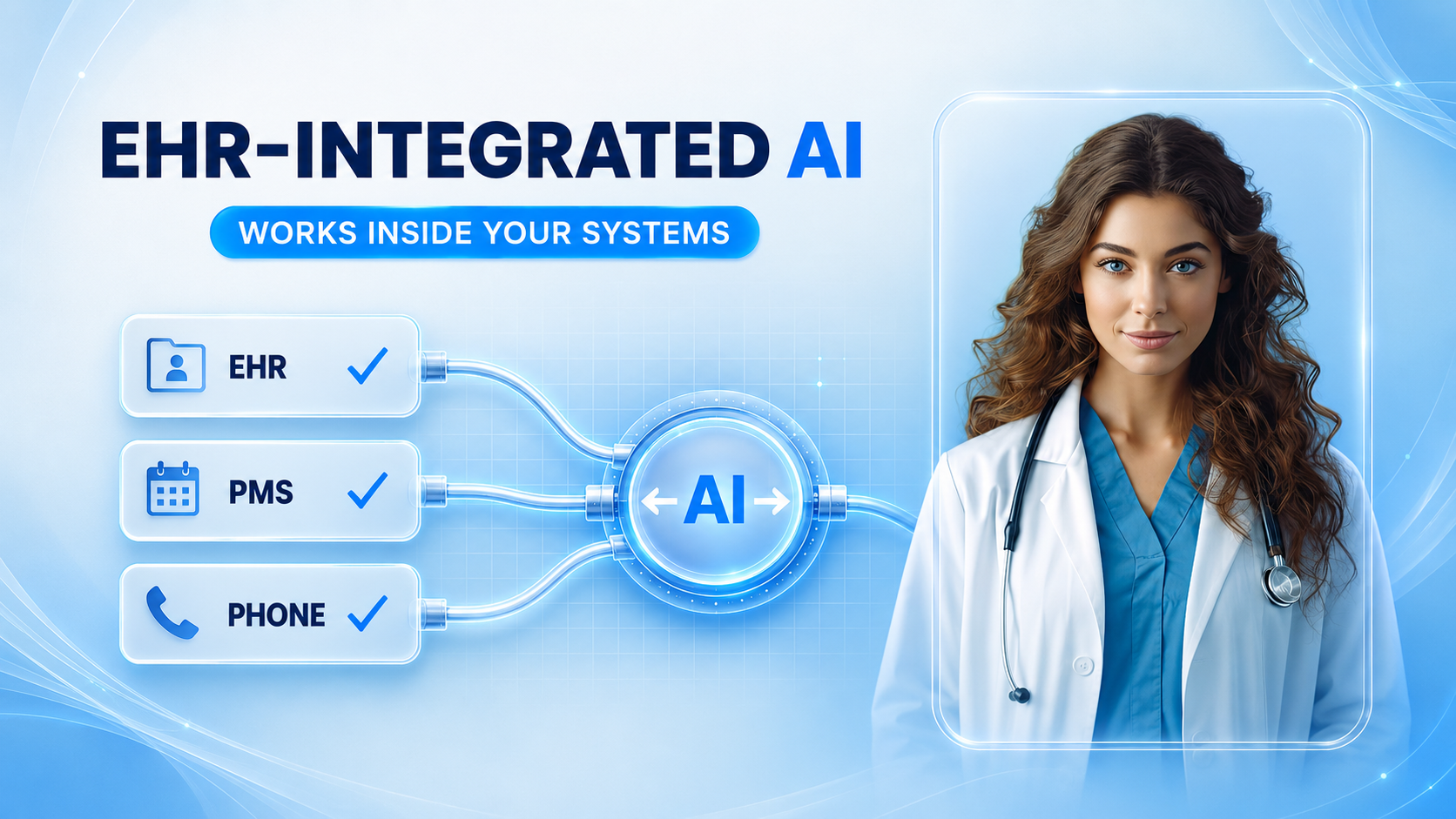
- EHR-integrated AI is only useful if it finishes the work inside your systems, not just answers the phone and hands the task back to staff.
- The question that matters is not how many systems a platform connects to, but whether it connects to the ones your practice actually runs.
- Shallow integration reads a little and leaves your team to re-enter everything; deep integration completes the workflow and writes the result to the chart in real time.
- The workflows worth checking are scheduling, refills, eligibility, prior authorization follow-up, payments, referrals, and recalls, end to end.
- Multi-site groups often run more than one EHR, so coverage of your specific mix is what makes one consistent patient experience possible.
- New to the category? Start with the voice agent versus chatbot difference, or a practical look at how to choose an AI platform.
After the AI Answers, Who Updates the Chart?
Picture the front desk on a normal Tuesday. A call comes in, the AI answers it, books the appointment, and the caller hangs up happy. Then someone on your team opens the EHR and types the whole thing in again, because the tool that "handled" the call never actually wrote anything back.
That second step is the part nobody demos. And it is the part that decides whether a platform saves your team time or quietly adds to their day. Your staff are not the problem here. A shallow connection is.
This is the real subject behind the phrase EHR-integrated AI. Not whether a platform can talk to a patient, but whether it can finish the task inside the systems your team already opens every morning, so nothing lands back on them afterward. That distinction, and how to test it, is what this guide is about.
We will keep it grounded in how a US practice actually runs: multiple systems across sites, a revenue cycle that stretches for weeks after the visit, and staff who are already stretched. If you want the plain-language version of how AI connects to your EHR in the first place, Confido Health covers it in its guide to integrating AI into your EHR.
Why Healthcare AI Companies Overuse the Word Integration
"Integration" has become the safest word on a sales call. It sounds technical, it sounds finished, and it commits to almost nothing. Every platform can claim it, because reading a single data field and running your entire front and back office both count as "integrated" under that one label.
For someone running operations, that vagueness is expensive. If a platform only reads availability, or only completes a first booking, then every reschedule, refill, eligibility check, and balance question it touches still comes back to your team to key in by hand. On paper the call was automated. In practice you have a new reconciliation list.
So the useful question is not whether a platform integrates. It is what the platform does inside your systems when the call ends, and which of your systems it can do that in. Everything else is a label. Confido Health explains the shift from talking to completing work in its overview of moving from chatbots to workflow execution.
What EHR Integration Actually Changes in Your Day
Integration depth sits on a spectrum, and the two ends produce very different Tuesdays.
At the shallow end is read-only or one-way access. The platform can see a schedule or push one record, but the update arrives in a batch later, or a staff member has to confirm and reconcile it. The conversation happened without a person, and the paperwork did not.
At the deep end is real-time, two-way write-back. The platform reads the patient record during the call and writes the booking, the cancellation, the refill request, the verified benefit, or the updated phone number straight into the EHR or practice management system the moment it happens. The task is completed and documented before the next call rings. That is the line between a pleasant conversation and finished work, and it is the only version of EHR-integrated AI that actually returns time to your staff.
The Question That Matters: Does It Run Your Systems?
Here is where most articles get the emphasis wrong. They lead with an integration count, as if a bigger number were the point. For your practice, it is not. A platform that connects to a hundred systems is no use to you if it does not connect to the two or three you actually run.
For EHR-integrated AI, this is the question that decides everything, because US groups rarely run one system. Growth by acquisition leaves most multi-site and multi-specialty organizations on a mix: primary care on one EHR, the specialty clinics on another, the dental locations on a dedicated PMS, all sitting behind different phone systems. A dental support organization or a private-equity-backed group can be running several platforms across a dozen or more sites at once. That is not a corner case. It is the normal shape of a growing US practice.
This is the honest reason a broad integration library matters. Not as a bragging number, but as the odds that a platform already speaks to your specific mix, so you can run one patient experience across every location instead of buying a separate tool per system. When the same scheduling logic, the same escalation rules, and one shared view of performance run across every site, that is when a group actually feels the value. Confido Health works through this for mixed estates in its guide to patient access for multi-specialty groups.
The Workflows Real Integration Should Complete
Since the point of integration is finished work, the fair way to judge a platform is to look at the workflows it can complete on its own, not the ones it can start. A capable EHR-integrated AI should, inside a single call, handle the following.
- Pull the patient record, confirm identity, and apply your rules for the right provider, visit type, and location.
- Book, reschedule, and cancel appointments, then write each change into the record in real time.
- Route refill requests, run eligibility and benefit checks, follow up on prior authorization, and answer balance and billing questions in the same conversation.
- Run outbound recalls, reminders, and reactivation, and book the return visit on the call.
- Hand off to the right staff member, with context, when a case needs human judgment, so nothing gets dropped.
The through-line is completion, not routing. A tool that only greets callers and transfers them is doing the easy part. Confido Health frames the same shift when it compares in-house teams, outsourcing, and AI for the call center.
Where the Payoff Shows Up: the Back Office
Scheduling is the visible win, but the deeper return sits in the back office, where read-only tools cannot reach. In a US practice, a lot of the workload lives after the front desk: verifying eligibility before the visit, chasing prior authorization through payer portals, and explaining balances that only become clear once the claim is adjudicated weeks later. This work is high-volume, rules-based, and rarely needs clinical judgment, which is exactly why it drains so many staff hours.
Prior authorization is the clearest case. In the American Medical Association's 2026 survey, 95% of physicians said prior authorization delays access to necessary care, and practices complete an average of around 40 requests per physician each week. A platform that reads and writes across your systems can run eligibility checks before the visit, confirm coverage, follow up on authorizations, and write each result straight to the chart, which also keeps the claim clean downstream. A shallow connection never touches any of that. Confido Health treats this as core operations in its work on AI for prior authorization.
From our experience, this is where multi-location groups feel the change most, because deep write-back returns capacity across every site at once rather than shaving a minute or two off the front desk. Much of what gets called a patient access problem, laid out in Confido Health's breakdown of why patients cannot get through, is really a workflow that never got completed.
Shallow Integration vs Deep Integration at a Glance
This is a fair summary, not a scorecard with a winner decided in advance. The right depth depends on how much of your call volume has to end in completed, documented work, which is the real test of any EHR-integrated AI.
Questions to Ask Before You Sign
Before you commit to any EHR-integrated AI, a short evaluation separates a real integration from a hopeful one faster than any feature list.
The first question is direction and timing. Is the connection two-way and real-time, or read-only with a batch sync and manual cleanup afterward?
The second is the one most demos skip. Ask to watch a live write-back, an appointment the AI books appearing in your own environment while you are looking at it. If the vendor can only show a slide, treat the integration as unproven.
The third is about your systems specifically. Which of the platforms we run today, across medical, dental, and telephony, are live in production, not on a roadmap?
The fourth is scope. Does it complete eligibility, prior authorization follow-up, and billing questions inside the same call, or only scheduling?
The fifth is consistency and compliance. Can it run one workflow across all of our locations with shared reporting, and what protects patient data, including a Business Associate Agreement, encryption, and audit trails?
Here's How Confido Health Can Help
If your evaluation keeps returning to one worry, whether the work actually lands in the systems you already run, that is the exact problem Confido Health was built to solve. Confido Health is a Voice AI healthcare operations platform with real-time, two-way integration into your EHR and PMS, so its AI Agents work inside your operation rather than beside it.
Here is what Confido Health delivers:
- Connects to the systems you already run, with more than 40 live EHR, PMS, and telephony integrations including Epic, Athenahealth, eClinicalWorks, Dentrix, and Open Dental, so it fits your estate instead of asking you to change it.
- Completes healthcare workflows end to end, across scheduling, reschedules, refills, eligibility and prior authorization follow-up, payments, referrals, and recalls, then writes each result to the chart in real time.
- One consistent workflow across every location, even when your sites run different systems, with shared reporting so leaders see performance across the group.
- Answers every call on the first ring, around the clock, inbound and outbound, with a warm transfer to your team only when a case truly needs a person.
- Returns real capacity to staff, with an 80% reduction in manual administrative work in the workflows it handles and a 15 to 20% increase in revenue collections.
- Live in under 30 days using expert-approved templates, without pulling your team off patient care to set it up.
From our experience, the moment the integration question settles is when a leader watches a task land in the record during the demo. At Dallas Renal Group, which handles about 10,000 calls a week, Confido Health resolves roughly 40% of that volume automatically, and missed calls have dropped sharply, from around 130 a day to about 70, with every action written back to the record as it happens.
Confido Health is more than a tool. It is the operational layer that turns a patient call into completed, documented work inside the systems your team already trusts.
Want to see what real EHR-integrated AI looks like in your own environment? Book a demo and ask us to write one back to your system live.
Still comparing the field? See how the leading AI healthcare companies line up on what they actually complete.
FAQs
What is EHR-integrated AI?
EHR-integrated AI is a platform that connects to your electronic health record so it can read patient information and, when the integration is deep, write completed work back into the record. A capable one books appointments, verifies eligibility, and updates the chart during the call, rather than only answering the phone.
Can AI update an EHR automatically?
Yes, when the integration is two-way and real-time. The platform records the outcome of a call, such as a booked appointment or a verified benefit, directly in the EHR as it happens. If a platform is read-only, it cannot update the record, so staff still re-enter everything afterward.
Does the number of integrations matter?
Only in that it raises the odds a platform already connects to the specific systems your practice runs. The count itself is not the point. What matters is whether it supports your EHR, your PMS, and your phone system, live in production today.
What is the difference between reading and writing to the EHR?
Reading lets the platform see data such as open slots. Writing lets it record the result, a booking or a benefit check, straight into the chart. Real value comes from two-way, real-time write-back, because that is what keeps your team from re-keying work after the call.
How can I tell if a vendor's integration is real?
With EHR-integrated AI, ask for a live write-back during the demo and watch an action the AI takes appear in your own system immediately. Then ask which of your specific systems are live in production rather than planned. A slide is not proof.
Will an integrated platform work with our phone system?
It should. Confido Health works within existing telephony, including RingCentral, Mango, and 3CX, so you do not need to change your phone setup to go live.
Can EHR-integrated AI handle insurance and prior authorization?
Yes, when it reaches the back office. Confido Health runs eligibility checks, confirms coverage before the visit, and follows up on prior authorization, then writes the results to the chart, which keeps claims cleaner downstream instead of leaving the work for staff.
Is patient data safe in an integrated AI platform?
It should be governed by a Business Associate Agreement, with encryption, role-based access, and audit trails. Confido Health operates HIPAA-aligned workflows under a BAA, and the covered entity still oversees overall compliance in its own implementation.
How long does it take to implement EHR-integrated AI?
With Confido Health, workflows typically go live in under 30 days using expert-approved templates, with measurable results in the first 60 to 90 days. Timelines depend on how many systems and workflows you connect, so confirm the plan for your specific estate during evaluation.
Is an EHR-integrated platform the same as an AI receptionist?
An AI receptionist that only answers and routes calls is a small piece of it. EHR-integrated AI goes further by completing the task and updating your systems, so the value is finished work across the front, mid, and back office, not just a friendlier greeting.
.webp)
