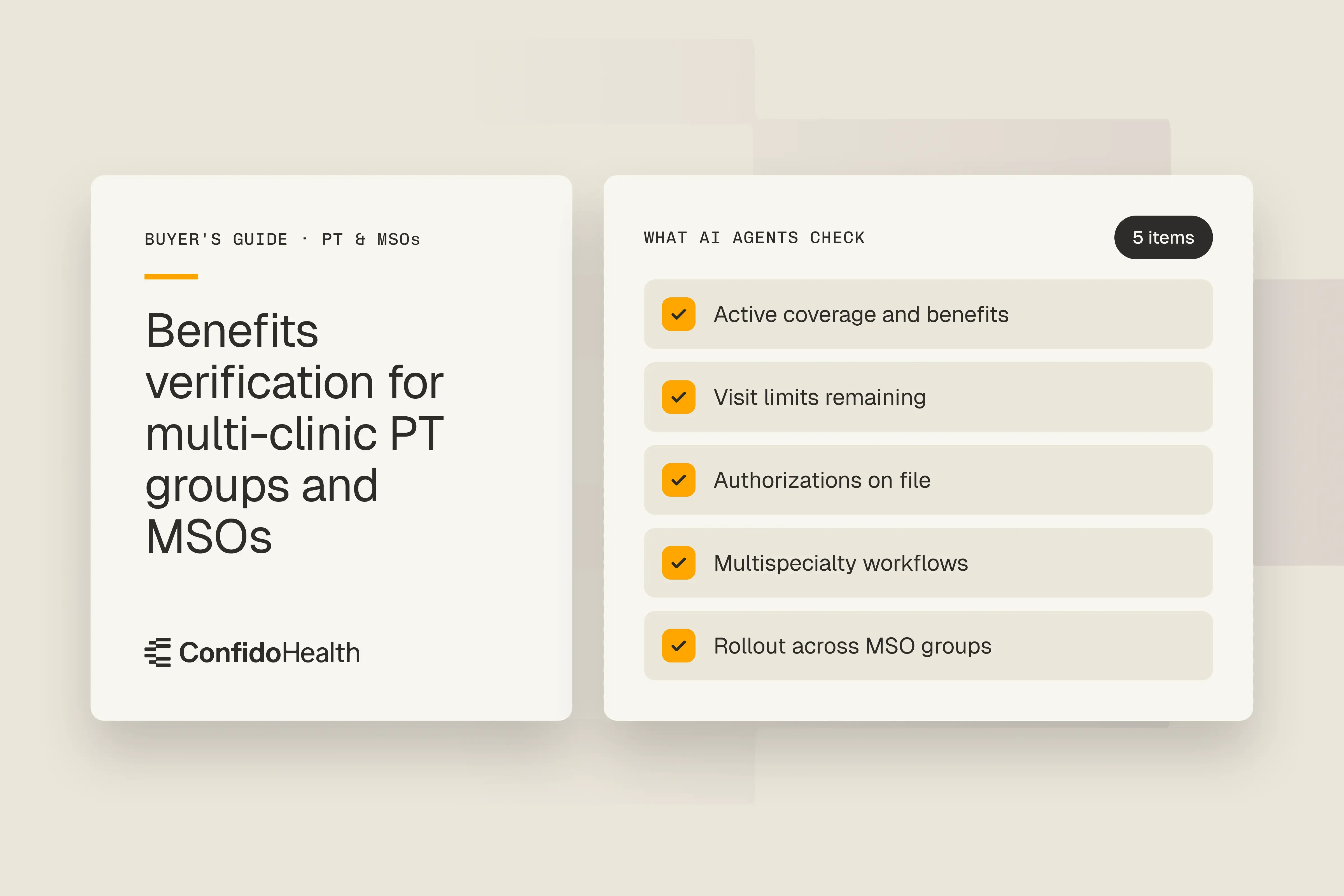

- Physical therapy benefits verification must continue throughout the plan of care. Checking coverage only at intake can miss exhausted visit limits and expired authorizations during follow-up sessions.
- Verification should cover more than active insurance: remaining visits, limits shared with other therapy services, copays, deductibles, authorization dates, and whether additional sessions require review or exceed a hard cap.
- AI agents act on verification results by tracking visit counts, managing authorization renewals, following up with payers, processing faxes, and writing updates to the EHR.
- Confido Health connects verification with wider clinic operations, including referrals, scheduling, patient balances, and denial resolution across multi-clinic physical therapy groups.
- ROI comes from fewer avoidable denials, recovered staff capacity, accurate collections, and scalable operations. The article cites one 18-location physical therapy and chiropractic group that freed the equivalent of 3 full-time staff and went live within 4 weeks of contract.
Introduction
Maria is on her 13th physical therapy session for a rotator cuff repair. She is doing well. Her therapist wants 4 more weeks. Then the claim for session 13 comes back denied.
Nothing about Maria's coverage changed. Her plan was active the day she walked in, and the front desk confirmed it. What nobody caught was that her payer approved 12 sessions, not 16, and the approval expired 2 weeks earlier. By the time anyone noticed, the group had delivered 2 sessions that may never get paid for.
Coverage at intake is almost always fine in physical therapy. The trouble shows up around session 9, or 12, or 20, when a visit limit runs out or an authorization lapses in the middle of a plan of care. For a group with 15, 30, or 50 clinics, that stops being a memory problem and becomes an operations problem.
If you are reading this, you probably already know that. The real question is what to do about it. This guide compares the 4 ways multi-clinic groups handle benefits verification, shows what eligibility automation for physical therapy should cover, explains where the return comes from, and gives you the questions to ask any vendor before you sign.
How do physical therapy clinics automate insurance verification?
They check eligibility, benefits, and authorization before the evaluation, then keep checking visit limits and authorizations as the plan of care moves forward. Physical therapy insurance verification works when it is ongoing work tied to each patient's plan, not a single check at intake.
A physical therapy patient might come in 2 or 3 times a week for 2 or 3 months. Their coverage on day 1 and their coverage on day 60 can look very different, and the gap between the two is where denials live. The hard part is not any single check. It is doing the next one, for every patient, at every clinic, at the right point in their care.
What do eligibility automations for physical therapy need to check?
Three things, each on its own timeline: whether coverage is active, what the plan covers for therapy, and whether the payer requires authorization.
Most tools stop at the first row. The expensive problems sit in the other two.
Why do shared visit limits cause surprises?
Many plans set one combined limit for physical, occupational, and speech therapy, and some combine physical therapy with chiropractic care. A patient who saw a speech therapist in the spring may reach your clinic in the fall with 8 of 30 visits left, and the eligibility check will still come back active.
How is a soft visit limit different from a hard cap?
A soft limit means care past a certain visit needs a medical necessity review or new authorization. A hard cap means coverage stops. Mixing them up either turns patients away too early or leaves sessions unpaid.
Why do physical therapy denials hit follow-up visits?
Because the first authorization gets handled and the renewal slips. Everyone requests the initial approval. Far fewer teams catch the moment approved sessions are about to run out.
Maria's case is the classic version: approved for 12, plan of care for 16, nobody re-requests in time. In our work with physical therapy groups, this is where most of the money in verification goes. Adding staff rarely fixes it, because the work is not hard. It is easy to miss when it is one of hundreds of dates moving at once.
What else drives denials and lost collections?
Three smaller leaks add up across a group. Sessions booked outside the plan of care's frequency. Signed plans of care sitting in a fax queue while the patient keeps coming in. And patient estimates that get secondary insurance wrong, where a wrong "$0 due" quietly costs as much as a denial.
Which verification approach fits a multi-clinic physical therapy group?
There are 4 common approaches. Each one fits a different size and stage of the group, and the right choice depends on how much of the plan of care you need covered and how many clinics you run.
When does in-house verification still make sense?
For a small group with a stable payer mix and an experienced front desk, in-house verification can work well. It starts to break when the group crosses into multiple states, or when the people who know the rules leave.
Why is verification software not enough on its own?
Software returns coverage data. Someone still has to act on it, track renewals, chase faxes, and update the chart. For physical therapy, where coverage changes across a plan of care, follow-up work is most of the job.
Where do outsourced services fall short?
Outsourcing moves the work off-site, but the group loses visibility, and quality often varies by who is on shift. Fees also grow with volume, so the cost rises exactly as the group scales.
Why are AI agents the strongest fit for multi-clinic groups?
AI agents do the ongoing work, not just the first check, at every clinic at once. They keep visit counts and authorizations current, handle the faxes and payer follow-up, write results to the EHR, and bring your team in only for judgment calls.
What should you ask a vendor before you sign?
Ask how the vendor handles the full plan of care, not just intake. These questions separate tools that check coverage from platforms that finish verification:
- How do you track authorizations and visit counts across the full plan of care?
- How do you handle limits shared with occupational, speech, or chiropractic care?
- How do you tell a soft visit limit from a hard cap?
- Who requests renewals, and when?
- What happens to signed plans of care and payer responses that arrive by fax?
- How do patient estimates handle secondary insurance?
- How do you handle workers' comp and personal injury cases?
- Which EHR fields do you write back to, and do they update without staff re-keying?
- How do you support different rules by clinic and state?
- When do you hand a case to staff, and what context comes with it?
- How long until the first clinic is live, and how do you roll out the rest?
What is the ROI of AI benefits verification for physical therapy?
The return comes from 4 places: sessions you get paid for that would have been denied, staff capacity you get back, balances you collect correctly, and clinics you can add without adding verification staff.
How do you estimate the revenue at risk?
Start with your own numbers. Take the sessions delivered last quarter after an authorization or visit limit ran out, and multiply by your average reimbursement per session. Most groups cannot pull that number cleanly, because authorization problems show up as tasks, faxes, and rescheduled visits rather than in one report. If that is you, your task queue is your denial report, and it is undercounting.
How much staff capacity comes back?
One 18-location physical therapy and chiropractic group we work with freed the equivalent of 3 full-time staff after rolling out Confido Health. That capacity goes back to patients in the clinic and the cases that need judgment.
How fast does the return show up?
That same group went live within 4 weeks of contract and rolled out across all 18 clinics, starting from scheduling rules that had never been written down. Renewal and visit-limit savings start with the first plans of care that run through the new process.
What can Confido Health do for physical therapy groups?
Confido Health takes the administrative work off your front desk and billing team across every clinic, from the first referral fax to the last balance collected. Our AI agents do that work inside the systems you already run and write every result back to the record.
Who is Confido Health?
Confido Health is the AI system of action for healthcare operations. Physical therapy groups have already invested in good systems of record: the EHR, the practice management system, the phone system, the fax line, and the payer portals. Those systems store information well. What they do not do is finish the work that moves between them. We built Confido Health for that gap, and we work inside the systems you have rather than replacing them.
How do Confido Health AI agents work?
Work reaches a physical therapy clinic in many ways. A physician faxes a referral. A signed plan of care comes back. A payer asks for more documentation. A balance goes unpaid after the last session. Our AI agents pick up that work wherever it starts, carry it to a finished result, and write the result to your EHR or practice management system. Your team steps in only when something needs judgment. Confido Health is HIPAA-compliant and SOC 2 Type II certified.
Which insurance and authorization workflows are covered?
How does Confido Health verify visit limits?
Eligibility, copays, deductibles, and visit limits get verified before the evaluation, written to the chart, and kept current through the plan of care, including shared and soft limits.
How does Confido Health manage authorizations?
Authorizations get handled from the first requirement check through submission, follow-up, and renewal, so approved sessions do not run out mid-plan.
How does Confido Health process faxes?
Signed plans of care, physician referrals, and payer responses get read, matched to the right patient, filed, and acted on.
Which intake and scheduling workflows are covered?
How do physician referrals become booked evaluations?
Referrals move from the moment they arrive to a booked evaluation, with the referring office kept up to date.
How are sessions booked within the plan of care?
Sessions get booked, rescheduled, and confirmed within each plan of care's frequency, and cancelled slots get filled from the waitlist.
How are lapsed patients brought back?
Patients who stopped mid-plan, or who are due for care again, get brought back.
Which billing and revenue workflows are covered?
How are patient balances collected?
Balance questions, payment plans, and text-to-pay are handled, with secondary coverage applied correctly, so balances get collected before they age.
How are claim denials resolved?
Denials get classified by reason, the payer gets contacted, and claims get corrected, resubmitted, and tracked to resolution.
How are payer underpayments spotted?
Payer responses become data that shows which payers are not paying what their contracts say.
Why do physical therapy groups choose Confido Health?
Because verification in physical therapy is not a one-time check, and most tools treat it like one.
How does verification follow the full plan of care?
We track visit limits and authorizations across the entire plan of care, including shared and soft limits. That is the work that prevents session-13 denials, and the work that is hardest to keep up with by hand across dozens of clinics.
How are faxes kept from stalling verification?
Most of the paperwork behind physical therapy verification arrives by fax. Our AI agents read, match, file, and act on every one, so verification never waits on a fax queue.
Why does one connected operation prevent denials?
The same AI agents verify coverage, renew authorizations, bring in referrals, and collect balances. A coverage problem found at intake does not quietly become a denial or a surprise balance at checkout.
Is Confido Health built for clinics in multiple states?
Yes. Rules run by clinic and by state on one platform, a new clinic starts with the group's standards on day 1, and leadership sees verification and authorization status across every location.
Where are your authorizations slipping today?
Send us your authorization renewal backlog and visit-limit denials by clinic. We will show you which ones Confido Health would have caught before the sessions ran out, and what that is worth to your group.
Bring us one month of visit-limit and authorization denials. We will show you which session each one could have been caught at, and how Confido Health AI agents would have caught it.