
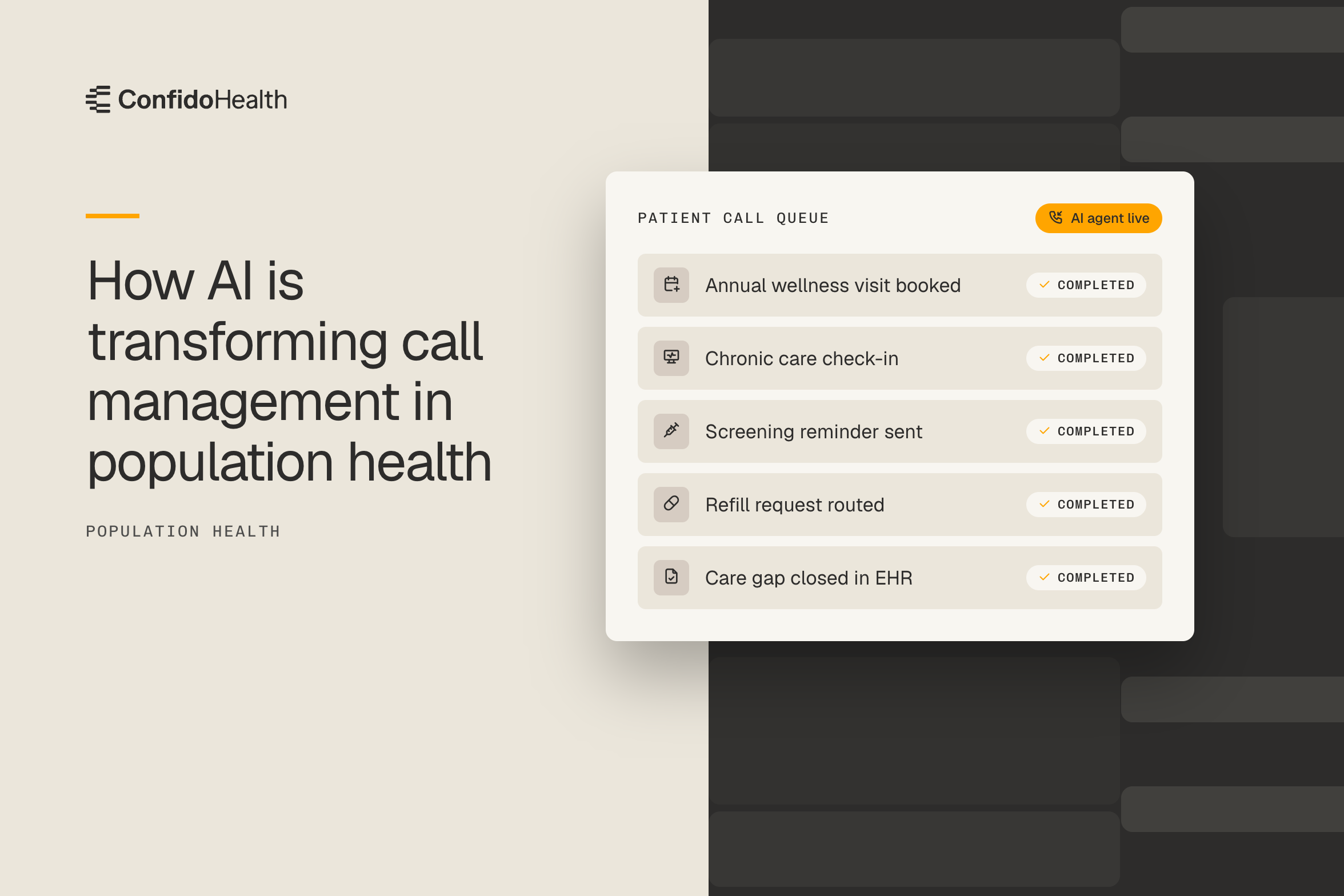

- AI turns patient lists into coordinated outreach, helping healthcare organizations move from identifying care gaps to scheduling and completing care.
- Automated campaigns support preventive screenings, annual wellness visits, chronic care, referrals, and post-discharge follow-ups, with outreach prioritized by patient need and urgency.
- Real-time scheduling, reminders, and repeat outreach help patients take the next step, while EHR/PMS updates keep care teams informed.
- Care teams remain involved when human judgment is needed, including clinical concerns, access barriers, and complex patient requests.
- Confido Health’s AI Voice Assistant supports multilingual outreach and connected workflows, helping teams scale campaigns across specialties and locations.
- Success is measured through completed care and operational outcomes, including closed care gaps, completed visits, referral completion, and staff time saved.
Introduction
Your population health team may know exactly who needs attention. You may have lists of patients overdue for screenings, annual wellness visits, chronic care follow-ups, or vaccinations. But a list alone does not close a care gap. Someone still has to reach each patient and help them take the next step.
The need is enormous. According to Forbes, less than 10% of US adults receive all the high-priority preventive services recommended for them. Now add the outreach required for chronic care, referrals, vaccinations, and post-discharge follow-ups. Even the most organized teams can quickly fall behind.
So, how do you even begin to close care gaps at that scale? This is where AI changes the equation. It turns long patient lists into coordinated campaigns that identify, reach, engage, schedule, and follow up with patients. Instead of simply making more calls, your team can move more patients back into care while focusing on those who genuinely need human support.
What Does Call Management Mean in Population Health
Population health call management is basically how your organization reaches groups of patients who need a specific type of care. It connects patient data with real conversations, scheduling, follow-up, and care coordination. It helps you move from knowing who needs care to actually helping them receive it.
It starts with a specific group of patients
So first things first, you actually need to know who requires outreach. Your organization can use information from your EHR/PMS, claims, scheduling records, referrals, and clinical registries to build that patient list. It might include Medicare patients eligible for an Annual Wellness Visit, people overdue for tests, or patients recently discharged from the hospital.
Patients are prioritized by need and urgency
Does every patient need to be called at the same time? Not really. A patient discharged yesterday will likely need attention sooner than someone who recently became eligible for a routine screening. Your team can organize patients by clinical need, risk, urgency, eligibility, or how long their care has been delayed.
Outreach covers many different care needs
Population health outreach is not just limited to appointment reminders. It can support patients who are:
- Overdue for annual wellness visits
- Due for preventive screenings or vaccinations
- Managing chronic conditions
- Waiting to complete a referral
- Behind on medication-related follow-up
- Recovering after a hospital discharge
- Returning after a missed appointment
The reason for each call can be different. But the larger goal is the same: keep patients connected to the care they need.
Every conversation should make the next step easier
Telling a patient that they are overdue is not always enough. What should they do next? Who should they see? Can they schedule now? A good population health call answers all these questions and helps your patient take action. It could mean booking a visit, confirming a referral, arranging follow-up, or connecting the patient with a care coordinator.
Follow-up continues until there is a clear outcome
What happens if the patient does not answer the first call? They should not simply disappear from the list. Effective call management records every attempt and continues outreach according to your organization’s rules. The workflow ends when the patient completes the next step, declines care, requests a later call, or needs human support.
Success means closing care gaps, not making more calls
A campaign can make thousands of calls and still achieve very little if patients are left unsure about what to do next. That is why call volume alone does not tell you whether your outreach worked. The real questions are: Did the patient schedule? Was the referral completed? Did they attend the visit? Most importantly, did the care gap close?
Why Population Health Outreach Is So Difficult to Scale
Calling a few patients is manageable. Reaching thousands of people, all with different care needs and timelines, is another story. Even a well-organized team can find it difficult to keep every campaign moving.
Every patient needs to be contacted at a different time
Population health work does not arrive in tidy batches. One patient may become eligible for an annual wellness visit today. Another is already overdue for lab work. Someone else was discharged yesterday and needs a follow-up call right away. And your team is expected to manage all these groups at once. Each one comes with different timelines, appointment types, providers, locations, and outreach rules. What looks like a simple list can become complicated real quick.
One call is rarely enough
Patients won’t always answer the first time. They could be at work, driving, looking after their children, or just avoiding a number they do not recognize. Some patients might even hear your voicemail and plan to call back later but forget. Others need to check their schedule or speak with a family member first. This does not mean they are unwilling to receive care. It usually means your team needs to follow up again. That is where things get difficult. Staff make the first call, another urgent task comes in, and the callback gets pushed to tomorrow. Before long, more patients have joined the list, and the team is already behind.
Care coordinators spend too much time trying to reach people
Care coordinators are there to understand patient needs, remove barriers, and help people move through their care. But unfortunately, a large chunk of their day goes into dialing numbers, leaving voicemails, checking schedules, and documenting unanswered and missed calls. It is a pretty poor use of their time and expertise. Instead of coordinating care, they spend hours simply trying to begin the conversation.
Patient information lives in too many places
The information your team needs is rarely available in one place. Your EHR/PMS may show the care gap and manage scheduling, while the campaign list sits in another platform. Referral updates may arrive through a portal or fax, and call outcomes may be tracked in a spreadsheet.
So, who keeps everything connected? Usually, your staff. They move between systems, check patient records, copy updates, and try to ensure every list reflects what is actually happening. Which makes it super easy for something to get missed! A patient may receive another call after already scheduling, a completed referral may still appear open, or a request for help may remain buried in a note that the care coordinator never sees.
The patient list grows faster than the team
Every new campaign brings more calls, callbacks, scheduling tasks, and documentation. But you cannot keep adding staff whenever the outreach list gets longer. Your team does what it can. It starts with the most urgent patients and plans to return to everyone else later. Then another campaign begins, more patients become eligible, and “later” keeps moving further away. At some point, the issue is no longer how hard your staff are working. There are simply more patients to reach than hours available in the day.
Proactive care slowly becomes reactive
When your team falls behind, the most urgent needs naturally take over. Staff respond to immediate concerns, complaints, and approaching deadlines. Meanwhile, preventive screenings wait. Routine monitoring slips. Referrals stay open. Patients who do not seem urgent remain at the bottom of the list until their needs become more serious. That leaves healthcare organizations with a difficult question: how do you keep thousands of patients connected to care without asking an already busy team to keep making more calls?
What Happens When Patient Outreach Falls Behind
Now, a delayed call may look harmless. It’s just a small administrative issue after all. But across a large patient population, those delays compound. This can affect health outcomes, quality performance, staff capacity, and eventually your revenue.
Preventive care gets delayed
Many preventive services depend on patients taking action before they feel unwell. If reminders do not happen, or patients cannot easily schedule after receiving one, screenings and wellness visits may be postponed for months. The care gap remains open even though the organization correctly identified it. Repeated delays also make future outreach harder. The patient list becomes larger, campaigns overlap, and staff must decide which overdue group to address first.
Chronic conditions become harder to manage
Chronic care depends on regular contact. A patient may need monitoring, medication review, lab work, or an office visit before the condition appears to be getting worse. When follow-up is inconsistent, your care team loses opportunities to intervene earlier. Not every missed call causes a clinical problem. But across thousands, inconsistent patient engagement can make chronic disease programs less reliable. Structured outreach gives your team a better chance to keep patients connected to the care plan.
Referrals remain incomplete
Your referrals can stall for many reasons. The specialist may be waiting for records, patients may not understand the next step, the receiving office may not have reached them, or the next available appointment may not fit their schedule. Without follow-up, nobody gets a clear view of what happened. The result is not only a lost appointment. It can also mean delayed diagnosis, poor continuity, and frustration for the patient and referring provider.
Quality metrics decline
Many quality metrics are based on what patients actually complete, not what your team recommends. Identifying an overdue screening, for example, will not improve the related metric until the patient completes it. The same applies to wellness visits, chronic care follow-ups, and referrals.
When outreach falls behind, more care gaps remain open. As a result, your organization may see weaker performance across preventive care, chronic disease management, transitional care, and patient engagement measures. Consistent outreach helps more patients take the recommended next step and ensures every outcome is properly recorded.
Staff burnout increases
Calling patient after patient can be emotionally and mentally draining, especially when most attempts go unanswered. Apart from calling, your staff also manages documentation around every contact. Over time, the combination of dialing, waiting, recording, and retrying leaves less room for work that feels meaningful. This can affect morale across care management, patient access, front desk, and clinical support teams. When an AI Voice Assistant handles routine contact attempts, staff can spend more time speaking with patients who have real questions or need additional help.
Revenue opportunities are missed
Population health is first and foremost about helping people receive the right care at the right time. But when patients repeatedly fall out of the care journey, the effects eventually reach your organization’s revenue too.
Unscheduled annual wellness visits leave appointment capacity unused. Incomplete referrals reduce downstream visits. Missed chronic care follow-ups weaken continuity, while open care gaps can affect performance against quality and utilization goals in value-based arrangements.
Over time, the impact goes beyond immediate revenue. Patients who struggle to get reminders, schedule care, or receive follow-up may begin to see your organization as difficult to navigate. Consistent outreach supports better care, steadier revenue, and the long-term trust patients place in your organization. All three depend on making sure patients do not quietly disappear from the care journey.
How AI Changes Population Health Call Management
The clearest way to understand the role of AI is to follow the workflow from the first patient list to the final documented outcome. Each step builds on the one before it.
AI identifies patients who need outreach
A campaign begins with a defined clinical or operational rule.
For example:
- Medicare patients eligible for an Annual Wellness Visit
- Patients with diabetes overdue for monitoring
- Adults due for a recommended screening
- Patients recently discharged from the hospital
- Patients with an open referral
- Patients who missed a chronic care appointment
- Patients due for a vaccination
The AI Voice Assistant works with EHR/PMS, scheduling, and campaign data to identify the relevant population. This matters because outdated lists create wasted work. If someone has already scheduled, completed the service elsewhere, moved to another provider, or opted out of contact, the workflow should account for that information before outreach begins. A connected system gives the campaign a more accurate starting point.
AI prioritizes outreach based on clinical rules
Not every open care gap carries the same urgency. A post-discharge call may need to happen within a short window. A patient with repeated missed chronic care visits may need earlier attention than someone who recently became due for a routine wellness visit. AI can organize outreach using rules established by your clinical and operational teams.
Those rules may consider:
- Type of care gap
- Length of time overdue
- Patient risk level
- Recent discharge status
- Existing appointments
- Previous outreach attempts
- Preferred language
- Provider or location
- Campaign deadlines
The AI Assistant does not create the clinical policy. Your organization defines it. AI applies that policy consistently across the campaign. This helps your team focus limited human capacity on patients with the greatest need.
AI reaches every patient at scale
Once the population is defined and prioritized, outreach can begin without staff manually working through a call list. An AI Voice Assistant can manage thousands of concurrent calls while keeping each interaction individual. It can address the patient by name, explain the reason for the call, follow approved workflows, and respond naturally to common questions. Scale alone is not enough, though. Patients need to feel that the conversation is relevant and respectful.
Good outreach should account for:
- The reason the patient is being contacted
- The patient’s preferred language
- The appropriate time and frequency of outreach
- Previous responses or failed attempts
- Accessibility needs
- Approved consent and contact preferences
- The correct escalation route
But do remember - the goal is not to flood patients with reminders. It is to stay in contact and give each patient the right set of next steps.
Patients can schedule during the conversation
This is one of the most important differences between a reminder and a complete workflow. If a patient is told to call back later, search for a number, use another portal, or wait for a separate scheduling team, there is a good chance the task will remain unfinished. An AI Assistant connected to the scheduling system can help the patient act while their attention is already on the issue.
It can:
- Find an appropriate provider
- Offer available dates and times
- Apply location preferences
- Follow visit-type rules
- Schedule the correct appointment
- Reschedule an existing visit
- Provide pre-visit instructions
- Send intake forms or confirmations
The patient does not have to begin a second interaction. The conversation moves directly from awareness to action. This is extremely useful for population health campaigns because every added step can reduce completion. Making scheduling part of the outreach call removes one of the most common points of drop-off.
AI follows up until the task is completed
One unanswered call should not remove a patient from the campaign. The AI Assistant can make additional attempts based on your approved outreach plan. It can vary the timing, record each result, and stop when the patient schedules, declines, opts out, or needs staff support.
Follow-up also continues after scheduling. For example, the workflow can send a confirmation, provide preparation instructions, remind the patient before the visit, and re-engage them if they cancel or do not attend. That creates continuity across the entire campaign. Outreach becomes a managed pathway, right from eligibility to completed care.
Every interaction updates the EHR/PMS automatically
Population health programs need reliable documentation. After each conversation, the result should be available to the people responsible for the patient’s care. That may include:
- Successful contact
- Appointment scheduled
- Patient declined
- Call-back requested
- Wrong or disconnected number
- Language preference
- Reported access barrier
- Clinical question raised
- Human follow-up required
- Referral status
- Next outreach date
When this information is written directly into your EHR/PMS or relevant workflow, your staff does not have to re-enter it later. Live updates also prevent duplicate work.
Eventually, your leadership gets a more accurate view as well. Instead of waiting for staff to compile a report, they can see how the campaign is moving in real time.
Care teams focus on patients who genuinely need human support
The final step is not removing people from the workflow. It is bringing them in at the right moment. Routine conversations can be completed by the AI Assistant. Complex needs can be directed to the appropriate person.
A care coordinator may need to step in when a patient:
- Reports a new or worsening symptom
- Has concerns about medication
- Faces transportation or financial barriers
- Does not understand the care plan
- Needs clinical guidance
- Has a sensitive personal situation
- Requires a decision outside the approved workflow
This is where human judgment matters most. So instead of spending the morning making unanswered calls, your team receives a focused worklist of patients who need their attention. Staff have more time to listen, solve problems, and coordinate care.
What an AI-Powered Population Health Campaign Looks Like in Practice
Let’s look at an entire AI workflow execution in a real-world setting. Imagine Elena, Director of Population Health at a multi-location primary care group. Her team has just identified 1,200 Medicare patients who may be eligible for an Annual Wellness Visit. On paper, it looks like a simple outreach campaign. But in practice, Elena knows how much work is hiding behind that list.
Monday morning: Elena receives a list of 1,200 patients
Elena’s team starts with a report showing 1,200 patients who appear eligible for an Annual Wellness Visit. Under a manual process, staff would have to review the list, check patient records, assign calls, and work through each name one at a time.
But first, they need to know whether the list is accurate. Have some patients already scheduled? Did anyone recently complete the visit? Has someone moved to another provider or asked not to receive calls?
The AI Assistant checks the list against current EHR/PMS and scheduling information. Patients who already have the correct appointment are removed from outreach. Incorrect or incomplete records are flagged. Elena’s team now has a cleaner list and avoids calling patients who have already taken action.
The campaign is organized around what each patient needs
The rest of the patients are not treated as one identical group. Some have only recently become eligible. Others are overdue from the previous year. A few missed an earlier visit, while some prefer a particular provider, location, or language.
The AI Assistant organizes patients into the appropriate campaign pathways. Elena and her team decide which groups should be contacted first, how often outreach should happen, and which situations should move to staff.
A newly eligible patient may simply need an explanation of the visit. Someone who missed a previous appointment may need more help finding a suitable time or location. The campaign follows the same overall goal, but the conversations feel relevant to each patient.
By Tuesday, outreach is already underway
The calls begin based on the schedule approved by Elena’s team. When a patient answers, the AI Assistant explains why the organization is calling and what an Annual Wellness Visit involves. It can answer routine questions, confirm basic information, and ask whether the patient would like to schedule.
If the patient prefers another supported language, the conversation can continue in that language. There is no need to place the patient in a separate queue or ask another multilingual staff member to call later.
What about the patients who do not answer? Their outcomes are recorded, and they remain in the approved follow-up sequence. Elena’s team does not have to create another spreadsheet or remember who needs a second attempt.
Interested patients schedule during the same conversation
One of Elena’s biggest frustrations with previous campaigns was the gap between reaching a patient and getting the visit booked. A staff member might leave a message asking the patient to call back. The patient might return the call, wait on hold, and decide to try again later. Even a successful reminder could still end without an appointment.
Now, when a patient is ready, the AI Assistant checks available appointments in the connected EHR/PMS. It follows the organization’s rules for visit type, provider, location, and availability. The patient can choose a suitable time and book the visit during the conversation.
A confirmation and any required instructions follow. The patient does not need to call another number, repeat their information, or complete a separate scheduling journey. For Elena, that is when outreach becomes much more useful: the call ends with a clear next step already in place.
The patients who need more help reach Elena’s team
Most patients only need an explanation and help scheduling. But some conversations are more complicated. One patient cares for a spouse and cannot attend during normal morning hours. Another has transportation concerns. Someone is unsure whether the visit is necessary, while another mentions a clinical issue that should be reviewed by a care team member.
Those cases are escalated to Elena’s team with the relevant context attached. Her care coordinators can see why the patient was contacted, what was discussed, and what kind of help is needed. They do not have to start the conversation from the beginning. More importantly, they are spending their time with patients who genuinely need human understanding and problem-solving, not making repeated calls that go unanswered.
Nonresponders do not quietly disappear from the campaign
By the end of the first round, many patients have scheduled, some have declined, and others have not answered. In a manual campaign, this is often where the work begins to lose momentum. Elena’s team may intend to call every nonresponder again. But new tasks arrive, urgent cases take priority, and the callback list keeps growing.
With the AI Assistant, patients who do not answer stay in the campaign according to the organization’s outreach rules. Another attempt can happen at a different approved time. Wrong numbers, unavailable voicemail, and callback requests are recorded separately.
If repeated attempts are unsuccessful, the patient can move into another approved pathway, such as a text, portal message, letter, or staff review. Every patient has a status and a next step, even when the first conversation does not happen.
Elena can see what is happening while the campaign is running
Previously, Elena might have waited until the end of the week for someone to collect call logs and update a spreadsheet. By then, it was difficult to fix problems without slowing the campaign further. Now, she can follow its progress as it happens. She can see how many patients have been contacted, how many are scheduled, how many need follow-up, and which cases were escalated to staff.
She can also spot problems early. If one location is running out of suitable appointments, her team can respond before more patients are called. If a patient group has a lower response rate, Elena can review the outreach timing or approach. She is no longer looking at call volume alone. She can see whether patients are moving from eligibility to scheduling and, eventually, to completed care.
The campaign continues until the care gap has a clear outcome
Booking an appointment is an important step, but it is not the end of the campaign. Patients can still forget, cancel, or need to reschedule. The AI Assistant continues with confirmations, reminders, rescheduling support, and no-show follow-up. Once a patient completes the visit, the outcome is reflected in the EHR/PMS and campaign reporting. By the end, the original list of 1,200 patients is no longer just a static report. Each patient has a clear outcome: visit completed, appointment scheduled, follow-up pending, care declined, contact information incorrect, or human support required.
For Elena, that is the real difference. Her team does not simply make more calls. It runs a complete campaign in which every patient is tracked, every response leads somewhere, and every unresolved care gap has a clear next step.
Best Practices for AI-Powered Population Health Call Management
AI can increase your outreach capacity, but a successful program still needs clear priorities and well-designed workflows. These practices help keep the technology connected to the outcomes your team actually wants.
Start with your highest-impact patient populations
You do not need to launch every population health campaign at once. Begin with a group where the need is clear, the workflow is repeatable, and the next step can be completed. Annual wellness visits, preventive screenings, chronic care follow-ups, and incomplete referrals are often useful starting points.
Look for campaigns with:
- A well-defined eligible population
- A clear action for the patient
- Enough appointment capacity
- Measurable outcomes
- A known escalation pathway
- Significant manual outreach volume
A focused first campaign makes it easier to test the workflow, train teams, and identify any gaps. Once it works well, you can apply the same operating model to additional populations.
Connect AI with your EHR/PMS and scheduling systems
A disconnected outreach platform can generate activity without completing the work. Deep EHR integration allows the AI Assistant to use current patient information, check appointment availability, schedule the correct visit, document the result, and recognize when the care gap has closed.
Before launching a campaign, confirm:
- Where the patient list comes from
- Which data fields are required
- How eligibility is validated
- Where appointment rules live
- What information must be written back
- How staff will receive escalations
- How completed care will be confirmed
These connections reduce duplicate work and prevent your team from maintaining another isolated list.
Build outreach around clinical workflows
Every campaign should have a clear pathway, not just a message.
For each patient group, define:
- Why the patient is eligible
- What the AI Assistant should explain
- What actions it can complete
- Which questions it can answer
- What requires a warm transfer or staff follow-up
- How many outreach attempts are appropriate
- What counts as campaign completion
Clinical and operational leaders should shape these rules together. The AI Assistant then executes the agreed workflow consistently. It should not improvise clinical policy or make decisions outside the approved pathway.
Measure outcomes, not just outreach activity
Dial volume is easy to measure, but it is not the point of population health.
Your reporting should connect outreach to action. Useful metrics include:
- Contact rate
- Conversation completion rate
- Appointment scheduling rate
- Referral completion rate
- Visit completion rate
- Care gaps closed
- Time from identification to action
- Escalation rate
- No-show rate
- Staff time returned
- Performance by patient segment
- Performance by language, location, or campaign
These measures help you see where the workflow is working and where patients still encounter barriers. For example, a campaign may have a strong contact rate but a low scheduling rate. That could mean appointment availability, timing, or visit instructions need attention. More calls alone will not solve that problem.
Keep care teams focused on exceptions
Your staff should not have to review every completed conversation. Create clear rules for the cases that need human involvement. These may include clinical questions, reported symptoms, complex referral problems, repeated failed outreach, sensitive social needs, or requests outside the approved workflow.
The AI Assistant can complete routine work and present staff with a smaller, more complex queue. That queue should also include the context needed to act. A task that simply says “call patient” sends the coordinator back to the beginning. A useful escalation explains what happened and why human support is needed.
Make the patient experience part of campaign design
Operational scale should never come at the expense of trust. Patients should understand who is contacting them, why the call matters, and what they can do next. The conversation should feel natural and give the patient room to ask questions.
Pay attention to:
- Clear introductions
- Simple language
- Respectful contact frequency
- Language access
- Accurate patient information
- Easy scheduling
- Appropriate transfer options
- Opt-out and consent requirements
- Consistent follow-through
A technically successful call can still fail if the patient feels confused or pressured. Good population health outreach makes care easier to access.
How Confido Health’s AI Voice Assistant Supports Population Health
Confido Health’s AI Voice Assistant can help you run population health outreach as one connected campaign. It takes care of the work right from identifying a care gap to helping the patient complete the visit. All of this while keeping your staff involved whenever a patient needs more personal support.
- Runs large outreach campaigns: Need to contact thousands of patients about wellness visits, screenings, vaccinations, or chronic care? Confido Health’s Voice AI can handle thousands of concurrent calls, so your team does not have to spend weeks working through the same list manually.
- Schedules care during the call: When a patient is ready, Confido Health’s Voice AI can check real-time availability in your EHR/PMS and book the correct visit. It follows your rules for providers, locations, appointment types, and scheduling, so patients do not have to contact another team later.
- Speaks with patients in more than 20 languages: Patients can understand why they are being contacted, ask questions, and move forward in a language they are comfortable using. You do not need a separate callback queue or outreach process for every language.
- Keeps track of patients who do not answer: One missed call should not mean a missed care opportunity. Confido Health’s AI Voice Assistant can try again based on your approved outreach schedule, record each outcome, and stop when the patient schedules, declines, opts out, or requires staff support.
- Closes the gaps between referrals and completed care: Confido Health’s Voice AI can confirm referral details, help patients schedule with the right specialist, send reminders, and follow up when the referral remains incomplete. This gives every open referral a clearer next step instead of leaving it sitting in a queue.
- Keeps patients engaged after they schedule: Booking the appointment is only part of the journey. Confido Health’s AI Voice Assistant can manage confirmations, pre-visit instructions, rescheduling, cancellations, and no-show follow-ups, helping more scheduled visits reach completion.
- Updates the systems your team already uses: Confido Health integrates with more than 40 EHR/PMS and telephony systems, including Epic, athenahealth, eClinicalWorks, ModMed, NextGen, Tebra, RingCentral, Mango Voice, and 3CX. Patient responses, appointments, and escalation needs are recorded without asking staff to update another spreadsheet.
- Brings in your team at the right moment: Most patients may only need a reminder or help finding an appointment. If someone reports a clinical concern, faces an access barrier, or needs support beyond the approved workflow, the conversation moves to the appropriate team member with the context already available.
- Supports patients after discharge: Post-discharge outreach needs to happen quickly. Confido Health’s Voice AI can check whether patients understand their next steps, remind them about follow-up care, help schedule the required appointment, and bring in the care team if a clinical concern comes up.
- Shows you how each campaign is performing: Your leadership team can see who was reached, who scheduled, which patients need another attempt, and where staff support is required. If one group is responding poorly or a location is running short on appointments, you can spot it while the campaign is still active.
- Scales with your organization: Confido Health’s AI Voice Assistant is built to support healthcare organizations ranging from up to 1,500+ providers and 500+ locations. You can keep outreach consistent across teams, specialties, and locations without building a different process for each one.
- Gives staff their time back: Confido Health’s AI Voice Assistant can save four to five staff hours per provider per day across supported administrative workflows. Your team can spend less time dialing numbers and updating callback lists, and more time helping patients who genuinely need their judgment, care, and attention.
The Future of Population Health Management With AI
Population health is still largely built around reports, campaign lists, and scheduled outreach cycles. That will not be enough for much longer. The next generation of AI will help organizations spot needs earlier, respond to changes faster, and shape outreach around what is most likely to help each patient.
AI will help predict care gaps before they grow
Today, teams often act after a patient has already missed a visit, ignored several reminders, or become overdue for care. In the future, AI will help identify the early signs that a patient may be drifting away. A history of missed appointments, delayed refills, incomplete referrals, or unanswered messages could signal that a patient needs help sooner. Instead of waiting for the care gap to widen, your team could step in while it is still easier to address.
Outreach timing will become much smarter
Is there one perfect time to call every patient? Of course not. Some people respond in the morning, while others are much easier to reach after work. Future AI systems will learn from previous contact patterns and help choose the right time, channel, and frequency for each patient. Outreach will feel less like a fixed campaign schedule and more like a conversation designed around when the patient is most likely to engage.
Campaigns will adjust while they are still running
Right now, teams often review campaign performance after the outreach period ends. By then, there may be little they can do about poor response rates or limited appointment availability. Future campaigns will adjust as results come in. If one patient group is not responding, the timing or approach could change. If a location runs out of suitable appointments, outreach could shift toward another location or pause until more capacity becomes available. Teams will be able to improve a campaign while it is happening, not only learn from it afterwards.
AI will help uncover the reason behind an open care gap
A patient may appear in a report as “overdue,” but that label does not explain why. Did they forget? Are they worried about the cost? Are they confused about the referral? Future AI systems will become better at recognizing these patterns across conversations and patient history. That means your team will not simply see that a gap is open. It will have a clearer idea of what is keeping the patient from moving forward and what kind of support may help.
Population health will extend beyond a single organization
Patients often move between primary care, specialists, hospitals, pharmacies, labs, and community services. Yet much of today’s outreach still happens within separate systems. Over time, AI could help coordinate these transitions more closely. A missed specialist visit could alert the referring team. An incomplete lab order could trigger the appropriate follow-up. A community resource could become part of the patient’s care pathway. Population health will begin to feel more connected across the full care journey, not limited to one organization’s campaign list.
Leaders will be able to look ahead, not only report backwards
Most population health dashboards explain what has already happened. Future reporting will also help leaders understand what may happen next. Like: which patient groups are at risk of falling behind? Which campaigns may exceed staff capacity? Which locations may need more support? This kind of forward-looking insight will help organizations plan earlier instead of waiting for problems to appear in the final numbers.
Conclusion
Population health does not improve because your organization has a longer patient list, a better dashboard, or more accurate risk scores. It improves when someone acts on that information. The patient who is overdue for a screening needs to understand why it matters. The person with an open referral needs help reaching the specialist. The recently discharged patient needs a timely check-in. The patient managing a chronic condition needs an easy way back into care. And doing this well across thousands of people is not a small communication task. It’s a whole operational system.
AI gives healthcare organizations the capacity to run that system more consistently. It can identify the right patients, start timely conversations, schedule care, follow up, update the EHR/PMS, and bring staff into the cases where human support matters most.
Confido Health’s AI Voice Assistant turns population health outreach into a connected, end-to-end campaign. Your care teams get time back, your patients get a clearer path to care, and your organization can move from identifying care gaps to closing them. So are you ready to make your population health campaigns easier to run and harder for patients to fall out of? Book a demo with Confido Health today!
FAQs
Why is patient outreach important in population health?
Patient data can show you who needs care, but outreach helps patients act on that information. Timely conversations can bring people back for screenings, wellness visits, chronic care, referrals, and follow-up appointments before needs become more difficult to manage.
How does AI improve population health call management?
AI helps healthcare organizations run outreach campaigns across large patient populations. It can prioritize patients, hold natural conversations, schedule appointments, follow up with nonresponders, document outcomes, and direct complex cases to care teams.
Can AI help close care gaps?
Absolutely! AI can help close care gaps by connecting identification with action. It can contact eligible patients, explain the next step, schedule the right service, continue follow-up, and update the EHR/PMS when the patient completes or declines the recommended action.
Can AI support value-based care initiatives?
Yes. Confido Health’s Voice AI can support value-based care by helping organizations reach more eligible patients and maintain consistent follow-up. This can strengthen preventive care, chronic disease management, referral completion, transitional care, and the workflows behind quality performance.
How should healthcare organizations measure AI-powered outreach?
Healthcare organizations should measure completed outcomes, not only call volume. Useful measures include contact rates, appointments scheduled, visits completed, referrals closed, care gaps resolved, time to action, staff escalations, no-shows, and staff time returned.
How does Confido Health’s AI Voice Assistant support population health programs?
Confido Health’s AI Voice Assistant runs proactive campaigns, schedules patients during conversations, follows up with nonresponders, and writes outcomes back to connected systems. It supports more than 20 languages and brings care teams into conversations that require human judgment.