
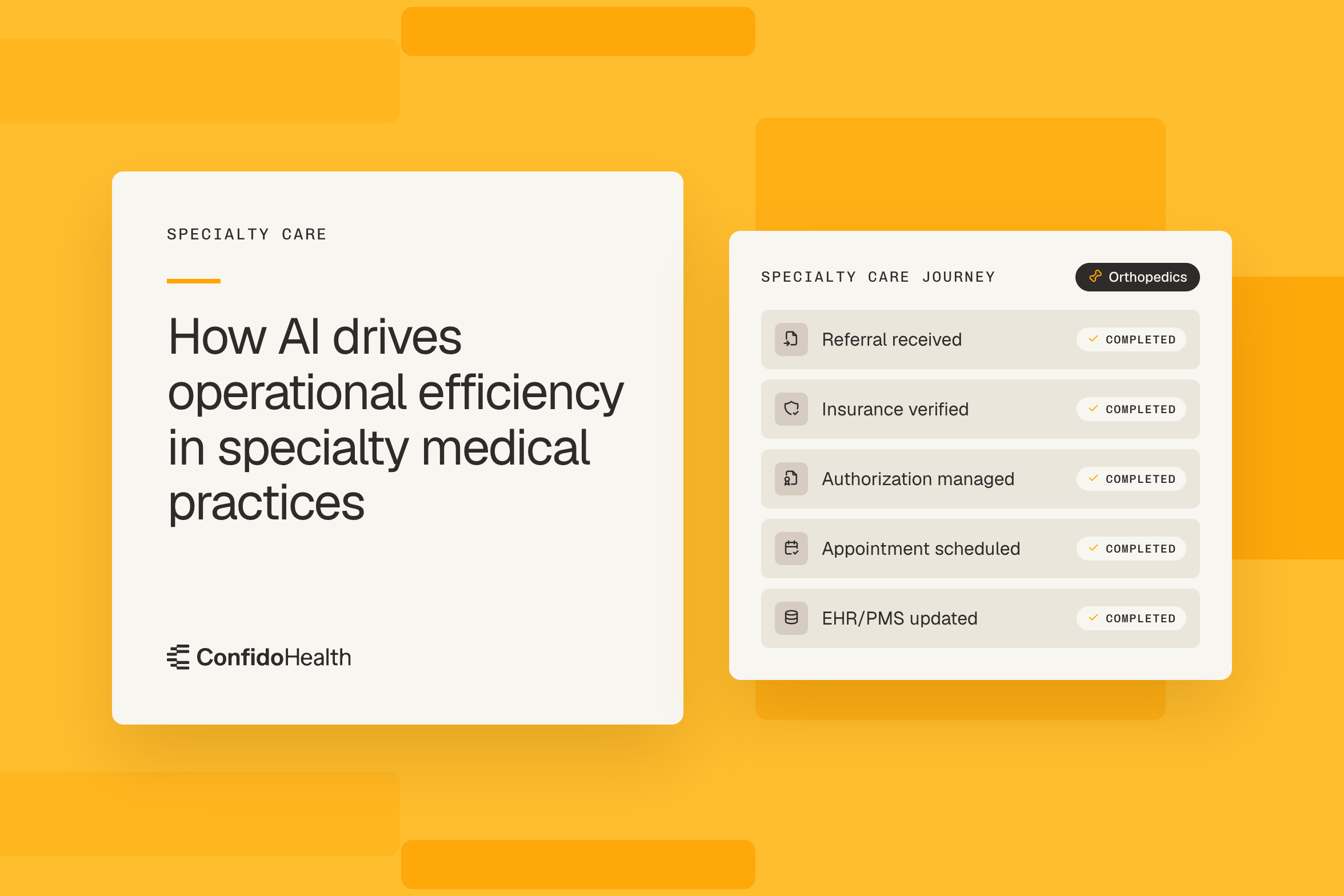

- AI helps specialty practices scale complex administrative workflows, including scheduling, referral coordination, insurance verification, prior authorization, billing communication, and patient follow-up.
- Specialty-specific scheduling rules improve booking accuracy, matching patients with the right provider, location, appointment type, and required resources.
- Connected workflows help reduce referral leakage and administrative delays, supporting timely care, fuller schedules, and stronger revenue performance.
- EHR/PMS and telephony integrations keep patient records updated, reducing duplicate data entry and manual coordination across teams.
- Clinical questions and urgent concerns follow defined escalation pathways, keeping staff involved when patients need human judgment or personal support.
- Confido Health’s AI Voice Assistant provides 24/7 support in 20+ languages, helping specialty groups deliver consistent service across providers and locations.
- Measure success through completed workflows and patient outcomes, including referral conversion, authorization turnaround, scheduling accuracy, staff time saved, and patient satisfaction.
Introduction
Running a specialty practice is getting more expensive, and fast. MGMA reported that median operating costs increased 29.3% over five years. It is not hard to see why. Behind every appointment sits a long list of work, from referrals and records to insurance checks, prior authorization, scheduling, procedure preparation, and follow-up.
Now imagine managing all of that across more providers, locations, and patients. The processes that worked for a smaller practice start to feel stretched. Calls pile up, referrals take longer to move, authorization updates are harder to track, and experienced staff become the people everyone depends on to fix every exception.
So, how do you grow without letting administrative work grow just as quickly? This is where AI can make a real difference. It helps specialty practices handle routine workflows consistently at scale, while your staff stay focused on patients who need judgment, reassurance, or personal support. In this blog, we will look at where specialty operations start to break and how AI can help your practice grow without making care feel less human.
How Specialty Medical Practices Operate Differently
Specialty care is not a single visit and a follow-up. It is a care journey with multiple stages, multiple stakeholders, and multiple points where something can go wrong administratively even when nothing is going wrong clinically. Here is what makes specialty operations distinct:
One Patient Journey Can Involve Several Stages of Care
A gastroenterology patient does not just schedule an appointment. They come through a referral, need a consultation, require a procedure, need pre-procedure preparation instructions, undergo the procedure, require post-procedure follow-up, and may need ongoing monitoring depending on what was found. Each stage involves different scheduling rules, different care team members, and different administrative requirements. Managing that journey well requires coordination across every stage, not just the booking.
Each Specialty Follows Its Own Operating Model
Orthopedics schedules differently from behavioral health. Nephrology coordinates care differently from pain management. Oncology manages patient communication differently from physical therapy. Every specialty has its own clinical protocols, its own scheduling logic, its own documentation requirements, and its own patient communication needs. What works as a standard administrative model in one specialty does not translate directly to another.
Several Clinical and Administrative Teams Share Responsibility
In most specialty practices, patient care is not managed by a single team. Referral coordinators receive and process incoming referrals. Scheduling teams manage the calendar. Authorization staff handle payer approvals. Billing teams manage financial communication. Clinical teams manage the care itself. Each team owns a piece of the patient journey, and the handoffs between them are where administrative continuity most often breaks down.
Small Errors Can Delay High-Value Visits and Procedures
In specialty medicine, the administrative stakes are higher than in primary care because the visits and procedures at risk are more valuable. A colonoscopy appointment can fall through because the prior authorization was not obtained in time. A surgical consultation can be rescheduled because the pre-visit documentation was incomplete. A nephrology follow-up could be missed because the referral never converted to a scheduled appointment. These are not just minor inconveniences. They are revenue events and major care continuity failures.
Patient Questions Are More Detailed and Sensitive
Specialty patients ask more detailed questions than primary care patients. What does this procedure involve? How should I prepare? What does my insurance cover? Some questions are administrative and can be answered right away. Others are clinical, such as questions about medications or symptoms after a procedure, and need to reach the care team quickly, including after hours.
Care May Continue for Months or Even Years
Specialty care can go on for years. A patient managing chronic kidney disease with your nephrology group may be in active care for years. A behavioral health patient may be seen weekly. A pulmonology patient managing COPD needs consistent monitoring and regular follow-up. The administrative relationship does not end after a single visit. It requires ongoing scheduling, ongoing communication, and ongoing care coordination across an extended timeline.
Where Specialty Practice Operations Break Down at Scale
Most breakdowns do not happen overnight. They develop gradually as patient volume grows, locations are added, and the gap between what the administrative infrastructure can handle and what the clinical operation requires quietly widens. Here’s what that looks like in practice.
Growing Call Volumes Overwhelm Patient Access Teams
As your specialty practice grows, the volume of patient calls grows with it. Scheduling requests, referral status inquiries, billing questions, clinical questions, and general inquiries all flow through the same access points. At some scale, the volume exceeds the capacity of your team to answer every call, complete every workflow, and maintain the quality of every interaction simultaneously. Soon missed calls start becoming missed appointments, and eventually missed appointments become missed revenue.
Referrals Arrive Incomplete and Remain Unconverted
Specialty practices receive referrals from multiple sources, in multiple formats, with varying levels of completeness! When referral processing is manual, incomplete referrals create delays while missing information is chased down. Referrals that do not convert to scheduled appointments within a reasonable window convert to referral leakage, where the patient ends up at a different specialty group. And truth be told, for a multi-provider specialty practice, the cumulative revenue impact of referral leakage is substantial.
Provider-Specific Knowledge Becomes Difficult to Manage
In specialty medicine, scheduling decisions are generally provider-specific. For example, a particular physician might perform a specific procedure only on Thursdays. A specialist might prefer new patient consultations in the first half of the day. One provider might just be a pediatric specialist. So, as the number of providers grows, the knowledge required to book appointments correctly expands significantly. And when that knowledge lives primarily in your front desk team's heads, every team member's absence creates a knowledge gap that produces scheduling errors.
Complex Scheduling Rules Lead to Booking Errors
Specialty scheduling involves layered rules that interact in ways that are really easy to get wrong manually. Like, your appointment type determines duration - duration determines which operating room is needed - the room availability intersects with the provider schedule. Even insurance type affects which appointment types are available. When all of these rules are applied manually, errors can happen at each step along the way. This is how errors multiply.
Multi-Location Operations Create Inconsistent Patient Experiences
Specialty groups operating across multiple locations also develop location-specific administrative habits over time. The way referrals are processed at one site differs from the way they are handled at another. The communication protocol for prior authorization delays is handled differently across sites. Patients who interact with multiple locations in your network notice the inconsistency even when they cannot articulate exactly what is different. And eventually, inconsistency erodes organizational trust.
Prior Authorization Delays Appointments and Procedures
Prior authorization is one of the most admin-demanding workflows and one of the most consequential when it falls behind. A procedure that requires authorization cannot be performed without it. If the authorization process is not initiated early enough, or if payer follow-up is not timely, the appointment or procedure is delayed. The patient experience suffers. The provider's schedule develops avoidable gaps, and the revenue that was planned does not materialize on time.
Billing Questions Add Pressure to Administrative Teams
Specialty care generally involves more complex billing situations than primary care. Procedure codes, facility fees, specialist cost-sharing, balance after insurance, and payment plan questions all require knowledgeable, accurate communication. When billing queries flow to the same teams managing scheduling, referrals, and authorization, the combined admin load creates a situation where routine billing communication competes with higher-priority coordination work for the same attention.
After-Hours and Urgent Calls Lack a Consistent Response Pathway
Specialty patients have clinical questions and urgent concerns outside of business hours. A patient experiencing post-procedure symptoms who calls after hours and reaches voicemail is not well-served. A patient with a medication question who reaches only voicemail may wait until morning for a clinician to call back. After-hours coverage in specialty medicine requires a structured, consistent response capability that most specialty practices do not have in place.
Disconnected Systems Create Duplicate Work and Missed Updates
Specialty practices run multiple systems that do not share information automatically. EHR/PMS, scheduling platform, authorization tracking, billing system, and patient communication tools may all operate with partial connections that require manual bridging. Every manual connection between systems is a step where information can be lost, delayed, or entered incorrectly.
The Wider Impact of Operational Inefficiency
Now, operational inefficiency in specialty medicine is not just an admin problem. It creates consequences that reach your patients, your clinical teams, your revenue, and your organizational reputation. Here is the fuller picture of what happens when specialty operations cannot keep pace with clinical demand.
Patients Wait Longer to Receive Specialty Care
When referral processing is slow and scheduling errors require rescheduling, the time between a patient's referral and their first specialty appointment grows. For patients with time-sensitive conditions, administrative delays have clinical consequences. For those who experience poor patient access, the impression of your organization is shaped by the wait before any clinical care has even started.
Referral Leakage Interrupts Continuity of Care
A referral that does not convert to a scheduled appointment does not stay in your system waiting for follow-up. More often than not, it is redirected. The patient calls another specialist, and the referring provider routes their next similar referral to a different group. Referral leakage is both a clinical problem, because it interrupts the care continuity the referring provider intended, and a financial one, because the specialist visit revenue that should have come to your practice goes elsewhere.
Avoidable Cancellations Leave Schedules Underused
Cancellations in specialty medicine often result from administrative failures rather than patient preference. A patient who was not properly reminded about their appointment. A patient who was not informed about their preparation requirements until the day before. A patient whose insurance issue was not resolved until they arrived, at which point the appointment could not proceed. These are recoverable problems with better administrative infrastructure.
Administrative Delays Weaken Revenue Performance
Every administrative delay that affects a clinical workflow eventually shows up in your revenue cycle. Delayed authorizations mean delayed procedures. Delayed billing communication means delayed payments. Incomplete referral processing means revenue that was anticipated does not materialize on schedule. The revenue cycle in specialty medicine is only as strong as the administrative workflows that feed it.
Staff Burnout and Turnover Increase
Your administrative teams may be working as hard as they can and still feel like they are falling behind. Calls keep coming in, referral lists keep growing, and too much of the day goes into chasing updates or repeating manual tasks.
Over time, that pressure takes a real toll. People feel overwhelmed, the work becomes harder to manage, and experienced employees begin to leave. Replacing them is costly, but the practice also loses the knowledge they carried. Often, the real problem is not the team. It is that the practice has grown faster than the systems supporting it.
Inconsistent Service Damages Patient Trust
In specialty medicine, patients are often anxious. They are dealing with conditions that affect their quality of life. They are navigating complex insurance requirements. They are managing care across multiple providers. When the administrative experience around that care is inconsistent, difficult, or unresponsive, it adds stress to an already stressful situation. Patients who lose confidence in the administrative operation of your practice are more likely to seek care elsewhere.
What AI-Powered Operational Efficiency Actually Means
AI in specialty medicine is not just a phone answering service with smarter call routing. It is an operational layer that understands the specific context of specialty care, applies your clinical and administrative rules to every patient interaction, and completes the workflows behind those interactions automatically. Here is what that distinction looks like in practice:
AI Understands the Reason Behind Each Patient Interaction
A patient calling your orthopedic practice is not just a caller. They are potentially a new patient from a referral, an existing patient with a post-surgical question, or a patient calling about a scheduled procedure. AI that understands specialty context can identify the nature of the interaction and handle it through the appropriate workflow rather than routing everything through a generic scheduling queue.
Approved Operational Rules Guide Every Conversation
Your scheduling rules, your authorization requirements, your provider preferences, your documentation protocols, and your communication standards are all encoded into the AI workflow. Every patient interaction follows the rules your organization has defined rather than depending on individual staff members to apply those rules consistently from memory.
Patient Requests Lead Directly to Completed Actions
AI does not capture requests and create tasks for your team to complete later. It completes the actions during the interaction. The appointment is confirmed. The authorization check is initiated. The insurance verification result is written to the patient record. The referral is routed and tracked. The workflow is done, not started.
Inbound and Outbound Workflows Remain Connected
Specialty operations require both inbound handling, the calls and requests that patients and referring providers initiate, and outbound coordination, the follow-up, recall, authorization tracking, and proactive communication that your team needs to initiate. AI manages both within a connected operational infrastructure rather than treating them as separate functions.
Information Moves Into the EHR/PMS in Real Time
Every interaction outcome is recorded in your clinical and operational systems during the interaction that generates it, not after your team finds time to update records manually. Your systems always reflect current reality.
Routine Work Continues Without Manual Follow-Up Lists
Authorization follow-up, referral tracking, appointment reminders, recall outreach, and post-visit communication all happen automatically based on triggers in your clinical and scheduling data rather than depending on someone maintaining and working through a manual follow-up list.
Clinical and Complex Cases Reach the Right Staff Member
AI identifies the interactions that require human involvement and routes them to the appropriate team member, with the relevant context already captured so the handoff is smooth rather than requiring the patient to repeat themselves.
Every Location Follows a More Consistent Operating Process
The same scheduling rules, the same communication protocols, the same authorization workflows, and the same patient experience standards apply at every location in your network simultaneously, without depending on individual location teams to apply them consistently from training alone.
How AI Supports the Specialty Care Journey End to End
Let’s follow one patient through the complete journey. Daniel has persistent knee pain, and his primary care provider refers him to a multi-location orthopedic group. Here is how AI keeps each administrative step moving from referral to ongoing care.
1. Referral received: Daniel’s referral arrives by fax and is matched with his patient record. AI identifies the reason for referral and opens the correct orthopedic workflow.
↓
2. Documents checked: The referral is reviewed for the records needed before scheduling. AI notices that Daniel’s imaging report is missing and flags it immediately.
↓
3. Missing information collected: AI contacts the referring office through the approved process and follows up for the missing report. The referral does not sit unnoticed in a pending queue.
↓
4. Right specialist identified: Daniel is matched with a provider based on his condition, insurance, preferred location, and the group’s provider-specific rules. He is not just booked with whoever has the first opening.
↓
5. Insurance verified: AI checks Daniel’s eligibility and relevant benefits before the appointment is confirmed. Any coverage issue is identified early instead of being discovered at check-in.
↓
6. Authorization managed: If Daniel needs an MRI or procedure that requires authorization, AI initiates the approved workflow and tracks the status. Denials or unusual payer requests are sent to staff for review.
↓
7. Appointment scheduled: AI checks real-time availability in the EHR/PMS and offers Daniel suitable options. He selects a time, and the correct appointment is booked during the conversation.
↓
8. Pre-visit preparation completed: Daniel receives his intake forms, imaging instructions, and appointment details at the right time. AI tracks completion and follows up if anything is still missing.
↓
9. Appointment confirmed: An appointment reminder is sent before the visit, and Daniel can confirm, cancel, or reschedule without calling the front desk. If a slot opens earlier, he can also be contacted through the waitlist workflow.
↓
10. Visit completed: Daniel sees the orthopedic specialist, and the next step in his care plan is recorded. This might include physical therapy, further imaging, medication, a procedure, or another visit.
↓
11. Follow-up coordinated: AI contacts Daniel with approved follow-up information and helps him schedule the next appointment. Any clinical concern is passed to the appropriate care team member.
↓
12. Routine requests managed: If Daniel later calls about a refill, bill, payment, or appointment, AI understands the request and opens the correct workflow. Staff step in only when clinical or financial judgment is needed.
↓
13. Ongoing care maintained: When Daniel becomes due for another assessment, AI begins the recall outreach and helps him schedule. If he does not answer, follow-up continues according to the practice’s approved rules.
↓
14. Every outcome recorded: Referral progress, appointments, patient responses, pending tasks, and escalations are updated in the EHR/PMS. Your team can see where Daniel is in the journey without checking several disconnected lists.
This is what end-to-end support looks like. AI does not handle one isolated step and leave your staff to connect the rest. It keeps the administrative journey moving while your team stays available for the moments that genuinely need human judgment and care.
How Different Specialty Operating Models Use AI
No two specialties run on the same operational model. The workflows that define gastroenterology operations look different from those in behavioral health, and the scheduling logic in orthopedics differs from what nephrology requires. AI that is built for specialty medicine accommodates these differences.
Procedure-Intensive Specialties
Gastroenterology, orthopedics, urology, ophthalmology, and pain management share a common operational challenge: complex procedure scheduling that requires coordination across providers, rooms, equipment, preparation protocols, and authorization workflows. AI manages this coordination automatically, ensuring that every procedure appointment is correctly resourced, authorized, and prepared for before the patient arrives.
Chronic Care Specialties
Nephrology, cardiology, pulmonology, and endocrinology serve patient populations who need consistent, longitudinal engagement. AI maintains that engagement through regular follow-up outreach, recall management, care gap identification, and the kind of ongoing patient communication that supports adherence and prevents the acute episodes that come from lapses in chronic disease management.
Referral-Heavy Specialties
Neurology, rheumatology, and oncology receive high volumes of referrals from primary care and other specialties. The operational challenge is converting those referrals to scheduled appointments quickly and completely, without the leakage that occurs when referral processing is slow or inconsistent. AI manages referral intake, documentation collection, patient outreach, and scheduling in a connected workflow that dramatically improves referral conversion rates.
High-Frequency Care Specialties
Physical therapy, behavioral health, and chiropractic care operate on high visit frequencies with ongoing scheduling demands. AI handles the scheduling cycle for these high-frequency care relationships without requiring manual rebooking at every appointment.
Multi-Location Specialty Networks, Hospital-Owned Specialty Groups, and Enterprise Specialty Networks
For organizations operating specialty care across multiple sites, AI creates the operational consistency that manual processes just can’t sustain across locations. Every site follows the same appointment scheduling rules, the same communication protocols, and the same authorization workflows. Leadership has real-time visibility across every location simultaneously.
How to Introduce AI Into a Specialty Medical Practice
Bringing AI into your practice does not mean changing everything at once. The best approach is to start with one real operational problem, get the workflow right, and expand when your team can clearly see that it is working.
Step 1: Choose one problem worth solving
Start with the workflow creating the most frustration for your team. It might be referral follow-up, prior authorization, appointment scheduling, or after-hours calls. Choose something that takes up significant time and has a clear outcome you can measure.
Step 2: Write down how the workflow actually works
Your staff already follow dozens of rules, even if those rules are not formally documented. Capture the provider preferences, scheduling requirements, payer rules, communication steps, and common exceptions. You may also discover that different people or locations have been handling the same task differently.
Step 3: Connect AI with your existing systems
AI can only complete the work when it is deeply integrated with your EHR/PMS and telephony systems. Without those connections, it may answer a question but still leave your staff to schedule the appointment, update the record, or create the next task manually.
Step 4: Decide when your staff should step in
Be clear about what AI can handle and what should always reach a person. Clinical questions, urgent concerns, sensitive conversations, and situations outside the approved workflow need a defined path to the right team member. Your staff should receive the context so the patient does not have to start again.
Step 5: Test both everyday and unusual situations
Do not test only the easiest calls. Check common requests, complicated scheduling cases, missing referral information, unusual payer rules, and failed authorization scenarios. This helps you see whether the workflow works in real practice, not just under ideal conditions.
Step 6: Start small and measure what changes
Begin with one workflow, team, or location and compare the results with your starting point. Look at measures such as response time, referral conversion, authorization turnaround, scheduling accuracy, staff hours saved, or completed workflows. Ask your staff what feels easier and where they still see friction.
Step 7: Improve the model before expanding it
Use what you learned to fix unclear rules and strengthen the workflow. Once the process works consistently, you can add another workflow or location. This matters because expansion magnifies whatever is already there, including both the strengths and the unresolved problems.
How to Measure Operational Efficiency at Scale
You need more than call volume to understand whether AI is improving your operations. The right metrics show whether patients are getting through, workflows are being completed, staff are getting time back, and available capacity is being used more effectively.
- Patient access and answered call rates: Track how many patient calls are answered and how many are lost to long hold times, voicemail, or abandonment.
- First-interaction resolution: Measure how often patients leave the first conversation with their request fully completed, without needing a callback or another transfer.
- Referral-to-appointment conversion: Monitor how many received referrals turn into scheduled appointments. A higher conversion rate means fewer patients are being lost between referral and care.
- Time from referral receipt to scheduling: Track the number of hours or days between receiving a referral and confirming the appointment. This reveals whether referrals are moving or sitting in administrative queues.
- Scheduling accuracy: Review whether patients are booked with the correct provider, location, appointment type, duration, and required resources.
- Prior authorization turnaround time: Measure how quickly authorization requirements are identified, requests are initiated, and decisions are received before the scheduled service.
- Cancellation and no-show rates: Compare cancellation and no-show rates before and after introducing confirmation, reminder, rescheduling, and follow-up workflows.
- Waitlist backfill success: Track how often canceled appointments are filled before they become unused provider time.
- Provider schedule utilization: Measure how much available clinical time is filled with correctly scheduled appointments. This gives you a clearer view of whether operational improvements are creating usable capacity.
- Workflow completion and escalation rates: See how many routine interactions are completed end to end and how many reach staff for further support. Escalations should reflect genuine exceptions, not unfinished routine work.
- Staff hours returned: Calculate how much time staff are no longer spending on repetitive calls, manual updates, callback lists, and routine follow-up.
- Patient satisfaction: Track how patients rate scheduling, responsiveness, clarity, and the overall administrative experience.
- Multilingual access: Review response, scheduling, and completion rates across supported languages to ensure language access continues throughout the full workflow.
- Revenue recovered through completed workflows: Measure revenue connected to improved referral conversion, fewer cancellations, successful waitlist backfills, faster authorizations, and better schedule utilization.
Taken together, these metrics show whether the AI infrastructure you implemented is producing real operational change. The goal is not simply to complete more interactions. It is to help more patients move through care while giving your staff and providers more usable capacity.
How Confido Health's AI Voice Assistant Helps Specialty Practices Scale
Confido Health's AI Voice Assistant is built for the operational reality of specialty medicine, where the workflows are complex, the patient populations are diverse, and the stakes of administrative failure are higher than in general practice settings. Here is what it delivers for specialty organizations:
Answers Patient Calls Around the Clock
New patient inquiries, referral status calls, and scheduling requests are handled the moment they come in. Clinical questions, such as medication or post-procedure concerns, go to the care team, and urgent calls escalate to the on-call provider according to the practice’s protocols.
Handles Complex Scheduling Across Providers and Locations
Specialty scheduling rules, provider-specific preferences, procedure resource requirements, and multi-location availability are all applied automatically during every scheduling interaction. Bookings are accurate. Errors that require rescheduling are reduced. Provider schedules are utilized more fully.
Coordinates Referrals From Intake Through Appointment Completion
Referrals are received, classified, and processed automatically. Missing documentation is collected through AI-initiated outreach. Patients are contacted to schedule their specialist appointment. Referral completion is tracked until the appointment is confirmed. Referral leakage decreases because the coordination process does not depend on manual follow-up.
Supports Eligibility Verification and Prior Authorization
Insurance eligibility is verified in real time during the scheduling interaction. Authorization requirements are identified at the point of scheduling, and the initiation process begins automatically. Payer follow-up is managed within the authorization workflow. Your revenue cycle starts clean because the front-end processes that determine billing accuracy are executed consistently.
Manages Billing, Payments, and Patient Responsibility Questions
Billing queries, balance explanations, coordination of benefits questions, and payment plan discussions are handled through natural AI conversations connected to your billing data. Your billing team focuses on complex accounts and exceptions rather than routine patient financial communication.
Supports Refill, Recall, and Reactivation Workflows
Prescription refill requests are captured and routed accurately. Recall outreach runs continuously based on your clinical protocols. Lapsed patients receive reactivation communication that makes re-engagement easy and includes scheduling capability within the interaction.
Provides After-Hours Support and Escalates Urgent Concerns
Routine after-hours patient requests are handled completely without voicemail as the default. Urgent calls are identified and escalated to the appropriate clinical team member through a defined pathway. Your patients are never left without a response outside of business hours.
Communicates Naturally in More Than 20 Languages
Every patient in your diverse specialty population receives the same quality of administrative support in the language they are most comfortable with. Multilingual capability is built into the system natively across more than 20 languages.
Integrates With More Than 40 EHR/PMS and Telephony Systems
Native integrations with Epic, Athenahealth, eClinicalWorks, ModMed, NextGen, Tebra, and others, plus telephony integration with RingCentral, MangoVoice, 3CX, and others, mean every workflow outcome is written to your systems in real time without manual data entry.
Supports Organizations With 10 to 1,000 Plus Providers Across 10 to 500 Plus Locations
Confido Health's AI Voice Assistant handles thousands of concurrent patient interactions simultaneously, maintaining consistent quality across single-specialty practices and large multi-specialty enterprise networks.
Returns Four to Five Staff Hours Per Provider Per Day
By handling the routine administrative volume that currently consumes your team's time, Confido Health's AI Voice Assistant returns meaningful administrative capacity that your staff can direct toward the complex coordination, patient relationships, and higher-value work that genuinely benefits from their expertise.
Conclusion
AI in specialty medicine does not change the clinical work. It changes the operational work that surrounds it. Every referral converted instead of leaked. Every authorization obtained instead of delayed. Every patient reached instead of lost between visits. Every location running the same process instead of developing its own variation. These are operational improvements with clinical and financial consequences that compound over time.
The specialty groups that build this operational infrastructure now are the ones that will scale most effectively, retain patients most reliably, and perform most strongly on the quality and revenue metrics that specialty medicine increasingly depends on. The technology exists - the integrations are built, and the workflows are proven!
If your specialty practice is managing the kind of operational complexity described above and you are ready to see what it looks like when that complexity is handled automatically at scale, book a demo with the Confido Health team today! See it running. Ask the hard questions. Find out what your specialty operation looks like when it finally has the infrastructure it deserves.
FAQs
How can AI improve efficiency in a specialty medical practice?
AI handles the high-volume, complex administrative workflows that specialty practices manage every day, including scheduling, referral coordination, prior authorization, insurance verification, billing communication, and patient follow-up. By completing these workflows automatically during patient interactions and updating your EHR/PMS in real time, AI reduces the manual coordination burden on your team and improves the consistency of every administrative process across your organization.
Which specialty practice workflows can AI support?
Confido Health's AI Voice Assistant supports the full range of specialty administrative workflows, including new patient intake, referral processing and conversion, insurance eligibility verification, prior authorization initiation and follow-up, procedure and appointment scheduling, pre-visit preparation communication, post-visit follow-up, prescription refill routing, billing communication, recall and reactivation outreach, and after-hours patient support.
Can AI manage complex specialty scheduling rules?
Yes! Confido Health's AI Voice Assistant applies provider-specific scheduling rules, procedure resource requirements, appointment type logic, and multi-location availability constraints automatically during every scheduling interaction. Specialty scheduling decisions that currently depend on staff institutional knowledge are encoded into the AI workflow and applied consistently at scale.
Can AI support insurance verification and prior authorization?
Yes. Insurance eligibility is verified in real time during scheduling interactions, and prior authorization requirements are identified automatically at the point of booking. Authorization requests are initiated without staff involvement for routine cases, and payer follow-up is tracked within the authorization workflow. Confido Health's Voice AI integrates with 40+ EHR/PMS systems to write verification and authorization outcomes directly to patient records.
Is AI suitable for multi-location specialty practices?
Absolutely! Confido Health's AI Voice Assistant is specifically designed for multi-location specialty organizations, applying consistent scheduling rules, communication protocols, and operational standards across every location simultaneously. Leadership gets real-time operational visibility across the entire network, and patients receive a consistent experience regardless of which location they contact.