

- This guide is for COOs and Practice Administrators at multi-location groups with 10 or more providers who are watching review scores slip without a clear reason.
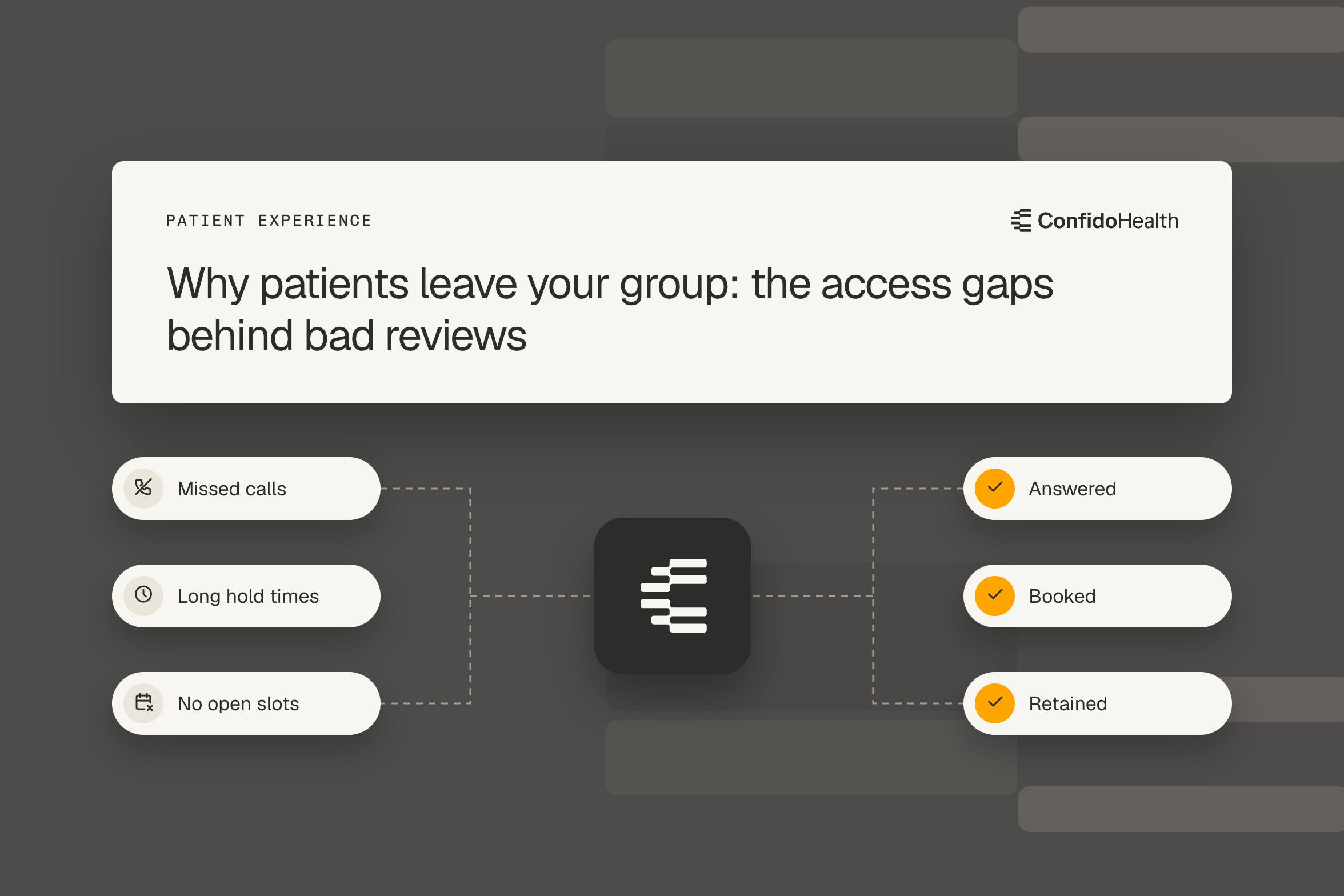
- Most bad reviews are not about clinical care. They are about getting through: calls nobody answers, appointments patients cannot change, bills nobody explains, and referrals that go silent.
- Below are the 7 access gaps that show up most in patient complaints, what each one costs a group, and how groups close them, with results from Confido Health customers.
- The fix starts with reading reviews as operational data, sorted by gap and by location.
Introduction
A COO at an 18-location group reads the month's new Google reviews. 2 sites dropped below 4 stars. The complaints are not about the doctors. "Called 4 times, no answer." "Could not reschedule without taking time off work." "Got a bill I did not understand and nobody called back." "My referral sat for 3 weeks."
The clinical team is doing its job. The patient never got far enough to notice. Every one of those reviews describes something that happened before the visit or after it, on the phone, in a text that never came, or in a voicemail box that filled up at 5 p.m.
That is the pattern behind most patient churn at multi-location groups. Patients do not leave because of a single bad visit. They leave because getting care took too much effort, and they say so in public. This guide walks through the 7 access gaps behind those reviews and how groups close each one.
The 7 Access Gaps Behind Bad Reviews
1. Calls nobody answers
What patients say
"I called 4 times." "Went straight to voicemail." "On hold for 20 minutes, then it hung up."
What it costs
Every unanswered call is a patient who may book somewhere else. At group scale, the leak hides inside daily volume: no single site looks broken, but missed calls add up across every location.
How groups close it
Answer every call, during and after hours, and resolve routine requests on the first call. Before Confido Health, Formé Medical Center, a primary care, urgent care, and women's health practice, was missing 20 to 30% of incoming calls. Its AI Teammates now answer during and after hours and resolve 60% of inbound calls without staff. Alpha Dental, a multi-location dental group, reached a 91% inbound answer rate across locations.
2. Appointments patients cannot change
What patients say
"Had to call during work hours just to reschedule." "Easier to just not show up."
What it costs
A patient who cannot reschedule often becomes a no-show, which costs the slot, the provider hour, and frequently the patient.
How groups close it
Let patients confirm, cancel, or reschedule in the same call or text that reminds them, and send the open slot to the waitlist. Dallas Renal Group, a 51-location nephrology network, reached 60 to 70% appointment confirmation through AI confirmation calls and cut no-shows by 50%.
3. Silence after hours
What patients say
"Nobody picks up after 5." "Left a message Friday, heard back Tuesday."
What it costs
Patients who need care tonight go to another clinic, an urgent care, or the emergency room, and they remember who did not answer.
How groups close it
Answer after-hours calls with the same standard as daytime calls: book what can be booked, and escalate urgent symptoms to the on-call provider according to the group's own protocols. See our guide to AI answering services for urgent care.
4. Bills nobody explains
What patients say
"Got a bill I did not expect." "Called billing 3 times, nobody could tell me what it was for."
What it costs
Confusing balances age into collections and turn a good clinical visit into a 1-star review weeks later.
How groups close it
Explain the statement line by line on the call, offer a payment plan in the same conversation, and follow up before the balance ages. A 70-location ophthalmology group using Confido Health handled 58,000+ financial services calls in 11 months, and its monthly collections grew to more than 3 times prior levels.
5. Not being understood
What patients say
"Nobody spoke Spanish." "They kept transferring me until I gave up."
What it costs
Patients who cannot get through in their own language book less, show up less, and rarely say why. They just leave.
How groups close it
Serve patients in their language from the first ring, across every workflow, not just a greeting. An 11-location FQHC launched English and Spanish confirmation calls from day 1, with parent-and-guardian logic for pediatric visits. 80% of AI-confirmed patients showed up, a 10% higher show-up rate than staff-made confirmation calls.
6. No follow-up after a missed visit
What patients say
"Missed one appointment and never heard from them again."
What it costs
A missed visit without follow-up is how patients quietly leave a practice. The next sign is a review written months later, or nothing at all.
How groups close it
Call the same day to rebook, and run recall for patients overdue on preventive or chronic care. Formé recovers 50 to 60 patients a month through recall outreach. Dallas Renal Group recovers $30,000+ in revenue each month from missed patients. See our guide to AI use cases that reduce no-shows.
7. Referrals that go silent
What patients say
"My doctor referred me 3 weeks ago and nobody called." "Had to chase the referral myself."
What it costs
A referral that never becomes a visit loses the patient and strains the relationship with the referring office that sent them.
How groups close it
Take every faxed and phoned referral to a booked visit: read the fax, call the referring office for missing details, check coverage, call the patient, and update the referrer. See our guide to referral management software.
How to Read Your Reviews as Operational Data
- Pull 90 days of reviews by location. Include Google, CG-CAHPS comments, and any internal complaint log.
- Tag each complaint to one of the 7 gaps. Most will fit. The ones that do not are usually about clinical care, and those belong to a different review.
- Match the tags to your phone data. Answer rate, abandonment, after-hours volume, and confirmation rate by site usually line up with where the complaints cluster.
- Fix the largest gap at the lowest-rated sites first. Then measure reviews and access data again in 60 days.
- Track access weekly, not quarterly. Survey and review scores lag. Answer rate and confirmation rate move first.
What We Have Learned Closing Access Gaps
The complaints point to the workflow
When Dallas Renal Group analyzed more than 15,000 historical calls, most volume came from repeatable workflows: scheduling, confirmations, and routine questions. The complaints patients write tend to follow the same pattern.
Most groups have no documented process to fix
Formé had 12 to 15+ appointment types and no documented scheduling rules. A 70-location ophthalmology group had no written billing scripts. Closing an access gap often starts with defining the process before automating it.
Start with one gap, then expand
Every large Confido Health deployment started with one workflow, proved it in a pilot, then scaled across locations. Dallas Renal Group expanded to all 51 locations after its pilot showed results.
AI can outperform the old process on experience
At the 11-location FQHC, AI confirmation calls produced a higher show-up rate than calls made by staff. A consistent conversation, every time, in the patient's language, is itself a better experience.
How Confido Health Closes Access Gaps
Confido Health is the AI system of action for healthcare operations. Its AI Teammates close all 7 gaps on one platform, inside the EHR, PMS, and phone systems a group already runs:
- Answer every call, during and after hours, and resolve routine requests on the first call
- Confirm, reschedule, and backfill appointments in the same conversation
- Escalate urgent after-hours calls according to the group's own protocols
- Explain bills, enroll payment plans, and follow up on balances
- Serve patients in 20+ languages across every workflow
- Rebook missed visits the same day and run recall
- Take faxed and phoned referrals to a booked visit
Every outcome writes back to the EHR or PMS, and leaders see answer rates, confirmation rates, and resolution by location every week, well before the next review or survey cycle. Confido Health is live across 1,000+ locations, and is HIPAA compliant and SOC 2 Type II certified.
Find the Gaps Behind Your Reviews
Running 10+ locations or providers? Send us your answer rate, abandonment rate, and recent reviews by location, and we will show you which access gaps are driving your lowest-rated sites and which Confido Health would close first.
Book a demo or browse our specialty webinars.
Frequently Asked Questions
Why do patients leave a medical practice?
Most patients leave because getting care takes too much effort: unanswered calls, appointments they cannot change, unexplained bills, and no follow-up after a missed visit. Confido Health closes these access gaps across every location on one platform.
Are bad reviews usually about clinical care?
Often not. Many complaints describe what happened before or after the visit, on the phone or in billing. Tagging reviews by access gap usually shows where the fix is operational.
How does Confido Health improve patient reviews?
Confido Health AI Teammates answer every call, reschedule on the spot, explain bills, serve patients in their language, and follow up after missed visits, which removes the problems patients most often complain about.
Can AI give patients a better experience than staff on the phone?
For routine calls, it can. At an 11-location FQHC, AI confirmation calls produced a 10% higher show-up rate than calls made by staff, with consistent bilingual conversations every time. Staff stay available for the calls that need a person.
What should we measure to catch access problems early?
Track answer rate, call abandonment, after-hours volume, confirmation rate, and no-show rate weekly by location. Confido Health reports each of these, so leaders see problems before they show up in reviews.
Does Confido Health work alongside our survey or review platform?
Yes. Survey and review platforms measure the experience. Confido Health runs the access workflows that shape it, and gives you weekly operational data to explain what the scores show.
Which access gap should we fix first?
Start with the gap behind the most complaints at your lowest-rated sites. For most groups, that is unanswered calls or rescheduling. Confido Health typically starts there and expands to billing, recall, and referrals.
Does Confido Health replace front desk staff?
No. AI Teammates take the repeatable calls, so front desk teams spend their time on patients in the office and on the calls that need a person.
Is Confido Health HIPAA compliant?
Yes. Confido Health is HIPAA compliant, SOC 2 Type II certified, and signs a Business Associate Agreement with every customer.