
- Insurance eligibility verification should confirm active coverage, the correct payer, secondary insurance, service-specific benefits, visit limits, authorization requirements, and patient costs before the visit.
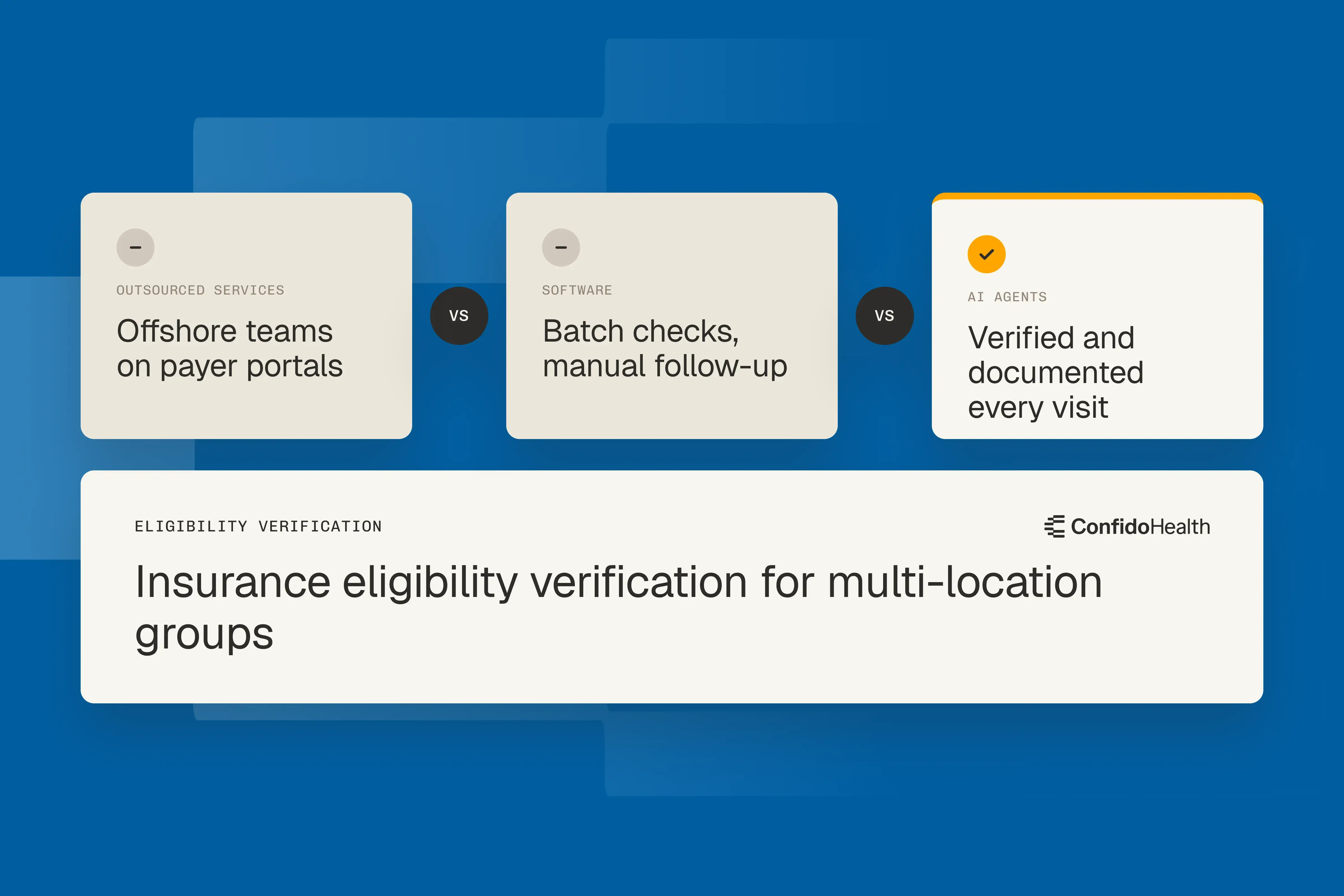
- Verification software retrieves coverage data, outsourced services add manual follow-up, and AI agents resolve gaps through payer calls, patient outreach, and updates to the patient record.
- AI agents work alongside existing eligibility tools, recheck coverage before later visits, and escalate complex cases to staff with the relevant context.
- Multi-location groups need verification rules tailored to each location, provider, and specialty, including therapy visit limits, dental benefits, and Medicaid coverage changes.
- Confido Health connects eligibility verification with prior authorizations, fax processing, denial resolution, and patient collections, writing results directly into existing EHR and practice management systems.
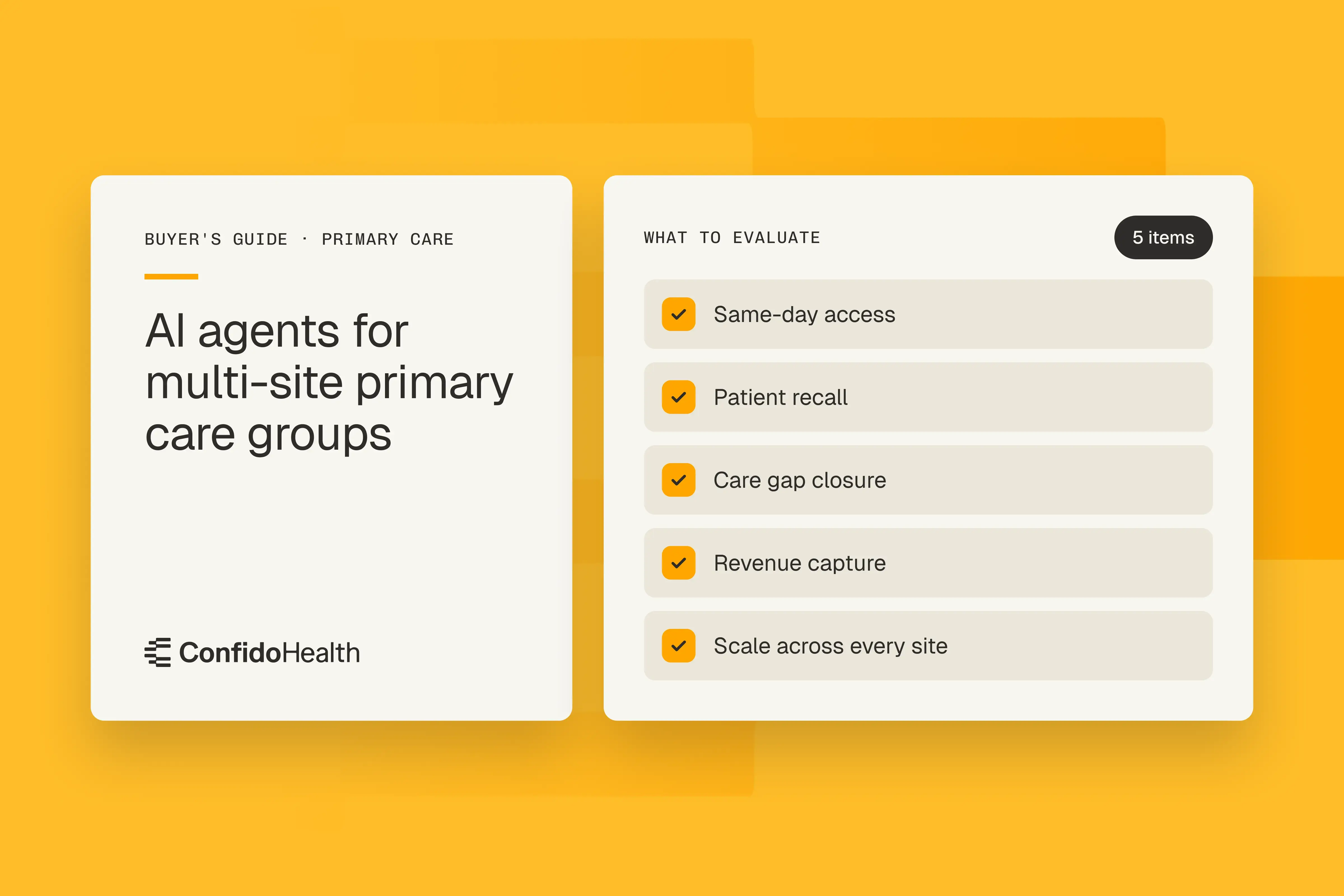
- When comparing vendors, assess how they handle incomplete responses, patient outreach, system integration, operational visibility, and costs as the group grows.
Every Monday, Dana pulls the denial report for a medical group with 24 locations and more than 120 providers. Most weeks, the top reason is the same: eligibility. Coverage terminated. Wrong payer on file. Secondary insurance never billed. Patient responsibility estimated at $0 when it was $340.
The frustrating part is that every one of those patients was verified. The group runs electronic eligibility checks on every appointment. The portal said active. The clearinghouse returned a clean response. And the claim still came back denied.
That gap is what this guide is about. An eligibility check tells you a plan exists. It does not always tell you who the real payer is, what the plan covers for this service, whether a carve-out vendor manages the benefit, or what the patient will owe. For a single practice, a sharp front desk can call the payer when something looks off. For a group with dozens of locations or hundreds of providers, the calls never get made, because there are too many of them.
So how should a group with 10+ locations or providers handle insurance eligibility verification? Most end up choosing between 3 approaches: verification software, outsourced verification services, or AI agents. This guide explains how AI eligibility verification works, compares all 3 head to head, runs Dana's denials through each one, and helps you decide which fits your group.
What is the best AI insurance eligibility verification for multi-location groups?
For groups with 10+ locations or providers, the best approach checks coverage electronically, then finishes the work when the electronic check falls short, by calling the payer, reaching the patient, and writing the result to the chart. That usually means AI agents working on top of the eligibility tools a group already has.
Software alone covers the easy cases. Outsourcing covers more but adds cost and distance. The work that actually prevents denials is the follow-through after the portal response, and that work grows with every location and provider you add.
How does AI handle insurance eligibility verification for multi-location groups?
AI agents take the result of every electronic eligibility check, decide whether it answers what the visit needs, and finish the work when it does not. They do this for every appointment, at every location, before the patient arrives.
What does an AI agent do after the eligibility check?
It confirms the right payer, looks for secondary coverage, and checks the benefits, limits, and patient cost the visit depends on. When the response is incomplete, it calls the payer. When coverage is missing or has changed, it contacts the patient. Then it writes the answer to the chart.
How is AI different from automated eligibility checks?
Automated checks send a request and return a response. AI agents act on the response. That is the difference between knowing a plan is active and knowing what this patient will owe for this visit.
Where do people stay involved?
Staff handle the cases that need judgment, such as unclear plan designs or coverage disputes, with the context already gathered.
What should AI insurance eligibility verification cover?
Insurance eligibility verification confirms that a patient's coverage is active for the date of service. AI verification should go further and confirm what that coverage means for this visit.
Most denials and surprise balances come from the lower rows, not the first one. That is the yardstick for the comparison below: how far down this table each approach actually gets.
Where do portal checks fall short, and how does AI fill the gap?
Electronic checks are fast and cheap, and every group should use them. But the response often leaves out what the visit actually depends on, and those gaps are where AI agents earn their place.
What do electronic eligibility responses often miss?
Visit and frequency limits, service-specific benefits, and remaining counts are frequently missing or generic. A plan may show "active" while the patient has used every covered physical therapy visit or dental cleaning for the year.
Why do carve-outs and secondary plans cause denials?
Some benefits are managed by a separate vendor, such as a behavioral health, radiology, or therapy benefit manager, and the main payer's response will not show their rules. Secondary coverage is just as easy to miss, and when it is, claims go to the wrong payer or patients get the wrong estimate.
What happens when coverage changes between visits?
Patients change jobs, lose Medicaid at redetermination, or move into a managed care plan. A check run at scheduling can be wrong by the visit.
Every one of these gaps needs someone to call the payer or reach the patient. Who does that is the real difference between the 3 approaches.
Verification software vs outsourcing vs AI agents: how do they compare?
All 3 can confirm active coverage. They differ in who finishes the work when the electronic check is not enough, how that work scales across locations and providers, and how much of it you can see.
How does insurance eligibility verification software work?
Verification software sends electronic checks to payers, usually through a clearinghouse or payer portals, and returns a coverage response. Medical insurance eligibility verification software often runs these checks in batches the day before appointments.
Where does verification software work well?
It is fast, inexpensive per check, and accurate for the first row of the table: active coverage and the basic plan. Every group should have it as a base.
Where does verification software break?
It returns data and stops there. Incomplete responses, missing limits, secondary coverage, and carve-outs all become tasks for your front desk. At 10+ locations or providers, those tasks pile up faster than staff can work them, and the ones that slip become denials.
How do outsourced insurance verification services work?
Insurance verification services assign a third-party team to verify coverage for your appointments. The team logs into your systems, runs checks, calls payers when needed, and records the results.
Where does outsourcing work well?
It takes volume off your staff, and unlike software, an outsourced team will call payers. For groups that have no capacity to follow up on incomplete checks, that is a real step up.
Where does outsourcing break?
You lose visibility into how the work gets done, and quality often varies by who is on shift. Same-day and last-minute appointments are hard to cover across time zones. Outsourced insurance eligibility verification services rarely contact patients about changed coverage, and fees rise with volume, so the cost grows exactly as you add locations and providers.
How do AI agents handle insurance eligibility verification?
AI agents run on top of the eligibility tools a group already has. They take each check result, finish what it leaves open by calling payers and reaching patients, and write the final answer to the chart.
Where do AI agents work well?
They cover the whole table, not just the first row, at every location at once. They follow your rules by location, provider, and specialty, recheck coverage before later visits, and give leadership one view of verification status across the group.
When do AI agents hand work to staff?
When a case needs judgment, such as an unclear plan design, a coverage dispute, or a payer response that calls for a decision. The case reaches your team with the context already gathered.
Would AI agents have caught Dana's eligibility denials?
Take 3 of the denials from Dana's Monday report and run them through each approach.
Software alone would have caught none of these reliably. Outsourcing might have caught some, depending on scope and shift. AI agents are built to catch all 3, because the follow-through is the job.
Is verification software or outsourcing enough without AI?
Outsourcing goes further than software because a person calls the payer. Software is cheaper and faster for the basic check. For most groups, the choice between them is really a choice about who handles the exceptions: your staff or someone else's. Neither one removes the exceptions, which is the gap AI agents close.
Outsourcing vs AI agents: which is better for multi-location groups?
Both call payers. The differences are speed, visibility, patient outreach, and cost as you grow. AI agents work same-day across every location, contact patients directly, write results to the chart, and do not need more people as volume rises. For groups with 10+ locations or providers, that usually tips the decision to AI agents.
Do AI agents replace insurance eligibility verification software?
No. Most groups already use a clearinghouse or portal checks, and AI agents use those results. The software handles the check. The AI agents handle everything the check leaves open. There is no rip-and-replace.
When should a multi-location group move to AI eligibility verification?
When is verification software alone still enough?
You have fewer than 10 locations or providers, a simple payer mix, and front desk staff with time to follow up on incomplete responses.
When does outsourcing still fit?
You have no internal capacity, your appointments are mostly booked well in advance, and you are comfortable with less visibility into how the work gets done.
When is it time for AI agents?
You have 10+ locations or providers, mixed payers or several specialties, same-day appointments, or eligibility denials that keep showing up after coverage was "verified."
How does AI eligibility verification work for each specialty?
The checks look similar everywhere. What breaks is different in each specialty, and AI agents need the rules for each one. Here is where eligibility most often goes wrong across the specialties Confido Health supports, starting with 4 that have their own guides.
How does AI help FQHCs and community health centers verify Medicaid?
Medicaid coverage churns. Patients lose coverage at redetermination, switch managed care plans, or qualify for a sliding fee scale. FQHCs need coverage rechecked before every visit, and patients need help with expired coverage in their own language. One 11-location FQHC we work with went live across all sites in 30 days, with English and Spanish outreach from day 1.
How does AI help physical therapy groups track visit limits?
Coverage at intake is usually fine. The denials show up around session 12, when a visit limit runs out or an authorization expires mid-plan. See our guide to benefits verification for multi-clinic physical therapy groups.
How does AI help dental groups and DSOs get full breakdowns?
Frequency limits, waiting periods, downgrades, and remaining annual maximums matter most. Dental portal responses are often thin, so DSOs depend on payer calls for full breakdowns, then need them written back to the practice management system. See our guide to dental insurance verification for DSOs.
How does AI help DME suppliers verify orders?
Coverage criteria, prior authorization, and rental versus purchase rules matter most. DME orders usually arrive by fax with documentation gaps, so verification depends on reading the order, checking coverage, and chasing what is missing.
What trips up eligibility in other specialties?
Confido Health AI agents apply these rules by specialty and location on one platform, so each service line verifies the way its payers require.
What should you ask before buying AI eligibility verification?
Every vendor will show you a clean eligibility check in a demo. The questions below get past the demo to the work that actually prevents denials. For each one, we explain why it matters and what a strong answer sounds like.
What happens when the eligibility response is incomplete?
This is the most important question on the list. Electronic responses often leave out limits, secondary coverage, or carve-out details, and that missing information is where most eligibility denials start. A strong answer describes exactly what the AI does next, such as calling the payer or contacting the patient, rather than flagging the case for your staff.
Who calls the payer, and when?
Some vendors call payers for every gap. Others only call in narrow situations, or leave calls to your team. Ask which situations trigger a payer call, how quickly it happens, and where the answer gets recorded. If the answer is “your staff,” the vendor is selling you a check, not verification.
How does the platform find secondary coverage and carve-outs?
Missed secondary insurance sends claims to the wrong payer, and carve-out vendors for behavioral health, radiology, or therapy have rules the main payer will not show. A strong answer explains how the platform identifies both before the visit, not after a claim comes back denied.
Who contacts patients about expired or changed coverage?
Coverage changes between scheduling and the visit more often than most groups expect, especially with Medicaid. Someone has to reach the patient, get the new information, and recheck it. Ask whether the platform does this itself, how it reaches patients, and in which languages.
Is coverage rechecked before later visits?
A check at scheduling can be wrong by the visit, and for patients in an ongoing course of care, it can be wrong by visit 10. Ask when rechecks happen, whether they cover visit limits and authorizations, and whether they run automatically or only when someone asks for them.
Which fields get written back to the EHR or practice management system?
Verification only saves time if the results land where your staff already work. Ask for the exact fields the platform writes, such as payer, copay, deductible, remaining limits, and secondary coverage, and ask to see a result appear in your own system during the demo.
How does the platform handle rules by location, provider, and specialty?
A group with 10+ locations or providers rarely runs one rulebook. Payer mix, state rules, and specialty requirements all vary. A strong answer shows rules set by location and specialty on one platform, so a new location starts with your standards on day 1.
What will leadership be able to see?
Outsourcing often leaves leadership with a monthly report and little else. Ask what verification status, exceptions, and denial trends you can see by location and provider, and how current that view is. If you cannot see it, you cannot manage it.
How does cost change as you add locations and providers?
Per-check, per-seat, and per-FTE pricing all grow with volume, which means verification costs rise exactly as the group grows. Ask the vendor to price your current volume and your volume after your next 5 locations, so you can compare how each option scales.
How does Confido Health use AI agents for eligibility verification?
Confido Health takes eligibility work, and the work around it, off your front desk and billing team at every location and for every provider. Our AI agents work inside the systems you already run and write every result back to the record.
Who is Confido Health?
Confido Health is the AI system of action for healthcare operations. Groups with 10+ locations or providers have already invested in good systems of record: the EHR, the practice management system, the phone system, the fax line, and the payer portals. What those systems do not do is finish the work between them. We built Confido Health for that gap, and we work inside the systems you have.
How do Confido Health AI agents work?
Work reaches a group from many directions: an appointment request, a faxed referral, a payer response, a coverage change, an unpaid balance. Our AI agents pick it up wherever it starts, carry it to a finished result, and write the result to your EHR or practice management system. Staff step in only when something needs judgment. Confido Health is HIPAA-compliant, SOC 2 Type II certified, and works across 50+ EHR, PMS, and phone systems.
Which verification workflows are covered?
How does Confido Health verify coverage?
Eligibility, payer, secondary coverage, copay, deductible, and limits are verified before the visit and written to the chart.
How does Confido Health handle incomplete responses?
When the electronic response falls short, AI agents call the payer to fill the gap and record the answer.
How does Confido Health handle changed or missing coverage?
Patients with expired, missing, or changed coverage are contacted before the visit, in 20+ languages.
Which connected workflows are covered?
How does Confido Health manage prior authorizations?
Authorizations are handled from the requirement check through submission, follow-up, and renewal.
How does Confido Health process faxes?
Referrals, orders, and payer documents get read, matched to the right patient, filed, and acted on.
How does Confido Health handle denials and balances?
Denials get classified, worked with the payer, corrected, and resubmitted. Patient balances get collected with payment plans and text-to-pay.
Why do groups with 10+ locations or providers choose Confido Health's AI agents?
Because the check is the easy part. Groups choose Confido Health for the follow-through.
How does Confido Health finish what portals leave open?
AI agents call payers, reach patients, and find secondary coverage and carve-outs, so incomplete responses stop turning into denials.
Why does connecting verification to the rest of the cycle matter?
The same AI agents handle prior authorization, faxes, denials, and balances. A coverage problem found before the visit does not become a denial or a surprise bill after it.
Is Confido Health built for groups across specialties and states?
Yes. Rules run by location, provider, and specialty on one platform, so each specialty in the group verifies the way its payers require.
How fast can a group go live?
An 11-location FQHC went live across all sites in 30 days. An 18-location physical therapy and chiropractic group went live within 4 weeks of contract and freed the equivalent of 3 full-time staff.
How much could AI eligibility verification save your group?
Running 10+ locations or providers? Send us last quarter's eligibility-related denials by location. We will show you which ones Confido Health would have caught before the visit, and what that is worth.
Every eligibility denial was preventable at some point before the visit. Let us show you where that point is for your group, location by location.