

.svg)
- AI stands for artificial intelligence, and in plain terms it is technology that takes on tasks that normally need a person's judgment, like understanding a request and acting on it.
- The words that trip people up, LLM, generative AI, AI agent, agentic AI, each describe one clear idea, and this guide explains them one at a time.
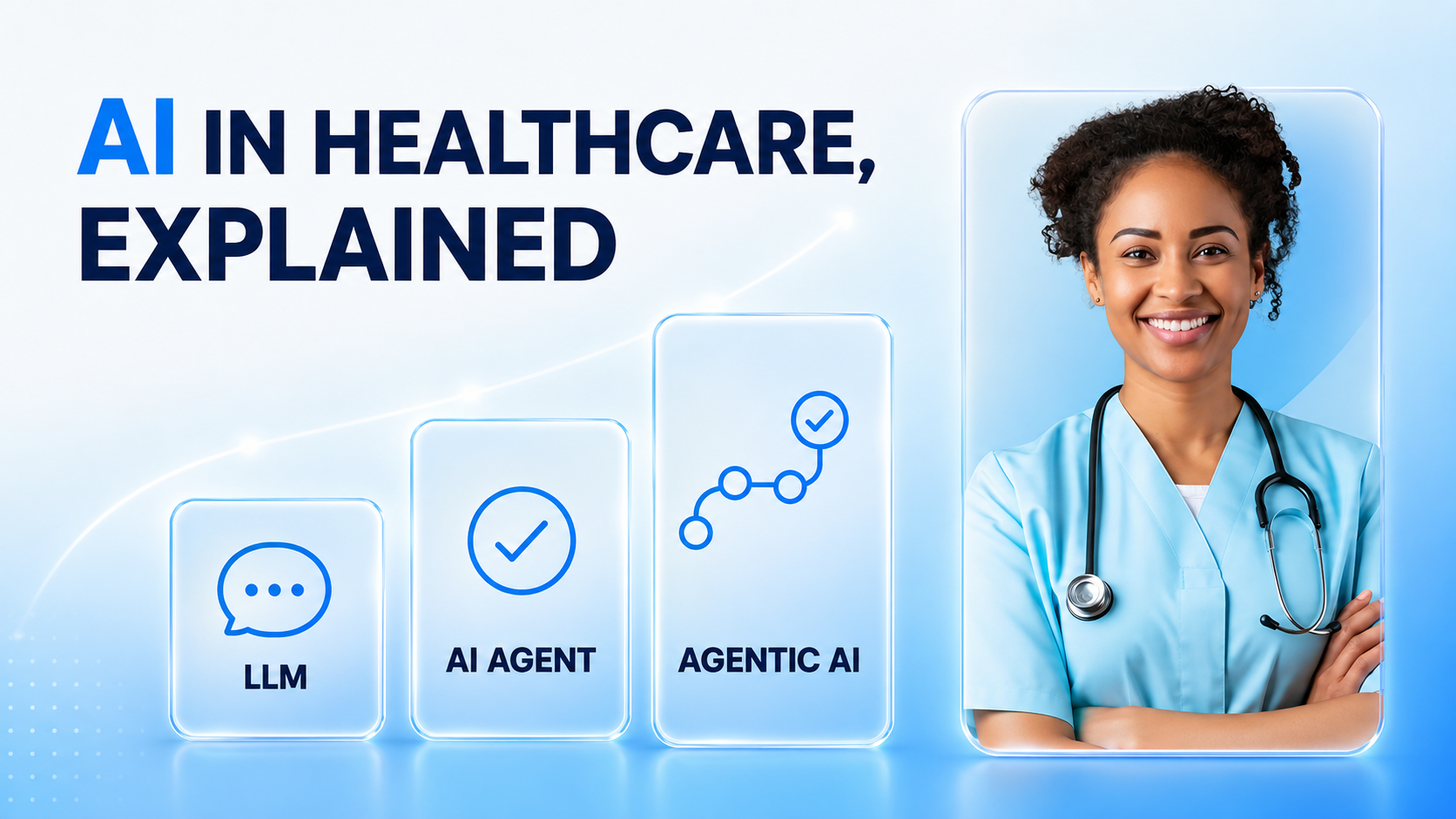
- An LLM is the technology behind tools like ChatGPT and Claude; an AI agent goes further and takes action; agentic AI plans and finishes a task made of several steps.
- In healthcare, AI is landing first on administrative work, easing the load on staff and widening patient access.
- The line that separates a helpful tool from a real time-saver is whether it completes the work or only talks about it.
- For the deeper distinction, see how AI moves from chatbots to workflow execution.
Hearing "LLM" and "Agentic AI" and Just Nodding Along?
You would not be the first. Plenty of people running healthcare practices have heard that AI can help, tried a chatbot once or twice, and now sit in vendor calls hearing LLM, agent, and agentic AI without a clear sense of what any of it does. The words fly by, everyone nods, and the real question goes unasked: what is AI in healthcare, really, and what would it do inside my clinic?
That is a fair question, and you do not need a technical background to answer it. You just need the vocabulary explained in plain language, without the acronyms piling up.
So that is what this guide does. By the end you should understand what AI is, what the common terms mean, how AI is changing the way people work, and where it is already making a difference in a practice. Once that foundation is in place, deciding whether and how to use it becomes a much calmer conversation.
What Does AI Actually Mean?
To answer what is AI in healthcare, let us start with the term itself. AI stands for artificial intelligence. In plain language, it is technology that can take on tasks that would normally need a person's judgment, such as understanding what someone is asking and responding in a way that makes sense.
Here is the difference that matters. A calculator follows fixed rules a person wrote out in advance, so it can only do exactly what it was told. Artificial intelligence works differently. It learns patterns from very large numbers of examples, then uses those patterns to handle a new situation it has not seen word for word before. That is why AI can understand a sentence phrased in an unexpected way, or recognize that two differently worded requests mean the same thing.
It is not thinking the way a person does. It is recognizing patterns at a scale and speed no person could match. Hold on to that one idea, because every term below is just a more specific version of it.
What Is Machine Learning, and How Is It Different?
Machine learning is the method behind that pattern-spotting. Instead of a person writing every rule, the system studies many examples and works out the patterns on its own. Give it enough past appointment data, for instance, and it can learn which patients are most likely to miss a visit.
Machine learning is not separate from AI. It is one of the main ways AI is built. When people say a tool "learns," this is usually what they mean.
What Is Generative AI?
Generative AI is the kind that creates something new rather than just sorting or predicting. It can produce text, speech, and other content that reads as if a person made it. In a practice, that might look like drafting a clear reply to a patient message or turning a call into a short, readable summary.
This is the wave most people noticed first, because it is what powers the chat tools that made AI feel suddenly useful. If you want the practical contrast with the older, rules-based systems many practices still run, Confido Health covers generative AI versus older automation.
What Is a Large Language Model, and Is It the Same as ChatGPT?
A large language model, or LLM, is the technology trained to understand and produce human language. It is the engine. Tools like ChatGPT, Claude, and Gemini are the products built on top of that engine.
So an LLM is not the same as ChatGPT. ChatGPT is one application that uses an LLM. This matters in healthcare for a simple reason: an LLM on its own is very good at language and knows nothing about your schedule, your payers, or your patients. It can explain how to book an appointment, but it cannot actually book one until it is connected to your systems and given the ability to act. That gap is exactly what the next few terms fill.
What Is Conversational AI, and Is It Just a Chatbot?
Conversational AI is any AI you can talk or type with in natural language. A basic website chatbot is the simplest version: it answers typed questions and stops there. More capable conversational AI can hold a real back-and-forth, understand what a caller means even when they phrase it loosely, and keep track of the thread.
The difference between a scripted chatbot and true conversational AI is larger than it looks, and it decides whether patients feel helped or stuck in a menu. Confido Health breaks this down in its explainer on conversational AI, explained.
What Is a Voice AI Agent in Healthcare?
A voice AI agent is conversational AI built for the phone. It listens to what a caller says, understands the request in everyday words, and speaks back naturally. In a practice, that means it can answer the calls that usually go to voicemail, understand why the patient is calling, and handle the request rather than reading from a fixed script.
This is where AI starts to matter for patient access, because the phone is still where most patients reach a practice. If you want the clean distinction, Confido Health explains how a voice agent differs from a chatbot.
What Is an AI Agent, and What Is Agentic AI?
Here are the two terms causing the most confusion right now, so they are worth slowing down on.
An AI agent is AI that can take an action, not just answer a question. A regular chatbot tells you how to reschedule. An AI agent actually reschedules, using the tools and systems it is connected to.
Agentic AI is the version that can carry out a whole task made of several steps, deciding what to do next as it goes. In plain terms, it works in a loop: it understands the goal, makes a plan, takes the first step, checks the result, then takes the next step, repeating until the task is finished or it decides a person should step in.
Picture a patient who calls to move an appointment and also asks whether their insurance is still on file. An agentic system recognizes both requests, checks real-time availability, applies the practice's scheduling rules, moves the appointment, confirms the coverage, records all of it, and reads the outcome back to the patient. It did not just answer. It finished the job. That shift, from responding to resolving, is the most important idea in this whole guide, and it is the same one shaping the wider market that Confido Health maps in its outpatient agentic AI market map.
AI vs LLM vs AI Agent vs Agentic AI: What Is the Difference?
If the terms still blur together, this table is the fastest answer to what is AI in healthcare, lining them up with what each one looks like inside a practice.
How Is AI Actually Used in Healthcare Today?
This is the practical heart of what is AI in healthcare. Healthcare runs on an enormous amount of administrative work, and that is where AI is landing first. Take one task as an example. In the American Medical Association's 2026 survey, 95% of physicians said prior authorization delays access to necessary care, and practices complete an average of around 40 requests per physician each week. Multiply that kind of burden across scheduling, refills, billing questions, and phone coverage, and it is easy to see why teams are stretched thin. Confido Health looks at where this is already working in its piece on AI beyond the hype.
AI helps by absorbing the repetitive side of that load. It can answer the phones that go to voicemail, complete routine scheduling, verify coverage, and follow up with patients, which directly improves whether a patient can actually reach care when they need it. Handling prior authorization is a clear example of the back-office work Confido Health treats as core, covered in its guide to AI for prior authorization.
It also helps where communication is delicate or complex. A peer-reviewed study published in the Journal of Medical Internet Research found that a multilingual AI outreach program produced a 2.6 times higher screening opt-in among Spanish-speaking patients than English-speaking patients, which suggests AI can widen access rather than narrow it. That is why practices use it to reach multilingual patients so language is not the reason someone cannot get an appointment. You can see the full range of front and back office work in Confido Health's use cases.
How Should I Evaluate an AI Platform for My Practice?
Once the terms make sense, the practical side of what is AI in healthcare comes down to the buying question, and it gets sharper. The weak question is "does it use AI?" Nearly everything does now. The useful questions are about what the platform finishes and where it runs.
A short checklist covers most of it. Can it complete a whole workflow, such as booking and updating the record, or does it only answer and hand the task back to staff? Does it work inside your existing EHR and phone systems, so nothing lands back on your team to re-enter? Can it follow your scheduling rules and run the same way across multiple locations? Does it hand off to a person when a case needs human judgment? And is it built for healthcare, with a Business Associate Agreement, encryption, and audit trails? If you want to see how the platform's impact translates into numbers, Confido Health offers an ROI calculator as a starting point.
The single line that separates a helpful tool from a real time-saver is whether the system completes the work or just talks about it. A tool that answers a question but leaves staff to do the booking, verifying, and updating has only moved the work around.
What Are the Biggest Misconceptions About AI in Healthcare?
When people ask what is AI in healthcare, a few beliefs come up in almost every conversation, and clearing them up makes the rest easier.
The first is that AI will replace staff. In practice, the tasks AI handles well, answering common questions and completing standard steps, are rarely the meaningful parts of a job. When those get absorbed, staff get their attention back for the work that needs empathy and judgment. The goal is to support the team, not shrink it.
The second is that ChatGPT is an AI agent. It is not. It is an application built on an LLM, very good at language, but it cannot act inside your systems on its own. The third is that all healthcare AI is the same. The difference in whether a platform completes work and writes it back to the record is enormous. The fourth is that voice AI is just a fancier phone tree. A phone tree routes you through menus, while a voice agent understands what you say and handles it.
Two more are worth stating plainly. AI does not make clinical decisions. Healthcare-grade platforms like Confido Health support administrative work, not diagnosis or treatment. And AI does not work well without integration. Without a real connection to your systems, even a capable tool leaves the actual work for staff to finish by hand.
Here's How Confido Health Can Help
If you have read this far, you now have a clear answer to what is AI in healthcare, and you may want to see the agentic approach applied to real patient access. Confido Health is a working example. Confido Health is a Voice AI healthcare operations platform built specifically for healthcare practices, with real-time, two-way integration into your EHR and PMS, so its AI Agents work inside your operation rather than beside it.
Here is what Confido Health delivers:
- AI Agents that complete the work, not just answer, across scheduling, reschedules, refills, insurance and eligibility, payments, referrals, and recalls, then write each result to the record in real time.
- Works inside the systems you already run, with real-time EHR, PMS, and phone integrations, so a finished task lands in the chart automatically and nothing comes back to staff.
- Answers every call on the first ring, around the clock, inbound and outbound, in more than 20 languages, with a warm transfer to your team whenever a case needs human judgment.
- Built to support your team, not replace it, absorbing the repetitive phone and admin work so staff can focus on patients and the cases that need a person.
- Proven results, with an 80% reduction in manual administrative work in the workflows it handles and a 15 to 20% increase in revenue collections.
- Live in under 30 days using expert-approved templates, without pulling your team off patient care to set it up.
From our experience, most groups start with their heaviest call volume and expand from there. You can see the kind of teams already using it on Confido Health's customer stories.
Confido Health is more than a tool. It is the operational layer that turns a patient call into completed, documented work inside the systems your team already trusts.
Curious what agentic AI would do for your own patient access? Book a demo and watch a workflow run from the first ring to the final write-back.
FAQs
What is AI in the simplest terms?
What is AI in healthcare in the simplest terms? AI stands for artificial intelligence. It is technology that handles tasks that normally need a person's judgment. Instead of following only fixed rules, it learns patterns from many examples and uses them to make sense of new situations, such as understanding a request phrased in an unexpected way.
What is an LLM, and is it the same as ChatGPT?
An LLM, or large language model, is the underlying technology trained to understand and produce human language. Tools like ChatGPT, Claude, and Gemini are built on LLMs. The LLM is the engine, and the app is the product you interact with, so the two are related but not the same.
What is the difference between an AI agent and agentic AI?
An AI agent can take an action, not just answer a question. Agentic AI is an agent that plans and completes a task made of several steps, deciding what to do next as it goes and finishing the whole job before handing back to a person. In short, one acts, and the other sees the task through.
How is AI actually used in healthcare today?
When people ask what is AI in healthcare in day-to-day terms, the most common uses are administrative: answering calls, scheduling, verifying insurance, sending follow-ups, and easing documentation. These are high-volume, repetitive tasks, which makes them a strong fit for AI, and automating them improves patient access without adding staff.
Does AI make clinical decisions?
No. Healthcare-grade platforms support administrative and communication work, such as scheduling, reminders, and call handling. They do not diagnose, treat, or provide medical advice. Clinical decisions stay with your providers, and a well-designed system escalates to a person whenever a case needs clinical judgment.
Is voice AI just a new version of an IVR?
No. An IVR, or phone tree, routes callers through fixed menus and buttons. A voice AI agent understands what a caller says in natural language and handles the request, so patients describe what they need instead of pressing options and waiting.
Will AI replace healthcare staff?
No. AI takes over repetitive, high-volume tasks so staff can focus on the work that needs empathy and judgment. The best results come from AI supporting people, with a person handling exceptions and anything sensitive.
Is patient data safe with AI tools?
It should be. Healthcare-grade platforms operate under a Business Associate Agreement with encryption, access controls, and audit trails. Any vendor you consider should be able to explain its compliance safeguards clearly before you deploy.
Do we need technical staff to use AI in a practice?
Not for platforms built for healthcare operations. A well-designed system fits into your existing EHR and phone setup and is configured to your workflows, so your team does not have to build or maintain anything technical.
What is the one thing that separates good healthcare AI from the rest?
Whether it completes the work. A tool that answers a question but leaves staff to do the booking, verifying, and updating has only moved the work around. A system that finishes the task and writes the result where it belongs is the one that gives time back.
.webp)
