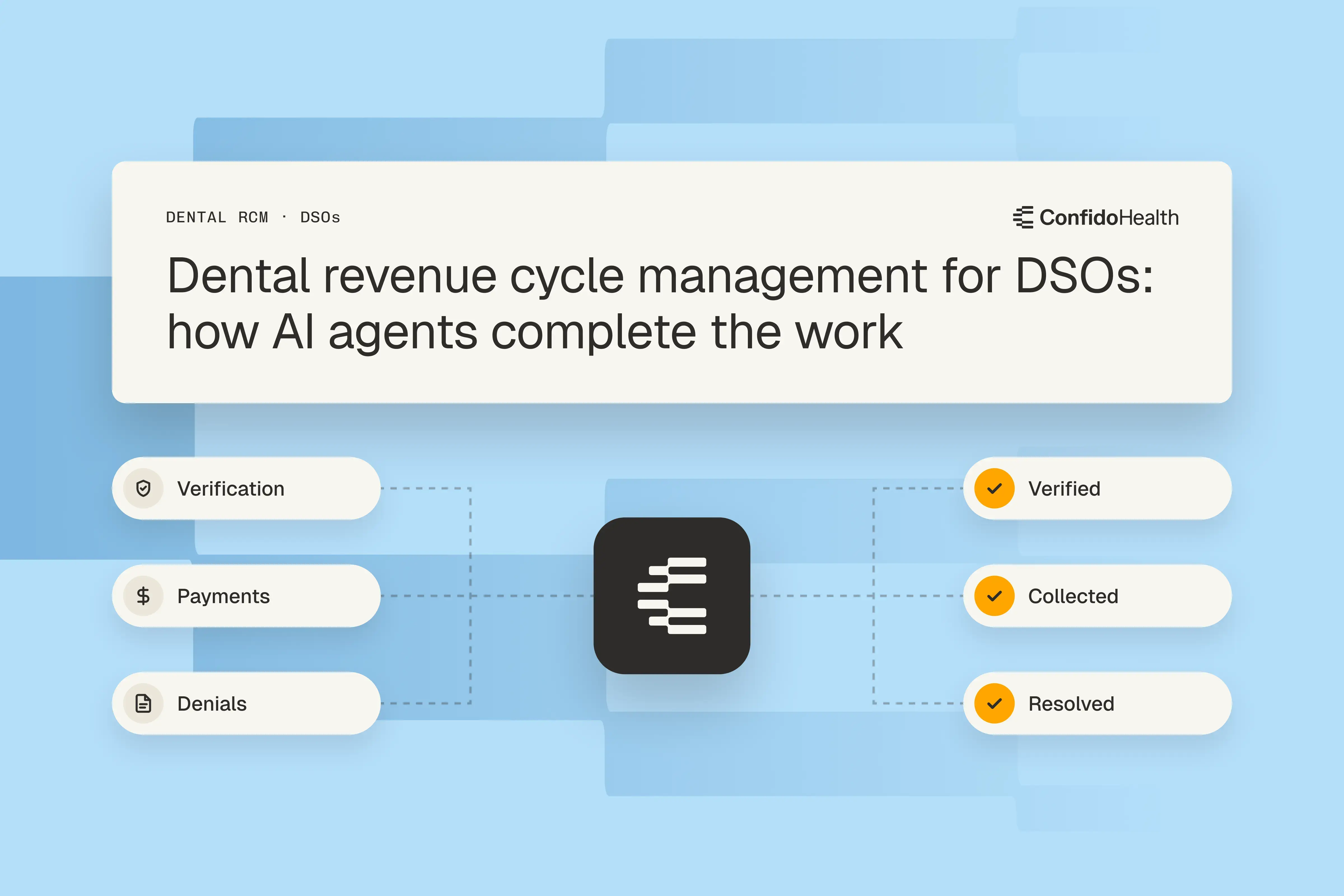

- Dental revenue cycle management covers the full payment process, from insurance verification and treatment estimates to claims, denials, payer follow-up, and patient collections.
- Revenue losses often start with incomplete benefit breakdowns, missed secondary coverage, inaccurate estimates, and delayed follow-up across offices.
- AI agents complete repeatable tasks such as payer calls, denial corrections, resubmissions, and balance outreach, while staff handle cases requiring judgment.
- Confido Health connects verification, payments, denials, and recall within the practice management systems each DSO location already uses.
- Tracking verification completion, aging claims, denial reasons, patient balances, and payer underpayments by office helps leadership identify where revenue is slipping.
- A 19-location dental group working with Confido Health recovers $150,000 every quarter, according to the blog.
Introduction
When we start working with a DSO, one of the first things we look at is a stack of written-off balances. We trace each one back to where it started.
Very few of them start in collections. Most start weeks earlier. A breakdown that missed a frequency limit. A secondary plan that never made it into the chart. An estimate the patient agreed to that turned out to be $300 low. By the time the balance reaches the collections queue, the patient is annoyed, the visit is a distant memory, and the money is mostly gone.
In a single office, these problems get caught because the people involved talk to each other. The front desk mentions the odd insurance card. The coordinator double-checks the estimate. Someone remembers the patient whose claim came back short last month.
A DSO with 30 offices does not get those hallway fixes. Verification happens at the front desk, estimates happen in the operatory, claims go to a central billing team, and patient balances go out as statements. Each step is done by a different person, often in a different building, sometimes in a different practice management system.
This guide is for the people who own that problem. It covers where dental revenue cycle management loses money at DSO scale, how the main approaches compare, how to size what is at stake in your own offices, and what to ask before you choose.
What is the best AI dental revenue cycle management for DSOs?
For DSOs and multi-location dental groups, the best results come from running verification, patient payments, denials, and payer follow-up as one connected process. AI agents suit that work because the same agent that verifies coverage can carry that answer through to the claim, the denial, and the balance.
Software helps you see the work, and billing companies give you more people to do it. AI agents do the work themselves and write the results into the practice management system your offices already use.
What is dental revenue cycle management?
Dental revenue cycle management covers every step between booking an appointment and collecting the last dollar for it. For a DSO, that includes the insurance side and the patient side, at every office.
Most of what goes wrong in that right-hand column is not complicated. It is work that needed someone to follow up and did not get it.
Where does dental RCM lose revenue at DSOs, and where can AI step in?
The losses at a DSO are rarely one big failure. They are small misses that repeat across every office, every week.
Verification that stops too early
An electronic check confirms the plan is active and often leaves out the details that decide whether a claim gets paid. AI agents complete the breakdown before the appointment and call the payer when something is missing.
Estimates that do not hold up
If the coordinator builds an estimate from half a breakdown, the patient finds out the real number when the bill arrives. That conversation costs you the balance and sometimes the patient.
Denials that run out the clock
Each denial needs a reason, a fix, and a resubmission before the payer's deadline. When billing is stretched, denials sit until it is too late.
Insurance AR that nobody works
Claims past 60 or 90 days need phone calls. Those calls compete with everything else billing does, and they usually lose.
Patient balances that wait on the mail
Most patients do not respond to a paper statement right away, and the longer a balance sits, the less of it you collect.
Payers that pay below the fee schedule
A PPO payment that comes in a few dollars short is easy to miss on one claim. Across a year of claims at a DSO, it adds up to real money.
In-house billing vs dental RCM services vs software vs AI agents: how do they compare?
When does an in-house billing team make sense?
For a single office or a small group, an in-house team works well because billing and the front desk can talk every day. As offices are added, the volume grows faster than the team, and follow-up is usually the first thing to slip.
What do dental RCM companies do well, and where do they fall short?
Dental RCM companies bring payer experience and take volume off your staff. The trade-offs are less visibility into the work, more distance from the patient, and pricing that is usually a percentage of collections, so your billing cost rises with your revenue.
When is dental RCM software enough?
When you have the people to act on what it shows you. Dental RCM software organizes and reports on the work. Someone still has to make the calls, fix the denials, and follow up on balances.
Why do AI agents suit growing DSOs?
They do the follow-up work themselves, at every office, without the cost rising each time you add a location or collect more revenue. The record stays in your systems, not a vendor's.
How much revenue is your DSO leaving in the revenue cycle?
You do not need a vendor to estimate this. Pull 4 numbers from last quarter, by office:
- Insurance AR over 90 days. Claims this old are often collectible, but only if someone works them now.
- Denials not resubmitted. Add up denied claims that were never corrected and sent back.
- Patient balances over 60 days. These lose value every month they sit.
- Write-offs by reason. Look for adjustments tied to eligibility, frequencies, and downgrades, since those usually trace back to verification.
The total is your revenue at risk. In our experience, the hard part for most DSOs is not the math. It is getting these numbers from every office in the same format. If that takes a week of spreadsheets, that tells you something too.
What should DSOs measure in dental revenue cycle management?
Once you choose an approach, these are the numbers worth tracking by office. Each one tells you something different about where revenue is slipping, and comparing them across offices shows you where to look first.
How many patients are fully verified before the appointment?
Track how many scheduled patients have a full breakdown in the practice management system before they arrive, not just an active-coverage check. When this number is low, you will see it a few weeks later in denials and surprise balances.
How much insurance AR is over 60 and 90 days?
Aging insurance claims are money you have already earned and not yet collected. A growing balance past 90 days usually means nobody owns the follow-up calls, and the older a claim gets, the harder it is to collect.
What is your denial rate by reason and by payer?
The overall denial rate tells you there is a problem. The breakdown tells you what to fix. If most denials trace back to frequencies or missing information, the fix is at verification. If they cluster around one payer, that payer needs attention.
How many days does insurance take to pay?
This shows how quickly insurance money reaches your account after a claim goes out. If it creeps up, look for claims stuck waiting on attachments, corrections, or follow-up.
How much do you collect at the time of service?
Balances are easiest to collect while the patient is still in the office. A low number here often points to estimates nobody trusts, or front desk teams who are not comfortable asking.
How much in patient balances is over 60 days?
After 60 days, balances get harder to collect every month they sit. If this number keeps growing, mailed statements are probably doing most of the work, and they are not working.
Which payers pay below your fee schedule?
Short payments are easy to miss one claim at a time. Tracked by payer, they show you who is underpaying, and that gives you something concrete to bring to contract renewal.
Look at each number by office, not only as a group total. A DSO average can look healthy while 3 offices carry most of the problem.
What should DSOs ask before choosing an AI dental RCM partner?
Which steps does it complete, and which does it only track?
Many tools show you what needs doing. Ask which steps the platform finishes and which still end up with your staff.
What happens when a payer response is incomplete?
This is where a lot of dental revenue is lost. You want to hear that the payer gets called and the answer gets recorded. If it only gets flagged for your team, that work is still yours.
How does it handle more than one practice management system?
DSOs that grew through acquisitions often run several. Ask how results get into each one, and whether every office ends up on the same standard.
How does it collect from patients?
Ask about payment plans, text-to-pay, and who answers when a patient calls about a balance.
What will leadership be able to see?
Verification, denials, aging, and collections by office and by payer, in one place. A monthly summary report is not the same thing.
How does the cost change as you grow?
Ask the vendor to price your current offices and then your next 10. With percentage-of-collections or per-office pricing, the cost grows with you.
How does Confido Health run dental revenue cycle management with AI agents?
Confido Health AI agents take on the follow-up work that slips at DSO scale, inside the practice management systems your offices already use.
What comes off each team's plate?
The front desk stops chasing insurance details. AI agents complete full dental breakdowns before the appointment, call payers when electronic data falls short, and reach patients whose coverage has changed, in 20+ languages.
Treatment coordinators start every estimate with a complete breakdown already in the practice management system, so the number they present is the number the patient pays.
The billing team stops losing denials to the clock. AI agents classify each denial by reason, contact the payer to confirm what is missing, correct and resubmit, and track the appeal to resolution. They also answer patient balance questions, set up payment plans, and send text-to-pay links.
Patient care coordinators get help filling the schedule, with recall for patients who are due and reactivation for patients with treatment that was never scheduled.
What stays with your team?
Coverage disputes, complex treatment plans, hardship requests, and anything that needs judgment. Those cases reach your people with the account history already gathered.
How does it fit your current setup?
Confido Health works inside the practice management systems you already run, including across offices on different systems after acquisitions. Your billing team stays in place and works the exceptions, with the repeatable follow-up handled for them.
What will leadership see?
Verification, denials, insurance aging, patient collections, and payer underpayments by office, measured the same way across every location. Payer intelligence also shows which payers consistently pay below their contracts, which is useful at contract renewal time.
Why do DSOs choose Confido Health instead of more staff or a billing company?
When the revenue cycle falls behind, most DSOs consider 3 options: hire more billers, sign a dental RCM company, or bring in AI agents. Here is why groups choose Confido Health.
You keep control of your revenue cycle
With an outsourced billing company, the work and often the data move outside your walls. With Confido Health, the work happens inside your own practice management systems, and your leadership sees every office's numbers directly.
Your cost stops tracking your collections
A percentage-of-collections contract means a better quarter costs you more. Hiring means a new biller every few offices. Confido Health absorbs new offices and higher volume without the cost rising at the same pace.
Acquisitions get absorbed faster
Every acquired office comes with its own system and habits. Confido Health works across those systems, so a new office follows the group's revenue cycle process within its first few weeks instead of waiting on a system migration.
One partner replaces a stack of point solutions
Many DSOs run separate tools or vendors for verification, payer calls, patient payments, and recall. Each handoff between them is a place where information gets lost. Confido Health covers all of it on one platform.
The results show up in collections
A 19-location dental group working with Confido Health recovers $150,000 every quarter.
It clears enterprise security review
Confido Health is HIPAA compliant and SOC 2 Type II certified, which matters for PE-backed DSOs with formal vendor review.
Is AI dental revenue cycle management right for your DSO?
It is usually a strong fit if you recognize several of these:
- You run offices on more than one practice management system
- Insurance AR over 90 days keeps growing
- Denials regularly age past filing deadlines
- Patient balances depend on mailed statements
- Leadership cannot compare revenue cycle performance across offices
- You are planning more acquisitions in the next year
If you run a single office with a stable billing team and low aging, you may not need it yet. For most growing DSOs, the question is less whether to fix the follow-up gap and more how to do it without adding headcount or giving up control.
How much revenue could AI recover across your DSO?
Send us your insurance aging, denials, and patient balances by office. We will show you which ones Confido Health would have resolved, and what that is worth to your group.
Most of the write-offs we trace back started as a small miss weeks earlier. We can show you where those misses are happening in your offices.