
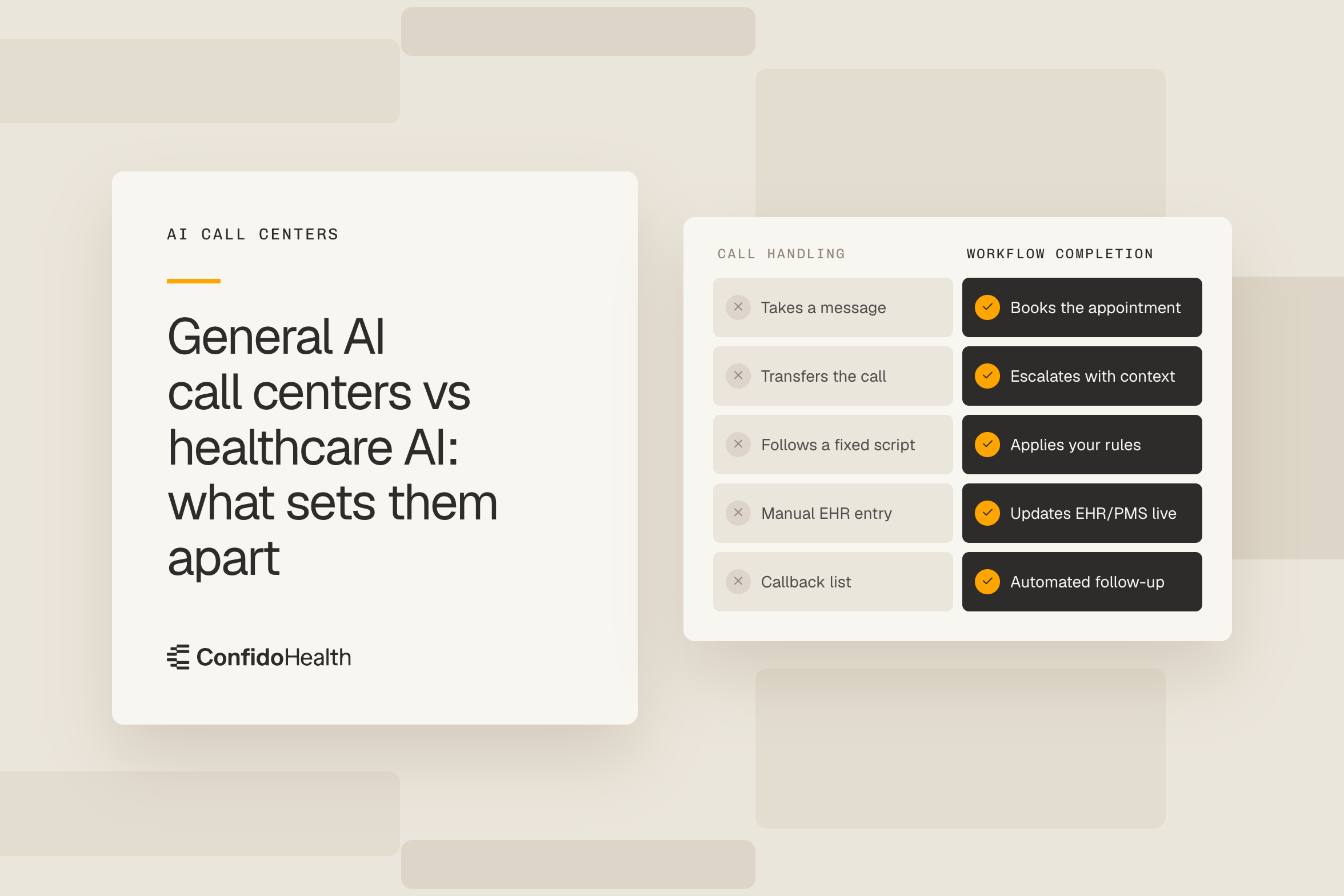

- Healthcare AI connects patient conversations with completed administrative workflows, including scheduling, insurance verification, referral coordination, billing questions, and refill routing.
- Healthcare calls require specialty-specific rules and live patient data, with clear escalation pathways for urgent concerns, clinical questions, and sensitive situations.
- Real-time, bidirectional EHR/PMS integration enables workflow completion, allowing AI to retrieve information, take action, update records, and trigger follow-up.
- Evaluate platforms using your actual workflows, testing complex scheduling, multilingual conversations, after-hours support, peak demand, and staff handoffs.
- Confido Health’s AI Voice Assistant connects inbound calls and outbound outreach, integrating with 40+ EHR/PMS systems and supporting complete workflows in 20+ languages.
- Staff receive full conversation context when human support is needed, helping patients continue without repeating their information.
- Measure success through completed work, including first-contact resolution, scheduling accuracy, referral conversion, staff time saved, and patient satisfaction.
Introduction
A patient calls with what sounds like a simple request. But within minutes, that conversation can touch scheduling, insurance, referrals, medication, or even an urgent concern. If the right information is missed or the next step is unclear, the impact can travel much further than the call itself.
In fact, research notes that poor communication contributes to more than 60% of hospital adverse events in the US. It is a powerful reminder that healthcare communication cannot stop at answering, transferring, or taking a message. The conversation needs to lead somewhere. Answering quickly matters, but so does understanding the patient correctly, taking the right action, and making sure nothing gets lost after the call ends.
This is also what separates AI call center companies. Some help agents, some route calls, and some hold convincing conversations. The real difference is whether the platform leaves work behind for your staff or completes the request inside your EHR/PMS. This blog will help you compare those capabilities and understand what your healthcare organization actually needs.
What Does an AI Call Center Company Actually Do?
The term AI call center covers a surprisingly wide range of capabilities, and what they mean by that varies enormously depending on the company and the platform. Here are the four distinct levels of what AI call center companies actually deliver.
Supports Human Agents During Live Calls
At the most basic level, some AI call center tools work alongside human agents rather than replacing them. They surface relevant patient information on the agent's screen during a call, suggest responses, or even flag relevant clinical rules. So your staff or a human still handles the entire conversation and completes the task. The AI is just a support layer, not an independent interaction handler.
Answers and Routes Calls Independently
A step up from agent support: AI that can answer patient calls without a human on the line, understand the general nature of the request, and route the call to the appropriate department or team. This replaces IVR systems with something that feels more conversational. But routing is not resolution. The patient still ends up talking to a staff member who completes the actual task.
Manages One Defined Call Workflow
Some AI call center platforms handle specific workflows end-to-end. It could be appointment reminders, prescription refill intakes, post-discharge check-in calls and so on. Within their defined scope, they work well. Outside of it, they cannot help, and they usually require separate tools for each additional workflow, which creates the tool sprawl that most healthcare organizations are now increasingly trying to escape.
Connects Conversations with Complete Operational Workflows
This is the level that actually changes how healthcare organizations operate. AI that understands the full range of patient requests, applies your clinical and operational rules, accesses and updates your EHR/PMS in real time, completes the task during the interaction, and manages follow-up outreach automatically. This is not just call handling. This is operational infrastructure that happens to handle calls.
Why Healthcare Calls Are More Complex Than They Seem
Healthcare calls are not like customer service calls in most other industries. A patient calling a bank to check their balance is a fundamentally different kind of interaction from a patient calling their healthcare provider. Healthcare calls carry clinical context, operational dependencies, and administrative consequences that most general-purpose AI call center solutions were just not designed to manage. The complexity is deeper, the stakes are higher, and the margin for error is smaller. Here is why that matters when you are evaluating AI call center companies.
Patients Do Not Always Know Which Department They Need
A patient calling with a medication question may actually need their prescribing provider, the pharmacy coordination team, or the billing department depending on the specifics of their question. A patient calling about a referral may not know whether to call their primary care office, the specialist's office, or the insurance company. AI that cannot navigate this ambiguity intelligently routes calls to the wrong destination or escalates unnecessarily.
The Same Request Can Follow Different Rules Across Specialties
Scheduling a follow-up appointment in orthopedics follows different rules from scheduling one in behavioral health. An insurance verification call for a routine visit follows different rules from one for a procedure requiring prior authorization. AI that applies a single fixed logic to all healthcare calls produces errors that require staff time to correct.
Scheduling May Depend on Referrals, Insurance, or Pre-Visit Requirements
A new patient calling to schedule a specialist appointment cannot always be booked directly. The right provider needs to be identified, referral documentation may need to be verified, insurance eligibility needs to be confirmed, authorization may be required, and pre-visit preparation instructions may need to be communicated. This makes scheduling calls in healthcare multi-step workflows that touch several systems before an appointment can actually be confirmed.
Routine Calls Can Quickly Become Urgent or Sensitive
A patient calling to reschedule a follow-up appointment may mention symptoms that require clinical attention. A billing query may reveal a patient in financial distress who needs compassionate communication rather than a payment demand. A new patient inquiry may come from someone navigating a diagnosis they do not fully understand yet. AI that handles healthcare calls needs to identify these moments and respond appropriately rather than just following a transactional workflow path.
Small Administrative Errors Can Delay Care or Affect Revenue
An incorrect insurance detail entered during scheduling creates an eligibility failure at billing. A missed prior authorization results in a denied claim and care that was delivered without confirmed payment. A scheduling error in a procedure-intensive specialty creates a cascade of coordination failures that requires multiple staff members to resolve. In healthcare, the downstream consequences of front-end call handling errors are disproportionate to the errors themselves.
Demand Continues Across Languages, Locations, and Business Hours
Your patients do not all call from the same location, speak the same language, or need help during office hours. A multilingual patient population needs access to clear, consistent support whenever they reach out. The AI should understand which location they are contacting, follow the right workflow, and continue the conversation in their preferred language. Patients should not receive a different experience simply because of when, where, or how they call.
How AI Workflows Manage a Patient Call End-to-End
A good AI call should feel simple for the patient, even when a lot is happening behind the scenes. Once they explain what they need, the conversation should keep moving without repeated questions, unnecessary transfers, or another callback. Behind that smooth experience is a clear workflow that takes the request from the first hello to a completed outcome.
Identifies and Verifies the Patient
Before any request can be addressed, the AI confirms who it is speaking with. Patient identity verification, which may involve date of birth, account number, or other identifiers, happens at the start of the interaction and pulls the patient's relevant information from your EHR/PMS into the active workflow context.
Understands the Request and Checks for Urgency
Natural language understanding identifies what the patient actually needs, even when they phrase it in unexpected ways, ask about multiple things in the same call, or start with one request and change to another. The AI also checks for signals that the request may be urgent or clinically sensitive and adjusts accordingly.
Retrieves the Right Information From Connected Systems
The AI accesses your appointment scheduling system, your EHR, your insurance verification tools, your authorization tracking, and your billing data in real time to retrieve the information needed to address the patient's request accurately. It is working with live data, not stored snapshots.
Applies the Relevant Clinical and Operational Rules
Scheduling rules, insurance requirements, authorization criteria, provider preferences, specialty-specific protocols, and your organization's operational policies are all applied to the patient's specific request. The AI does not apply generic logic. It applies your logic.
Completes the Task or Brings in the Right Staff Member
For requests within its operational scope, the AI completes the task during the interaction. Appointments are confirmed. Insurance is verified. Refills are routed. Billing questions are answered. When a situation genuinely requires human judgment, the AI escalates with full context, not just a transferred call.
Updates the EHR/PMS and Triggers Any Required Follow-Up
Every completed action is written to the relevant systems in real time. If the interaction triggers downstream workflows, such as an authorization request, a pre-visit preparation sequence, or a follow-up reminder, those are initiated automatically before the call ends.
Call Handling vs Workflow Completion
The single most important distinction in the AI call center space is the difference between a system that handles calls and a system that completes workflows. Here is what that looks like across every dimension of a patient interaction.
Following One Patient Call From First Ring to Workflow Completion
A completed workflow is easier to understand when you see it through a real patient request. Imagine Rachel has been advised to schedule a sleep study. She calls during her lunch break, hoping to find a convenient appointment without being passed between departments.
Rachel explains why she is calling
Rachel says her provider has ordered a sleep study and that she would prefer an evening appointment at a location near her home.
↓
The AI confirms her identity and finds the order
The AI verifies Rachel’s details and checks the connected EHR/PMS. It finds the sleep study order and reviews the information already available.
↓
The correct workflow begins
The AI identifies the type of study ordered and checks whether any records, referrals, or insurance steps are still required before scheduling.
↓
Insurance and authorization requirements are checked
Rachel’s eligibility is verified, and the AI checks whether prior authorization is needed. If another step is required, the right workflow begins without leaving Rachel to figure it out herself.
↓
Suitable appointments are found
The AI applies the correct location, appointment type, timing, and scheduling rules. It then offers Rachel options that match her evening preference.
↓
Rachel chooses an appointment
She selects a suitable date and time while she is still on the call. There is no transfer, callback, or second conversation.
↓
The appointment is booked and recorded
The booking is added to the EHR/PMS immediately, along with the outcome of the conversation.
↓
Preparation instructions are sent
Rachel receives her confirmation and the instructions she needs before the study. Any required forms and reminders are also triggered.
↓
The call ends with everything in place
Rachel hangs up knowing when and where her study will happen, what she needs to do beforehand, and what comes next. Her request does not become another message or callback task for your staff.
That is AI workflow completion in practice. The AI does not simply answer Rachel’s question. It connects the conversation with the systems, rules, and actions needed to move her request forward.
How to Compare AI Call Center Companies Step-by-Step
The evaluation process that produces the best outcomes is one that starts with your workflows rather than just the vendor's features. Here’s how you can approach this:
Step 1: Map the Calls and Workflows You Want the Platform to Handle
Before talking to any vendor, document the specific call types your organization handles, the rules that govern each one, the systems each call needs to touch, and what a fully completed outcome looks like for each call type. This map is your evaluation rubric. Every vendor is evaluated against it.
Step 2: Check Whether the Platform Completes Tasks or Only Handles Conversations
This is the most important question in the entire evaluation. Ask every vendor to demonstrate, specifically and in detail, what happens in your EHR/PMS when a scheduling interaction ends. If the answer involves a staff member completing a manual step, the platform is handling the conversation, not completing the workflow.
Step 3: Test the Depth of Its EHR/PMS and Telephony Integrations
Request your vendor to send a specific list of their EHR/PMS integrations. Confirm bidirectional real-time connectivity rather than read-only access or batch syncing. Test telephony integration compatibility with your existing phone infrastructure. Integration claims need to be verified rather than accepted at face value.
Step 4: Evaluate Scheduling, Provider Matching, and Healthcare Workflow Accuracy
Ask vendors to demonstrate scheduling interactions that involve complex rules, such as specialty-specific scheduling requirements, provider preferences, or procedure resource coordination. Generic scheduling demos are not sufficient evidence for healthcare operational environments. Test the rules that are actually relevant to your organization.
Step 5: Review Escalation, Multilingual, and After-Hours Capabilities
Look closely at what happens when the AI reaches a situation that needs human support. The transfer should feel smooth, with the patient’s details and conversation context carried forward so they do not have to start again. Multilingual support should extend across the complete workflow, not stop after the greeting. After-hours calls should also move toward resolution instead of automatically becoming messages or callback tasks for the next morning.
Step 6: Test Performance Across Peak Volumes, Providers, and Locations
A platform that works well under demonstration conditions may not perform consistently under your peak call volumes, across your number of providers, or spanning your number of locations. Request performance data and references from organizations of similar scale and complexity.
Step 7: Review Security, Compliance, and Data Governance
Every AI call center platform that handles healthcare calls processes protected health information. HIPAA compliance, data encryption, access controls, audit trail capability, and Business Associate Agreement coverage are not optional considerations. Confirm these specifically for every platform you evaluate.
Step 8: Define Implementation Support and Measurable Success Criteria
Ask vendors how implementation works, how long it takes, what your team needs to provide, and what ongoing support looks like after go-live. Define your success metrics before deployment, workflow completion rates, first-contact resolution, staff hours saved, scheduling accuracy, and patient satisfaction, so you can measure whether the platform is actually delivering.
Red Flags to Watch for During Evaluation
Some AI call center platforms look strong in demonstrations but slowly reveal their limitations in practice. Here are the signs that a platform may not deliver the operational impact it is promising:
Calls End with Messages Instead of Completed Actions
If the demo consistently ends with the AI telling the patient that someone will follow up with them, that is a call-handling platform, not a workflow completion platform. The benchmark is whether the patient's request is resolved before the call ends.
Most Patient Requests Still Require Staff Follow-Up
If the workflow demonstration shows AI capturing requests that staff then complete, the administrative burden has not been reduced. It has been reorganized. Staff time saved is only real if the tasks no longer need to happen, not if they happen in a different sequence.
Integrations Allow Data Access But Not Real-Time Updates
Read access to your EHR without write capability means the AI can have an informed conversation but cannot complete an operational workflow. Confirm bidirectional real-time integration explicitly rather than assuming it from the term integration.
Routine Conversations Frequently Transfer to Staff
Occasional escalation is appropriate and necessary. Frequent escalation for routine requests means the AI's operational scope is narrower than your actual call mix, which means the staff workload reduction will be significantly smaller than projected.
Workflow Support Ends After Appointment Scheduling
If the platform handles scheduling well but cannot manage referral coordination, insurance verification, billing queries, refill routing, or recall outreach, you will need additional tools for each of those workflows. The management overhead of multiple disconnected tools is a cost that rarely appears in initial vendor comparisons.
Performance Becomes Inconsistent During Peak Demand
An AI platform must work just as reliably during a Monday morning rush as it does during a quiet afternoon. If response times, accuracy, or call quality drop when demand rises, the platform is not truly solving your patient access problem.
Reporting Focuses on Call Activity Instead of Resolution
Call volume, answer rate, and average handle time tell you whether calls are being answered. Workflow completion rate, first-contact resolution, and staff escalation rate tell you whether the platform is working. If the vendor's reporting dashboard is built around activity metrics rather than outcome metrics, that reflects their underlying model.
Every Additional Workflow Requires Another Separate Tool
Healthcare call management involves many interconnected workflows. A platform that handles each one as a separate product with a separate implementation, separate integration, and separate pricing is not a platform. It is a product catalog that will create the fragmented infrastructure you were trying to escape.
How Confido Health Goes Beyond the Traditional AI Call Center
Enterprise healthcare organizations manage high call volumes, complex workflows, multiple locations, and patient needs that rarely fit into a simple script. Confido Health is designed around that reality, connecting each conversation with the administrative work needed to move the patient’s request forward. Here is what that looks like in practice:
Takes Ownership From the First Ring to the Completed Task
When a patient calls an organization running Confido Health's AI Voice Assistant, the call does not end with a message, a transfer, or a callback promise. It ends with a completed outcome: appointment confirmed, insurance verified, all questions answered, refill routed, and billing query resolved! The task is done before the call ends, and your staff does not inherit the work.
Works Directly Inside Your EHR/PMS and Telephony Systems
Confido Health's Voice AI integrates natively with 40+ EHR/PMS platforms, including Epic, Athenahealth, eClinicalWorks, ModMed, NextGen, Tebra, and others. Telephony integration with RingCentral, MangoVoice, 3CX, and others means deployment within your existing phone infrastructure. Every action is written to your systems in real time during the interaction that generates it.
Connects Inbound Calls with Outbound Follow-Up
Patient access does not only happen when patients call in. Recall outreach, appointment reminders, waitlist management, care gap campaigns, and post-visit follow-up are all outbound workflows that connect to your inbound call management. Confido Health's Voice AI manages both within one operational system rather than requiring separate tools for each direction.
Supports Scheduling, Referrals, Insurance, Payments, Refills, and Recall
The full range of administrative workflows that drive healthcare operations is handled within the same connected system. You are not combining five tools. You are deploying one operational infrastructure that covers the complete scope of what patient-facing healthcare administration requires.
Scales Across Providers, Specialties, Locations, and Call Volumes
Confido Health's AI Voice Assistant handles thousands of concurrent patient interactions simultaneously, maintaining consistent quality and operational rule application across organizations with 10 to 1,000 plus providers and 10 to 500 plus locations. Your peak-demand Mondays are managed the same way as your quiet Tuesday afternoons.
Communicates Naturally in More Than 20 Languages
Every patient in your diverse population receives the same quality of interaction in the language they are most comfortable with. Multilingual capability is native to the system, not an add-on translation layer, which means the full workflow completes in the patient's language rather than just the greeting.
Brings Staff in With Full Context When Human Support Is Needed
When an interaction genuinely requires human judgment, a clinical decision, or sensitive communication that benefits from a human relationship, Confido Health's Voice AI escalates with the complete interaction context. The staff member receiving the call knows exactly what has already happened, what the patient needs, and what information has already been confirmed. The patient does not start over.
Gives Leaders Visibility Into Completed Workflows and Outcomes
Real-time dashboards surface workflow completion rates, call resolution data, scheduling performance, referral conversion, recall outreach results, and demand patterns across every location simultaneously. Your leadership team manages an operational picture, not a call log.
How Confido Health Works in a Multi-Location Healthcare Organization
To see what this looks like beyond a feature list, let’s look at a multi-specialty healthcare organization with 40 locations and several hundred providers. Elena, its Patient Access Director, is responsible for keeping calls, scheduling, outreach, and escalations moving across the network.
The challenge
Elena’s mornings often begin with peak call volumes across every location at once. Patients wait on hold, voicemail and callback lists build up, and staff spend most of the day moving between scheduling, insurance, referral, and follow-up tasks. Outbound campaigns fall behind because urgent inbound calls take priority. Even with experienced teams, maintaining the same level of service across 40 locations is difficult.
The Confido Health implementation
Confido Health’s AI Voice Assistant becomes part of the organization’s existing EHR/PMS and telephony setup. It answers inbound calls, completes routine scheduling and insurance workflows, and runs referral, recall, reminder, and waitlist outreach in the background. Calls that require clinical judgment or more complex support reach the right staff member with the conversation context already available. Elena can follow workflow completion, escalation, and demand across locations through real-time reporting.
The results
Instead of starting each day with a growing queue, Elena’s teams can focus on the patients and situations that genuinely need them. They end up saving four to five staff hours per provider each day, with response times of under one minute, zero unattended voicemails, and 97% patient engagement and satisfaction rates. The organization gains more consistent access across locations while staff regain time for complex coordination and direct patient support. Most importantly, calls no longer end as messages waiting for someone else to complete the work!
Conclusion
Now, most AI call center platforms may sound similar at first. They answer calls, understand patient requests, and promise better access. The real difference is what remains after the patient hangs up.
If staff still need to call back, update the EHR/PMS, or finish the request manually, the workload has only moved. The stronger platforms carry the conversation through to a clear outcome, whether that means booking an appointment, checking insurance, updating a referral, or starting the right follow-up.
That distinction matters even more when you are supporting high patient volumes across specialties, locations, and languages. You need more than faster call handling. You need every routine interaction to keep work moving.
Confido Health’s AI Voice Assistant is built around that idea. Book a demo to see how it can help your organization turn patient calls into completed workflows while giving staff more time for the people who need them most!
FAQs
How is an AI call center different from a traditional call center?
A traditional call center uses human agents to answer calls and complete tasks. An AI call center uses artificial intelligence to handle those interactions automatically. The quality of that automation varies enormously: some AI call centers route calls better than an IVR, while others, like Confido Health's Voice AI, complete the full administrative workflow during the call, update your EHR/PMS in real time, and manage follow-up outreach automatically.
What is the difference between call handling and workflow completion?
Call handling means the AI answers the call and captures what the patient needs, leaving the actual task for a staff member to complete afterward. Workflow completion means the AI executes the task during the interaction, confirms the outcome with the patient, and updates your operational systems before the call ends. The staff workload reduction from workflow completion is significantly greater than from call handling alone.
What should healthcare organizations look for in an AI call center company?
Start by asking whether the platform completes tasks or creates tasks. Confirm bidirectional real-time EHR/PMS integration rather than read-only access. Evaluate scheduling depth against your actual scheduling rules rather than generic demo scenarios. Check multilingual capability, after-hours performance, and escalation quality. And define measurable success criteria before deployment so you can verify whether the platform is delivering.
Does an AI call center replace healthcare staff?
Not at all. AI call center solutions in healthcare reduce the routine administrative volume that currently consumes most of your team's time, freeing them for the complex coordination, sensitive patient interactions, and clinical judgment-dependent work that genuinely benefits from human expertise. Confido Health's Voice AI is designed to support your team by handling what does not require them, so they can focus on what does.
How is Confido Health different from a typical AI call center?
Confido Health's AI Voice Assistant completes administrative workflows end-to-end rather than capturing requests for staff follow-up. It integrates natively with 40+ EHR/PMS systems and existing telephony infrastructure, applies your specific scheduling and operational rules dynamically, communicates in 20+ languages, handles both inbound and outbound workflows within the same system, and gives leadership real-time visibility into workflow completion across every location and provider in the organization.